
Executive Overview
In the current cinematic landscape, where high-concept premises are frequently flattened by algorithmic formulas, a distinct brand of whimsical yet biting storytelling continues to carve out unexpected spaces. Following an eccentric late-night double feature pairing—transitioning from the high-octane athletics of Heated Rivalry to the early-morning screening of the folkloric tragicomedy Wicker—critics and audiences alike have been forced to re-examine the boundaries of romantic fantasy on film. Directed with a deceptively simple fairy-tale cadence, Wicker weaves a narrative that is at once visually arresting, deeply funny, and unexpectedly profound.
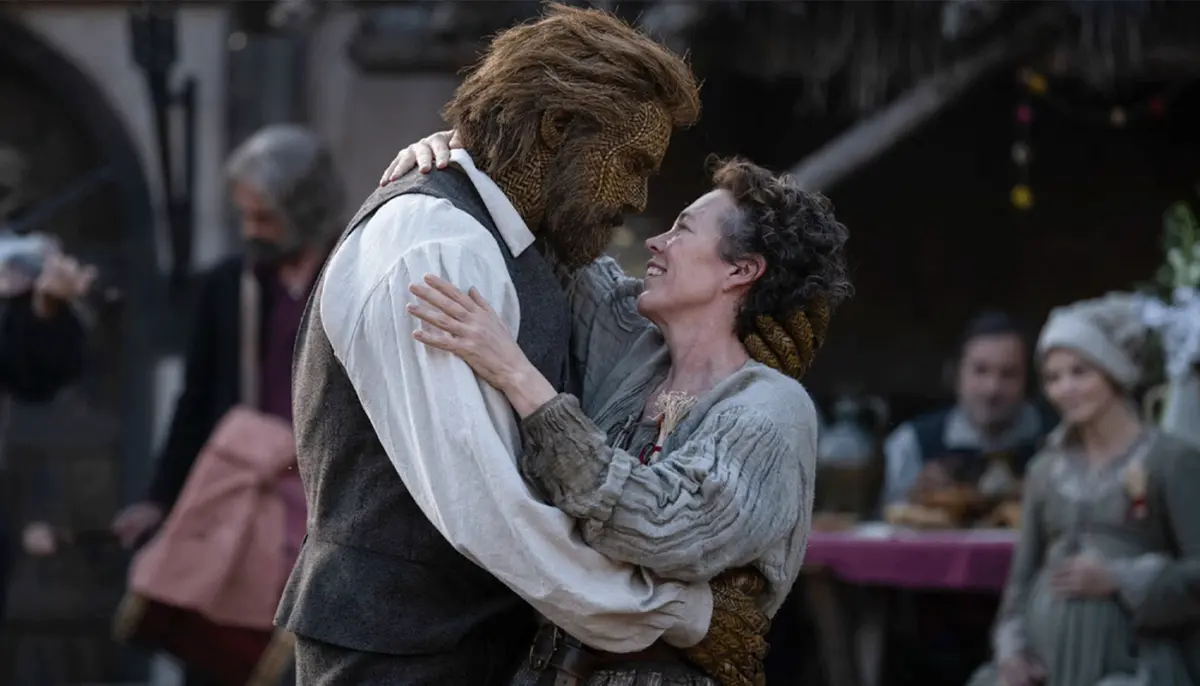
At its core, the film adapts Ursula Wills’s bittersweet short story, “The Wicker Husband,” centering on a lonely, isolated woman (the Fisherwoman, portrayed with searing vulnerability by Olivia Colman) who commissions a handcrafted husband from a weary local artisan (the Basketmaker, played with grounded cynicism by Peter Dinklage). The resulting creation—a sentient, living construct of woven willow and organic matter in the cinematic form of Alexander Skarsgård—quickly scandalizes an intensely rigid, transactional rural village.
While surface-level discourse surrounding the film has playfully leaned into its provocative framing, a deeper critical analysis reveals a sharply observed commentary on human intimacy, gender dynamics, transactional relationships, and the existential risk required to genuinely love and be loved. This report offers a comprehensive examination of Wicker, exploring its thematic architecture, its fidelity to and departure from its literary source material, and its enduring resonance within modern cinema.
Read Also
Detailed Chronology: From Page to Screen and Village to Screenplay
To understand the cinematic triumph of Wicker, one must trace its journey from Ursula Wills’s deceptively sparse prose to its realization on the silver screen. The adaptation process honors the structural heartbeat of traditional folklore while expanding its emotional and sociological stakes.
Phase I: The Literary Blueprint of "The Wicker Husband"
In Ursula Wills’s original short story, the characters are archetypal rather than deeply individualized. The protagonist is simply known as "the ugly girl," an outcast whose physical isolation mirrors her emotional void. Desperate for companionship in a community defined by sharp judgment and marital inadequacy, she seeks out the village basketmaker to commission a husband.
Wills utilizes the repetitive structural patterns intrinsic to classic fairy tales. When the newly formed Wicker Husband prepares for his wedding, he visits the local tailor, shoemaker, and innkeeper in a strict, cyclical order, repeating the refrain: "For I am being married tomorrow." This rhythmic pacing lulls the reader into a false sense of security, encouraging them to view the villagers as flat caricatures rather than fully realized psychological entities. However, Wills weaponizes this superficiality. The arrival of a husband who genuinely dotes on his wife exposes the hollow, transactional nature of the other marriages in the village. The local wives burn with jealousy over the attention bestowed upon the marginalized protagonist, while their husbands feel threatened by a standard of devotion they cannot emulate. The narrative’s dark edge culminates when the Tailor’s Wife plants seeds of doubt regarding the Wicker Husband’s fidelity, driving the protagonist to a tragic fit of distress in which she sets fire to her companion. Though she ultimately returns to a restored, albeit damaged, husband, Wills offers no tidy "happily ever after"—only the haunting realization of human fragility.
Phase II: Cinematic Translation and Expansion
Directorially, Wicker translates Wills’s literary motifs into visual grammar, heightening both the comedic absurdity and the emotional devastation of the premise.
- The Arrival and the Community Shock: The film opens with the Fisherwoman—freed from traditional patriarchal definitions as an orphan—securing her Wicker Husband. Their immediate, enthusiastic domesticity results in a famously shattered bed and a scandalized village square.
- The Public Unveiling: At a local wedding, the contrast between the couple and the community is stark. While the Fisherwoman and her Wicker Husband move in a graceful, albeit reluctant, partnership, the other couples perform dances that are rigid, brusque, and combative.
- The Escalation of Doubt: Echoing the original story, the community’s collective insecurity breeds malice. The Tailor’s Wife, herself defined entirely by her lineage and marital status (formerly the "Doctor’s Daughter"), orchestrates a campaign of psychological warfare to destabilize the Fisherwoman’s unprecedented happiness.
- The Conflagration and Reconciliation: The film retains the harrowing third-act burning of the Wicker Husband, driven by the protagonist’s manufactured doubts. Yet, where the short story leaves off on an ambiguous, melancholic note, the film introduces an expanded thematic arc involving a strange Wicker Child, ultimately culminating in a structurally distinct, earned resolution.
Supporting Context & Metrics: Thematic Architecture of the Village
A rigorous analysis of Wicker requires examining the socio-economic and relational ecosystem constructed within the film’s universe. The narrative operates not merely as a romance, but as an anthropological study of isolation and exchange.
The Economics of Affection: Transactional vs. Grace-Based Relationships
| Relationship Dynamic | Primary Motivator | Character Representation | Nature of Interaction |
|---|---|---|---|
| Standard Village Marriages | Status, Duty, Conformity | The Tailor & Tailor’s Wife, The Baker & Baker’s Wife | Rigid, transactional, bound by ceremonial collars and societal expectation. |
| The Fisherwoman & Wicker Husband | Mutual Freedom, Trust | Olivia Colman & Alexander Skarsgård | Ostensibly transactional at purchase, evolving into unconditional grace and shared joy. |
| The Wicker Child Dynamic | Desperation, Possession | The Young Woman & The Basketmaker | Born from despair and an attempt to replicate happiness; ultimately languishes when treated as a commodity. |
The film establishes its economic worldview in its opening moments, where characters routinely exchange pleasantries such as "lovely transacting with you." In a society where even matrimonial bonds are sealed with literal collars enforcing obedience, every interaction is a ledger entry.
It is precisely against this hyper-capitalist backdrop of human connection that the Fisherwoman’s relationship with her Wicker Husband becomes revolutionary. Even though she financially compensates Peter Dinklage’s Basketmaker for his labor, the Basketmaker approaches the commission as an act of profound empathy, explicitly noting that the created man must possess free will.
This distinction is crucial. When the Wicker Husband performs arduous labor—such as repairing the Fisherwoman’s roof or rebuilding their chronically broken bed—he does so not out of a sense of indentured servitude or patriarchal obligation, but because, as he simply states to the scoffing village men, "it makes my wife happy." Conversely, the village men, such as the Baker who openly begs the Wicker Husband to seduce his neglected wife, view intimacy as a mechanical puzzle to be solved through transaction rather than emotional attunement.
Official Statements and Critical Reception
The unique tonal balancing act of Wicker—famously dubbed by early audiences as the "horny basket movie"—has generated significant discourse among critics, literary scholars, and the creative team behind its realization.
Critical Commentary on Genre Subversion
Film historians have noted that Wicker utilizes the trappings of folk horror and erotic fantasy as a Trojan horse for a serious meditation on vulnerability.
"Wicker effectively takes the thematic nuggets planted by Ursula Wills and translates them beyond a cautionary tale into an effective commentary on the nature of genuine love and intimacy. We all have much going on beneath the surface, and it is often much easier to believe the bad rather than the good."
— Excerpts from Contemporary Cinematic Analysis
The Basketmaker’s Manifesto: Deconstructing "Fuckable Furniture"
A pivotal moment in shifting the film’s tonal perception away from mere titillation occurs during the third act confrontation. As the Fisherwoman succumbs to internal panic, lamenting that her constructed husband could never possess true human emotion, the Basketmaker delivers a blistering, blunt rebuke. Rejecting the notion that his creations are mere objects of utility or indulgence, the Basketmaker asserts that he did not craft the husband to be "a piece of fuckable furniture."
This line serves as the ideological anchor of the film. It explicitly separates Wicker from exploitation tropes, reframing the material as a philosophical inquiry into what it means to animate an object—or a person—with genuine agency, love, and respect.
Future Outlook: The Enduring Legacy of Wicker’s Folk-Romance Synthesis
As Wicker continues its journey through specialized cinema circuits and streaming platforms, its legacy points toward a refreshing shift in contemporary storytelling. The film demonstrates that audiences are increasingly hungry for narratives that refuse to choose neatly between high-brow literary deconstruction and uninhibited, genre-bending entertainment.
Key Takeaways for Modern Filmmaking:
- Embracing Ambiguity in Romance: The film proves that romantic narratives are enhanced, rather than weakened, by acknowledging the inherent risks and uncertainties of emotional exposure. A "happy ending" does not require the erasure of flaw or decay; the Wicker Husband’s persistent wooden rot serves as a poignant reminder that all bonds require active, unceasing maintenance.
- Subverting Folktale Tropes: By utilizing the cyclical, rhythmic language of traditional fairy tales while injecting contemporary psychological realism, filmmakers can successfully challenge audience assumptions about character morality.
- The Rejection of Relational Commodification: In an era dominated by hyper-individualism and transactional networking, Wicker champions the radical nature of unmerited grace—exemplified when the Fisherwoman chooses to care for the ailing Wicker Child despite having nothing to gain.
Conclusion: Riding Into the Uncertainty
In its unforgettable final sequence, the film offers a masterclass in poetic justice. While the greedy villagers, manipulated by the promise of a "Wicker Woman," receive partners fashioned from harsh blackthorns, the Fisherwoman and her Wicker Husband—accompanied by the Basketmaker and the Wicker Child—ride into the sunset.
They carry no guarantees of an uncomplicated, everlasting fairy-tale perfection. Their wood may rot, and their doubts may occasionally flare, but it is precisely that courageous embrace of uncertainty that transforms Wicker from an eccentric midnight screening curiosity into an enduring cinematic achievement on the nature of the human heart.





Comments
Facebook App ID not configured. Please add it in the Customizer.