In the literary calendar, August stands as a crucial marker for global literature, dedicated entirely to Women in Translation (WIT) Month. Established to correct the systemic underrepresentation of women writers from non-English-speaking traditions, WIT Month has grown from a modest grass-roots internet campaign into a powerhouse global celebration. At the forefront of this international literary advocacy is Words Without Borders (WWB), an organization dedicated to promoting cultural understanding through the translation, publication, and promotion of international literature.
For the August observance, the WWB editorial and operational staff have curated an eclectic, politically charged, and deeply personal reading list. Spanning Arabic, Albanian, Spanish, German, and Danish, these selections showcase the immense stylistic range and emotional depth of contemporary women writers. More than just a list of book recommendations, the 2026 staff picks offer an urgent snapshot of modern translation culture, highlighting the vital labor of translators who act as dual architects of text and meaning. From the post-apocalyptic lyricism of Palestinian poetry to the sun-drenched psychological tensions of a Danish lake house, this year’s curation underscores how translated literature bridges geographic divides while confronting the most pressing social and existential questions of our time.
Detailed Chronology: The Evolution and Impact of Women in Translation Month
To fully understand the weight of the Words Without Borders 2026 selections, it is necessary to examine the historical trajectory that made such a vibrant landscape of translated women’s literature possible.
Women in Translation Month was founded in August 2014 by literary blogger Meytal Radzinski. At the time, statistical disparities in the publishing industry revealed a stark imbalance: books by women in translation accounted for a minuscule fraction of total translated works published in English-speaking markets. Radzinski issued a call to action to readers, reviewers, bloggers, and publishers to consciously read, review, and promote works by women writers from other languages throughout the month of August.
Institutional Adoption and Global Reach (2015–2020)
In the years following its inception, WIT Month transcended its origins in the blogosphere. Major publishing houses, independent presses, literary magazines, and cultural institutions began timing major translations of works by women to coincide with August. Initiatives like WWB played a pivotal role in amplifying these efforts, utilizing their platforms to foreground literary voices that might otherwise remain obscured by dominant linguistic hegemonies.
The Contemporary Landscape (2021–Present)
By the mid-2020s, the fruit of this labor became glaringly apparent. Translated works by women began capturing major international accolades, including the International Booker Prize, the National Book Award for Translated Literature, and various PEN translation prizes. The 2026 WWB staff picks reflect this maturation of the field, featuring books that have already secured major literary nominations or are heavily tipped for upcoming awards season recognition.
The 2026 Staff Picks: Curated Deep Dives
The six books chosen by the Words Without Borders team for August 2026 represent a masterclass in cross-cultural curation, bridging poetic experimentation, historical reckoning, and contemporary psychological drama.
+-------------------------------------------------------------------------------------------------+
|                                 WWBS 2026 WIT MONTH STAFF PICKS                                 |
+--------------------------+-----------------------+---------------------+------------------------+
| Book Title               | Author                | Translator          | Original Language      |
+--------------------------+-----------------------+---------------------+----------------        |
| The Sleep Thief          | Ibtisam Azem          | Sinan Antoon        | Arabic                 |
| She Who Remains          | Rene Karabash         | Izidora Angel       | Albanian               |
| The Queen of Swords      | Jazmina Barrera       | Christina MacSweeney| Spanish                |
| Exophony                 | Yoko Tawada           | Lisa Hofmann-Kuroda | Japanese & German      |
| Enter World              | Dalia Taha            | Sara Elkamel        | Arabic                 |
| Seeing Further           | Esther Kinsky         | Caroline Schmidt    | German                 |
| Waist Deep               | Linea Maja Ernst      | Sherilyn Nicolette  | Danish                 |
+--------------------------+-----------------------+---------------------+------------------------+
1. The Sleep Thief by Ibtisam Azem (Tr. by Sinan Antoon)
Recommended by Sohini Basak, Poetry Editor, The Sleep Thief marks the debut novel of Palestinian author Ibtisam Azem. The slim, dreamlike narrative centers on a Palestinian man named Gharib—whose name literally translates to "the stranger"—over the course of a few transformative days.
Basak praises the novel’s lyrical and gently experimental structure. The translation is handled by acclaimed poet and novelist Sinan Antoon, whose deep familiarity with Arabic artistic cadences ensures that Azem’s prose retains its haunting, rhythmic resonance in English. The book investigates themes of displacement, memory, and foreignness within one’s own land, establishing Azem as a vital voice in contemporary Middle Eastern fiction.
2. She Who Remains by Rene Karabash (Tr. by Izidora Angel)
Susan Harris, Editorial Director, champions Rene Karabash’s She Who Remains, a striking exploration of patriarchal control, queer identity, and ancient tradition in an Albanian mountain village. The novel follows Bekija, a young woman caught between an unwanted arranged marriage and a forbidden passion for a female friend. Faced with insurmountable societal constraints, she chooses to become a "sworn virgin"—renouncing her femininity to live and move through society as a man under the unyielding grip of the Kanun, an ancient code of law.
Rendered in a poetic stream of consciousness by translator Izidora Angel, the book is praised for its dazzling linguistic control. Published earlier in the year, She Who Remains quickly earned a spot on the International Booker Prize longlist/shortlist track, with Harris predicting it will dominate US translation prize nominations in the fall.
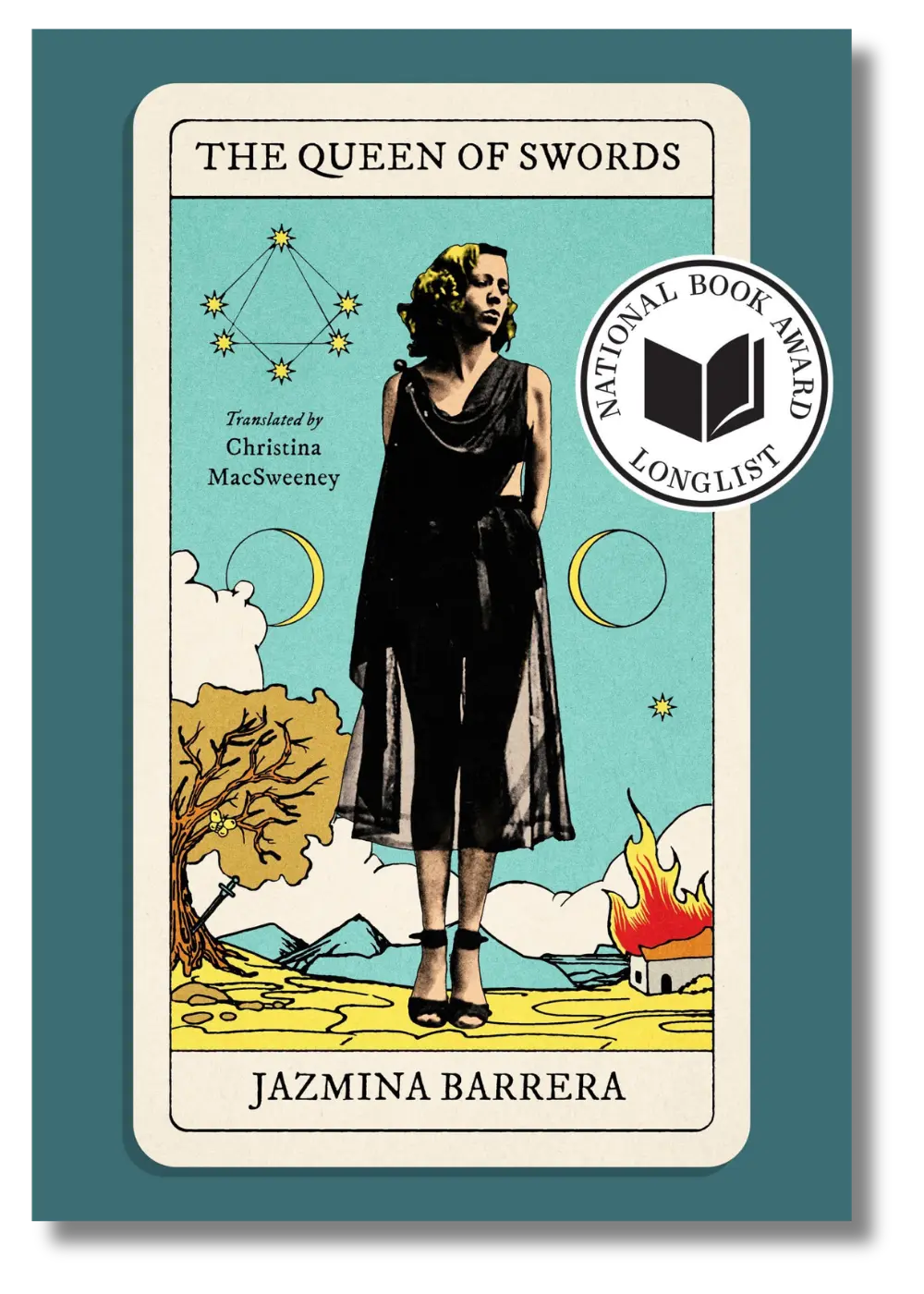
3. The Queen of Swords by Jazmina Barrera (Tr. by Christina MacSweeney)
For Alicia Lim, Finance and Operations Manager, Jazmina Barrera’s The Queen of Swords represents a masterclass in experimental biographical writing. Blending memoir with critical biography, the book acts as an imaginative, time-defying conversation between Barrera and the enigmatic Mexican writer Elena Garro.
Rather than offering a linear recounting of facts, Barrera stitches together literary fragments, deliberately leaving gaps and loose threads exposed. Translated with agile precision by Christina MacSweeney, the book invites readers to commune with ghosts, sit with the contradictions of Garro’s tumultuous life, and embrace the profound mysteries of creative existence.
4. Exophony: Voyages Outside the Mother Tongue by Yoko Tawada (Tr. by Lisa Hofmann-Kuroda)
Nina Perrotta, Senior Editor and Development Manager, turns her attention to non-fiction with Yoko Tawada’s essay collection Exophony. Tawada, a celebrated author who writes in both Japanese and German, explores the profound dislocations and enrichments of operating outside one’s native language.
With essay titles like "On Mistranslating the Moon" and "Los Angeles: The Poetic Ravine between Languages," Tawada’s intellectual agility and wit shine through Lisa Hofmann-Kuroda’s sensitive translation. The collection offers invaluable insight into translingual writing, linguistic displacement, and the creative potential of inhabiting multiple cultural frameworks.
5. Enter World by Dalia Taha (Tr. by Sara Elkamel)
Alex Tan, Editorial Fellow, describes Dalia Taha’s poetry collection Enter World as a distilled, elemental accounting of a life lived amid the ruins of Palestine. Every poem is theatrically staged with titles prefixed by the word "enter"—such as enter wrist pain, enter apartheid, and enter girl with books.
Translated nimbly by Sara Elkamel, Taha’s work balances everyday realism with cosmic scope. Olive trees and morning dew sit uncomfortably close to checkpoints, torturers, and the quiet resilience of a populace surviving under military occupation. Tan notes that readers of Adania Shibli and Etel Adnan will find familiar oracular precision here, alongside an eschatology heavy with the conviction that another world remains possible.
6. Seeing Further by Esther Kinsky (Tr. by Caroline Schmidt)
Maggie Vlietstra, Education Program Manager, recommends Esther Kinsky’s Seeing Further, translated from German by Caroline Schmidt. Set against the backdrop of a dilapidated movie theater in rural Hungary, the novel follows a woman who takes on the arduous task of refurbishing the space.
Vlietstra highlights the book as an ideal read for cinephiles, champions of communal artistic experiences, and those resistant to the rapid digitization of culture. Kinsky’s prose, handled expertly by Schmidt, uses physical architecture as a metaphor for memory, community preservation, and shared human encounter.
7. Waist Deep by Linea Maja Ernst (Tr. by Sherilyn Nicolette Hellberg)
Closing out the summer reading list is Anna Claire Weber’s pick, Waist Deep, the debut novel by Danish author Linea Maja Ernst, translated by Sherilyn Nicolette Hellberg. Set at a Danish lake house during a sun-drenched summer, the novel follows a group of college friends who reunite to reminisce, caught in a delicate web of genuine affection and silent mutual judgment.
Drawing comparisons to Shakespeare’s A Midsummer Night’s Dream, the novel combines lush prose with luxurious pacing. Weber praises Ernst for her lighthearted yet sharp-eyed critique of millennial neuroses, making it one of the finest fictional encapsulations of what it feels like to navigate adulthood, societal responsibility, and the lingering desire to abandon all duties.
Supporting Context & Metrics: The State of Women in Translation
While the enthusiasm surrounding WIT Month is palpable, quantitative data from literary research organizations indicates that structural challenges remain pervasive within the global publishing ecosystem.
The Translation Ratio: Historically, works in translation have accounted for roughly 3% of all trade books published in the United States. Within that small slice, books authored by women have historically trailed behind their male counterparts, though recent advocacy campaigns have narrowed this gap.
The Rise of Independent Presses: University presses and independent publishing houses—such as New Directions, Archipelago Books, Deep Vellum, and Two Lines Press—continue to serve as the primary engines for publishing international women writers. Commercial houses have increasingly acquired translated titles, largely driven by the crossover success of authors like Olga Tokarczuk, Han Kang, and Annie Ernaux.
Award Representation: Over the last five years, translations by women have achieved unprecedented representation on major shortlists, proving that critical acclaim directly follows institutional and financial investment in diverse linguistic narratives.
Official Statements and Editorial Perspectives
The Words Without Borders team views their August selections not merely as seasonal reading material, but as an ongoing political and cultural intervention.
"Women in Translation Month is a vital reminder that literary history is actively shaped by what we choose to translate and publish," noted an internal WWB editorial bulletin. "By spotlighting these voices from Arabic, Albanian, Spanish, German, Danish, and beyond, we are challenging the monocultural biases that have historically dominated Western publishing."
Translators, too, occupy a central role in this discourse. In conversations surrounding this year’s picks, translators like Sinan Antoon, Izidora Angel, and Sara Elkamel have repeatedly emphasized the ethical responsibility of translation—treating it not as a mechanical act of word-substitution, but as an act of cultural custodianship and political solidarity.
Future Outlook: Where Do We Go From Here?
As Women in Translation Month continues to expand its cultural footprint, industry analysts are looking toward the future with cautious optimism. Several key trends are expected to shape the landscape of translated literature in the coming years:
Digital Accessibility and Audiobooks: Publishers are increasingly investing in audio editions of translated works, opening up new avenues for accessibility and audience engagement.
Institutional Grants and Funding: Continued philanthropic and governmental support for translation grants remains vital. Organizations like PEN America and the National Endowment for the Arts (NEA) play an indispensable role in funding translation projects that commercial publishers might otherwise pass over due to perceived financial risk.
Broadened Linguistic Horizons: While European languages have traditionally dominated translation markets, initiatives like those spearheaded by WWB are successfully shifting attention toward under-translated languages across the Global South and Middle East.
Ultimately, the Words Without Borders staff picks for August 2026 serve as an invitation: to read widely, to question linguistic boundaries, and to recognize that translated literature is not a peripheral genre, but the very heartbeat of global human expression.








Comments
Facebook App ID not configured. Please add it in the Customizer.