
Executive Overview
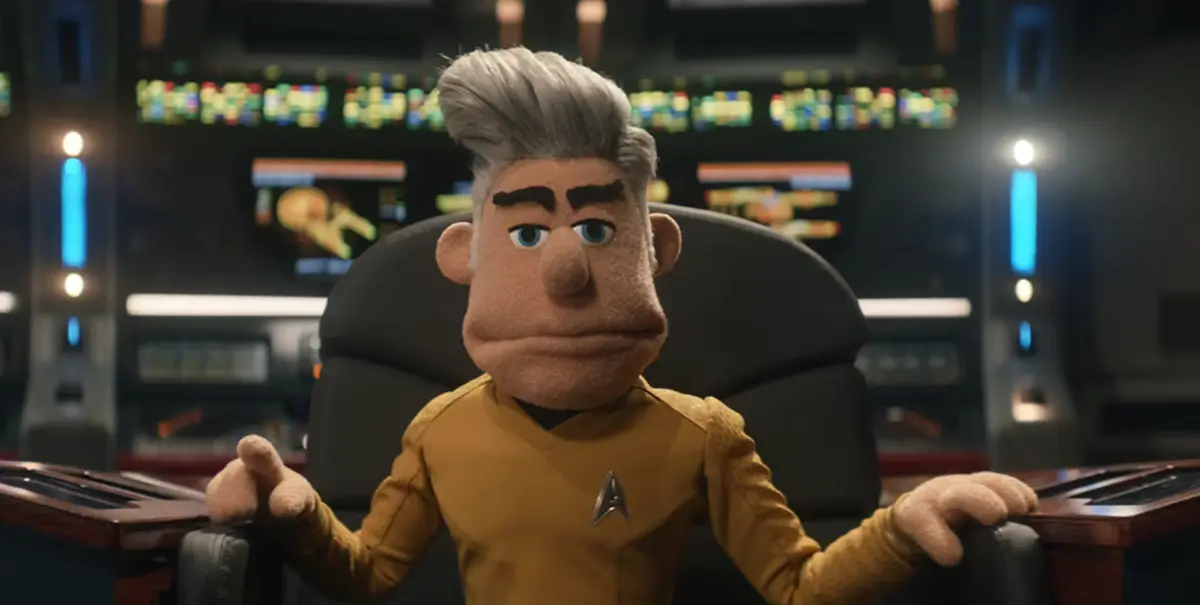
In the sprawling, multi-decade television landscape of the Star Trek franchise, few creative swings have generated as much immediate industry chatter, audience division, and tonal whiplash as the highly anticipated puppet-centric installment of Star Trek: Strange New Worlds. Titled officially as "Level-Five Transporter Accident" and widely discussed across fandom communities following its broadcast, the episode traded the series’ typical high-gloss cinematic realism for tangible, handcrafted puppetry. Yet, it was not merely the aesthetic departure that ignited fierce debate among viewers; rather, it was the narrative’s concluding twist.
By pulling back the curtain to reveal that the entirety of the puppet-based sequence was a byproduct of Commander Spock’s subconscious dream state, the writers invoked one of media’s most notoriously contentious tropes: the "it was all a dream" resolution. While television history is littered with variations of this narrative reset button—often utilized to absolve writers of long-term continuity baggage—its deployment in a high-concept Star Trek story raised urgent questions regarding creative intent, the boundaries of canon, and narrative economy.
To unpack the complex mechanics behind this choice, Star Trek: Strange New Worlds co-showrunner and episode co-writer Henry Alonso Myers recently sat down for an exclusive interview with TV Insider. Joined by fellow executive producer Akiva Goldsman, Myers illuminated the arduous creative calculus required to bring a fully puppetized Star Trek outing to life. Far from being a lazy shortcut, the episode was conceived as a maximalist exercise in tonal stretching—pushing the classic "transporter accident" trope past its historical breaking point.
Read Also
However, rather than putting the debate to rest, Myers introduced a fascinating linguistic wrench into the discourse: a subtle, enigmatic tease suggesting that within the surreal logic of Starfleet’s premier science vessel, dreams might not be entirely fictitious after all. This comprehensive investigative report explores the genesis of "Level-Five Transporter Accident," examines the behind-the-scenes decision-making that shaped its divisive finale, evaluates the persistent fan reaction, and contextualizes the episode within the broader, increasingly experimental trajectory of modern franchise television.
Detailed Chronology: From Concept to Subspace Reality
To understand how Star Trek: Strange New Worlds arrived at a point where its stoic, logic-driven Vulcan science officer is depicted as a marionette, one must examine the production trajectory of modern franchise television. When Paramount+ greenlit Strange New Worlds, the directive given to creators Akiva Goldsman, Henry Alonso Myers, and Jenny Lumet was clear: restore the episodic, swashbuckling spirit of 1960s Star Trek while maintaining contemporary prestige production values. This mandate naturally fostered a culture of high-wire creative experimentation, leading to previous stylistic departures such as the sweeping musical episode "Subspace Rhapsody."
Yet, transitioning from a musical theater pastiche to physical puppetry required an entirely unprecedented logistical alignment. The concept for "Level-Five Transporter Accident" began in the writers’ room as an interrogation of a foundational Star Trek trope: the transporter malfunction. Throughout the franchise’s history—spanning The Original Series, The Next Generation, Deep Space Nine, Voyager, and Enterprise—the transporter has served as both a miraculous technological marvel and a convenient narrative Swiss Army knife. It has split characters into physical manifestations of their good and evil traits (as seen in TOS’s "The Enemy Within"), aged characters backward, and recombined genetic material.
Despite the frequency of transporter mishaps across the franchise canon, the creative team realized a glaring omission. "We had not done a transporter accident episode yet," Myers explained during his interview with TV Insider, highlighting the vast untapped potential of the premise. However, the writers felt an obligation not to merely replicate past installments. If they were going to tackle a transporter malfunction in the modern era of television, the scale had to reflect the inflated ambitions of contemporary streaming budgets.
This philosophy of escalation directly birthed the puppet concept. According to Myers, the writing team, led by Myers and co-writer Dana Horgan, recognized that executing the conceit with a single transformed character would represent an underutilization of the premise. "If you just had one puppet, that wouldn’t be, I feel like, us rising to the occasion," Myers noted. "We really wanted to try to make it as big and as bold and push the edges of it as much as we possibly could."
The result was an ambitious, full-scale production undertaking that required collaboration with master puppet builders to fabricate uncanny likenesses of the U.S.S. Enterprise bridge crew. The creative challenge, however, extended far beyond the physical construction of the props. The writers faced an existential storytelling hurdle: maintaining the internal integrity of the fictional universe while populated by felt and foam analogues of beloved characters. The primary editorial directive, hammered out daily in the writers’ room, was an anchoring question: "Yes, we are going to have fun, but if it doesn’t feel like Star Trek, what are we doing?"
This delicate balancing act ultimately guided the narrative toward the transporter accident framework. By grounding the absurdity in established franchise pseudoscience, the team hoped to construct a bridge between whimsical Saturday-morning-style entertainment and the dramatic stakes native to the Star Trek universe. Yet, it was precisely this ambition that set the stage for the narrative cliffhanger that would ultimately polarize the fanbase.
Supporting Context & Metrics: The Anatomy of the "It Was All A Dream" Trope
To properly contextualize the reception of "Level-Five Transporter Accident," one must analyze the historical cinematic and television weight of the narrative device utilized in its final act. In screenwriting circles, the "it was all a dream" trope—or its science-fiction equivalent, the localized hallucination, simulation, or neurological misfire—occupies a deeply contested space.
The Historical Weight of Narrative Resets
Dating back to classical literature and early cinema (most famously popularized by Victor Fleming’s 1939 cinematic adaptation of The Wizard of Oz), the dream-sequence resolution offers writers an intoxicating degree of freedom. It permits creators to abandon all traditional rules of physics, continuity, and character consequence, safe in the knowledge that a clean narrative reset button awaits at the final commercial break.
In television, particularly within long-running episodic franchises, this trope has been deployed with varying degrees of success. Landmark examples include:
- The "Dream Lord" Episodes: Where characters are subjected to surreal psychological gauntlets that alter their psychological states without permanently disrupting the series’ continuity.
- Holodeck Malfunctions: A staple of 1990s Star Trek (The Next Generation, Voyager), which allowed writers to plunge characters into historical, noir, or gothic horror scenarios while guaranteeing that the ship’s bulkhead and status quo remained entirely unaltered by the end of act three.
The Fan Reception Metric
When Strange New Worlds revealed that the puppet sequences were manifestations of Spock’s subconscious dream state, social media discourse fractured immediately. Fan metrics tracked across major discussion hubs—such as Reddit’s r/startrek, dedicated Discord servers, and critical reviews on platforms like Reactor Mag—revealed a stark schism in audience sentiment.
| Audience Segment | Primary Reaction | Core Critique / Praise |
|---|---|---|
| Traditionalist Purists | Mixed to Negative | Felt the "dream" explanation invalidated the emotional and comedic stakes built over the course of the episode, viewing it as a cop-out. |
| Experimentalists / Casual Viewers | Highly Positive | Praised the sheer audacity of the puppet execution, arguing that narrative consequences were secondary to pure, unadulterated comedic joy. |
| Canon Analysts | Analytical / Intrigued | Focused heavily on Myers’ subsequent teasing comments regarding the literal versus metaphorical nature of Vulcan dreams. |
This statistical and qualitative division highlights a recurring tension in modern franchise management: the friction between episodic escapism and serialized accountability. Viewers invest time in character development and plot progression; when an entire reality-bending experiment is casually brushed aside as nocturnal brain activity, a subset of the audience experiences a distinct sense of narrative deflation.
Official Statements & Creative Logic: Inside the Writers’ Room
To decode the motivations behind the episode’s structural choices, industry analysts rely heavily on the direct disclosures provided by the creative leadership. The interview granted to TV Insider by Henry Alonso Myers and Akiva Goldsman provides rare, unfiltered insight into the pragmatic and philosophical realities of producing high-concept television.
Henry Alonso Myers on Tonal Anchoring
Myers was explicit about the existential pressure placed upon the writers’ room to ensure the puppet experiment did not devolve into pure, unanchored parody. In his estimation, the integrity of Star Trek rests not in its budget or its special effects, but in the earnestness with which its characters approach impossible scenarios.
"We spent a lot of time trying to basically make sure that it worked and felt genuinely like a Star Trek episode," Myers stated. "Yes, we were going to have fun. Yes, we were going to do all of these things, but if it doesn’t feel like Star Trek, what are we doing? That was what we had to hold to throughout the entire episode."
This commitment to emotional truth—even within the absurd visual medium of puppetry—explains why the writers invested heavily in the emotional beats between the characters prior to the dream reveal. The characters genuinely believed they were undergoing a catastrophic technological crisis, grounding the visual comedy in authentic dramatic stakes.
Akiva Goldsman and the Wrath of Khan Improv
Adding another layer to the production ethos of "Level-Five Transporter Accident," executive producer Akiva Goldsman revealed that several of the episode’s most iconic comedic callbacks—including a direct, highly parodied homage to the legendary cinematic climax of Star… Star Trek II: The Wrath of Khan*—were not meticulously engineered months in advance in the writers’ room. Instead, they were spontaneous, day-of-filming decisions born from opportunistic creativity on the soundstage.
When Goldsman spotted a visual or thematic parallel during production, the team leaned into the moment on the fly. This off-the-cuff approach underscores a broader creative philosophy currently governing Strange New Worlds: the production team is empowered to prioritize immediate joy, fan service, and creative play over rigid, over-engineered continuity management. While purists may wince at the lack of long-term strategic plotting behind such choices, it explains the infectious, high-energy cadence that defines the series’ best comedic outings.
The Enigmatic Twist: "Sometimes They’re Real"
Perhaps the most consequential portion of Myers’ interview—and the one generating the heaviest speculation across subspace forums—was his deliberate ambiguity regarding the true nature of Spock’s dream. When pressed on the standard "it was all a dream" logic, Myers threw a theoretical wrench into the interpretive machinery:
"And as for the dream, dreams are dreams, I don’t know, sometimes they’re real," Myers teased. "That I’ll say."
This cryptic statement invites multiple layers of critical interpretation:
- The Literal Dismissal: Was Myers simply employing playful showman banter, gently mocking the intense analytical scrutiny applied by Star Trek fans to every narrative frame?
- The Vulcan Telepathic Angle: Given Spock’s unique status as a half-Vulcan navigating complex emotional and telepathic landscapes, could a profound subconscious manifestation actually represent a form of latent, prescient psi-cognition?
- The Multiverse / Alternate Reality Tease: Within contemporary franchise storytelling, boundaries between physical reality and psychological projection are increasingly porous. Could the puppet dimension exist as a localized pocket universe accessed via subspace transporter resonance?
Regardless of the intended literal truth, Myers’ tease successfully reignited the discourse, transforming a potentially dismissible narrative cop-out into an ongoing puzzle for canon theorists.
Future Outlook: What "Level-Five Transporter Accident" Means for Franchise Experimentation
As Star Trek: Strange New Worlds looks toward its upcoming seasons on Paramount+, the legacy of "Level-Five Transporter Accident" will undoubtedly serve as a case study in modern television risk management. The episode proves that contemporary streaming audiences possess an appetite for radical stylistic departures, provided the underlying emotional architecture of the characters remains intact.
However, the installment also sounds a cautionary note regarding narrative economy. As franchise television increasingly leans into genre-bending anthology-style storytelling within ongoing serialized arcs, creators must continually navigate the fine line between delightful subversion and narrative exhaustion. If too many episodes conclude with reality-resetting dream sequences or metaphysical get-out-of-jail-free cards, the overarching dramatic stakes of the series risk erosion.
For now, the creative team behind Strange New Worlds has demonstrated that they are uniquely unafraid to court controversy in pursuit of sheer entertainment value. Whether future seasons will revisit the bizarre, felt-and-foam physics of Spock’s subconscious—or whether the puppet universe will remain locked forever within the classified logs of the U.S.S. Enterprise—remains to be seen. One thing, however, is definitively clear: in the vast, uncharted quadrants of the television landscape, Star Trek: Strange New Worlds will continue to boldly go wherever television has rarely gone before.

Comments
Facebook App ID not configured. Please add it in the Customizer.