
The landscape of modern television is littered with the ghosts of revivals past—cash-grab reboots relying heavily on cynical nostalgia, attempting to rekindle lightning in a bottle for audiences that have long since moved on. Yet, occasionally, a legacy project emerges that defies these cynical expectations, choosing instead to navigate the delicate, often awkward territory of rediscovering its own voice. Enter Mystery Science Theater 3000: The RiffTrax Experiments, the long-awaited and fiercely anticipated return of the original architects of cinematic mockery: Michael J. Nelson, Kevin Murphy, and Bill Corbett.
For over two decades, this core trio has successfully honed their comedic blades through RiffTrax, the independent digital enterprise that kept the spirit of bad-movie appreciation alive in the digital age. However, stepping back onto the iconic Satellite of Love introduces a distinct set of structural pressures, stylistic expectations, and emotional stakes. Rather than presenting a frictionless, laser-targeted product engineered for immediate algorithm consumption, The RiffTrax Experiments embraces vulnerability. It is a show that takes its time finding its footing, stumbling slightly over modern pop-culture references in its opening minutes before settling into the comfortable, uniquely idiosyncratic rhythm that defined a golden television era.
This comprehensive analysis examines the structural mechanics of the revival, the cultural significance of selecting the Florida horror artifact Sting of Death as its inaugural feature, the distinct boundaries separating MST3K from RiffTrax, and the surprising artistic philosophy that aligns this project more closely with avant-garde prestige television like Twin Peaks: The Return than a standard internet comedy special.
Read Also
Detailed Chronology & Structural Breakdown
To understand the rhythm of The RiffTrax Experiments, one must examine how the premiere episode unfolds, moving from an intentionally reluctant opening sketch through a masterclass in cinematic degradation, and finally into the warm, comforting familiarity of the screening room.
The Return to Space: An Opening Marked by Reluctance
The revival kicks off with a framing sequence designed to subvert expectations of triumphant fanfare. In lieu of an energetic, high-octane welcome, viewers are treated to an opening sketch that whisks us back to the Satellite of Love with minimal exposition. The tone is deliberate, almost sighing: “Well, here we go again.”
This initial hesitancy is palpable. Early jokes focusing on contemporary pop culture occasionally misfire, and an undeniable hint of nervousness colors the banter between characters who haven’t shared this specific narrative sandbox in decades. It mirrors the social friction of running into an old, deeply cherished friend after a prolonged absence—there is mutual affection, but a brief, awkward calibration period is required to synchronize frequencies.
This approach contrasts sharply with the recent Netflix revival spearheaded by Jonah Ray and Felicia Day, which favored massive production budgets, dense continuity plots, and an unrelenting, hyper-enthusiastic delivery of rapid-fire jokes. While that iteration ultimately won over skeptics through sheer earnestness, The RiffTrax Experiments scales back the narrative clutter. The opening host segment features Mike Nelson working a mundane shift at the Moose Lick County Dairy Co-op before being unceremoniously abducted back into his old life. It is absurd, nonsensical, and largely indifferent to the complex lore accumulated across decades of network and streaming migrations. It asks the ultimate meta-question: Why are we all here? The answer, as it has always been, waits in the dark of the screening room.
The Masterpiece of Mediocrity: Dissecting Sting of Death
If the host segments provide the structural scaffolding, the cinematic target supplies the beating, rubbery heart of the enterprise. For this revival, the team targeted Sting of Death, a 1965 Florida horror oddity that operates as a masterclass in unintentional comedy.
Following a group of vibrant "youths" played conspicuously by members of the American Association of Retired Persons (AARP), the plot revolves around beachside revelry interrupted by a mysterious creature and its apparent battalion of jellyfish. To call the film a baffling mess of poor directorial choices is an understatement. Viewers are immediately confronted with baffling narrative non-sequiturs:
- Why does the resident professor sport a bizarre, unexplained mark on his forehead that is dropped almost as soon as it is introduced?
- Are we genuinely expected to sympathize with vapid teenagers who subject a social outcast to Toxic Avenger-level torture, entirely oblivious to the fact that he is destined to become the film’s mutant antagonist?
- Did this entire cinematic endeavor exist purely because a group of weekend filmmakers secured a fan boat and an underwater camera, shouted "hell yeah, brother," and completely abandoned any pursuit of structural competence?
The film is further elevated by jaw-dropping stylistic choices. Unnecessary, lingering dance sequences are filmed from low angles with Dutch tilts that suggest the cinematographer’s artistic awakening was directly tied to disorientation. The centerpiece of these gatherings is a non-choreographed dance known simply as "The Jellyfish," performed by cast members who appear entirely unbriefed on the steps. The monster reveal—a creature outfitted in a costume so fragile it prevents basic mobility yet resembles an assembly of dollar-store trash bags—solidifies its status as a lab-grown MST3K classic.
While Sting of Death could easily have functioned as a standard RiffTrax audio commentary, placing it within the framing of Mystery Science Theater 3000 alters its context. The blend of vague cultural exploitation, breezy pacing, and aggressively un-scary threats fits the classic DNA of the franchise’s golden age.
Supporting Context & Metrics
MST3K Versus RiffTrax: Defining the Mechanical Differences
A recurring point of curiosity among dedicated fans is the precise demarcation line separating an installment of RiffTrax from a traditional MST3K episode. Over twenty years of digital distribution, RiffTrax perfected the art of the rapid-fire audio track over feature films, shorts, and blockbusters. However, the television format of MST3K relies heavily on a triad of distinct storytelling layers:
- Host Segments & Original Music: While this revival features fewer host segments than vintage television syndication allowed, those included utilize theatricality impossible in an audio-only commentary. Seeing Mike Nelson, Crow T. Robot, and Tom Servo perform the "Tardigrade" dance highlights the irreplaceable value of physical comedy and musical numbers.
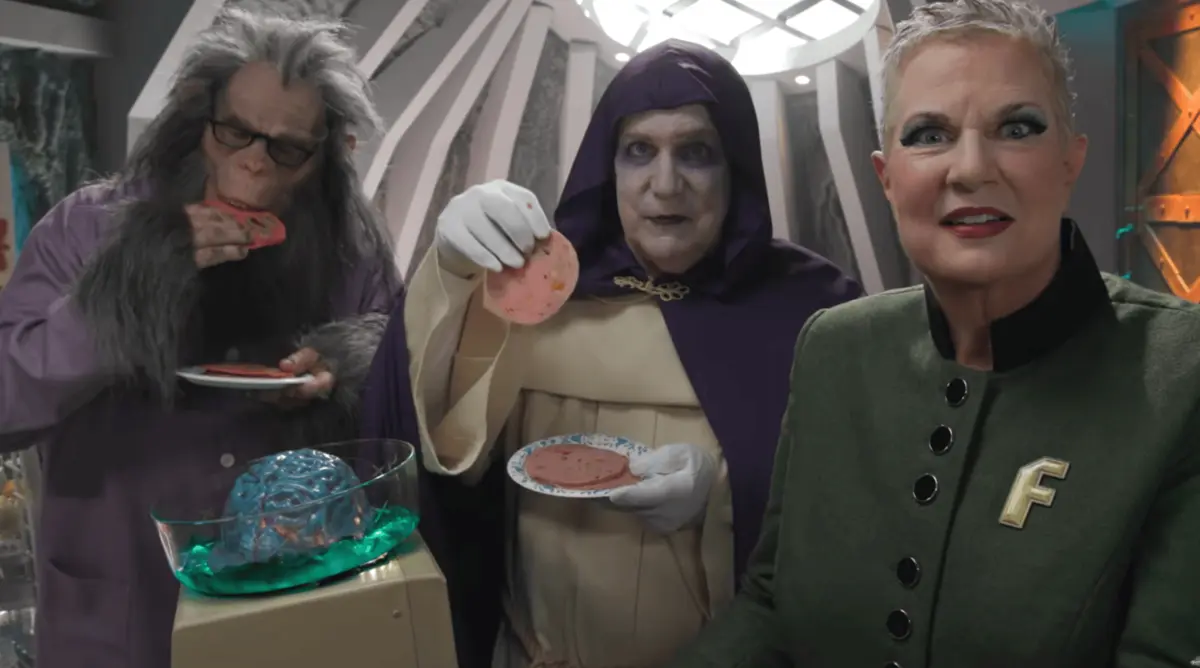
- The Returning Rogues Gallery: Mary Jo Pehl, Bill Corbett, and Kevin Murphy reprise their roles as Pearl Forrester, Brain Guy, and Professor Bobo, respectively. Their brief narrative intervention—introducing a new corporate sponsor in the form of Syd’s Olive Loaf and outlining Pearl’s vague ambitions to sell experimental data to "the A.I."—injects a distinct flavor of chaotic corporate satire.
- Pacing and Silence: Perhaps the most critical differentiator is the mastery of negative space. Classic MST3K understands when not to speak. As the episode progresses, Nelson, Corbett, and Murphy slide effortlessly into a rhythm characterized by expert comedic timing. Tom Servo can be heard chuckling softly to himself at minor visual absurdities that pass without a formal one-liner, while Mike delivers bone-dry observations born of his character’s quiet bewilderment at being dragged back into servitude.
The Economics of Laughter in Modern Media
During interviews conducted alongside the revival’s release, the hosts noted that the unexpected longevity of the brand stems from a fundamental cultural shift: an audience-wide craving for pure, unadulterated comedy at a time when major studio television and film budgets are poured into cinematic universes, franchise setup, and high-stakes drama.
There is an undeniable novelty in watching an episode of The RiffTrax Experiments and experiencing visceral, genuine laughter. Unlike the modern blockbuster paradigm—which often elicits a passive, MCU-style acknowledgment that a joke was technically delivered—this format invites communal release. Whether experienced during limited theatrical screenings or streamed at home, the sensation remains rooted in the joyful subversion of cinematic pompousness.
Official Statements & Creative Philosophy
The transition from independent streaming audio to a fully operational revival was not designed to be a frictionless nostalgia trip. According to production insights and creator commentary, the driving philosophy was to avoid both cynical cash-grabs and rigid "greatest-hits" compilations.
"What we got instead is an episode from old hands who are happy to be here, but not so happy to be here that they’re content just to coast off what they did in the past," notes production analysis of the revival’s tonal balancing act. "What awkwardness there is feels like the earnest attempts of our hosts trying to explore what this fully-operational revival can do."
This refusal to coast gives the project an unexpected artistic credibility. Rather than recycling old catchphrases with calculated precision, the creative team treats the revival as an ongoing experiment in reinvention. Cultural callbacks spanning To Kill a Mockingbird, Star Wars: The Last Jedi, and classic MST3K deep cuts like Time Chasers are woven organically into the runtime, serving the immediate scene rather than checking items off a fan-service checklist.
Future Outlook: A "Subtly Bold" Legacy
To categorize Mystery Science Theater 3000: The RiffTrax Experiments strictly as a nostalgia act is to misunderstand its cultural function. In its structural unpredictability, tonal shifts, and unapologetic embrace of its own history alongside its awkward growth pains, the revival bears a strange, spiritual resemblance to David Lynch’s Twin Peaks: The Return.
Like that landmark television event, The RiffTrax Experiments does not simply pick up where memory suggests it left off. It acknowledges the passage of time, the aging of its creators, and the evolution of the media landscape, yet pushes forward with an idiosyncratic confidence. It is not a sweeping storytelling masterpiece intended to redefine the television medium; rather, it functions with the quiet, deliberate consistency of a well-crafted artisan condiment—subtly bold, deeply comforting, and entirely secure in its own bizarre identity.
As long as there are poorly budgeted Florida horror films featuring jellyfish attacks, nonsensical dance numbers, and questionable cinematic choices, the Satellite of Love remains in exceptionally capable hands. The revival proves that while television formats will inevitably shift and distribution models will evolve, the fundamental human impulse to sit in the dark, point at a screen, and laugh together remains an enduring, irreplaceable art form.




Comments
Facebook App ID not configured. Please add it in the Customizer.