
Executive Overview
Ben Gregor’s cinematic adaptation of Enid Blyton’s enduringly popular yet historically contentious children’s fantasy series, The Magic Faraway Tree, arrives on screen carrying an aesthetic defined by unbridled charm and visual splendor. Written by Simon Farnaby—whose previous credits include the critically acclaimed Paddington 2 and Wonka—the film attempts to bridge the gap between 20th-century children’s literature and the modern anxieties of 21st-century youth, specifically screen addiction and the relentless pace of contemporary life.
Headlined by a stellar cast featuring Andrew Garfield, Claire Foy, and a breakout trio of young actors, the production trades the sterile industrial grays of modern urban existence for a vibrant, tactile countryside explosion of color and wonder. Yet, despite its enchanting production design, deeply committed performances, and a clear-eyed understanding of modern familial burnout, the film stumbles under the weight of structural overreach. Cramming no fewer than eleven distinct narrative engines into a single feature-length runtime, The Magic Faraway Tree frequently sacrifices emotional resonance and narrative tension for rapid-fire resolutions. While it succeeds as a comforting cinematic hug for younger audiences, it ultimately stops just short of achieving the timeless, genre-defining classic status of its spiritual predecessors.
Detailed Chronology: The Journey to the Faraway Tree
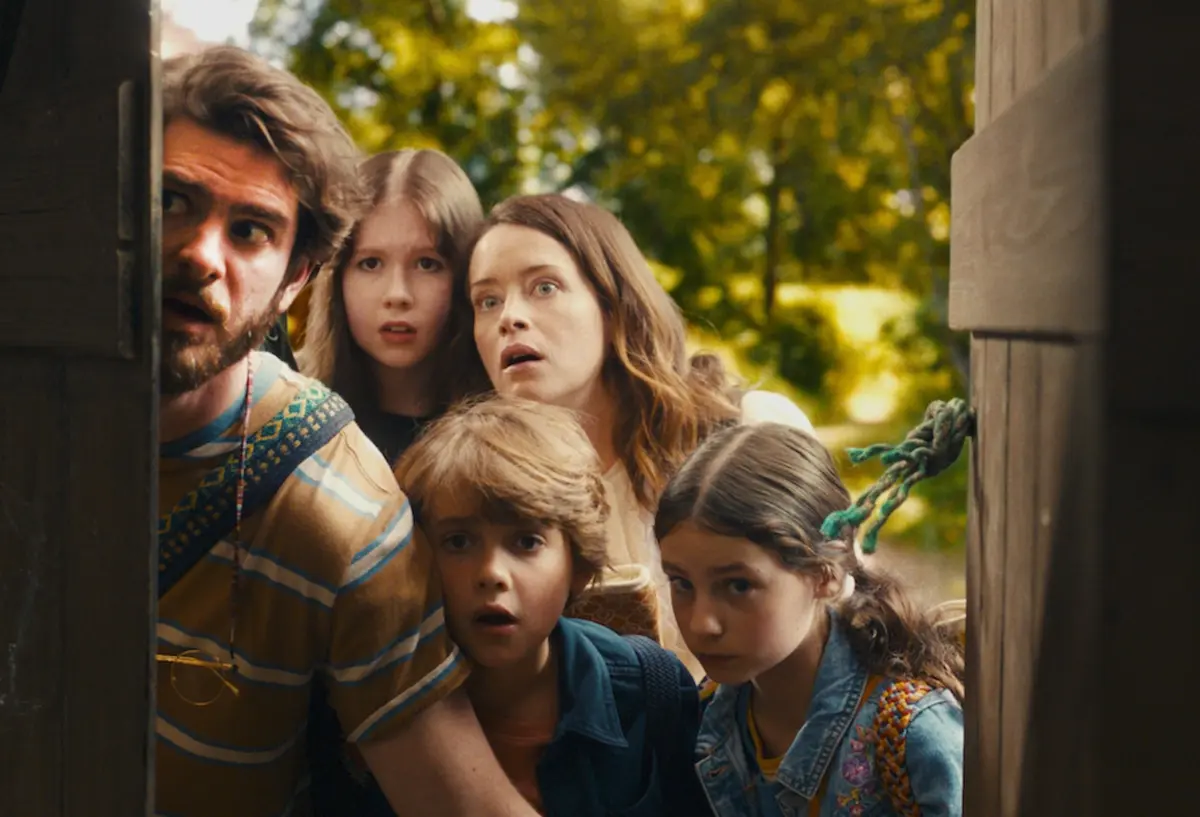
The narrative sets its thematic foundation in the stark, metallic reality of the Thompson family. Parents Tim (Andrew Garfield) and Polly (Claire Foy) find themselves increasingly alienated from their children by the digital age. Their offspring—tech-savvy influencer-in-training Beth (Delilah Bennett-Cardy), Minecraft-obsessed Joe (Phoenix Laroche), and the selectively mute Franny (Billie Gadsdon)—embody the modern disconnect between children and the physical world.
Read Also
The catalyst for change arrives when Polly impulsively resigns from her high-tech corporate position. She discovers that her employers have illicitly embedded spyware within a smart refrigerator she designed. Viewing this betrayal as a long-overdue sign to reclaim their family life, Tim and Polly uproot the household, abandoning the city for a ramshackle, off-grid barn in the countryside. While the elder children rebel against the lack of electricity and running water, young Franny immediately embraces the tranquil pace.
Almost immediately upon arriving in the countryside, Franny encounters a whimsical faerie. This prompts the discovery of an enormous, ancient entity: the titular Faraway Tree. Within its towering branches, the children encounter a vibrant community of eccentric denizens. Among them are Silky (Nicola Coughlan), a fairy defined by her luminous golden hair; the notoriously anti-human Moonface (Nonso Anozie); Dame Washalot (Jessica Gunning), whose compulsive laundering knows no bounds; the perpetually disgruntled Angry Pixie (Hiran Abeysekera); the hard-of-hearing Saucepan Man (Dustin Demri-Burns); and the amnesiac knight Mr. Watzisname (Oliver Chris).
Beyond the intrinsic magic of the tree itself, the film introduces a revolving celestial mechanism: every day, a new mythical "Land" drifts into the clouds above the canopy. Ranging from the Land of Goodies—where sugar-fearing extremists protest confectionary goods—to the neon-drenched, roller-skating Land of Birthdays and the traditional British royalty-satire of the Land of Know-Alls, these realms provide the film’s most visually inventive sequences. However, these fantastical explorations run parallel to the gritty, grounded domestic struggles of the adults: Tim’s desperate attempts to launch an artisanal tomato sauce business, the crushing financial reality of maintaining a dilapidated farm, and the menacing presence of Polly’s tyrannical mother, Grandma (Jennifer Saunders), alongside the updated authoritarian antagonist Dame Snap (Rebecca Ferguson).
Supporting Context & Metrics: Adapting Blyton for the 21st Century
Enid Blyton’s original The Magic Faraway Tree series, published between 1939 and 1951, has long occupied a complex space in children’s literature. Celebrated for its boundless imagination, the source material has simultaneously faced modern scrutiny for outdated tropes and character behaviors—most notably Dame Snap’s original literary incarnation as Dame Slap, whose pedagogical methods included physical violence toward children.
Modernizing the Source Material
The filmmakers made deliberate creative choices to update Blyton’s vision for a contemporary audience. By introducing screen addiction and tech-corporate overreach as the primary modern antagonists, the narrative imbues the ancient magic of the forest with a sense of urgent necessity.
- The Cast and Character Dynamics:
- Delilah Bennett-Cardy (Beth): Navigates the hazardous terrain of portraying a screen-addled teenager without alienating the audience, gradually grounding her transformation as she surrenders to the forest’s magic.
- Phoenix Laroche (Joe): Delivers sharp comedic timing despite receiving a comparatively lean narrative allocation.
- Billie Gadsdon (Franny): Carries the emotional anchor of the film, portraying selective mutism and childlike wonder with remarkable restraint and authenticity.
- Production Design and Aesthetics: The visual transition from the cold chrome-and-steel urban home to the rich, living textures of the countryside serves as a masterclass in atmospheric set design. The production avoids the dull, "used-dishwater" color grading typical of contemporary blockbusters, instead opting for a saturated, inviting palette.
Structural Shortcomings and Pacing Metrics
Despite these triumphs, an analytical breakdown of the film’s structural integrity reveals critical vulnerabilities.
| Metric / Structural Element | Evaluation | Impact on Narrative |
|---|---|---|
| Active Story Engines | Counted at 11 separate plots | Dilutes focus; prevents deep investment in individual character arcs. |
| Tension Window | Introduced at the 50-minute mark | Reduces stakes; problems are resolved within five minutes of introduction. |
| Adult vs. Youth Balance | Heavily skewed toward the children | Renders adult character beats (Tim’s childhood trauma, Polly’s corporate flight) feeling clunky. |
| World-Building Consistency | Barn interior vs. exterior logistics | Minor internal logic disconnects (e.g., modern bedrooms inside an unserviced barn). |
Official Statements & Industry Reception
While traditional studio press releases emphasize the legacy of Enid Blyton and the pedigree of a creative team steeped in the tradition of Paddington 2 and Wonka, critical consensus points toward a tension between artistic ambition and commercial safety wheels.
Industry insiders have noted that the film was greenlit with sequels already in development—a commercial strategy that explains several narrative anomalies. Major character motivations, such as Moonface’s deep-seated resentment of humanity and Silky’s complex desire to break free from isolation, are compressed into hurried expositions during the final act. Reviewers have highlighted this as a missed opportunity, suggesting that these subplots were held back to pad future franchise entries rather than allowed to organically breathe within the current runtime.
Furthermore, the creative choices of screenwriter Simon Farnaby are under particular scrutiny. Having previously co-authored Paddington 2—widely regarded as a gold standard in modern family cinema that masterfully trusts its audience with emotional gravity—Farnaby’s work here occasionally leans into the modern "streaming era" trap: repeatedly stating and resolving dramatic tension to prevent young viewers from checking out.
Future Outlook: Franchising, Sequels, and Cinematic Legacy
The commercial viability of The Magic Faraway Tree appears robust, anchored by recognizable A-list talent like Andrew Garfield and Claire Foy, alongside a bankable roster of British character actors including Nicola Coughlan, Nonso Anozie, and Jennifer Saunders. With sequels already greenlit, the overarching cinematic universe has ample runway to correct the structural missteps of this inaugural outing.
To elevate future installments from pleasant familial diversions to timeless classics, the creative team would do well to look toward historical milestones of fantasy storytelling, such as Jim Henson’s The Labyrinth or Wolfgang Petersen’s The Neverending Story. These works understood a fundamental rule of children’s cinema: young audiences do not need their anxieties entirely defused by immediate, consequence-free resolutions. By allowing stakes to remain high, tension to linger, and failure to feel genuinely consequential, the forthcoming sequels can harness the immense goodwill of this initial chapter and channel it into a richer, more enduring cinematic legacy.
In its current form, The Magic Faraway Tree functions beautifully as a warm, visually captivating, and comforting cinematic embrace. Yet, for all its dazzling whimsy and heartfelt performances, it ultimately leaves viewers wishing the filmmakers had possessed just a fraction more courage to let their magic wander into the deeper, darker woods.


Comments
Facebook App ID not configured. Please add it in the Customizer.