
Executive Overview
In an era defined by digital fragmentation, algorithmic echo chambers, and the steady retreat of civic life into the private sphere, a bustling neighborhood pub in Cambridge, Massachusetts, is proving that intellectual curiosity is far from dead. It just needed a better beverage selection.
The Plough and Stars, a beloved local institution situated in the heart of Cambridge, has struck a cultural nerve with its newly minted series of public events known simply as “Philosophy Nights.” Merging the time-honored tavern tradition of spirited debate over pints of stout and plates of pub fare with rigorous academic inquiry, these gatherings have transformed a local watering hole into an impromptu salon for the 21st century.
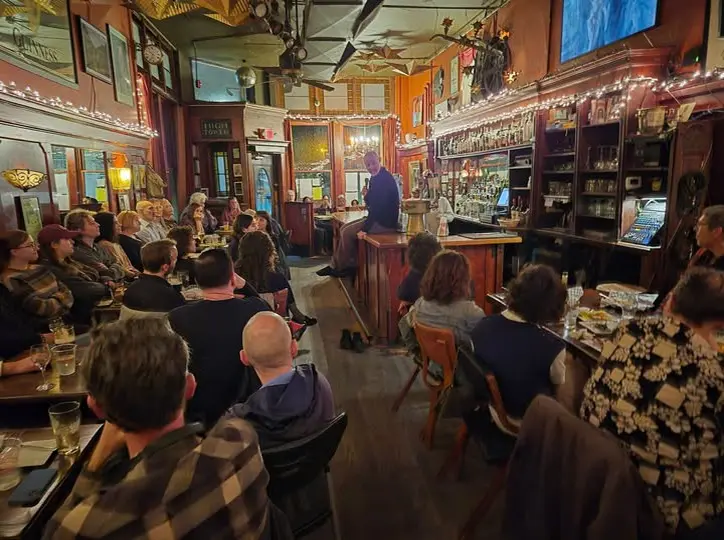
What began as an experimental community outreach effort has quickly snowballed into an unprecedented cultural phenomenon. Last month, patrons packed shoulder-to-shoulder into the venue to hear Agustín Rayo, a prominent philosopher and scholar from the Massachusetts Institute of Technology (MIT), deliver an accessible yet deeply engaging lecture on the complex intersections of mathematics and certainty. The reception was nothing short of electric, signaling a massive, largely untapped public appetite for high-level philosophical discourse delivered outside the traditional ivory tower.
Read Also
The momentum shows no signs of slowing. Later this month, the pub is scheduled to host Helena de Bres, a celebrated philosopher and author from neighboring Wellesley College, who will tackle one of humanity’s most enduring conundrums: “What is meaning in life?” The response from the community has overwhelmed the venue’s logistical capacity, with reports indicating that approximately 120 eager participants are currently languishing on the waiting list just to secure a spot in the room.
This unexpected marriage of casual hospitality and academic rigor raises broader questions about the state of public philosophy. While Cambridge and the greater Boston metropolitan area undoubtedly benefit from a uniquely dense concentration of world-class universities, brilliant minds, and an inherently academic-friendly populace, the explosive success of the Plough and Stars’ initiative points to a deeper, universal hunger. People are craving spaces where they can grapple with foundational questions about existence, ethics, and knowledge in real-time, face-to-face, and without the protective barriers of a university tuition fee or a scholarly journal paywall.
Across the globe, a quiet renaissance of pub philosophy, café dialogues, and tavern-based colloquiums is beginning to take shape. As we examine this burgeoning movement, this report delves into the chronology of the Plough and Stars’ success, analyzes the metrics of its unprecedented popularity, features perspectives from the minds driving the trend, and investigates similar grassroots public philosophy initiatives flourishing in dining establishments worldwide.
Detailed Chronology: From Concept to Cultural Phenomenon
To understand how a neighborhood pub became ground zero for contemporary public philosophy, it is necessary to retrace the trajectory of how these events materialized, scaled, and captured the imagination of the local community.
The Genesis of the Tavern Salon
The concept of discussing philosophy in places of public refreshment is, historically speaking, as old as philosophy itself. From the agoras of ancient Athens to the coffeehouses of 18th-century London and the bustling brasseries of post-war Paris, the exchange of deep ideas has always thrived best when lubricated by good food, drink, and a relaxed atmosphere.
However, in modern American cities, the traditional line separating academic institutions from neighborhood commerce has grown rigidly defined. Universities build gated campuses; local pubs focus on sports broadcasts, trivia nights, and craft beer rotations. Bridging this gap required a deliberate, localized effort.
The organizers behind the Plough and Stars initiative recognized that while Boston and Cambridge are brimming with intellectual capital, the pathways for everyday citizens to interact directly with top-tier researchers were largely restricted to formal university lectures, extension courses, or academic conferences—venues that can often feel intimidating, sterile, or financially prohibitive to the general public.
The Inaugural Event: Agustin Rayo on Math and Certainty
The turning point came last month when the pub hosted its inaugural marquee philosophy night. The organizers tapped Agustín Rayo, a distinguished professor at MIT whose work frequently explores the philosophy of language, metaphysics, and the nature of mathematical practice.
The premise was deceptively simple: take a topic that strikes terror into the hearts of many non-mathematicians—the nature of mathematical certainty—and unpack it in a space where patrons could simultaneously order a burger or a pint of cider.
By all accounts, the experiment exceeded every expectation. The venue reached maximum capacity long before the talk commenced. Patrons of all backgrounds—ranging from MIT graduate students and software engineers to local retirees, service industry workers, and curious undergraduates—piled into the space. Rayo’s lecture bypassed dry, overly technical jargon in favor of evocative, relatable thought experiments, sparking an interactive Q&A session that stretched long past the formal conclusion of the talk. The success of the evening proved definitively that the appetite for intellectual stimulation in a social setting was not merely theoretical; it was commercially and culturally viable.
The Sensation of Scale: The Helena de Bres Waitlist Crisis
Buoyed by the triumph of the inaugural night, the pub immediately scheduled its follow-up event, featuring Helena de Bres of Wellesley College. De Bres, known as much for her sharp wit and accessible writing as for her academic credentials, selected a topic with universal resonance: “What is meaning in life?”
The public reaction caught organizers completely off guard. Within hours of the event’s announcement, reservations vanished. Within days, the venue’s physical capacity was thoroughly overwhelmed. As of this writing, local reports confirm that approximately 120 people are trapped on the waitlist, desperate for a cancellation to open up a single chair in the house.
This waitlist crisis has transformed the event from a clever local gimmick into a bona fide hot ticket, rivaling the demand for high-profile concerts or sold-out theater performances in the Boston area. It also underscores a logistical challenge that the pub—and potentially other establishments—will need to navigate as public philosophy continues to surge in popularity: how to scale intimacy in an era of hyper-demand.
Supporting Context & Metrics: The Anatomy of Public Philosophy
To contextualize the phenomenon occurring at the Plough and Stars, it is essential to look at the unique demographic ecosystem of Cambridge, Massachusetts, while also evaluating the broader metrics of public intellectual engagement in the United States.
The Cambridge Ecosystem: An Intellectual Oasis?
Skeptics might argue that Cambridge is an unfair testing ground for public philosophy. Home to Harvard University and MIT, and immediately adjacent to Boston University, Tufts, Brandeis, and Wellesley, the region possesses a disproportionate density of philosophers, academics, and individuals with advanced degrees.
+-----------------------------------------------------------------+
|               GREATER BOSTON ACADEMIC DENSITY                   |
+-----------------------------------------------------------------+
|  [ Harvard University ]       [ Massachusetts Institute (MIT) ] |
|  [ Wellesley College ]        [ Boston University (BU) ]        |
|  [ Tufts University ]         [ Brandeis University ]           |
+-----------------------------------------------------------------+
                         │
                         ▼
+-----------------------------------------------------------------+
|         CULTURAL & INTELLECTUAL DEMOGRAPHIC FACTORS             |
+-----------------------------------------------------------------+
|  • High concentration of students, researchers, and faculty     |
|  • Culturally ingrained habit of attending lectures/seminars    |
|  • Proximity of neighborhood pubs to academic hubs              |
+-----------------------------------------------------------------+
                         │
                         ▼
+-----------------------------------------------------------------+
|                OUTCOME: HIGH-DEMAND EVENTS                      |
+-----------------------------------------------------------------+
|  • Packed houses for pub philosophy nights                      |
|  • 120+ individuals locked on waitlists for single speakers     |
+-----------------------------------------------------------------+
Undoubtedly, this demographic reality provides a foundational tailwind. It ensures a ready supply of world-class speakers who live down the street and a local populace already culturally conditioned to value lectures, seminars, and intellectual discourse.
However, attributing the success of the Plough and Stars entirely to local demographics would be a mistake. Academic communities can often be insular, elitist, and detached from the daily concerns of working-class or non-academic residents. The genius of the Plough and Stars lies precisely in its ability to strip away the academic pretension—the PowerPoint decks, the podiums, the dress codes, and the institutional gatekeeping—and rebrand philosophy not as a specialized profession, but as a shared human birthright.
The Rise of Accessible Public Discourse
The hunger for events like Philosophy Nights reflects a wider cultural weariness with digital polarization. Social media platforms, while nominally designed to connect people, have largely degraded public discourse into performative outrage, soundbites, and hostile factionalism.
In contrast, a philosophy night in a pub offers three critical elements that the digital world systematically destroys:
- Physical Proximity: Sharing physical space fosters empathy, patience, and civil listening in ways that digital comment sections never can.
- Slowing Down: Philosophy requires patience—the willingness to entertain complex nuances, define terms carefully, and tolerate ambiguity. A pub setting, anchored by food and drink, naturally encourages people to linger and slow down their cognitive processing.
- Democratization of Knowledge: When a tenured professor delivers a lecture over the clinking of beer glasses and the hum of an espresso machine, the traditional hierarchy of the classroom dissolves. The audience members are not passive grade-receivers; they are active interlocutors.
Official Statements & Academic Perspectives
The movement toward public philosophy is increasingly winning converts from within the academy itself. For decades, academic philosophy faced mounting pressure to justify its societal utility, often retreating into hyper-specialized subfields that speak only to other specialists. Initiatives like those at the Plough and Stars represent a deliberate counter-movement.
While official statements from specific event organizers emphasize the sheer joy of community engagement, academic participants have frequently noted the psychological and professional rewards of stepping outside campus walls.
Bridging the Town-Gown Divide
In recent interviews regarding public engagement initiatives, philosophers participating in similar community programs have highlighted several key insights:
- Revitalizing the Discipline: “Philosophy was born in the public square, not the departmental archive,” notes one regional scholar. “When we take these ideas back to where people gather—pubs, libraries, community centers—we are reminded of why we fell in love with the discipline in the first place. People outside the university care deeply about meaning, ethics, and truth; they just need an invitation to the conversation.”
- The Challenge of Translation: Translating complex theoretical frameworks—such as Agustin Rayo’s work on mathematical certainty or Helena de Bres’s explorations of meaning—into language that resonates with a diverse, general audience requires a distinct skill set. It forces academics to shed jargon and focus on core human intuitions.
- Mutual Enrichment: Scholars report that public Q&A sessions often yield fresh perspectives and unanticipated objections from non-academics whose life experiences differ vastly from those of career researchers.
Global Echoes: Public Philosophy Beyond Cambridge
While the Plough and Stars is currently basking in well-deserved media attention, it is by no means an isolated anomaly. Across the globe, a vibrant ecosystem of dining establishments, independent bookstores, and cultural hubs are hosting similar programming. To truly understand the scope of this trend, we must look beyond Massachusetts and examine how public philosophy manifests in other regions.
International and National Bar-Philosophy Initiatives
| Initiative / Venue | Location | Format & Focus | Cultural Impact |
|---|---|---|---|
| Café Philosophique Movements | Paris, France & Global | Originating in European cafes, these recurring meetings invite the public to discuss broad ethical and existential questions moderated by a philosopher. | Kept the tradition of the European coffeehouse salon alive across generations, influencing public policy debates and civic education. |
| Philosophy Pub Nights | Various Cities (UK & US) | Informal gatherings hosted in local pubs where graduate students or local professors give short provocations followed by open floor debates. | Fosters working-class and cross-generational engagement with ideas traditionally locked inside universities. |
| Café Scientifique / Philosophy Cafes | International | Blending science and philosophy, these events take place in restaurants and pubs to discuss bioethics, AI consciousness, and cosmology. | Demystifies cutting-edge research and integrates ethical reflection directly into technological development hubs. |
These international examples share a common DNA with the Plough and Stars experiment: they operate on the belief that profound ideas do not belong exclusively behind ivy-covered walls. Whether it is a bistro in Lyon, a pub in Dublin, or a tavern in Cambridge, these spaces serve as vital community anchors where intellectual life and social life seamlessly merge.
Future Outlook: Where Do We Go From Here?
As the Plough and Stars prepares for its upcoming events—and grapples with a formidable 120-person waitlist—the broader question facing the public philosophy movement is one of sustainability and expansion.
Scaling Without Losing Soul
The immediate logistical hurdle for successful public philosophy venues is managing crowd dynamics. When an event attracts triple-digit waitlists, organizers face difficult choices:
- Move to larger venues? Doing so risks stripping away the cozy, intimate tavern atmosphere that makes a pub philosophy night feel distinct from a standard university lecture hall.
- Increase frequency? Hosting events weekly rather than monthly could satisfy demand, but risks burning out both the volunteer organizers and the participating academic speakers.
- Empower decentralized replication: The most viable path forward is inspiration rather than centralization. If the success of the Plough and Stars encourages independent pubs, restaurants, and cafes in other cities to launch their own grassroots philosophy nights, the movement can scale organically.
The Long-Term Cultural Prognosis
The resurgence of tavern philosophy points to a hopeful cultural correction. As societies navigate turbulent political landscapes, rapid technological disruptions driven by artificial intelligence, and a persistent crisis of social isolation, spaces that encourage deep, face-to-face reflection are more than just a quirky night out—they are a vital public good.
By proving that people will eagerly line up—and wait weeks—to discuss the nature of mathematical certainty and the meaning of life over a pint of beer, the Plough and Stars has issued a quiet challenge to the hospitality and academic sectors alike. The message is clear: feed the body, nourish the spirit, and never underestimate the public’s appetite for a genuinely thoughtful conversation.





Comments
Facebook App ID not configured. Please add it in the Customizer.