
Executive Overview
In the landscape of contemporary speculative fiction, few authors have carved out a space as deeply reassuring, profoundly human, and philosophically engaging as Becky Chambers. Renowned for her Hugo Award-winning Wayfarers series and the gentle, introspective wonders of the Monk and Robot novellas (A Psalm for the Wild-Built, A Prayer for the Crown-Shy), Chambers has built a literary empire on the premise of "hopepunk"—narratives that reject dystopian nihilism in favor of radical empathy, community-building, and quiet resilience.
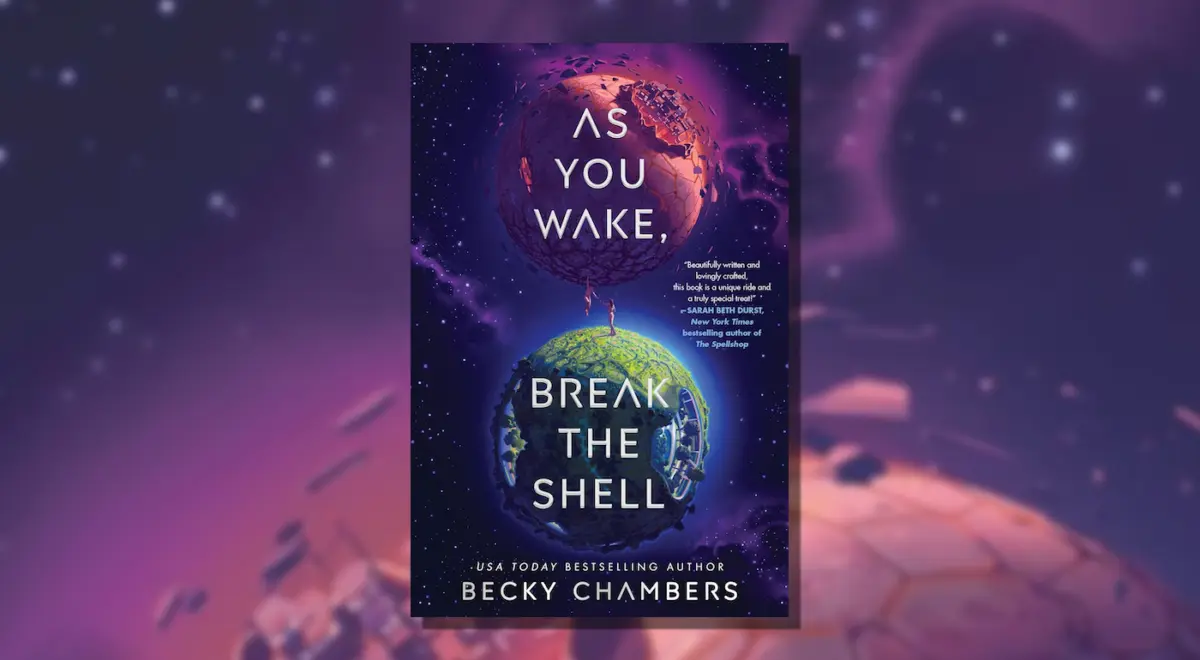
Now, Harper Voyager has set the literary world abuzz with the announcement of Chambers’s next major undertaking: a brand-new science fiction duology launching with the publication of As You Wake, Break the Shell on October 13th.
The novel transports readers to Fortune, a resource-poor, volcanically volatile terrestrial body where survival is an exercise in daily endurance. Far from the sprawling interstellar highways of her earlier works, As You Wake, Break the Shell narrows its lens to a claustrophobic, fragile ecosystem shared by two starkly different women: Signy, a reclusive, rule-bending botanist who bio-prints illicit medicine, and Cora, a high-stakes "rorqual pilot" capable of navigating the massive, sentient bio-ships that interconnect their isolated solar system.
Read Also
When a neurological occupational hazard known only as the "mindbleed" threatens Cora’s career and livelihood, her desperate search for a remedy leads her straight to Signy’s darkened, unassuming storefront. What begins as a clandestine transaction quickly spirals into a delicate architecture of risk, trust, and systemic subversion. This piece examines the structural, thematic, and cultural significance of Chambers’s latest work, tracing its narrative origins, contextualizing its world-building, and analyzing what this opening chapter signals for the broader trajectory of modern science fiction.
Detailed Chronology & Narrative Arc: Entering the World of Fortune
To fully understand the gravity of As You Wake, Break the Shell, one must examine the meticulous world-building established in the opening chapters of the novel. Chambers wastes no time immersing the reader in the harsh sensory realities of Fortune, a celestial body where life is perpetually pitted against elemental fury.
The Geography of Attrition: Midtown, Flytown, and the Volcanic Reach
The narrative kicks off with Cora navigating the atmospheric liabilities of Fortune’s older urban sprawl, colloquially known as Midtown, before retreating to the relative sanctuary of Flytown. Unlike the sprawling, sprawling developments of core worlds, Flytown represents the desperate ingenuity of marginalized populations: every dormitory, bodega, and dive bar is sealed beneath a massive bubbled dome.
Within these domes, pedestrians can traverse the settlement without donning external gear—a luxury given that the world outside the domes is defined by hostile weather and a persistent, abrasive rain of volcanic ash. Fortune is dominated by four active, violent volcanoes, irreverently dubbed by locals as Tantrum, Clockwork, Pitchfork, and "Bastard"—though the latter bears the painfully bureaucratic official moniker of Bulwark. This constant atmospheric shedding wears down the infrastructure of human endeavor. Shop signs are reduced to ghostly smudges; colorful mural art is systematically bleached by corrosive mineral dust.
Through a brief, poignant vignette involving an anonymous street artist working alongside an automated sweeper bot to apply a defiant stroke of purple paint over ash-choked layers, Chambers establishes a core thematic thesis: art and care are acts of persistent rebellion against an entropic universe.
The Threshold of the Unknown: J Street Plant Shop
Cora’s primary objective in Midtown is locating a mysterious establishment mapped on her goggles: the J Street Plant Shop. Expecting a potentially dangerous black-market den given the illicit nature of her visit, Cora is instead met with a profoundly underwhelming architectural facade. A drab metal airlock door, completely devoid of commercial allure, is flanked by windows painted over in solid matte black.
The ensuing interaction serves as a masterclass in classic Chambers character-work. Stranded in doubt and on the verge of abandoning her mission, Cora is interrupted by an unexpected figure: an impossibly elderly man—perhaps seventy years of age, a rarity in this taxing environment—waving cheerfully from a pristine second-story window framed by thriving houseplants and warm, fragrant light. Through an entirely silent, highly comedic pantomime of exaggerated head nods, directional pointing, and synchronized thumbs-up gestures, the stranger vouches for the shop behind the door, bridging the gap between isolation and community with a simple smile.
The Ritual of Cleansing and Revelation
Before crossing the threshold, Cora must execute the standardized decontamination ritual required of anyone moving through Fortune’s external spaces. Stepping onto a metal grate within the airlock, she extends her arms as mechanical fans roar to life, blasting the glassy, abrasive ash from her suit down through the floorboards.
This moment triggers a brief, bittersweet memory of her mother, whose pragmatic advice—"Always dust yourself off best as you can. It doesn’t have to be perfect, but it’s polite"—cements Cora’s sense of generational displacement. When the air cycles from the stale exterior atmosphere to the purified, rich interior air, the inner door slides open to reveal a staggering interior transformation. The old man was right: it is a sanctuary of vibrant, living green that promises to disrupt the status quo of both women’s lives.

Supporting Context & Metrics: The Anatomy of a Chambers Universe
To appreciate the scale of As You Wake, Break the Shell, it is vital to evaluate the mechanics of the universe Chambers has constructed, contrasting it with her previous bibliographical milestones.
The Mechanics of Rorqual Piloting
One of the most fascinating speculative concepts introduced in the excerpt is the role of the rorqual pilot. In Chambers’s solar system, human settlements are physically and economically bridged not by sterile steel rockets, but by rorquals—massive, living, biological starships.
Piloting these leviathans requires a profound, symbiotic neural bond between human and vessel. Cora’s connection to her ship, Colibri, is absolute. However, this profound intimacy comes at a severe biological cost: the "mindbleed." This occupational neurological hazard serves as a brilliant narrative device, exploring the toll of labor in high-stress, specialized environments. When a worker’s mind begins to bleed into the machinery—or vice versa—they face professional disenfranchisement. For Cora, the mindbleed is not merely a medical diagnosis; it is an existential threat to her identity, forcing her to seek out underground remedies that bypass the sanctioned, heavily monitored corporate medical channels.
Signy and the Ethics of Bio-Printing
While Cora commands the vastness of the interplanetary void, Signy operates at the microscopic and botanical scale. Operating out of the matte-windowed J Street shop, Signy is a brilliant, reclusive botanist who utilizes bio-printing technology to synthesize critical pharmaceuticals.
In a resource-poor system where the sociopolitical hierarchy leaves vulnerable populations to fend for themselves, Signy functions as an illicit angel of mercy. Bending the regulatory frameworks of Fortune, she creates life-saving medications for those who cannot afford corporate-tier healthcare. Her life is carefully calibrated: the emerald sanctuary of her shop, the comforting presence of an elderly neighbor (likely the very man who guides Cora through the window), and a fierce commitment to helping others without attracting the lethal attention of system authorities.
| Narrative Element | Character 1: Signy | Character 2: Cora |
|---|---|---|
| Primary Domain | J Street Plant Shop, Midtown (Fortune) | The void of the solar system / Aboard the rorqual Colibri |
| Core Profession | Reclusive Botanist & Illicit Bio-Printer | Rorqual Pilot (Biological Starship Navigation) |
| Primary Conflict | Balancing altruistic rule-breaking with personal safety | The onset of the "mindbleed" threatening her pilot license |
| Thematic Focus | Nurturing life within a dying, toxic environment | The high cost of symbiosis and technological intimacy |
Official Statements and Publication Details
Harper Voyager has positioned As You Wake, Break the Shell as one of the premier speculative fiction releases of the autumn season.
- Publisher: Harper Voyager (an imprint of HarperCollins)
- Release Date: October 13th
- Format: Hardcover, E-book, and Digital Audiobook
- Series Classification: Book 1 of a brand-new, highly anticipated science fiction duology.
While promotional statements from Harper Voyager emphasize Chambers’s signature knack for "finding warmth in the coldest reaches of space," early promotional snippets underscore a slight shift toward higher narrative stakes. While novels like A Psalm for the Wild-Built leaned heavily into philosophical pastoralism, As You Wake, Break the Shell introduces systemic pressure points—such as corporate medical gatekeeping, the vulnerability of informal economies, and the bodily degradation of high-tech labor—infusing her trademark gentleness with a sharper, more urgent edge of socio-political resistance.
Future Outlook: The Evolution of "Hopepunk" in Modern Sci-Fi
As readers prepare for the October 13th release, the broader literary community is asking what this new duology signifies for Becky Chambers’s career and the genre at large.
Chambers has consistently proven that science fiction does not require interstellar wars, genocidal alien empires, or galaxy-shattering cataclysms to captivate an audience. Instead, her work focuses on the micro-interactions that sustain human (and non-human) dignity. By pairing a pilot tethered to a living, breathing starship with a botanist growing illicit medicine behind blacked-out windows, As You Wake, Break the Shell promises to explore how ordinary people preserve their humanity within systems designed to grind them down.
The introduction of a multi-book duology format also marks an exciting structural evolution for the author. Historically celebrated for her standalone novels and tight two-part novellas, a full-scale duology allows Chambers the canvas necessary to expand her world-building while maintaining the intimate, character-driven pacing that her readership adores.
As Cora steps through the airlock into Signy’s green sanctuary, readers are invited to step alongside them into a universe that acknowledges the ash falling outside the dome, yet stubbornly insists on planting seeds anyway. When As You Wake, Break the Shell hits shelves this October, it will undoubtedly remind the literary world why Becky Chambers remains one of the most vital and beloved voices in modern speculative fiction.




Comments
Facebook App ID not configured. Please add it in the Customizer.