
Executive Overview
For well over a century, the monumental sandstone archways and palm-lined quadrangles of Stanford University have stood as a testament to the vision and immense wealth of Leland Stanford. Yet, the narrative etched into the institution’s official history has long omitted a pivotal truth: the university was not merely the singular enterprise of a Gilded Age industrialist, but the shared vision, tenacity, and financial fortitude of its co-founding matriarch, Jane Stanford.
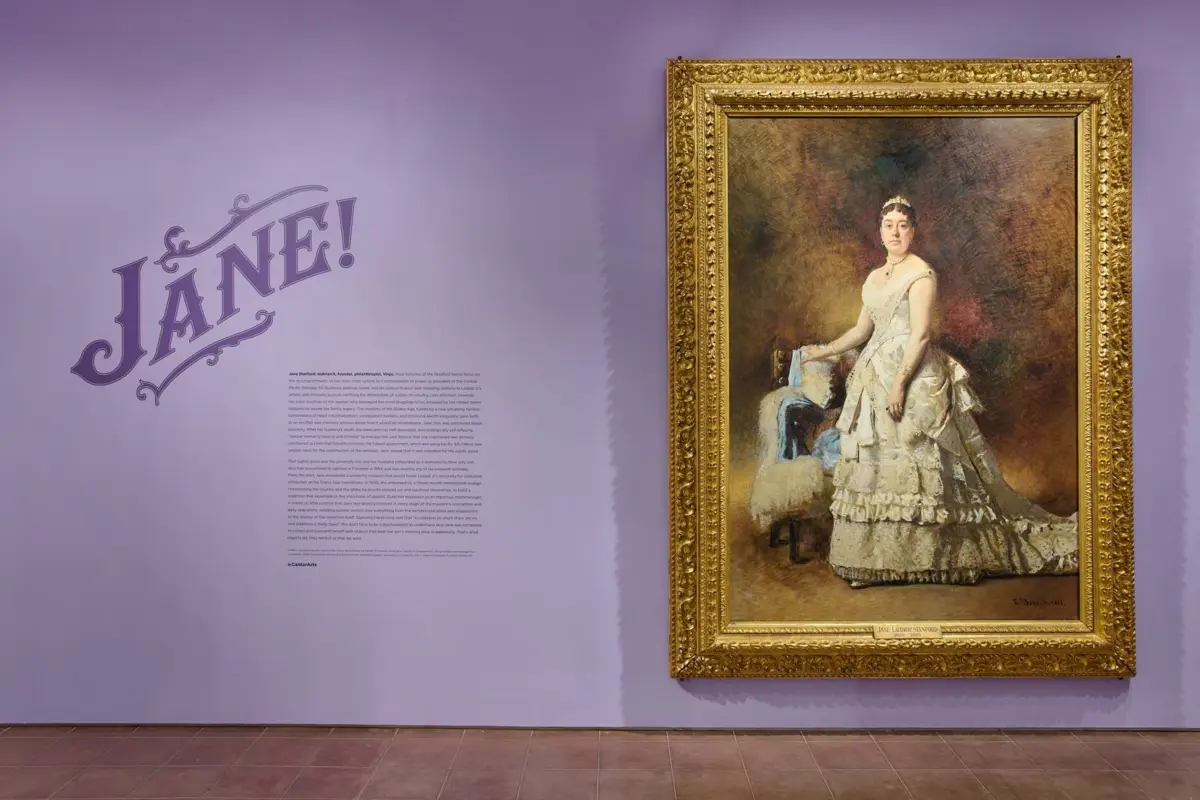
Now, a groundbreaking and deeply immersive exhibition at the university’s Cantor Arts Center, aptly titled "Jane!", is rewriting this historical oversight. Running through May 18, 2028, the showcase brings to light the multifaceted life of a woman who transformed immeasurable personal tragedy into a philanthropic empire, only to meet a shocking, violent end that has haunted historians for generations.
Featuring an array of artifacts never before displayed to the public—ranging from peculiar family keepsakes and death masks to bizarrely specific ceramics depicting her son’s final meal—the exhibition cuts through the sanitized veneer of late-19th-century elite history. It presents Jane Stanford as she truly was: a formidable, complex, and deeply human pioneer who navigated the treacherous waters of Victorian-era high society, spiritualism, and corporate power before falling victim to a still-unresolved strychnine poisoning in 1905.
Read Also
/https://tf-cmsv2-smithsonianmag-media.s3.amazonaws.com/filer_public/cb/f5/cbf53a8f-ab25-4f04-9809-58da970031e4/2026-07_jane_gc-4-web.jpg)
Detailed Chronology
The Catalyst of Tragedy (1884)
The trajectory of Jane Stanford’s life shifted irreversibly in the winter of 1884. While touring Europe with her husband, Leland—then a railroad magnate and former governor of California—their only child, 15-year-old Leland Stanford Jr., contracted typhoid fever in Athens, Greece. Despite frantic efforts by physicians, the teenager succumbed to the illness.
The loss hollowed out the Stanford family. Faced with the unimaginable void of childlessness, Jane and Leland sought a way to ensure their son’s name would echo through eternity. Rather than building a conventional mausoleum, they resolved to dedicate their fortune to the youth of California. As Isabelle Rogers, an assistant registrar at the Cantor Arts Center, observes, Jane felt that because "they didn’t have a child anymore… all of California could be her children."
The Birth of an Institution and Museum (1891–1894)
Leland Stanford Junior University officially opened its doors to students in October 1891. Young Leland had been an avid collector of antiquities, deeply inspired by the architecture and archaeological wonders he witnessed during his fateful European travels. He had harbored dreams of becoming a curator and opening a museum of his own.
/https://tf-cmsv2-smithsonianmag-media.s3.amazonaws.com/accounts/headshot/IMG_7600-edit-v2.png)
To honor this ambition, his parents established the Leland Stanford Jr. Museum—now the Cantor Arts Center—which opened in 1894. Exhibition curator Patrick R. Crowley notes that the museum’s facade was explicitly designed to mimic the National Archaeological Museum in Athens, anchoring the grieving parents’ loss in physical architecture. The museum’s foundational collection was built directly from the artifacts young Leland had gathered during his brief life.
The Burden of Sole Leadership (1893–1905)
When Leland Stanford died suddenly of heart failure in 1893, Jane was left to steer the nascent university through turbulent financial and administrative waters. In an era when higher education was almost exclusively governed by men, Jane assumed active, hands-on control of the institution.
She worked tirelessly to keep the university solvent during economic depressions, personally funding payrolls by pawning her famous jewel collection—captured dramatically in an 1898 painting by Astley D.M. Cooper featured in the current exhibition. Yet, her assertive management style frequently put her at odds with university administrators, most notably the university’s first president, David Starr Jordan.
:focal(1500x1000:1501x1001)/https://tf-cmsv2-smithsonianmag-media.s3.amazonaws.com/filer_public/cb/f5/cbf53a8f-ab25-4f04-9809-58da970031e4/2026-07_jane_gc-4-web.jpg)
The Fatal Poisoning (January–March 1905)
Jane’s life was cut short under deeply suspicious circumstances on January 14, 1905, while she was staying at her Pacific Heights mansion in San Francisco. After taking a sip of mineral water, she began vomiting violently. Subsequent chemical analyses revealed the water had been heavily laced with strychnine, a potent rat poison.
Fearing for her safety, Jane fled the mainland for an extended trip to the Orient. However, on February 28, 1905, while staying at the Moana Hotel in Honolulu, Hawaii, she fell desperately ill once again after taking a digestive powder. She died in agonizing pain shortly thereafter.
Though an autopsy definitively proved she had succumbed to a fatal dose of strychnine, university president David Starr Jordan orchestrated a cover-up, publicly attributing her death to heart failure. This narrative of natural causes remained the official institutional stance for nearly a century.
/https://tf-cmsv2-smithsonianmag-media.s3.amazonaws.com/filer_public/04/9d/049d1eb9-1c67-4577-a6ff-562c1f7bc7e4/mosaic.png)
Supporting Context & Metrics
The Gilded Age Power Couple
Jane Lathrop was born in Albany, New York, in 1828 into a large, middle-class family. In 1850, she married Leland Stanford, a young lawyer who would soon migrate west during the California Gold Rush. Leland leveraged opportunities in merchant wholesale and the burgeoning railroad industry, eventually becoming the president of the Central Pacific Railroad. On May 10, 1869, at Promontory Summit, Utah, Leland famously drove the ceremonial "golden spike," completing the first transcontinental railroad and cementing the family’s immense wealth and political clout.
Spiritualism as a Coping Mechanism
The overwhelming grief of losing her only child drove Jane into the arms of the burgeoning Spiritualism movement of the late 19th and early 20th centuries. Spiritualism offered grieving families the comforting, albeit controversial, premise that the physical boundary between the living and the dead could be bridged. Jane frequently engaged mediums in attempts to communicate with both her late husband and her son, integrating these spiritual beliefs into her daily life and decision-making processes.
The Evidence Room: Unseen Artifacts in "Jane!"
The Jane! exhibition at the Cantor Arts Center breaks new ground by displaying bizarre and intimate family heirlooms that illustrate the eccentricities and grief of the Stanford household. Notable items include:
/https://tf-cmsv2-smithsonianmag-media.s3.amazonaws.com/filer_public/c5/92/c5920bad-a7a1-405a-998e-8eb181e8a40b/jls14897_cdp-pub_angel.jpg)
- The Jewel Collection Painting: Astley D.M. Cooper’s 1898 canvas depicting the magnificent jewels Jane routinely sold off to keep the university afloat.
- The Last Breakfast Ceramics: A 1991 piece by ceramicist David Gilhooly recreating Leland Jr.’s final meal in Athens (bacon, eggs, and toast).
- Plaster Casts and Portraits: Artifacts linked directly to the murder investigation, including plaster hands initially mislabeled as Jane’s (later identified as belonging to President David Starr Jordan) and a long-forgotten mosaic portrait of Jane’s personal secretary, Bertha Berner, discovered in an attic near the campus.
Official Statements
Scholars, curators, and institutional leaders have weighed heavily on the re-examination of Jane Stanford’s legacy and the ongoing historical reassessment of her death:
-
Patrick R. Crowley, Exhibition Curator:
"There are some objects in there that are works by well-known artists, but then there are also some really strange, bizarre family heirlooms and keepsakes… Jane was so formidable, peculiar and unexpectedly human."
/https://tf-cmsv2-smithsonianmag-media.s3.amazonaws.com/filer_public/91/19/911943c8-65db-4727-8472-c9a7c4d406a0/jls18217_cdp-pub_portrait.jpg)
-
Laura Jones, Stanford University Archaeologist and Director of Heritage Services:
"She’s huge as a philanthropist, and she doesn’t really get recognized for that. People talk all the time now at Stanford about ‘founders.’ All our students want to found something or build something. And she really is our prototype… She was prepared as a widow to take on that role of making the decisions about the university’s future."
-
Isabelle Rogers, Assistant Registrar, Cantor Arts Center:
/https://tf-cmsv2-smithsonianmag-media.s3.amazonaws.com/filer_public/37/65/3765fd26-99f1-41ce-adf4-f98e9202dd97/leland.jpg)
"They didn’t have a child anymore, and so she thought that all of California could be her children… The exhibition emphasizes that there are still a lot of wonderful things in life, even when you’re in mourning."
-
Richard White, Stanford Historian and Author of Who Killed Jane Stanford?:
Discussing the contemporary newspaper reports surrounding her poisoning, White noted that the accounts were "often conveyed in breathless coverage by the city’s newspapers… They overlapped, changed over time and were full of contradictions, and that is their virtue. They map attempts to explain, deceive and justify." White maintains that Bertha Berner likely administered the poison to secure financial provisions in Jane’s will, while David Starr Jordan acted as an accessory after the fact to protect the university’s reputation.
/https://tf-cmsv2-smithsonianmag-media.s3.amazonaws.com/filer_public/41/6e/416e4309-595b-4fe7-9232-bd9aa2cbb6ba/199153_gilhooly_breakfast-2.jpg)
Future Outlook
The opening of the Jane! exhibition through May 2028 signals a profound cultural shift within elite American academic institutions toward historical transparency and gender equity in institutional founding narratives. For decades, the shadow of Leland Stanford eclipsed the gritty, resilient administrative labor performed by his widow during the university’s most vulnerable formative years.
Furthermore, by placing the mysterious circumstances of Jane’s death center stage, the university is actively confronting its own dark institutional past. No longer relegated to the realm of dark academia rumors or localized folklore, the strychnine poisoning of 1905 is now part of an open academic dialogue.
As thousands of students, researchers, and visitors walk through the Cantor Arts Center over the next two years, they will be forced to reconcile the sanitized myth of Gilded Age philanthropy with the complicated, tragic, and intensely human reality of Jane Stanford. In doing so, Stanford University is finally giving its founding matriarch the complex, unvarnished legacy she fought and died to build.



Comments
Facebook App ID not configured. Please add it in the Customizer.