
Executive Overview
For over nine centuries, the Tower of London has stood as England’s ultimate stone sentinel, withstanding medieval sieges, political betrayals, and twentieth-century blitzes. Yet, on a sweltering June day in 1381, this impenetrable fortress suffered an unprecedented humiliation: it was successfully breached by an angry, disenfranchised mob of ordinary English subjects. Once inside, the insurgents dragged the kingdom’s most powerful figures out to improvised execution blocks, permanently altering the trajectory of English social and political history.
This dramatic historical rupture forms the crucible of The Uprising, a high-stakes historical drama directed by veteran filmmaker Paul Greengrass (Captain Phillips, The Bourne Ultimatum). Set to premiere in theaters across the United States, the film stars Andrew Garfield as an unnamed, fictionalized "Ploughman"—an everyman farmer from Essex who emerges as a reluctant catalyst for the greatest popular revolt in medieval European history. Alongside Garfield, the film features Thomasin McKenzie as the rebel Alyce, Jamie Bell as the radical priest John Ball, Cosmo Jarvis as historic rebel leader Wat Tyler, and Woody Norman as the fourteen-year-old monarch, Richard II.
/https://tf-cmsv2-smithsonianmag-media.s3.amazonaws.com/filer_public/eb/84/eb843981-bc89-40b9-a3bb-384c8e813db7/uprising.png)
While Greengrass has utilized a fictionalized protagonist to personalize the human cost of fourteenth-century oppression, the backdrop of The Uprising is rooted in meticulous historical documentation. Supported by ongoing academic initiatives like the People of 1381 research project, historians now understand that the Peasants’ Revolt was far more than a chaotic, spontaneous riot. It was a sophisticated, geographically widespread socio-political uprising driven by structural inequality, demographic collapse, and regressive taxation.
Read Also
Detailed Chronology: The Spark, the March, and the Bloodshed
To understand the scale of the 1381 rebellion, one must examine the cascading crises that destabilized medieval England during the mid-to-late fourteenth century.
/https://tf-cmsv2-smithsonianmag-media.s3.amazonaws.com/accounts/headshot/meilan_headshot2.png)
The Seeds of Discontent: Plague and Poll Taxes
Decades before the uprising, England was ravaged by the Black Death (1348–1349), which wiped out an estimated 30 to 50 percent of the population. This catastrophic demographic shock inverted the traditional economic balance. With labor suddenly scarce, surviving peasants and serfs realized they could demand higher wages and better living conditions.
Alarmed by this shift in leverage, Parliament passed the Statute of Laborers in 1351, legally freezing wages at pre-epidemic levels and criminalizing the abandonment of land. Compounding this economic chokehold, the Crown imposed a series of poll taxes—flat-rate taxes levied equally on every person regardless of wealth—to fund the seemingly endless, costly military campaigns of the Hundred Years’ War with France.
:focal(750x500:751x501)/https://tf-cmsv2-smithsonianmag-media.s3.amazonaws.com/filer_public/eb/84/eb843981-bc89-40b9-a3bb-384c8e813db7/uprising.png)
By 1381, the third poll tax in four years had been levied. It was notoriously regressive, placing an unbearable financial burden on the rural and urban working classes while disproportionately shielding the wealthy.
May 30 – June 7, 1381: The Essex Spark
The powder keg finally ignited on May 30, 1381, in the Essex village of Fobbing, when locals violently resisted arrest by royal tax commissioners. Word of the confrontation spread rapidly via mounted couriers across Essex and Kent.
/https://tf-cmsv2-smithsonianmag-media.s3.amazonaws.com/filer_public/f3/23/f3230542-3c0b-4154-ac2c-1883dab3c485/towrlndn.jpeg)
By early June, delegates from neighboring villages convened in clandestine, sworn assemblies. They resolved to dismantle the corrupt bureaucratic machinery surrounding young King Richard II and eliminate the oppressive system of serfdom entirely. On June 7, rebels in Kent elected Wat Tyler, a charismatic craftsman of obscure origins, as their primary military leader.
June 12–13, 1381: The March on London and the Breach of the Tower
As Tyler’s forces converged on the capital, numbering fewer than 10,000 disciplined insurgents alongside swelling crowds of opportunists, King Richard II and his inner circle sought refuge within the Tower of London.

On June 13, the rebels breached London’s gates—facilitated in part by sympathetic locals and terrified gatekeepers. Once inside the capital, the mob orchestrated targeted strikes against the symbols of royal abuse:
- The Savoy Palace: The luxurious London residence of John of Gaunt, Duke of Lancaster (the king’s powerful uncle and de facto ruler), was systematically looted and burned to the ground.
- The Knights Hospitaller Priory: Destroyed alongside properties belonging to royal lawyers and administrators.
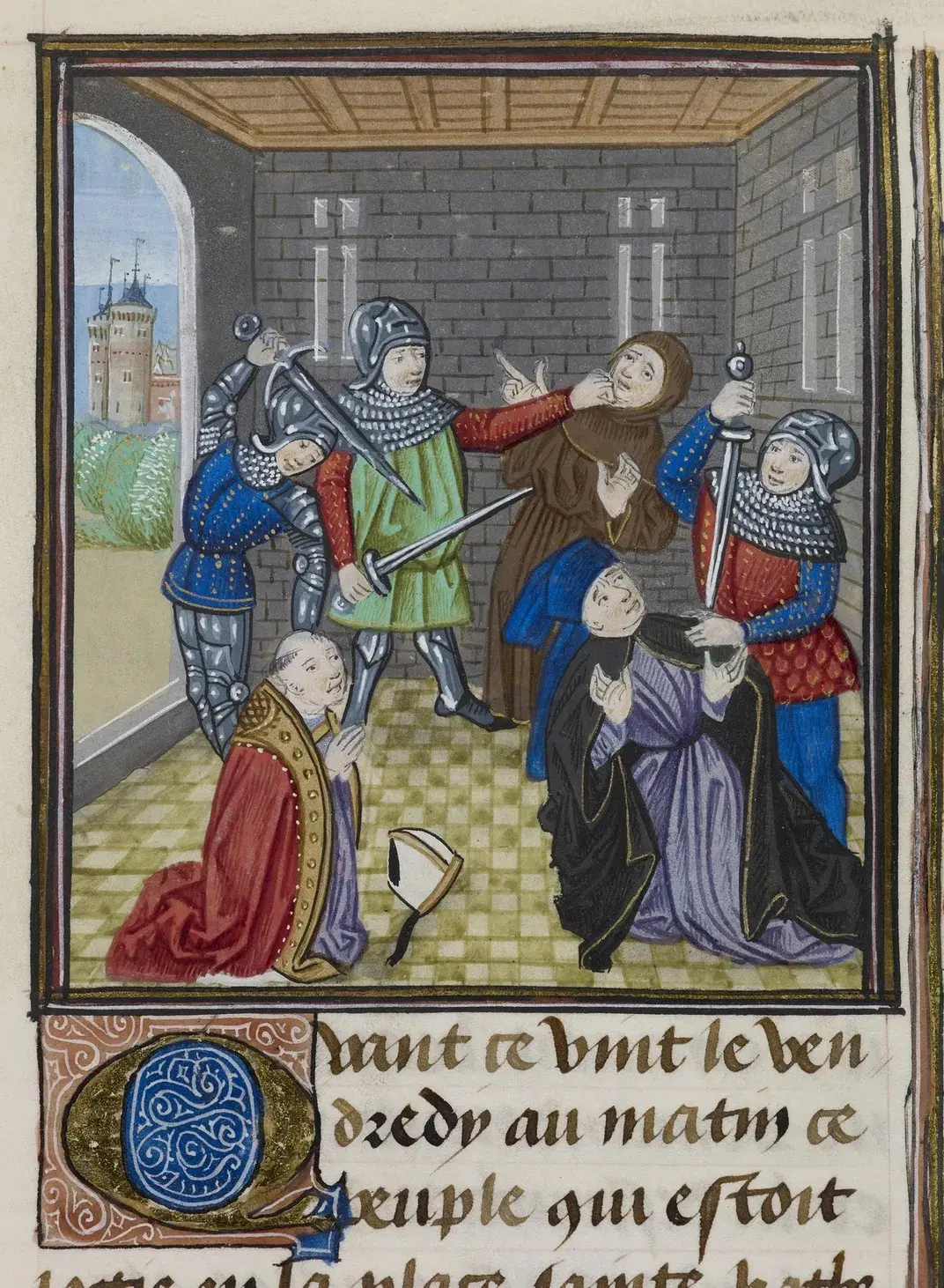
Critically, the mob gained access to the Tower of London itself—an architectural security failure that remains singular in the fortress’s history. Dragging out targets deemed traitors to the Crown, the insurgents executed Simon of Sudbury, the Archbishop of Canterbury, and Robert Hales, the Lord High Treasurer. Sudbury’s execution proved notoriously botched, requiring eight sword blows to sever his head.

June 14–15, 1381: The Confrontations at Mile End and Smithfield
Desperate to stem the violence, King Richard II agreed to meet the rebels at Mile End on June 14. In a stunning display of royal capitulation, the fourteen-year-old monarch listened to their demands and granted sweeping concessions: the abolition of serfdom, the fixing of rent caps at affordable rates, and general pardons for the participants.
However, the situation quickly unraveled. While moderate rebels dispersed following the Mile End agreement, radical factions continued their campaign of settling scores, executing Flemish merchants and burning administrative rolls.
/https://tf-cmsv2-smithsonianmag-media.s3.amazonaws.com/filer_public/e9/d7/e9d7b6f4-cbe4-4824-b39c-ffbe2bee4dc3/coronation_richard2_england_01.jpg)
On June 15, a tense final summit took place at Smithfield. Wat Tyler presented an even more radical slate of demands, calling for the total abolition of the nobility (save for the king) and the wholesale confiscation of church property. During the heated negotiations, a confrontation erupted between Tyler and William Walworth, the Mayor of London. Walworth lunged at Tyler, severely wounding him before the rebel leader was dragged into the street and decapitated.
Fearing an immediate massacre as the leaderless crowd panicked, King Richard II displayed remarkable political theatre. Riding forward, he famously shouted, "I will be your leader! Follow me!" Guiding the stunned insurgents away from the bloody scene, the king effectively neutralized the immediate threat without firing another shot.
/https://tf-cmsv2-smithsonianmag-media.s3.amazonaws.com/filer_public/b2/57/b2575827-b9cd-4d4c-9251-e10942e3e30a/jean_froissart_chroniques_154v_12148_btv1b8438605hf336_crop.jpg)
Supporting Context & Metrics: The Scale of the Revolt
While traditional historiography frequently frames the Peasants’ Revolt as a localized, desperate outburst of starving peasants, modern historical research paints a far more complex picture.
- Geographic Spread: The uprising touched more than half of England’s counties, with localized disturbances stretching from Yorkshire in the north down to Gloucestershire in the west.
- Demographic Diversity: The insurgency was not restricted to the agrarian poor. Court records analyzed by modern historians reveal participation from craftspeople, artisans, wealthy yeoman farmers, lower-level clergy, and even members of the landed gentry who stood to lose under the existing feudal structure.
- The People of 1381 Database: Modern scholarship—most notably spearheaded by the University of Glasgow’s Andrew Prescott and his colleagues—has cataloged approximately 28,000 historical records detailing individual participants, victims, jurors, and bail-payers. This granular data proves that the rebellion was orchestrated through sophisticated local networks rather than impulsive mob violence.
Official Statements and Artistic Vision
Speaking about his decision to center The Uprising on a fictionalized everyman rather than the historical heavyweights, director Paul Greengrass explained in his production notes:
/https://tf-cmsv2-smithsonianmag-media.s3.amazonaws.com/filer_public/5a/75/5a75f505-b703-436f-91c9-4f1c4e214740/john_ball_encouraging_wat_tyler_rebels_from_ca_1470_ms_of_froissart_chronicles_in_bl.jpg)
"I didn’t want to tell this story through the names we remember, like Wat Tyler or John Ball. Instead, I wanted to focus on someone history never named at all: a farmer, the first man to raise his hand in Essex. I wanted him to stand for all the ordinary people who actually rose up and paid the price for it."
Historical consultant and author Dan Jones (Summer of Blood: England’s First Revolution) emphasizes that while the Ploughman is an invention, his ethos mirrors the proto-outlaw archetypes of fourteenth-century literature:
/https://tf-cmsv2-smithsonianmag-media.s3.amazonaws.com/filer_public/fc/82/fc82e3ce-8a30-4e0b-80b7-2c56129421dc/murder_of_simon_sudbury_-_froissart_chroniques_de_france_et_d-39d103daba131be7940d74d1e915f053.jpg)
"You have a character, a yeoman, an ordinary guy who’s in a world in which the law seems to have been corrupted, and the spirit of justice is no longer present within the law. In order for these things to be brought together, he has to fight. He has to take vengeance. He has to be violent."
Lead actor Andrew Garfield, reflecting on the thematic resonance of the project in an interview with Esquire, noted the timelessness of the narrative:
/https://tf-cmsv2-smithsonianmag-media.s3.amazonaws.com/filer_public/45/87/4587ddb2-c9f0-40af-9c9b-9ae54bb8956d/peasants_revolt_death_of_wat_tyler.jpg)
"There’s a kind of genuine awakening happening, an awakening to one’s own dignity, to the dignity of every living thing, and with that a quest to put the world right. What was inspiring and exciting in the making of this film was this possibility of justice, this possibility of healing."
Future Outlook and Legacy
Though the royal government eventually reneged on its promises—dispatching punitive commissions under martial law to track down, try, and execute hundreds of remaining ringleaders like John Ball—the Peasants’ Revolt fundamentally transformed the English political landscape.
/https://tf-cmsv2-smithsonianmag-media.s3.amazonaws.com/filer_public/9b/cb/9bcb5610-7e78-4728-9d46-0068f92e7e93/4261_d027_00165rc.jpg)
- The Decline of Serfdom: Although feudalism did not vanish overnight, the 1381 uprising served as a permanent, terrifying warning to the landed aristocracy. Landowners recognized that pushing the working classes to absolute desperation carried a mortal cost, paving the way for the slow, inevitable collapse of serfdom and wage controls over the following century.
- The Evolution of Popular Protest: Historians agree that the 1381 rebellion set a powerful precedent for future large-scale political uprisings in Britain, including Cade’s Rebellion (1450) and Kett’s Rebellion (1549). As Dan Jones notes, after the summer of blood, it became "if not impossible, then highly inadvisable, to ignore the effects of policy on ordinary people."
- Cultural Resonance: The legacy of resistance against unfair taxation has echoed through centuries of British history, with poll-tax protests surfacing as recently as 1990.
As The Uprising arrives in theaters, it invites modern audiences to look past the velvet and crowns of medieval pageantry, directing their gaze downward to the mud, sweat, and quiet dignity of the ordinary individuals who first demanded a fairer world.


Comments
Facebook App ID not configured. Please add it in the Customizer.