
Executive Overview
There is a distinct atmospheric weight that settles upon the mind when literature turns its gaze toward the periphery. It is found where the tarmac gives way to packed earth, where municipal lighting yields to the unbroken shadow of ancient canopies, and where the collective memory of a settlement stretches back far further than the legal titles of the land. This is the domain of folk horror—a literary and cinematic subgenre that thrives not in the sprawling, neon-lit anxiety of the modern metropolis, but in the suffocating intimacy of isolation, the unyielding cycles of agrarian ritual, and the dark architecture of small-town conformity.
Folk horror subverts the pastoral ideal. Instead of offering a refuge from urban alienation, it reframes the countryside as a living, resentful entity. Here, the land watches, the animals behave with unnatural calculation, and the neighbors—bound by generational pacts and whispered condemnations—form an inescapable panopticon. While external threats certainly loom in the dark, moving unseen through primeval trees or bubbling up from stagnant bogs, the subgenre’s most potent monsters are rarely external invaders. Rather, they are born from within: the rot of institutionalized orthodoxy, the blood-soaked price of community survival, and the inescapable inheritance of family sin.
For readers seeking to venture beyond the safety of conventional urban narratives and confront the ancient, inhuman forces lurking at the fringes of civilization, the summer reading season offers a rich harvest. Below is a comprehensive examination of eight essential folk horror novels, each dissecting the machinery of isolation, ritual, and terror with unflinching precision.
Read Also
Detailed Chronology and Subgenre Evolution
To understand the contemporary landscape of folk horror, one must trace its historical lineage, which has evolved significantly over the past century.
- The Precursors (Early to Mid-20th Century): The roots of the subgenre reach back to the eerie ghost stories of M.R. James and the localized horrors of Arthur Machen, where antiquarian curiosity consistently unlocks ancient, pre-Christian terrors embedded within the British landscape. Shirley Jackson’s mid-century masterpieces later codified the mechanics of small-town malice and ritualistic scapegoating.
- The Golden Age (Late 1960s to 1970s): The subgenre crystallized into its distinct cinematic and literary identity during this era, famously encapsulated by what British film historian Mark Gatiss termed the "unholy trinity" of folk horror: Witchfinder General (1968), The Blood on Satan’s Claw (1971), and The Wicker Man (1973). These works established the core tropes: misplaced trust in pastoral authority, the collision of modernity with ancient pagan survivals, and the ultimate sacrifice of the outsider.
- The Contemporary Renaissance (21st Century): In recent years, folk horror has undergone a profound global expansion. Authors and filmmakers have moved beyond the traditional British countryside to interrogate American puritanism, indigenous mythologies, Caribbean and African diasporic folklore, and the brutal histories of colonization and enslavement. Today’s folk horror is intersectional, deeply atmospheric, and psychologically complex, utilizing historical frameworks to mirror modern anxieties regarding ecological collapse, systemic violence, and tribalism.
Supporting Context & Metrics: The Anatomy of Folk Horror
What makes a novel qualify as authentic folk horror rather than traditional supernatural or psychological horror? Literary critics generally point to a triad of foundational elements:
- Landscape as Character: The setting is not merely a backdrop; it is an active participant. Whether it is a Cornish village steeped in fey history, a suffocating North American bog, or an isolated Scottish island, the environment dictates the behavior, morals, and psychological state of its inhabitants.
- The Isolated Community: The narrative is typically bounded by geography or deeply entrenched social walls. Outsiders are viewed with immediate suspicion, while insiders are subjected to relentless surveillance and strict behavioral codes enforced through custom rather than law.
- The Weight of the Past: History in folk horror is never dead; it is not even past. Generational trauma, historical atrocities, and forgotten deities exert a gravitational pull that inevitably drags the characters back into cyclical patterns of violence and ritual.
Statistical analyses of contemporary speculative fiction reading trends indicate a sharp upward trajectory in reader demand for "cozy terror" juxtaposed with dark, atmospheric myth-making—a paradox that folk horror satisfies uniquely well by wrapping existential dread in the tangible textures of handicrafts, historical settings, and natural lore.
The Definitive Reading List: Eight Novels for an Unsettling Summer
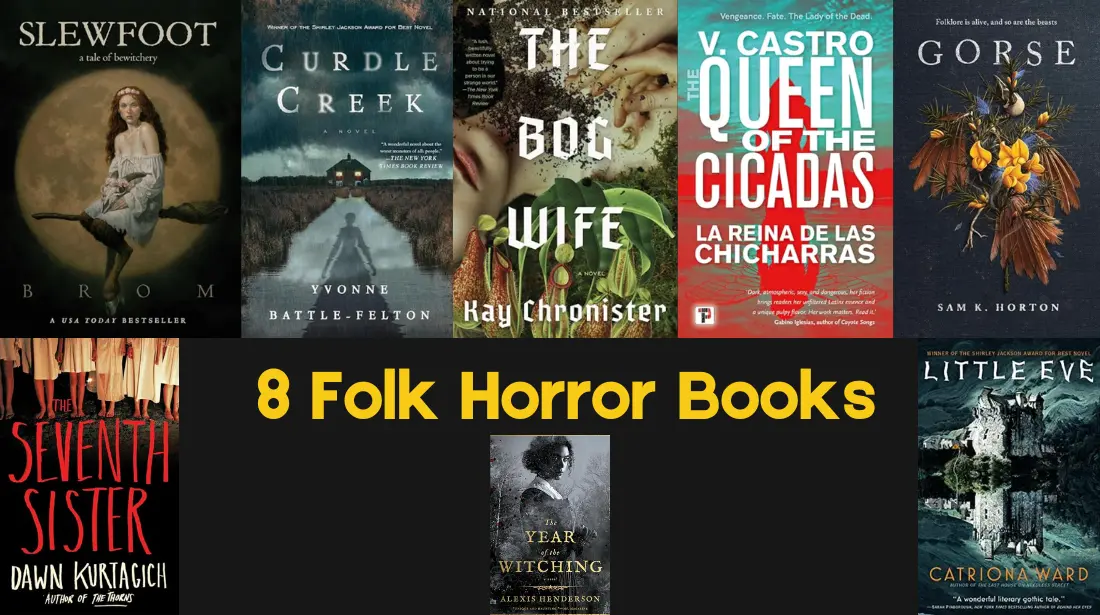
1. Slewfoot by Brom
- The Setting: A Puritan village, 1666.
- The Premise: A determined young widow finds her life upended when she becomes inexorably linked with a melancholic, ancient devil residing in the surrounding wilderness. As the village elders tighten their grip of religious surveillance and paranoia, the path to survival and autonomy for the outcast pair becomes soaked in blood, sacrilege, and righteous vengeance.
- Critical Assessment: Brom’s work is celebrated not only for its ferocious prose but for its haunting visual artistry. No folk horror reading list is complete without this visceral examination of early American puritanism and the primal forces it sought to exorcise. Readers are strongly encouraged to seek out editions featuring the author’s eerie, fully realized paintings, which anchor the text’s dark mythology in tangible form.
2. Curdle Creek by Yvonne Battle-Felton
- The Setting: Curdle Creek, a fictional, tightly controlled Black community operating under strict social laws.
- The Premise: In Curdle Creek, the survival metric is absolute: it is strictly "one in, one out." Osira, a newly minted widow, finds herself perpetually cast as the odd one out within a society governed by esoteric rituals, unyielding judgments, and severe punishments.
- Critical Assessment: Battle-Felton subverts traditional pastoral settings by centering a historical Black community, then weaponizing conformity against its members. This novel refuses the reader the comfort of easy answers. Instead, it propels the audience forward as if walking on hot coals, escalating steadily into realms of profound strangeness and interpersonal violence.
3. The Bog Wife by Kay Chronister
- The Setting: An isolated, damp wilderness dominated by an all-consuming peat bog.
- The Premise: What happens when the traditional family cycle breaks down—specifically, when the newly anointed patriarch’s wife fails to emerge from the bog as custom and family history dictate?
- Critical Assessment: Hailed by critics as a masterclass in modern dark fantasy and horror, The Bog Wife is a gorgeous, harrowing study of generational decay, familial codependency, and dark bargains. Chronister writes with a deep, encyclopedic knowledge of a particular landscape, ensuring that the scent of decomposing moss and ancient earth permeates every page.
4. La Reina de las Chicharras (The Queen of the Cicadas) by V. Castro
- The Setting: A dual-timeline narrative shifting between modern-day settings and the sun-baked agricultural fields of the past.
- The Premise: Decades after a brutalized migrant worker is murdered, her dying plea for vengeance reaches across time, catching the attention of the Aztec goddess of death. When modern descendants and interlopers awaken the sleeping spirits, retribution arrives with the deafening hum of cicadas.
- Critical Assessment: Combining brutalist, unsparing prose with propulsive pacing, V. Castro delivers a masterclass in contemporary folk horror. It stands as one of the most intellectually satisfying and sensorially rich revenge narratives in recent speculative fiction, wedding ancient Mesoamerican mythology to modern socio-political realities.
5. Gorse by Sam K. Horton
- The Setting: The coastal and moorland village of Mirecoombe, Cornwall, 1786.
- The Premise: In an era where the ancient regime is shifting, appointed "Keepers" labor to maintain the fragile, dangerous boundary separating the human world from the capricious realm of the fey.
- Critical Assessment: Heavier on atmospheric folklore and lighter on visceral gore, Gorse immerses the reader entirely in the specific magic and historical friction of 18th-century Cornwall. Horton creates a setting so vividly rendered that the geography itself appears to take root in the reader’s bones long after the final chapter is closed.
6. The Seventh Sister by Dawn Kurtagich
- The Setting: A remote, isolated island cloaked in perpetual sea mist and ancient vegetation.
- The Premise: A chilling rumination on the dual nature of childhood—simultaneously wondrous and terrifying. The novel follows seven sisters who retreat inward, descending into the ecstatic, insulated madness of their sibling bond, only to find that the dark secrets of their island home and shared past refuse to release them in adulthood.
- Critical Assessment: Dripping with moss, psychological dread, and maritime superstition, Kurtagich crafts an immersive environment where the psychological fractures of the sisters mirror the untamed, crumbling cliffs of their isolated domicile.
7. Little Eve by Catriona Ward
- The Setting: The remote Scottish island of Altnaharra.
- The Premise: A secretive, isolated clan awaits the apocalyptic end of the world, convinced it will arrive with a mysterious entity known as The Adder. However, their ultimate ruin arrives from a direction they never anticipated.
- Critical Assessment: Ward’s novel is a harrowing triumph of family horror filtered through a distinct folk lens. Its unsettling atmosphere, labyrinthine plotting, and unforgettable characters have cemented its status as a modern classic, turning countless readers into devoted followers of Ward’s dark imagination.
8. The Year of the Witching by Alexis Henderson
- The Setting: Betrayal-scarred, puritanical lands dominated by a fiercely dogmatic religious order.
- The Premise: Though operating within a high fantasy framework, Henderson’s debut functions impeccably as folk horror. It follows a young woman of mixed heritage who discovers the forbidden, heretical powers inherited from her executed mother, sparking an ideological and supernatural clash with the oppressive society surrounding her.
- Critical Assessment: Blood-soaked and fiercely feminist, this coming-of-age narrative investigates how religious orthodoxies utilize localized superstition and manufactured fear to police bodies, minds, and the untamed wilderness beyond village palisades.
Official Statements and Industry Insights
Writers and critics working within the speculative fiction space have increasingly emphasized the necessity of folk horror as a vehicle for processing historical and environmental anxieties.
Industry panels at major literary festivals frequently note that readers are gravitating away from abstract, cosmic threats in favor of localized, tangible dread. As cultural theorist and editor commentary often highlights, folk horror acts as a mirror to modern anxieties surrounding ecological stewardship, the weaponization of tradition, and the persistent human impulse to construct "in-groups" and "out-groups" at any cost. By returning to the soil, authors are able to unearth truths about human nature that slick, urban narratives frequently fail to reach.
Future Outlook
As the subgenre continues to diversify, the future of folk horror points toward an increasingly globalized, intersectional horizon. Writers from varied cultural backgrounds are digging into their own ancestral mythologies, local histories, and regional landscapes to unearth stories that challenge the traditional, Anglo-centric boundaries of the genre.
For the reader, this means the summer reading landscape will remain delightfully, chillingly unsafe. Whether you choose to walk the puritan trails of 17th-century New England, listen to the cicadas hum over the blood-stained fields of migrant labor, or lose yourself in the mist-shrouded bogs of the Scottish highlands, one truth remains absolute: the old gods are patient, the land remembers everything, and the scariest monster in the woods is almost always wearing a familiar face.


Comments
Facebook App ID not configured. Please add it in the Customizer.