
Executive Overview
Every morning, like clockwork, between 1:15 and 1:45 AM, a thunderous tremor rolls through the sub-Arctic darkness of northern Sweden. In Kiruna, the nation’s northernmost city, measuring your proximity to the world’s largest underground iron ore mine requires nothing more complicated than a full glass of water left upon a nightstand. When the tremors hit, concentric ripples disturb the surface. If you live in "Old Kiruna," the damaged and sinking sector near the municipal church and the aging hospital, the daily blasts register as miniature earthquakes that rattle windows and warp floorboards. Barely a mile to the east, however, the earth remains stubbornly still.
For nearly seventy-five years, relentless sub-level caving by the state-owned mining corporation Luossavaara-Kiirunavaara Aktiebolag (LKAB) has hollowed out the foundations of this frontier town. The ground beneath the surface has steadily sunk, cracked, and collapsed, threatening to swallow entire neighborhoods. In response, an unprecedented urban migration is underway: an entire city is unmoored from its roots and dragged two miles east.
What began as a localized engineering crisis has metastasized into a twenty-year social, political, and cultural experiment. With the backing of the Swedish state, LKAB is simultaneously dismantling the old city and assembling a replacement from scratch. Yet, as the ground fissures widen and the demolition crews push forward, this masterclass in crisis management exposes the deep fractures between industrial progress and human memory, calling into question the true cost of fueling Europe’s green transition.
Read Also
Detailed Chronology: From Model Industrial Town to Urban Migration
The history of modern Kiruna is inextricably bound to the veins of high-grade iron ore buried within the Kiirunavaara and Luossavaara mountains.
- The Early 1900s: Following the Swedish state’s extension of railways connecting the northern interior to the port of Luleå, LKAB established a model industrial settlement directly adjacent to the iron-rich mountains. Built on land historically used by Indigenous Sámi reindeer herders, the nascent town of Kiruna was designed to house the burgeoning workforce migrating from southern Sweden in pursuit of high wages. In exchange for local tax exemptions, LKAB financed the town’s critical infrastructure, including fire stations, hospitals, and a monumental wooden church.
- 1957: As the mineral wealth proved inexhaustible, the Swedish government steadily acquired shares in LKAB until the enterprise was fully nationalized, locking the municipality into a permanent, cradle-to-grave partnership with the mining giant.
- 2004: Decades of aggressive sub-level caving caught up with the geography of Kiruna. LKAB delivered a five-sentence letter to the Kiruna Municipal Council announcing that the city center was sinking into the extraction zones. Approximately six thousand residents—one-third of the city’s total population—would need to evacuate as schools, hospitals, and roughly one thousand workplaces faced inevitable demolition. Historic architectural landmarks, including the iconic red wooden church, were slated for either relocation or destruction.
- 2014: The formal physical migration of Kiruna began, with urban planners and architects from White Arkitekter tasked with designing "New Kiruna" two miles to the east. Pitched initially as a utopian endeavor to design a modern urban center from scratch, the project quickly revealed itself as a desperate exercise in corporate crisis management to ensure the survival of the municipality’s economy.
- August 2023: During a period of heavy demolition, the old city was effectively split in half, leaving both the old and new sectors partially functional. High-rise apartment complexes, community clubs, and schools were systematically gutted, while ground deformations advanced faster than anticipated.
- August 2025: In a massive engineering feat, the 670-ton Kiruna Church—originally modeled after traditional Sámi architecture—was raised 4.3 feet off its foundation and transported over the course of two days on a specialized 224-wheel modular trailer to a new plot near the municipal cemetery and the expanding eastern commercial district.
Supporting Context & Metrics: The Anatomy of an Impossibility of Refusal
To understand Kiruna is to understand an economic ecosystem defined by absolute dependency. Anthropologist Elisa Maria López famously characterized the city’s relationship with LKAB not merely as reliance, but as an "impossibility of refusal."
Key Economic and Demographic Metrics
- Mining Output: LKAB extracts enough iron ore daily to construct the equivalent of six and a half Eiffel Towers. Four heavily loaded trains depart the city every day, carrying concentrated pellets to the coastal port of Luleå.
- Employment Footprint: LKAB directly or indirectly employs roughly one-third of Kiruna Municipality’s 22,000 residents.
- The Scale of Displacement: Originally slated to displace 6,000 residents, expanding mining operations and newly discovered deposits of rare earth minerals have forced LKAB to announce that an additional wave of residents—comprising up to two-thirds of the total population—must relocate over the coming decade.
- Infrastructure Turnover: To establish a cohesive new city, duplicate infrastructure cannot be sustained. Schools, retail districts, and civic centers in Old Kiruna are deliberately decommissioned, stripped of usable materials, and reduced to rubble to force the complete demographic pivot to the east.
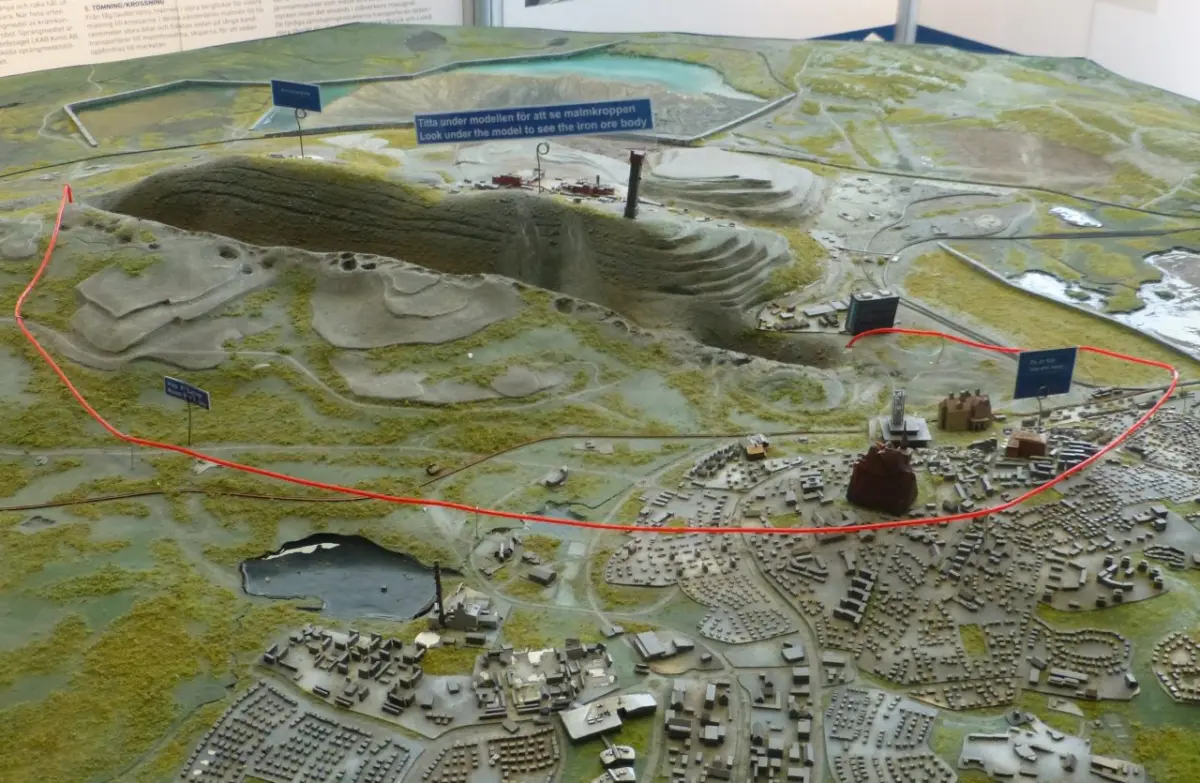
The geographical layout of Kiruna mirrors this industrial entrapment. Shaped roughly like an isosceles triangle bounded by the E10 highway and converging in the southwest residential sectors, the city offers a perpetual visual reminder of its master. From nearly any vantage point, drivers confront the flat-topped silhouette of Kiirunavaara, the towering smokestack, and the gaping black pit of the open mine.
Official Statements and Corporate-Municipal Synergy
The official narrative presented by municipal leadership and corporate stakeholders frames the urban transformation as an unprecedented opportunity for modernization, cultural renewal, and economic prosperity.
Mats Taaveniku, the chairman of the municipal council, championed the relocation with urgency from his offices in New Kiruna. Setting an aggressive population target of 25,000 residents by 2030, Taaveniku dismissed the nostalgia surrounding the old town as a luxury the city could no longer afford. Addressing gaps in civic infrastructure—such as the newly constructed hospital temporarily lacking a functional maternity ward—Taaveniku asserted that simultaneous building was the only viable path forward. "We have to build it right now," he stated plainly, noting the accelerated velocity of the subterranean crack lines threatening the remaining habitations.
Similarly, LKAB has marketed the upheaval as a corporate-sponsored rebirth, papering construction fences with optimistic corporate branding. Vinyl banners reading slogans like "It’s not the end of the world. It’s way beyond" attempt to recast the trauma of displacement as forward-looking progress.
However, this messaging stands in stark contrast to the lived reality of residents like Timo Vilgats, a local high school history teacher and community fixture. Reflecting on memorial gatherings for the old city, Vilgats highlighted the emotional dissonance experienced by longtime homeowners. While corporate compensation packages provide financial liquidity, they fail to account for the loss of personal histories embedded in domestic spaces. "She said, ‘No, I don’t talk about money. I don’t need money. I just want to live here,’" Vilgats recounted of an elderly resident facing the imminent destruction of her flat.
Future Outlook: Navigating the Horizon of a Green Transition
As Kiruna approaches the latter half of the 2020s, the city remains suspended between a dying past and an impersonal future. The physical relocation of monumental architecture, such as the 2025 transit of the historic wooden church, provides symbolic continuity, yet the psychological scars of the urban transformation run deep.
The discovery of Europe’s largest known deposit of rare earth minerals—essential for the manufacturing of electric vehicle batteries and wind turbines—guarantees that LKAB’s extraction operations will only intensify. Consequently, the town’s geographic footprint will likely continue its eastward retreat, placing mounting pressure on surrounding ecosystems, traditional Sámi reindeer herding migratory routes, and the fragile social fabric of the local community.
For residents like Timo Vilgats, who watched the historic church roll past his front porch to become his "newest neighbor," the challenge lies in avoiding bitterness while integrating the realities of corporate hegemony into daily life. New Kiruna offers paved walkways, modern insulation, and acoustic-paneled classrooms, but it also embodies the cold, wind-swept impersonality of a rushed urban experiment.
Ultimately, Kiruna serves as a sobering global case study for the twenty-first century. As the world demands minerals to fuel the global green energy transition, frontier towns like Kiruna bear the immediate ecological and psychological costs. The city’s survival depends on an uneasy bargain: an agreement to tear down the foundations of yesterday so that the industrial engines of tomorrow may continue to turn.



Comments
Facebook App ID not configured. Please add it in the Customizer.