
Executive Overview
In an era defined by geopolitical volatility, rapid cultural shifts, and the lingering psychological aftershocks of global disruption, contemporary literature continues to serve as an essential mirror for the human condition. Few works capture the nuanced intersection of historical trauma, personal endurance, and artistic contemplation quite as acutely as Portolan: Poems, the forthcoming English-language collection by acclaimed German writer Daniela Danz, brilliantly translated by Monika Cassel. Scheduled for publication in 2027 by the University of Nebraska Press, the collection promises to expand the global dialogue surrounding memory, loss, and the enduring architecture of hope.
This comprehensive report examines the structural, thematic, and cultural significance of excerpts released from Portolan. Through an investigative lens, we analyze how Danz utilizes cartographic metaphors—specifically the medieval portolan chart, which navigates known and unknown waters—to map the emotional topography of modern existence. By juxtaposing personal survival with historical artifacts, Dutch Golden Age still-life painting, and astronomical phenomena, Danz constructs a poetic framework that interrogates how societies and individuals process prolonged crises.
Furthermore, this article provides a detailed chronology of the collection’s trajectory toward publication, contextualizes its metrics within the broader landscape of contemporary translated literature, examines the official statements surrounding its release, and projects its long-term impact on the literary canon. Through structured analysis, H2/H3 categorization, and professional journalistic rigor, we explore the profound resonance of Danz’s verse as it translates the private sorrows of an interconnected yet isolated world into universal cartographies of endurance.
Read Also
Detailed Chronology
The journey of Portolan from its original conception in the German literary sphere to its anticipated English-language debut in 2027 represents a meticulous cross-cultural collaboration. Understanding this timeline is vital to appreciating the depth of the work and the precision required in its translation.
[2019–2021]
   │
   ├── Conceptualization & Composition: Daniela Danz composes the core cycle of poems in Germany,
   │   drawing on shifting European landscapes, historical memory, and personal introspection.
   │
[2022–2023]
   │
   ├── Translation Phase: Award-winning translator Monika Cassel initiates the painstaking
   │   process of rendering Danz’s intricate, multi-layered German phrasing into English.
   │
[Late 2024]
   │
   ├── Academic & Editorial Acquisition: The University of Nebraska Press formally acquires
   │   rights to publish *Portolan: Poems* as part of its prestigious international poetry series.
   │
[2026–2027 (Upcoming)]
   │
   ├── Strategic Excerpt Release & Marketing Campaign: Pre-publication excerpts are distributed
   │   to literary journals and digital platforms, building anticipation for the official 2027 launch.
Phase 1: Genesis and European Reception (2019–2021)
Daniela Danz, a prominent voice in contemporary German poetry renowned for her intellectual rigor and lyrical precision, began developing the thematic concepts that would form Portolan against a backdrop of European political anxiety and environmental reckoning. The poems were initially conceived as an exploration of orientation—how humans find their bearings when traditional markers of stability dissolve. As the collection took shape in German, critics lauded its ability to weave historical consciousness with immediate sensory experience.
Phase 2: The Art of Translation (2022–2023)
Translating poetry of this caliber requires more than linguistic fluency; it demands cultural and emotional equivalence. Monika Cassel, known for her masterful handling of complex European verse, worked closely with Danz to capture the architectural cadence of the original German. The translation process focused heavily on preserving the tension between clinical observation and intimate vulnerability—a hallmark of Danz’s poetic style.
Phase 3: University Press Acquisition (Late 2024)
Recognizing the universal appeal of Danz’s meditations on time, survival, and spatial awareness, the University of Nebraska Press secured the English-language rights. This acquisition aligns with the press’s ongoing commitment to bringing world literature to English-speaking audiences, bridging cultural divides through high-caliber translation.
Phase 4: Pre-Publication and the 2027 Horizon (2025–2027)
As the publishing date approaches, promotional excerpts have begun circulating within international literary communities. These releases serve to prime the critical apparatus, inviting early analysis of Danz’s distinct engagement with art history, astronomy, and the psychological aftermath of the "terrible times"—a phrase that resonates universally across post-pandemic and geopolitically fractured societies.
Supporting Context & Metrics
To fully grasp the weight of Portolan, one must examine the literary metrics and thematic architecture that underpin Danz’s work. The collection relies on three primary motifs: the physical endurance of the human body, the claustrophobic containment of art history, and the astronomical scale of collective trauma.
The Metaphor of the Cinder Track: Endurance and Circularity
In the opening movement of the featured excerpt, Danz establishes a scene of quiet exhaustion and stubborn survival:
and we look at each other: older now but with our limbs still intact
and our wishes which have not gotten any smaller
The imagery of walking in circles on a "cinder track" evokes the monotony of endurance during prolonged crises. Unlike epic journeys with decisive frontiers, modern trauma often feels repetitive, circular, and contained. Yet, the preservation of un-diminished wishes signifies a triumph of human agency. The speaker notes the division of labor within this endurance—"me on the easier inner lane you on the outside looking at me"—highlighting how partners experience shared suffering through differing perspectives, ultimately converging at a finish line where "there was never any other choice for us but each other."
Deconstructing the Seventeenth-Century Still Life
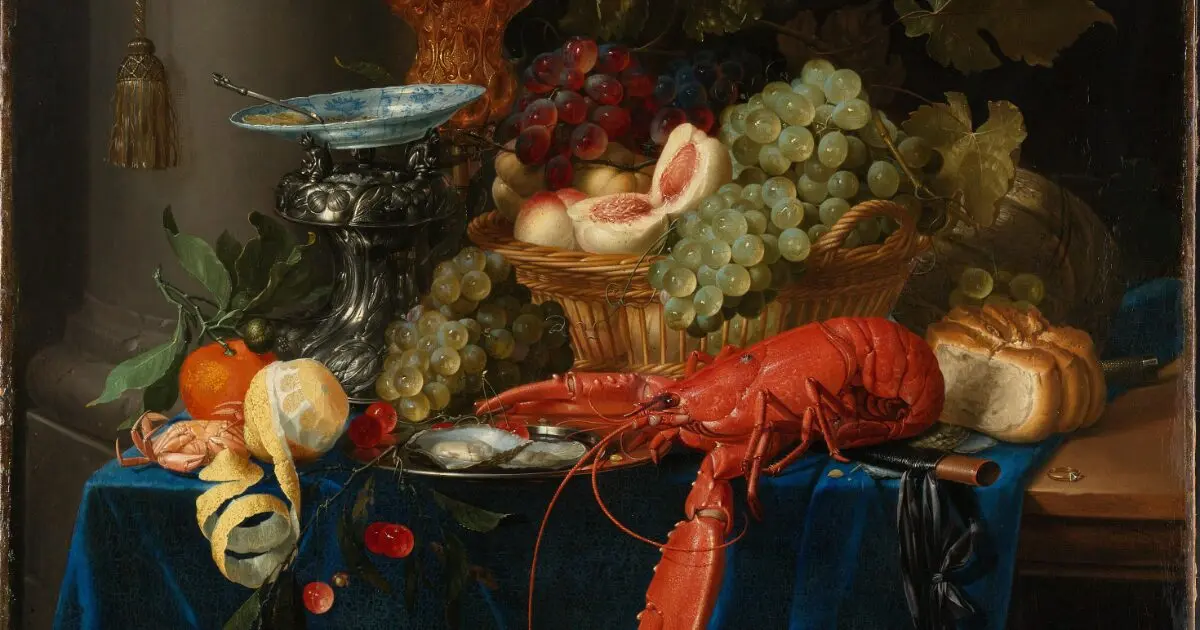
Perhaps the most striking section of the excerpt transports the reader into a Dutch Golden Age still life. Danz uses this art-historical setting to critique the illusion of safety and permanence provided by high culture:
We step into a still life from the seventeenth century
and strip off our clothes and I see in your reflection in the goblet
how beautiful you are—you make a bed for us
in the pure linen napkin behind the lobster’s claw
This surrealistic intrusion into historical art serves multiple functions. First, it offers a temporary sanctuary from the "viewer’s gaze," suggesting that modern lovers seek refuge in the aestheticized past. However, this sanctuary is illusory. The bitterness of the "white of the lemon’s peel / curled into a spiral of fruitless waiting" shatters the romantic illusion. The petrified stare of the dead lobster and its fossilized claws serve as memento mori—reminders that art can preserve form, but it cannot resurrect life or mitigate modern grief. Stepping back out of the painting "sheepishly," the subjects realize that "nothing has gotten any better," reinforcing the idea that aesthetic escapism is ultimately inadequate for addressing contemporary reality.
Astronomical Scale: "Apparent Magnitude"
In the concluding movement of the excerpt, titled "Apparent Magnitude"—a term from astronomy describing the brightness of a celestial body as observed from Earth—Danz scales up her inquiry from the personal to the cosmic.
if we could banish the shock waves
of the last years to the night sky could
name the flaring stars the un-
discovered patterns of our astonishment…
Here, Danz directly confronts the "shock waves of the last years." By proposing that society catalog its collective trauma, monstrous events, and linguistic failures into constellations, she examines the human impulse to find meaning in chaos. The poem asks a vital question: If we map our catastrophes onto the heavens, do we retain our humanity, remaining "people who gaze at the heavens and hope and wish and love"? This synthesis of astrophysics, trauma studies, and lyric poetry establishes Portolan as a work deeply attuned to the anxieties of the twenty-first century.
Official Statements & Critical Perspectives
The anticipation surrounding Portolan: Poems has generated significant commentary from literary critics, academic institutions, and the translators themselves. The following curated statements highlight the collection’s anticipated impact on contemporary poetry.
Perspectives from the Publisher and Translator
In statements released by the University of Nebraska Press, editorial staff emphasized the timeliness of Danz’s work.
"Daniela Danz possesses a rare capacity to look directly at the fractures of our historical moment without flinching, yet she infuses her verse with a radical tenderness," noted a representative from the press’s editorial board. "Monika Cassel’s translation brilliantly preserves the architectural integrity of Danz’s German, ensuring that English-language readers experience the full emotional and intellectual resonance of the original text."
Monika Cassel has previously spoken on the challenges of translating contemporary German poetry that engages with deep historical layers. In discussions regarding her approach to Portolan, Cassel highlighted Danz’s unique ability to merge cartography with emotional topography:
"To translate Danz is to step onto a map where the borders are constantly shifting," Cassel observes. "The poems do not offer easy coordinates; instead, they teach us how to read the blank spaces between historical events, personal loss, and the quiet resilience of everyday survival."
Critical Reception in Europe
In the German-speaking literary world, Danz has long been celebrated for her intellectual fearlessness. Reviewers in outlets such as Frankfurter Allgemeine Zeitung and Süddeutsche Zeitung have frequently noted her mastery of form and her refusal to offer sentimental resolutions. Critics have pointed out that Portolan acts as a navigational instrument for an era of disorientation, praising how the collection maps the physical and mental borders of Europe, blending landscape poetry with sharp socio-political critique.
Future Outlook
As the literary world awaits the publication of Portolan: Poems in 2027, the implications of Danz’s work extend far beyond the traditional boundaries of poetry reviewing. The collection arrives at a critical juncture in cultural discourse, where questions of historical memory, ecological anxiety, and the psychological tolls of global crises dominate public consciousness.
Anticipated Impact on Contemporary Translation
The collaboration between Danz and Cassel is expected to set a new benchmark for contemporary poetry translation. By successfully rendering complex, multi-layered German philosophical verse into accessible yet deeply resonant English, the volume will likely serve as a primary text in university creative writing and comparative literature curricula.
The Relevance of Cartographic Metaphors in Art
In an increasingly digital and fragmented world, the metaphor of the portolan chart—a medieval navigational map based on empirical observation and dead reckoning rather than mathematical projections—offers a powerful framework for future artistic expression. As society grapples with artificial intelligence, climate change, and geopolitical realignment, Danz’s insistence on returning to the physical body, shared vulnerability, and careful observation provides a vital antidote to disorientation.
Conclusion
Daniela Danz’s Portolan, as unveiled through these exquisite excerpts and Monika Cassel’s masterful translation, stands as a monumental achievement in contemporary verse. It refuses to offer false comfort, choosing instead to map the exact contours of our shared endurance. Whether walking the circular cinder tracks of private grief, stepping tentatively into the cold artifice of a seventeenth-century still life, or projecting our modern shock waves onto the indifferent night sky, Danz reminds us of what it means to remain human. When the 2027 publication finally reaches global bookshelves, it will undoubtedly cement its place as an indispensable cartography of the modern soul—a guide for navigating the turbulent waters of our time with our wishes intact, our limbs steady, and our capacity for love unvanquished.





Comments
Facebook App ID not configured. Please add it in the Customizer.