
Executive Overview
For decades, writing instructors, screenwriters, and novelists have relied on a foundational concept when building transformational fiction: The Lie the Character Believes. Popularized in craft manuals such as K.M. Weiland’s Creating Character Arcs, this maxim has served as the anchor for positive and negative character arcs alike. In short, the "Lie" represents the restrictive perspective that blinds a protagonist to a deeper thematic "Truth," forcing them to evolve, adapt, or—in tragic arcs—devolve.
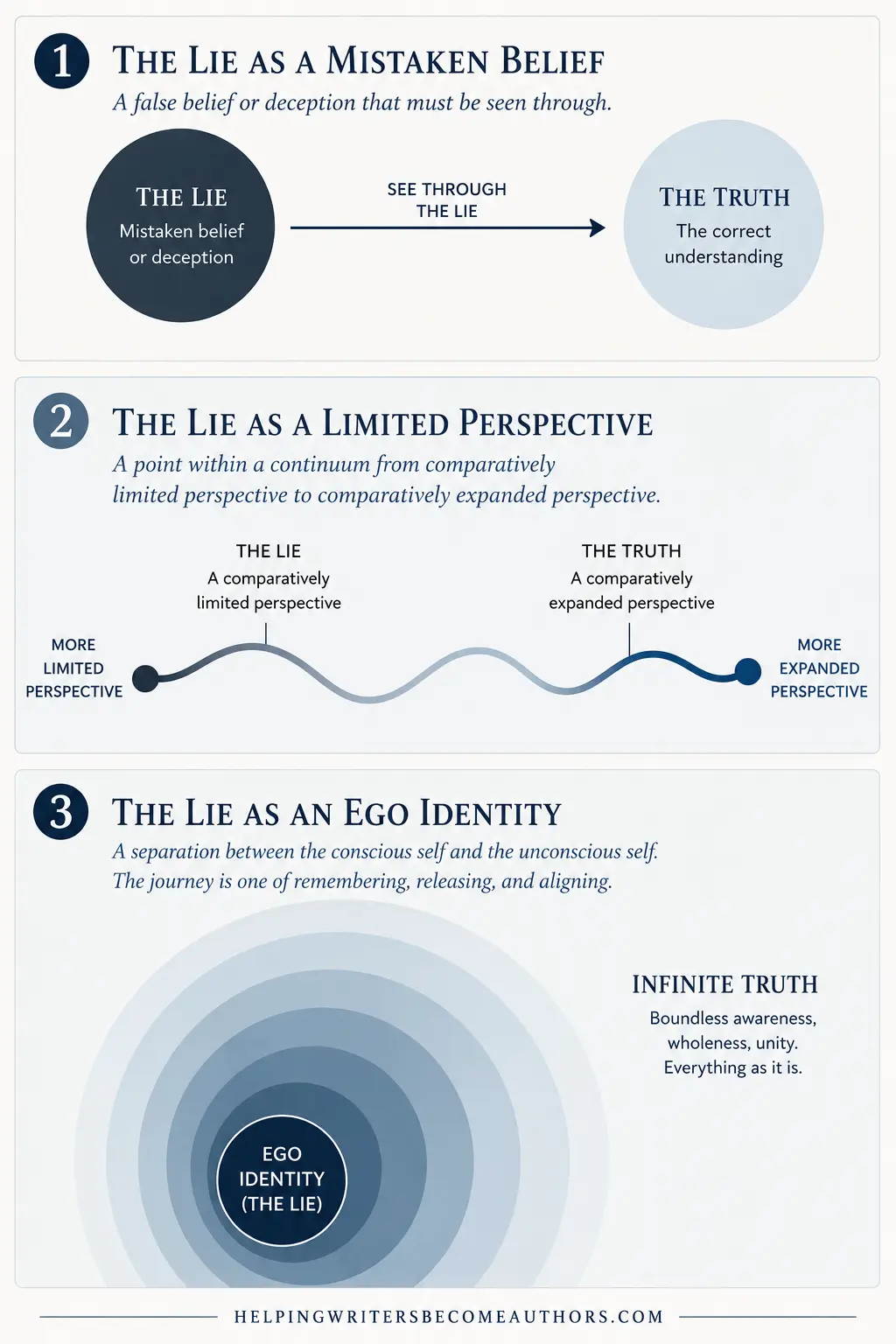
However, a profound shift in narrative theory is underway. Creators and theorists are beginning to recognize that what we call a "Lie" is rarely a simple falsehood or an outright deception. Instead, narrative architecture expert K.M. Weiland posits that this core psychological barrier is better understood through an escalating three-tier model:

- A mistaken belief
- A point on a continuum of relative perspectives
- An ego identity and psychological coping mechanism
This paradigm shift moves character development away from mechanical fixes ("correcting a wrong fact") and toward a paradigm of psychological alignment and individuation. By reframing character arcs not as dramatic transformations into entirely new entities, but as the stripping away of a false self, writers can unlock richer internal conflicts, more resonant themes, and deeply mythic storytelling.
Read Also
Detailed Chronology: The Evolution of the "Lie" in Writing Theory
To understand how storytelling theory has arrived at this psychological juncture, we must examine how the definition of the character’s internal obstacle has matured over time.

Phase 1: The Mechanical Era (The Outright Lie)
In early screenwriting and novel-writing paradigms, the Lie was treated as a discrete factual error. A protagonist held an incorrect premise about the world or themselves—for instance, “I am entirely unlovable” or “Strength means never asking for help.” The plot acted as a stress test designed to systematically break down this erroneous premise until the character accepted the counter-balancing thematic Truth. While functional, this black-and-white approach occasionally led to rigid, formulaic character development.
Phase 2: The Relativistic Continuum (Perspective Shift)
As writers analyzed complex, long-running series (such as Sarah J. Maas’s A Court of Thorns and Roses series), it became clear that a character’s "Truth" in book one often becomes their "Lie" by book three. For example, Feyre’s hyper-focused survival skills serve her family reliably until she is thrust into the Fae world. Her survivalist mindset—once her ultimate truth—becomes a limiting perspective that must expand. This realization led theorists to view the Lie and Truth not as binary opposites, but as anchor points on an ever-expanding continuum of human perspective. Yesterday’s expanded truth simply becomes tomorrow’s limited horizon.

Phase 3: The Consciousness Era (Ego, Coping, and Alignment)
Most recently, narrative theory has intersected with depth psychology—drawing heavily on the works of Carl Jung, Marie-Louise von Franz, and modern neurobiology. Theorists now argue that the Lie is not a cognitive error to be corrected, but a fissure in consciousness. It is an ego identity forged in childhood (the backstory "Ghost") designed to help the individual survive. When these coping mechanisms outlive their usefulness, they calcify into psychological prisons. Consequently, the true architecture of a character arc is revealed to be an act of alignment rather than transformation: the shedding of the ego to reconnect with the deeper, unconditioned Self.
Supporting Context & Metrics: The Three Models of Limiting Beliefs
To effectively apply this advanced philosophy to a manuscript, writers must evaluate the Lie across three ascending levels of psychological depth:

[Level 1: Mistaken Belief] ---> [Level 2: Relative Perspective] ---> [Level 3: Ego Identity / Separation]1. The Lie as a Mistaken Belief
At its most basic level, a Lie functions as a surface-level misconception. The character has been fed incorrect information, has misinterpreted an event, or is operating under a cultural delusion.
- Narrative Function: Drives external plot complications and straightforward miscommunications.
- Resolution: Discovery of facts or direct confrontation with reality.
2. The Lie as a Relative Perspective
Moving up the scale, the Lie is no longer "wrong" in an absolute sense; it is merely comparatively limited. At the start of a journey, a character’s perspective worked for them.

- Narrative Function: Creates nuance. The protagonist doesn’t need to be "evil" or "stupid"; they simply need to outgrow a worldview that is too small for their expanding world.
- Resolution: An expansion of awareness—moving from a narrow view to a holistic view.
3. The Lie as an Ego Identity and Separation
At its deepest level, the Lie is a defense mechanism erected by the ego. The ego identifies the self with temporary constructs—social roles, trauma, job titles, or coping mechanisms ("I am a survivor," "I am a failure"). This creates a fundamental separation between the conscious ego and the deeper unconscious psyche.
- Narrative Function: Generates profound internal conflict. The ego fights desperately to maintain the status quo because it perceives spiritual death in transformation.
- Resolution: Individuation. The character drops their psychological armor, surrenders control, and aligns with the integrated totality of the Self.
Official Statements & Expert Perspectives
Prominent voices in psychology and narrative craft have long pointed toward this intersection between storytelling and human consciousness.

- On the Illusion of Suffering: Richard Rudd, author of The Gene Keys, notes:
"The suffering we feel, though real within the context of our physiology, is an illusion when it comes to our minds… All it takes is willingness to feel the pain, and the miracle begins." This directly mirrors the climax of a positive change arc, where a protagonist must face the emotional agony of letting go of their protective ego identity.
- On the Role of the Ego: Jungian scholar Marie-Louise von Franz emphasized the exact purpose of the ego in individuation, writing:
“It even seems as if the ego has not been produced by nature to follow its own arbitrary impulses to an unlimited extent, but to help make real the totality—the whole psyche.”

- On Social Reality: Sociologists Peter L. Berger and Thomas Luckmann famously demonstrated that reality itself is a social construction. When characters inherit societal expectations, they absorb collective ego identities—acting as the "Tyrant-Ogre Holdfast" that Joseph Campbell identified as the ultimate antagonist of the Hero’s Journey.
Future Outlook: Implications for Writers and Storytellers
What does this conceptual evolution mean for the next generation of authors, screenwriters, and narrative designers?
- Richer, More Empathetic Antagonists: By viewing a character’s flaws not as petty moral failings or cartoonish "evil," but as deeply human coping mechanisms born of early trauma (the backstory Ghost), writers can craft villains and flawed protagonists with profound psychological realism.
- Shift from Plot-Driven Mechanics to Soul-Driven Arcs: Writers will increasingly look past mere external plot beats to examine how a character’s internal resistance mirrors universal archetypal patterns (such as the Mage or the Hero). The most compelling stories will be those that frame the climax not as a physical victory over an enemy, but as a psychological surrender of the false ego.
- Advanced Educational Frameworks: Courses addressing the intersection of depth psychology and plotting—such as specialized deep-dives into Shadow Archetypes and ego-driven versus soul-driven arcs—are rapidly replacing one-size-fits-all plotting templates. Writers are eager to master tools that translate real-world human healing into compelling narrative arcs.
Ultimately, the enduring power of storytelling lies in its mirror-like capacity to reflect our own psychological journeys. As K.M. Weiland’s refined framework demonstrates, every profound Positive Change Arc reminds us of a fundamental truth we instinctively recognize in our own lives: growth is not about becoming someone new; it is about stripping away the fear, the defenses, and the false identities to discover who we have always been beneath the surface.





Comments
Facebook App ID not configured. Please add it in the Customizer.