
Executive Overview
In the literary landscape, August is a month dedicated to a quiet yet profound revolution: Women in Translation (WIT) Month. Established to correct a historic and ongoing gender imbalance in the publishing world—where translated literature historically leans heavily toward male authors—WIT Month serves as both a celebration and a call to action. It is a dedicated time to spotlight the women writers who capture the complexities of the human condition across languages, as well as the translators who act as literary architects, bridging cultural divides to bring these texts to English-speaking readers.
As part of the annual festivities, the editorial and operational team at Words Without Borders has released its curated staff picks for August. This year’s selection is a dazzling testament to the global reach and artistic fearlessness of women writers and their translators. Spanning genres from poetry and experimental biography to personal essays and psychological fiction, the six chosen titles transport readers from the troubled landscapes of Palestine to the ancient mountains of Albania, from rural Hungary to the linguistic thresholds of Japan, Denmark, and Mexico.
These works do not merely entertain; they interrogate identity, memory, displacement, and desire. They invite readers to step outside the familiar architecture of their native tongues and inhabit different ways of seeing and being. This comprehensive report explores the staff picks for Women in Translation Month, examining the narratives, the creative processes of translation, and the cultural resonance of each featured title.
Read Also

Detailed Chronology: The Curated Selections
The Words Without Borders staff picks are curated through deeply personal, literary-minded lenses by editors who spend their careers championing global literature. Below is an exploration of the six titles anchoring the celebration.
1. The Sleep Thief by Ibtisam Azem (Translated from Arabic by Sinan Antoon)
- Recommended by: Sohini Basak, Poetry Editor
Ibtisam Azem’s debut novel, The Sleep Thief, is a slim, dreamlike narrative that operates on the precipice of reality and allegory. Translated from Arabic by renowned poet and novelist Sinan Antoon, the book centers on a Palestinian man named Gharib—whose very name translates to "the stranger"—over the course of a few pivotal days.
Sohini Basak highlights the novel’s lyrical and gently experimental structure, noting how Azem captures an atmosphere that is at once ethereal and grounded in the heavy realities of displacement. Sinan Antoon’s translation preserves the poetic cadence of the original Arabic, ensuring that the novel’s subtle rhythms and philosophical inquiries resonate deeply in English. The Sleep Thief stands as a haunting meditation on alienation, memory, and the persistent phantom weight of home.

2. She Who Remains by Rene Karabash (Translated from Bulgarian by Izidora Angel)
- Recommended by: Susan Harris, Editorial Director
Transporting readers to an isolated Albanian mountain village governed by the ironclad rules of ancient customary law, She Who Remains tells the gripping story of Bekija. Faced with an unwanted arranged marriage and a forbidden passion for a female friend, Bekija makes a radical choice: she invokes ancient tradition to become a "sworn virgin," renouncing all claims to traditional femininity to live, work, and move through society as a man.
However, this personal act of survival triggers a cascade of bloody violence that shatters her family and community. Translated with dazzling precision from the Bulgarian by Izidora Angel, Rene Karabash’s poetic stream of consciousness navigates turbulent themes of gender identity, queerness, ritual, and freedom. Published earlier in the year to critical acclaim—including a shortlist nomination for the International Booker Prize—Editorial Director Susan Harris predicts the novel will dominate translation prize nominations in the United States.
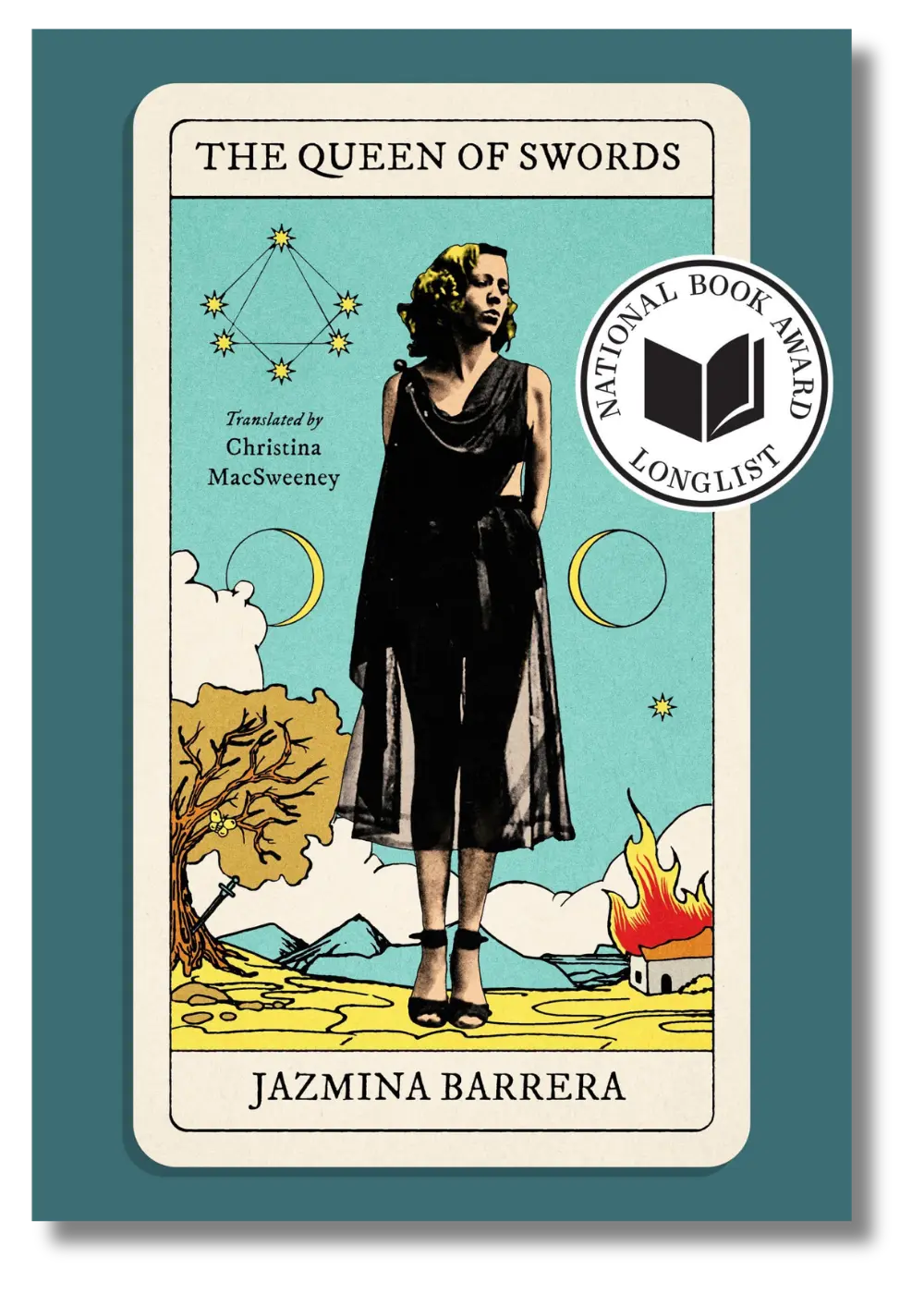
3. The Queen of Swords by Jazmina Barrera (Translated from Spanish by Christina MacSweeney)
- Recommended by: Alicia Lim, Finance and Operations Manager
Jazmina Barrera’s The Queen of Swords is an immersive, genre-bending work that reinvents the traditional biography. Blending memoir, criticism, and experimental narrative, Barrera constructs a conversation across time between herself and the enigmatic Mexican writer and intellectual Elena Garro.

Rather than offering a linear chronology, Barrera stitches together fragments of Garro’s tumultuous life, intentionally leaving loose threads, gaps, and contradictions exposed. Alicia Lim describes devouring the book, praising its ability to leave readers with more questions than answers. Christina MacSweeney’s translation captures Barrera’s intimate, inquiring tone, inviting readers to commune with ghosts, uncertainties, and the enduring mystery of a literary icon’s existence.
4. Exophony: Voyages Outside the Mother Tongue by Yoko Tawada (Translated from Japanese/German by Lisa Hofmann-Kuroda)
- Recommended by: Nina Perrotta, Senior Editor and Development Manager
For bilingual authors, language is not just a tool, but a landscape to be traversed. In Exophony: Voyages Outside the Mother Tongue, acclaimed author Yoko Tawada—who writes fluidly in both Japanese and German—explores the intellectual and emotional terrain of living and creating outside her native tongue.
Translated by Lisa Hofmann-Kuroda, this essay collection offers brilliant, witty, and deeply philosophical insights into the act of linguistic translation and transit. With tantalizing essay titles such as “On Mistranslating the Moon” and “Los Angeles: The Poetic Ravine between Languages,” Tawada interrogates how meaning shifts when words cross national and mental borders. Nina Perrotta points to this collection as an essential read for anyone fascinated by the friction and fluidity of international literature.

5. Enter World by Dalia Taha (Translated from Arabic by Sara Elkamel)
- Recommended by: Alex Tan, Editorial Fellow
Dalia Taha’s Enter World is described by Editorial Fellow Alex Tan as a "distilled, elemental collection that stages, with every poem, a life lived—thriving, attentive, defiant, tender—amid the ruins, in Palestine."
Structurally, the collection employs a theatrical device: every poem title commences with the word "enter"—as in enter wrist pain, enter apartheid, and enter girl with books. Translated nimbly by Sara Elkamel, Taha’s poetry achieves an encyclopedic ambition within a quotidian mise en scène. Suffering and beauty exist side by side; olive trees and morning dew share space with checkpoints, torturers, and prisoners incubating philosophy. Evoking the sparse, oracular precision of Adania Shibli and Etel Adnan, Enter World is an accounting of injustice infused with an eschatology that insists upon the possibility of another world.
6. Seeing Further by Esther Kinsky (Translated from German by Caroline Schmidt)
- Recommended by: Maggie Vlietstra, Education Program Manager
Cinematic nostalgia meets architectural preservation in Seeing Further by Esther Kinsky, translated from German by Caroline Schmidt. The novel follows a woman who stumbles upon a dilapidated, forgotten movie theater in rural Hungary and takes on the formidable, stubborn task of restoring it to life.

Education Program Manager Maggie Vlietstra champions the book as the ultimate summer read for cinephiles, champions of communal artistic experiences, and those resistant to the relentless march of technological isolation. Kinsky’s prose, rendered smoothly by Schmidt, explores the emotional resonance of shared spaces and the physical labor required to preserve memory against the tide of decay.
7. Waist Deep by Linea Maja Ernst (Translated from Danish by Sherilyn Nicolette Hellberg)
- Recommended by: Anna Claire Weber, Marketing & Communications Manager
Rounding out the list is Waist Deep, the steamy, sharp debut novel by Linea Maja Ernst, translated from Danish by Sherilyn Nicolette Hellberg. Set at an idyllic Danish lake house during the height of summer, the novel follows a tight-knit group of college friends who reunite to reminisce and catch up.
Beneath the veneer of lifelong intimacy lies a simmering tension; the characters are constantly on guard against one another’s real and imagined judgments. Marketing & Communications Manager Anna Claire Weber likens the dynamic to a modern A Midsummer Night’s Dream, complete with a marriage, mutual infatuations, and a lush pastoral setting. Beyond its luxurious pacing and sensuous prose, Ernst’s novel brilliantly pokes fun at millennial stereotypes, offering one of the most astute encapsulations of what it feels like to navigate adulthood, burnout, and the desire to shed responsibility in the twenty-first century.

Supporting Context & Metrics: The State of Women in Translation
To fully appreciate the significance of WIT Month and the curation by Words Without Borders, it is essential to examine the broader literary ecosystem. For decades, translation publishing suffered from a stark gender imbalance. Studies tracking translated fiction in English markets—most notably the pioneering data collected by researcher Meytal Radzinski, founder of WIT Month—revealed that the vast majority of translated books published in the West were written by men.
The Numbers Behind the Movement
- The Translation Gap: Historically, only about 3% of all books published in the United States were works in translation. Within that slim slice, works by female authors accounted for an even smaller fraction.
- The Shift: Over the past decade, grassroots advocacy, dedicated independent presses (such as Deep Vellum, Transit Books, Archipelago, and Two Lines Press), and initiatives like WIT Month have begun to close this gap. Today, translation prizes are increasingly recognizing women writers, and mainstream publishers are actively seeking out international women’s voices.
- Cultural Impact: As demonstrated by the inclusion of Rene Karabash’s She Who Remains on the International Booker Prize shortlist, translated literature by women is not merely a niche academic interest—it is driving global literary conversations and dominating major prize lists.
Official Statements and Editorial Perspectives
The curation of these titles reflects a deliberate institutional philosophy at Words Without Borders, an organization dedicated to promoting cultural understanding through the translation, publication, and promotion of international literature.
Speaking on the collective power of translated texts, the editorial board emphasizes that translation is an act of radical empathy. By opening windows into societies undergoing political upheaval (such as Palestine and Albania), exploring personal trauma and historical biography (such as the life of Elena Garro), or meditating on the mechanics of language itself (as Yoko Tawada does), translated literature dismantles parochial worldviews.

Furthermore, the involvement of celebrated translators—such as Sinan Antoon, Izidora Angel, Christina MacSweeney, Lisa Hofmann-Kuroda, Sara Elkamel, Caroline Schmidt, and Sherilyn Nicolette Hellberg—underscores the crucial collaborative nature of translated works. A great translation is not merely a linguistic substitution; it is a creative rebirth in a new tongue.
Future Outlook: The Horizon of Translated Literature
As Women in Translation Month 2026 draws to the forefront of the literary calendar, the momentum behind global women writers shows no sign of slowing down. The books recommended by the Words Without Borders staff point toward several emerging trends in international publishing:
- Genre Fluidity: Writers are increasingly discarding strict boundaries between memoir, poetry, fiction, and essay, resulting in hybrid texts that challenge Western publishing categorizations.
- Decentered Narratives: Publishers are looking beyond traditional European literary capitals, bringing vital voices from the Middle East, Eastern Europe, Latin America, and Scandinavia directly to English-speaking readers.
- The Visibility of Translators: Translators are increasingly receiving co-billing on book covers and participating actively in literary discourse, validating translation as an original artistic discipline.
Ultimately, the Words Without Borders staff picks for August serve as a roadmap for readers seeking depth, beauty, and intellectual challenge. Whether diving into the poetic ruins of Palestine with Dalia Taha, navigating the complex Albanian mountains with Rene Karabash, or reflecting on linguistic exile with Yoko Tawada, readers are reminded that literature knows no borders—and that the stories of women across the globe are essential to our collective understanding of the human experience.





Comments
Facebook App ID not configured. Please add it in the Customizer.