Two millennia after Mount Vesuvius buried the ancient Roman cities of Pompeii and Herculaneum in 79 C.E., the global cultural imagination remains inextricably bound to the tragedy of those who perished. For generations, the disaster has been defined by the haunting, hollowed-out plaster casts of human beings frozen in their final, agonizing moments—victims asphyxiated by toxic gases and buried beneath suffocating layers of pumice, ash, and pyroclastic flows.
However, a quiet revolution is underway in the fields of classical archaeology, epigraphy, and disaster psychology. Researchers are shifting their focus from the dead to the living: the individuals who managed to flee the catastrophe, navigate the chaotic aftermath, and rebuild their shattered lives in neighboring Roman communities.
This paradigm shift is the core subject of Pompeii: Out of Time With Tom Hiddleston, a semi-fictionalized documentary series airing on National Geographic. Hosted by British actor Tom Hiddleston—whose lifelong fascination with the site began during a formative visit at age 17 and ultimately inspired him to study classics at the University of Cambridge—the series marries rigorous academic research with cinematic storytelling. Executive produced by Kevin Wright, whose previous collaborations with Hiddleston include Marvel’s Loki, the docuseries utilizes high-end visual effects and dramatic reconstructions to explore a provocative question: What happened to those who made it out alive?
By tracking the fates of three historical figures—a shrewd businesswoman named Julia Felix, a teenage apprentice named Avianius Felicio, and an elite Praetorian soldier stationed in Herculaneum—the series and its underlying historical research challenge the long-held assumption that the eruption of Vesuvius was an instantaneous, absolute end for every resident of the doomed region. Instead, historians are discovering that survival was possible, albeit fraught with lifelong trauma, economic dislocation, and profound displacement.
Detailed Chronology: Unfolding Disaster and the Race for Survival
The popular conception of Vesuvius’s eruption as a sudden, cataclysmic explosion that erased Pompeii in the blink of an eye is a historical misconception. Modern vulcanology and the meticulous accounts left behind by Pliny the Younger reveal that the disaster was a protracted, intensifying process that unfolded over the course of more than 24 hours.
The Precursor Tremors and the Psychology of Normalcy
Long before the mountain blew its top, the region surrounding the Bay of Naples was rattled by seismic activity. In 62 or 63 C.E., a massive earthquake struck Campania, causing widespread structural damage that was still being repaired when Vesuvius erupted in 79 C.E. In the days and hours leading up to the final cataclysm, frequent tremors rocked Pompeii and Herculaneum.
To modern observers, such frequent warnings should have triggered immediate mass evacuations. Yet, as disaster psychologist Sarita Robinson explains in the documentary series, human behavior in life-or-death situations is governed by psychological normalcy biases. Earthquakes were a common occurrence in seismic Italy, much like minor traffic accidents or routine weather anomalies. Just as modern urbanites frequently ignore building fire alarms due to habitual desensitization, Pompeii’s residents learned to dismiss the rumblings beneath their feet.
When the mountain finally breached on the afternoon of August 24, 79 C.E., spewing a towering column of ash and pumice miles into the stratosphere, the initial reaction among many residents was hesitation rather than panic. This delay, while fatal for thousands, provided a narrow window of opportunity for the resourceful, the skeptical, and the swift-footed to escape.
The Protracted Eruption Phase
The eruption can be broadly divided into two primary phases:
The Plinian Phase (Day One): Lasting roughly 18 to 20 hours, this phase was characterized by a continuous, towering column of volcanic debris raining pumice and ash down upon Pompeii. While terrifying and structurally destructive, the accumulation of pumice was not instantaneously lethal across the entire city, giving mobile residents hours to pack valuables, locate family members, and flee south toward Stabiae or Nuceria.
The Pelean Phase (Day Two): The collapse of the eruption column triggered a series of superheated pyroclastic surges—devastating avalanches of gas, ash, and rock traveling at hurricane speeds. These fiery waves swept down the slopes of Vesuvius, instantly carbonizing and asphyxiating anyone still remaining in the path of destruction.
It was within the chaotic crucible of Day One that individuals like Avianius Felicio and Julia Felix faced life-or-death decisions that would determine whether their names would be found etched into the archaeological record of the dead—or resurrected in the records of surviving communities years later.
Supporting Context & Metrics: The Epigraphic Evidence of Survival
The methodological foundation of Pompeii: Out of Time rests heavily on the groundbreaking research of classicist Steven L. Tuck of Miami University. For years, Tuck has conducted meticulous epigraphic studies, tracking pre-eruption names recorded in Pompeian graffiti, wax tablets, and public inscriptions, and cross-referencing them with post-79 C.E. records across the Roman Empire.
Tracking the Diaspora
When Vesuvius erupted, it precipitated one of the ancient world’s first documented refugee crises. Survivors fled to neighboring towns such as Cumae, Puteoli, Neapolis, Nuceria, and Rome itself. Imperial authorities, under Emperor Titus, attempted to provide relief, but the sheer scale of displacement meant that thousands of dislocated families had to fend for themselves.
Tuck’s methodology is disarmingly simple yet revolutionary in execution: when a specific individual’s unique name appears in pre-eruption documents in Pompeii and subsequently surfaces in municipal records, tax rolls, or gravestones in a safe, adjacent town years later, researchers can definitively identify a survivor.
Case Studies in Resilience
1. Julia Felix: The Shrewd Landlord
Julia Felix was one of the most prominent property owners in ancient Pompeii. Excavations of her sprawling estate—uncovered as early as 1755—revealed a complex commercial enterprise. Facing economic shifts following the devastating earthquake of 62/63 C.E., which rendered public bathhouses temporarily unusable, Felix astutely converted sections of her luxury property into commercial rentals.
A famously preserved painted rental notice on her exterior wall advertised luxury baths, shops, and second-story apartments tailored for "the best people." Archaeologists such as Caitie Barrett note that Felix represents a remarkably rare historical archetype: an independent, highly successful female entrepreneur operating at the height of the Roman Empire.
While a body adorned with expensive jewelry was excavated from her estate in the 1950s near a shrine to the Egyptian goddess Isis—leading some to speculate she may have stayed behind to pray for divine intervention—her ultimate fate remains a tantalizing historical mystery, underscoring the absolute limits of material archaeology when attempting to read the internal motivations of the ancient dead.
2. Avianius Felicio: From Elite Decline to Adoption
The teenage Avianius Felicio provides a poignant window into the precarious socioeconomic strata of Pompeii. Inscriptional evidence indicates that while the Avianii family had once belonged to Pompeii’s elite class, their fortunes had severely waned by 79 C.E. A pre-eruption loan tablet lists a family member among the witnesses, positioned ignominiously just above the signatures of enslaved individuals (as witnesses traditionally signed in descending order of social rank).
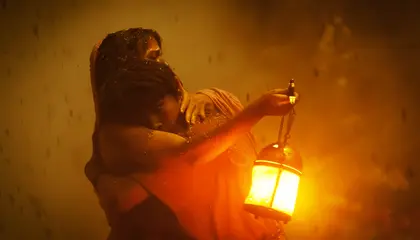
Working as an apprentice to the Masuri family, a local lineage of bronze-smiths, Felicio experienced the eruption as a vulnerable minor. Dramatic reconstructions in the documentary portray him caught in the seismic chaos, momentarily separated from his masters as he frantically searches for his mother.
Crucially, Tuck’s research uncovered Felicio’s post-eruption gravestone in the neighboring town of Nuceria. The poignant inscription reads: "To the Spirits of the Dead. The Masuri made [this] for Avianius Felicio, dearest foster son." This epigraphic artifact suggests that Felicio’s biological family likely perished in the disaster, leaving him an orphan who was formally taken in and cherished by his former employers—providing rare, tangible evidence of how orphaned minors survived and were integrated into new households in the post-Vesuvius world.
3. The Praetorian Soldier of Herculaneum
Situated much closer to the base of Vesuvius than Pompeii, the coastal town of Herculaneum suffered an even more rapid and terrifying inundation. Among the hundreds of skeletons excavated from the ancient shoreline boathouses and beachfronts in the 1980s was that of an unnamed man whose equipment set him apart from ordinary citizens.
Re-examinations of the artifacts discovered alongside his skeletal remains—including a military belt, a gladius (sword), and a pouch containing his monthly pay in Roman coins—indicate that he was an elite member of the Praetorian Guard, the emperor’s personal bodyguard unit stationed in Rome.
While some historians have hypothesized that he was part of the heroic rescue fleet organized by the scholar and naval commander Pliny the Elder, others remain skeptical, viewing him perhaps as an official dispatched on imperial business or security details. Regardless of his precise orders, his final moments on the beach at Herculaneum highlight the ultimate limits of military training and authority when confronted by the raw, untamed fury of a volcanic cataclysm.
Official Statements & Production Insights
The blending of rigorous academic scholarship with cinematic narrative design required a delicate balance between historical fact and creative interpretation. Speaking on the conceptual framework of the series, Tom Hiddleston emphasized the linguistic root of the discipline he studied at Cambridge.
"At university, I learned that the Latin word historia can be translated as either ‘history’ or ‘story,’" Hiddleston reflects in the documentary. "That means evidence and imagination intermingled. They are the same thing. We review the physical evidence left behind by the earth, and then we provide a fuller truth—presenting fictional scenarios that could have plausibly happened on that fateful day."
Executive producer Kevin Wright, drawing on his experience helming large-scale productions like Marvel’s Loki, noted that realizing the emotional weight of ancient history required the tools of modern blockbuster filmmaking:
"Sometimes you need that big VFX shot, you need the big drone to set the scale and sell the story, because that’s the only way you can do justice to the sheer magnitude of what happened," Wright told Ars Technica in an interview detailing the production. "That was where historical research and cinematic spectacle truly merged."
Archaeologists and classicists involved in the project have largely embraced this hybrid approach. While acknowledging that reconstructions must necessarily bridge gaps where the archaeological record falls silent, experts like Steven L. Tuck and Caitie Barrett argue that narrative dramatization breathes vital life into dry epigraphic fragments, making complex historical demography accessible to global audiences.
Future Outlook: The Next Frontier in Vesuvius Research
As archaeological techniques continue to advance at a staggering pace, the study of Pompeii and its diaspora is entering an entirely new technological epoch. Future research into the survivors of 79 C.E. will likely rely on several emerging methodologies:
Advanced Isotopic and DNA Analysis: Bioarchaeologists are increasingly utilizing stable isotope analysis on skeletal remains found across regional cemeteries in Campania. By examining dental enamel and bone chemistry, researchers can determine whether individuals buried in towns like Nuceria, Puteoli, or Cumae were native locals or displaced refugees from the Vesuvian zone.
Digital Epigraphy and Machine Learning: Natural language processing algorithms and high-resolution 3D surface scanning are allowing epigraphers to scan thousands of fragmentary inscriptions, graffiti, and wax tablets across the Mediterranean basin, potentially uncovering hundreds of new survivor profiles previously obscured by weathering or incomplete preservation.
Micro-Stratigraphic Excavation: Ongoing digs in unexcavated quarters of Pompeii (such as Regio V) continue to yield fresh domestic contexts, shedding light on the socio-economic status of marginalized residents—slaves, freedmen, and apprentices—whose stories have traditionally been overshadowed by elite literary accounts like those of Pliny the Younger.
Ultimately, Pompeii: Out of Time With Tom Hiddleston and contemporary archaeological investigations serve as a powerful reminder that history is not merely a catalog of static ruins and catastrophic endings. Beneath the layers of volcanic ash lies a resilient human story of flight, adaptation, endurance, and rebirth—proving that even when the earth itself gives way, human society finds a way to endure.

/https://tf-cmsv2-smithsonianmag-media.s3.amazonaws.com/filer_public/18/2a/182ab01e-864b-429e-a53a-0a1b41ecc75d/pompeii.png)
/https://tf-cmsv2-smithsonianmag-media.s3.amazonaws.com/accounts/headshot/Ellen_Wexler.png)
:focal(750x500:751x501)/https://tf-cmsv2-smithsonianmag-media.s3.amazonaws.com/filer_public/18/2a/182ab01e-864b-429e-a53a-0a1b41ecc75d/pompeii.png)
/https://tf-cmsv2-smithsonianmag-media.s3.amazonaws.com/filer_public/ee/53/ee536521-6613-4f49-acae-284942a3540d/101_tremors_pompeiioutoftimewithtomhiddleston_uhd_065.jpg)

/https://tf-cmsv2-smithsonianmag-media.s3.amazonaws.com/filer_public/f7/66/f7661576-1bd8-4601-9542-5e5d9c1121f9/102_eruption_pompeiioutoftimewithtomhiddleston_032.jpg)
/https://tf-cmsv2-smithsonianmag-media.s3.amazonaws.com/filer_public/ef/0d/ef0def5a-83aa-4c7c-8b55-7d0abf44ca4c/102_eruption_pompeiioutoftimewithtomhiddleston_uhd_075.jpg)



Comments
Facebook App ID not configured. Please add it in the Customizer.