
PUBLISHED: August 23, 2026
AUTHOR: Brian Bassanio
Executive Overview
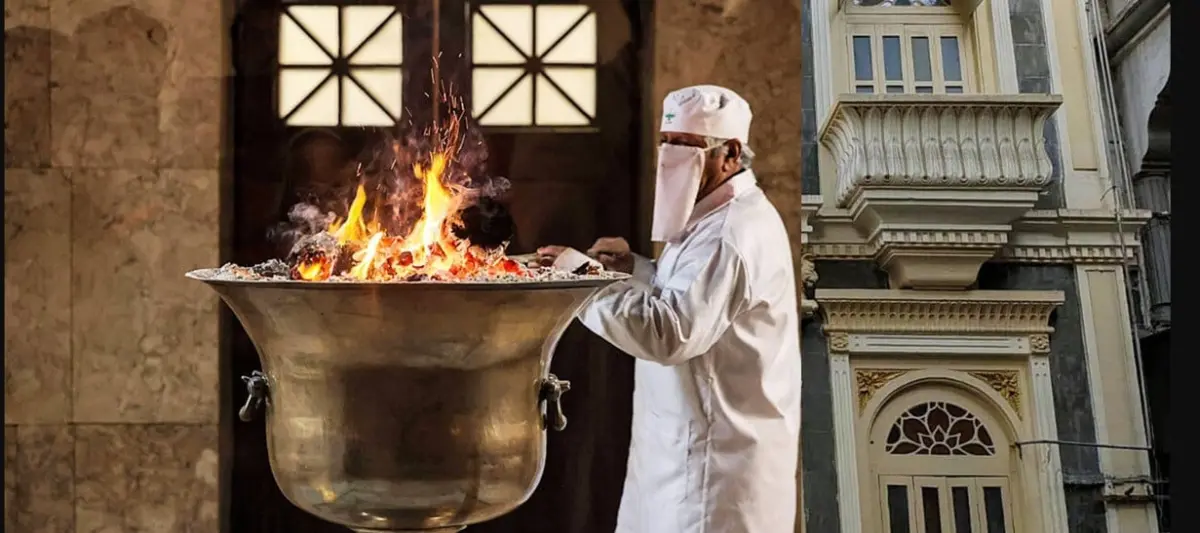
Nestled within the sprawling, chaotic megacity of Karachi lies a community of staggering historical consequence yet almost invisible demographic weight. The Zoroastrians of Pakistan—more commonly known by their South Asian ethnonym, the Parsis—number fewer than 1,000 souls today. Concentrated primarily in Karachi, with scattered, dwindling remnants in Lahore, Quetta, and Islamabad, this tiny minority once served as the foundational architects of modern Pakistan’s commercial and civic life. They erected schools, funded hospitals, and produced Karachi’s first elected mayor, leaving behind a legacy more commonly associated with grand colonial-era mansions and historic hotel chains than a living, breathing population.
Yet, hidden beneath the surface of their secular civic legacy sits a phenomenon that few outside the faith—and increasingly, few within it—have properly reckoned with: a living musical and oral tradition older than Sanskrit devotional music. Transmitted entirely through human memory rather than written scores, this unbroken chain of sacred recitation is closer to complete extinction in Pakistan than at any point in its recorded history.
Read Also
This is not, fundamentally, a story about religious dogma. It is an elegy for an accidental art form—a series of hymns never intended to be "beautiful" in the classical aesthetic sense, yet bound by hyper-strict rules of phonetic and musical exactness. As the last generation of custodians ages out of service with no successors waiting in the wings, the world is on the verge of losing a sonic archive that survived the collapse of empires, medieval sea migrations, and the violent geopolitical fractures of the twentieth century, only to quietly succumb to modern arithmetic.
Detailed Chronology: From Sasanian Shores to the Streets of Karachi
To understand the fragility of Pakistan’s Parsi community, one must trace a historical arc that stretches back over a millennium, bridging ancient Persia and the sun-baked coastlines of South Asia.
1. The Fall of the Sasanian Empire and the Gujarati Migration (7th–10th Centuries)
Though the word "Parsi" literally translates to "Persian," the community’s formative identity was forged in the crucible of Gujarat, not modern Iran. Following the catastrophic collapse of the Sasanian Empire during the Arab conquest of the seventh century, waves of Zoroastrian refugees fled their ancestral homelands.
The community’s foundational narrative is preserved in the Qissa-i-Sanjan, a Persian epic composed in 1599 by the priest Bahman Kaikobad. According to the text, a band of refugees sailed from Hormuz to the Gujarati coast, seeking asylum from a local Hindu ruler, Jadi Rana. The king granted sanctuary on the condition that the refugees adopt local dress, language, and customs while retaining their religious fidelity. Modern historians date this pivotal landing between the eighth and tenth centuries. This set in motion eight centuries of quiet, largely agrarian settlement in coastal Gujarat—centuries before the community’s fortunes were radically upended by the rise of British-administered Bombay.
2. The Colonial Era and the Settlement of Sindh (1844–1869)
Pakistan’s Parsis are culturally and genealogically an extension of this Gujarati diaspora, rather than a direct, modern migration from Yazd or Shiraz. The visual and linguistic markers of older Parsi women—such as the distinctive gara sari and the Gujarati-inflected Hindustani spoken at home—trace their lineage directly to Sanjan and Navsari.
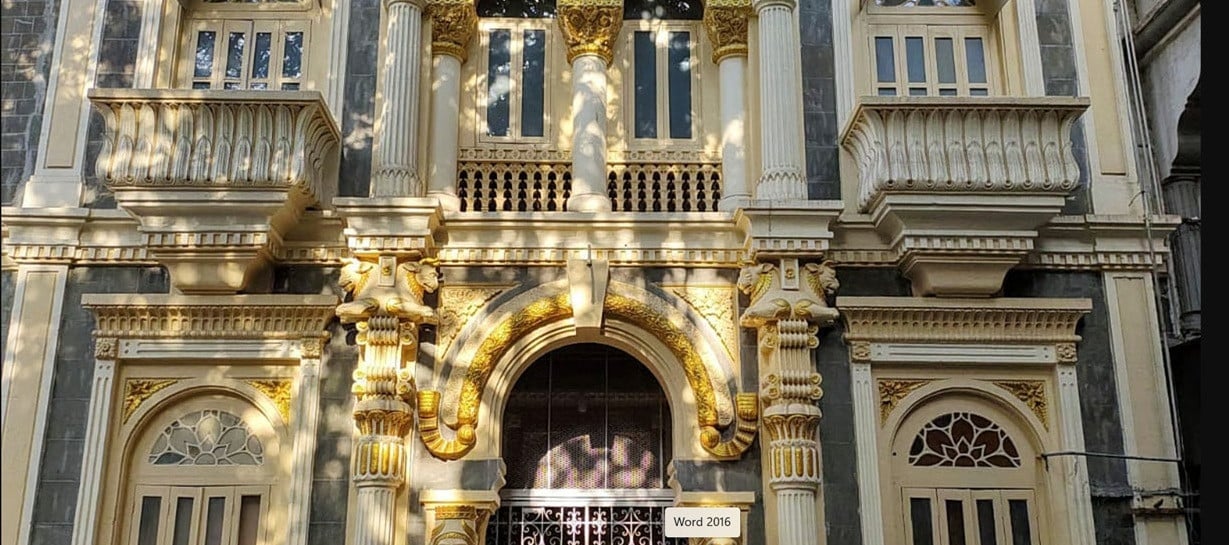
The Parsi footprint in the territories that now constitute Pakistan is a comparatively recent, colonial-era development. The first Parsi homestead in Karachi was established in 1844, precisely one year after the British conquest of Sindh. The city’s first fire temple, the Behrana Dar-e-Meher in Saddar, followed in 1849.
(Curiously, archaeological excavations have unearthed Sasanian-era silver coins at Banbhore near modern Karachi, pointing to ancient Zoroastrian maritime trade contacts with Sindh centuries prior. However, this ancient thread remains disconnected from the contemporary Gujarati Parsi community.)
3. The 20th-Century Peak and Post-Partition Decline (1951–Present)
Following their arrival in Sindh, the community punched far above its demographic weight. Parsis established elite institutions like the Mama Parsi Girls’ Secondary School and the BVS Parsi High School, financed major healthcare infrastructure, and gifted Karachi its first elected municipal leader: Jamshed Nusserwanjee Mehta, affectionately remembered to this day as "Baba-e-Karachi."
However, the population trajectory since the 1947 Partition of India has followed a steep, unyielding downward slope:
- 1951 Census: Just over 5,000 individuals.
- Mid-1990s: Approximately 2,800 individuals.
- 2015: Fewer than 1,500 individuals.
- Present Day: Low hundreds (estimated at roughly 900 in Karachi).
Supporting Context & Metrics: The Mechanics of Oral Preservation
The structural drivers behind this decline are prosaic yet relentless: the mass emigration of educated youth, depressed birth rates, and strict adherence to endogamy. Mainstream Zoroastrian interpretation does not admit converts, nor does it typically recognize the children of interfaith marriages into the priesthood or, in many cases, inside the sacred precincts of the fire temple. The community is not being actively driven out; rather, it is quietly running out of numbers.
The Liturgical Architecture: Avesta, Gathas, and the Yasna
Zoroastrian worship revolves around the recitation of the Avesta, the faith’s sacred scripture composed in an ancient Iranian language that ceased to be spoken over a millennium ago. The oldest layer of this corpus, the Gathas, consists of 17 hymns attributed directly to the prophet Zarathustra. Scholars date these verses between 1500 and 1000 BCE, rendering them among the oldest continuously recited religious texts in human history.
These texts form the structural backbone of the Yasna—a complex, 72-chapter liturgical service performed exclusively by ordained priests. Crucially, the entire service is executed entirely from memory.
Zoroastrian priests do not read from open texts during the liturgy. Trained from childhood to be "word-perfect," they operate under the theological conviction that a manthra (sacred utterance) only retains its metaphysical efficacy if every syllable, vowel length, and breath mark is reproduced precisely as transmitted down the ages. A mispronounced sound does not render the ritual imperfect; within the tradition’s internal logic, it invalidates the ritual entirely. This uncompromising standard explains why the Avesta survived for more than a thousand years via pure oral transmission before ever being committed to writing.
Music as an Accidental Art Form
For ethnomusicologists, the recitation of the Avesta presents a fascinating paradox. Is it music?
By design and aesthetic intent, the answer is no. There is no formal melodic composition, no written notation, and no artistic brief aimed at emotional evocation. Yet, a landmark 2004 doctoral thesis by Raiomond Mirza at London’s SOAS—utilizing extensive field recordings of priests across Iran and India—shattered the tidy academic boundary between "music" and "non-music."
Mirza discovered that priests unconsciously reproduce highly complex musical structures. Without any formal instruction in melody, priests across isolated geographies consistently deploy recurring melodic movements, specific ornamentation, and precise microtonal intervals (such as a documented tri-semitone shift).
Young priests are taught solely memorization and phonetic precision. Yet, generation after generation, priests who have never heard each other’s recordings produce structurally identical vocal architectures. The musicality is inherited implicitly, absorbed by ear from a mentor in a chain running back centuries. It is music as an accidental art form: rigorous, analytical, and breathtakingly consistent, sustained entirely by the demands of ritual exactness rather than artistic expression.
Liturgical Tiers and Infrastructural Limits
Zoroastrian worship is hierarchically organized:
- Khordeh Avesta ("Little Avesta"): Everyday prayers recited by laypersons or priests (e.g., the five daily Gah prayers). Requires no special ordination and can be performed at home or in modest spaces.
- The Yasna: A major liturgical service requiring an ordained priest, consecrated ritual space, and the preparation of sacred offerings.
- Inner Liturgies (Visperad and Vendidad): Extended ceremonies. The Vendidad, the longest of all, traditionally begins at midnight and spans roughly nine hours, reserved exclusively for the highest grade of consecrated temple fires.
Temples themselves are graded by the purity of their consecration:
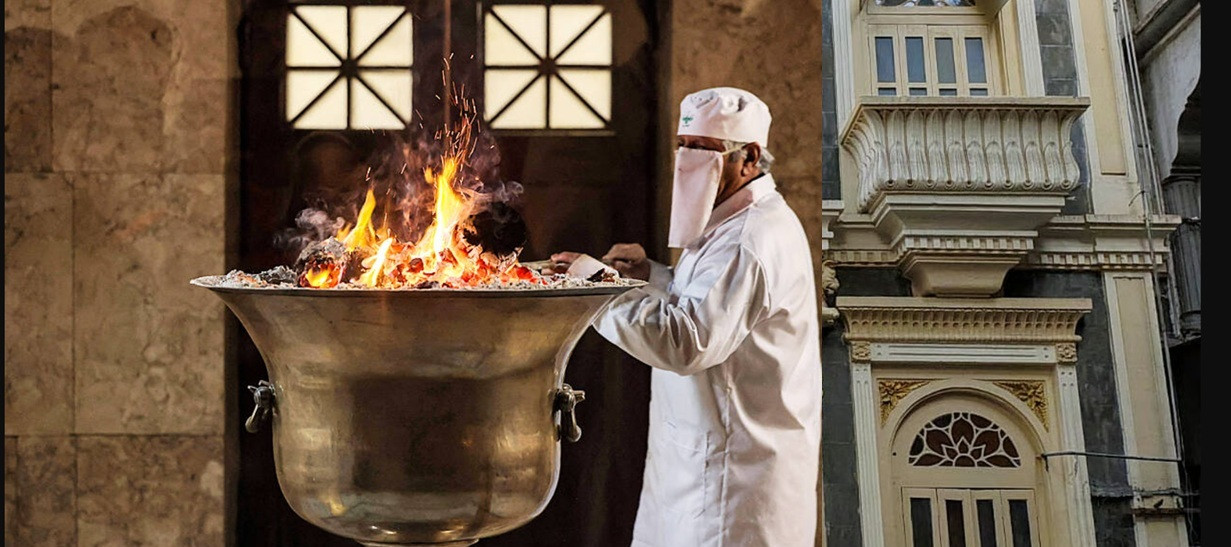
- Atash Behram: The highest grade, requiring fire gathered from sixteen distinct sources over months of ritual purification.
- Atash Adaran: An intermediate grade.
- Atash Dadgah: The most modest grade, common in smaller communities.
Pakistan possesses no Atash Behram. Karachi’s two functioning fire temples—the Behrana Dar-e-Meher in Saddar (1849) and the Wadia Dar-e-Meher (1869)—are both Adaran grade. Lahore and Quetta maintain smaller Dadgah shrines. Consequently, the most complex, extended liturgies of the Zoroastrian canon have not been performed on Pakistani soil for generations—not out of choice, but because the community never possessed the infrastructure for the highest tier, and now lacks the specialized clergy to perform even what it once managed.
Official Statements & Community Perspectives
While formal statements from institutional bodies are rare given the private, insular nature of Parsi community life, civic leaders and international scholars have increasingly raised alarms regarding the impending demographic cliff.
"The chain does not need doctrinal upheaval to break," notes a senior cultural researcher tracking minority heritage in South Asia. "It only needs one single generation in which no young man makes the journey to Mumbai, undergoes the grueling years of seminary training, and returns ordained. Once that link snaps, no amount of digital archiving can fully resuscitate the living breath of the tradition."
Community elders in Karachi frequently emphasize their deep, patriotic ties to Pakistan—pointing to decades of philanthropic investment in the nation’s educational and medical sectors. However, they privately concede that the institutional pipeline required to sustain ancient priestly traditions has completely atrophied within national borders.
Future Outlook: A Race Against Time
The immediate crisis facing Pakistan’s Zoroastrian community centers on an acute shortage of clergy. Karachi’s fire temples are currently sustained by a dwindling cadre of aging priests, several well past their eightieth year.
Because Pakistan houses no functioning Parsi seminary, ordination ceremonies (Navar and Martab) require young aspirants to travel to Mumbai’s Dadar Athornan Institute—itself operating with a critically shrinking cohort of students. For a community of 900 people experiencing steady youth emigration, producing young men willing to undertake years of rigorous, specialized theological training abroad for a vocation with zero secular economic viability at home is an increasingly impossible ask.
The Contrast with India and the Global Silence
While India has actively mobilized to preserve these fading traditions—bolstered by initiatives like the UNESCO-backed Parzor Foundation and SOAS’s Multimedia Yasna project (which filmed and annotated a complete Yasna liturgy in Mumbai in 2017)—no comparable ethnomusicological documentation has ever been undertaken in Pakistan.
The historic liturgical sounds unique to Karachi and Lahore’s temples—shaped by a distinct sub-regional history of migration, aging clergy, and local acoustic environments—remain unrecorded, unstudied, and unarchived.
Conclusion: The Diagnostic Question
The plight of Pakistan’s Parsis is the starkest possible illustration of a universal modern dilemma: the friction between rich, embodied cultural heritage and unforgiving demographic mathematics. It poses a piercing diagnostic question for cultural preservationists everywhere:
When confronted with an ancient, unwritten tradition, do we wait for institutional consensus, or do we act before the last living voice falls silent?
For the Zoroastrian priests of Karachi, as of this writing, the answer remains a quiet, precarious gamble against the ticking clock.





Comments
Facebook App ID not configured. Please add it in the Customizer.