
Executive Overview
The intersection of personal tragedy and creative output often produces some of the most compelling works of contemporary literature. This phenomenon is vividly demonstrated in Golden Boy, the forthcoming Young Adult sci-fi comedy novel by veteran screenwriter-turned-novelist A.J. Symon. Scheduled for publication on August 25, 2026, by Simon & Schuster Books for Young Readers, the novel has been pitched as an inventive blend of Weird Science and Marley & Me. The premise centers on a teenage girl whose life is upended when her beloved golden retriever inexplicably transforms into a real human boy.
However, beneath the whimsical, high-concept narrative lies a deeply personal exploration of loss. Symon, a Barnesville, Georgia resident deeply rooted in Southern culture, developed the core concept decades ago during a playful game of fetch that devolved into keep-away. Yet, the emotional scaffolding of the published manuscript was forged in the crucible of profound grief. Following the sudden loss of his service dog and "soul dog," Chip—who succumbed to an aggressive form of cancer nearly a decade after aiding Symon through his seizure disorder—the author channeled his heartbreak into the rapid composition of his first-ever novel.
This profile examines the nearly thirty-year evolution of Golden Boy, exploring Symon’s transition from the high-stress environment of the film industry to the deliberate pace of traditional publishing. Furthermore, it details how the author weaponized his grief against writer’s block, completing a 100,000-word manuscript in a mere four months. Through interviews, industry analysis, and contextual background, this report provides a comprehensive look at one of the most anticipated YA releases of late 2026.
Read Also
Detailed Chronology: A Thirty-Year Evolution from Pitch to Publication
The path from an accidental spark of inspiration to a major publishing house contract is rarely straightforward, but A.J. Symon’s journey with Golden Boy stands as an extreme example of long-term artistic gestation. The timeline of the project spans roughly three decades, transitioning across mediums, formats, and emotional landscapes.
Phase 1: The Initial Spark (Mid-1990s)
The genesis of Golden Boy occurred decades prior to its publication date, born from mundane domestic observation. While playing a standard game of fetch with his golden retriever, Symon found himself engaging in an impromptu game of keep-away. As the dog zoomed across the yard, refusing to surrender the ball, a speculative thought crossed the author’s mind: If that dog were human, he’d be an amazing running back.
At the time, Symon was firmly established in the entertainment industry as a screenwriter. The initial concept—a dog manifesting into a human football phenom—was filed away as a high-concept premise suited for the screen.
Phase 2: Screenplay Iterations and the Cinematic Lens
For years, Symon treated the idea through the prism of his primary profession. He made various attempts to draft the concept as a screenplay, framing it primarily as a wacky, slapstick adult comedy. In the film industry, narratives of this nature lean heavily into rapid-fire visual gags, externalized conflicts, and structural pacing designed to capture the attention of studio executives and test audiences.
However, these early film drafts never quite achieved the lasting resonance Symon sought. The concept remained dormant for long stretches, trapped between the commercial demands of Hollywood comedy and a lack of emotional grounding.
Phase 3: The Catalyst of Grief (The Mid-2020s)
The trajectory of the project shifted radically due to real-life circumstances. Diagnosed with a seizure disorder several years prior, Symon relied on Chip, a golden retriever who served as his certified service animal, constant companion, and caretaker for nearly a decade. Chip was, in modern colloquial terms, a "soul dog"—an animal whose presence was woven into the fabric of the author’s daily existence.
The turning point arrived with devastating swiftness. Chip was diagnosed with an aggressive form of cancer that presented symptoms only at its terminal stage. Within twenty-four hours of diagnosis, the dog was gone.
Plunged into acute grief, Symon abandoned his previous professional writing habits and turned to the keyboard as an emotional outlet. Instead of a detached comedic screenplay, he began drafting a novel. All the pain of loss, compounded by a decade of joy and loyalty, poured onto the page. When the initial wave of writing subsided, Symon realized he had inadvertently constructed the narrative he personally required to process his trauma.
Phase 4: Acquisition and the Simon & Schuster Debut (August 2026)
Transformed from an adult slapstick comedy into a grounded, character-driven Young Adult novel, the manuscript caught the attention of Simon & Schuster Books for Young Readers. Collaborating closely with his editor, Symon refined the emotional beats, balancing the comedic premise with poignant, tear-jerking elements. The book is officially slated for release on August 25, 2026, marking Symon’s official debut as a published novelist.
Supporting Context & Metrics: The Mechanics of a Memoir-Infused Comedy
To understand the structural success of Golden Boy, one must examine the metrics of its production and the thematic pillars supporting its narrative framework.
Production Metrics
- Drafting Velocity: Symon completed the first draft of Golden Boy in an unprecedented four-month window. This stands in stark contrast to his past screenwriting experiences, where structural roadblocks and institutional notes often protracted development phases.
- Gestation Period: Approximately 30 years elapsed between the initial afternoon in the backyard and the finalized publication date.
- Target Demographic: Young Adult (YA) Fiction, crossing over into Science Fiction and Humorous Contemporary.
- Geographic Anchor: Barnesville, Georgia, where a portion of the book’s proceeds are slated to support local golden retriever care.
The Psychology of Writing Through Trauma
Literary history contains numerous examples of authors utilizing fiction to metabolize grief—from C.S. Lewis’s A Grief Observed to Joan Didion’s The Year of Magical Thinking. However, translating acute personal trauma into a commercial Young Adult sci-fi comedy represents a unique creative challenge.
Psychologically, Symon’s inability to stop writing during the four-month drafting period aligns with trauma-processing behavior. By displacing his real-life service dog, Chip, into a fantastical, transformative narrative arc, the author was able to examine the dynamics of loyalty, companionship, and inevitable separation from a safe narrative distance. The protagonist’s journey of accepting a strange, newly humanized canine mirrors the author’s own journey of accepting an abrupt absence, reframing a tragic loss into an uplifting celebration of unconditional love.
Official Statements & Insights
In recent discussions regarding his transition from the screen to the page, Symon has offered candid reflections on the creative process, the mechanics of grief, and the stark cultural differences between two distinct entertainment sectors.
On the Genesis of the Story and Overcoming Writer’s Block
Reflecting on how the project superseded his historical struggles with writer’s block, Symon noted:
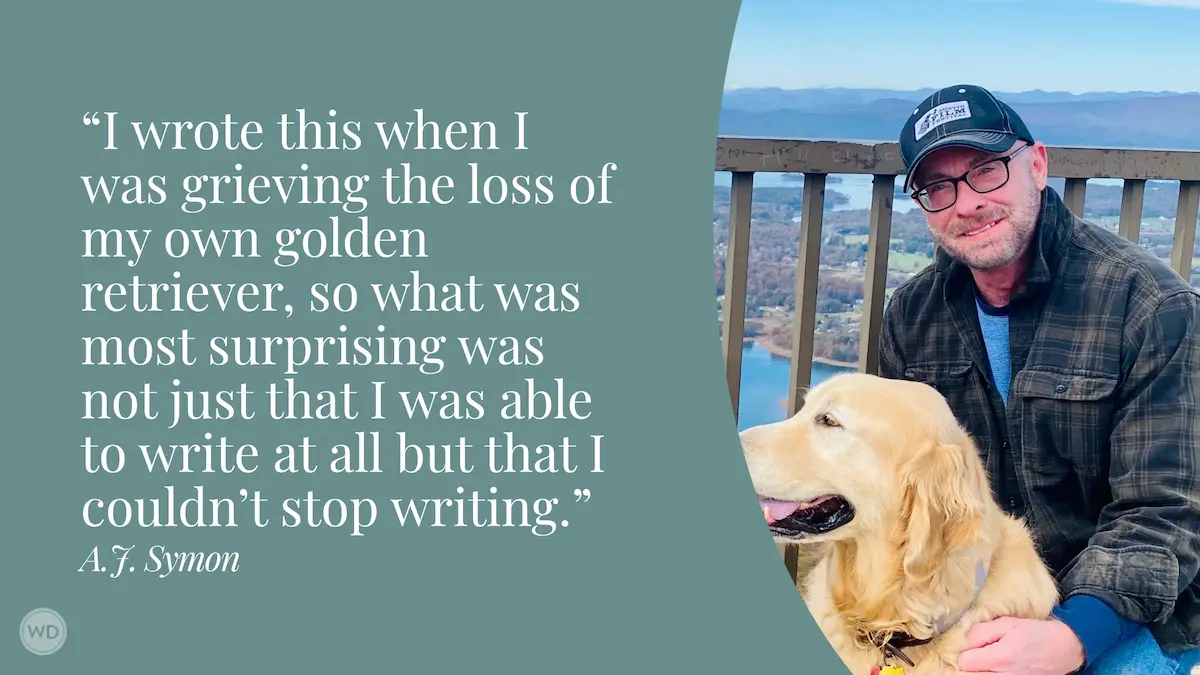
"I wrote this when I was grieving the loss of my own golden retriever, so what was most surprising was not just that I was able to write at all but that I couldn’t stop writing. On almost every project I’ve ever done, I’ve had periods of writer’s block. If I did with Golden Boy, I can’t remember it. It just poured out of me. I blew through the first draft in four months."
On the Craft of the First Draft
Addressing aspiring writers who struggle with the initial phase of creation, Symon emphasized the necessity of structural imperfection:
"Allow yourself to write badly. Even the greatest authors write awful first drafts. They just keep rewriting and rewriting and rewriting. The important thing is not to stop, or inertia takes over. Keep the momentum going even if you just write one word a day."
On the Cultural Shock Between Filmmaking and Publishing
Having spent decades navigating the high-stakes, fast-paced environment of Hollywood, Symon experienced a distinct paradigm shift when entering the traditional book publishing ecosystem:
"The contrast between filmmaking, where the anxiety level is ratcheted way up and people have a needed-it-yesterday mentality, and publishing, which tends to move much slower, was a bit of culture shock for me. As a screenwriter, your job is to deliver the script that the director (and often the producer) wants. He or she makes the final decisions. With the book, I had the final say, which was empowering but also a little nerve-wracking, to be honest. Its success is all on your shoulders."
Future Outlook: What Lies Ahead for A.J. Symon
As the August 25, 2026 release date for Golden Boy approaches, the literary and media landscapes are poised to observe how the YA market responds to Symon’s unique brand of high-concept humor paired with emotional vulnerability.
Impact on the Young Adult Genre
The YA sci-fi and contemporary comedy genres frequently seek out fresh premises that blend fantastical elements with authentic adolescent coming-of-age themes. By anchoring an absurd supernatural event—a dog turning into a human boy—to the universal themes of grief, adaptation, and friendship, Golden Boy occupies a distinct niche. It avoids the cynical detachment common in some contemporary YA properties, opting instead for a warm, Southern-infused optimism that echoes the sensibilities of classic family-friendly entertainment.
Upcoming Projects and Continued Writing
Far from viewing Golden Boy as a one-off creative endeavor born purely of necessity, Symon has signaled a permanent expansion into novel writing. Benefiting from the steep learning curve navigated alongside his Simon & Schuster editor during the development of this debut, the author is already deep into the drafting phase of his next book.
Armed with a newfound appreciation for the authorial autonomy inherent in the publishing industry—contrasted with the collaborative compromises of screenwriting—Symon plans to continue maintaining his residence in Barnesville, Georgia. There, surrounded by family and canine companions supported in part by the proceeds of his literary endeavors, he continues to mine the intersections of humor, humanity, and the deep bonds shared between humans and their pets.



Comments
Facebook App ID not configured. Please add it in the Customizer.