
Executive Overview
For over two decades, Jerry Hsu has occupied a singular position at the intersection of American youth culture, professional action sports, and contemporary documentary photography. Having risen to prominence in the late 1990s as a prodigy within professional skateboarding, Hsu helped redefine the visual and physical parameters of the sport. However, his enduring legacy extends far beyond the board. Over the past fifteen years, Hsu has established himself as a keen chronicler of urban decay, everyday surrealism, and domestic intimacy.
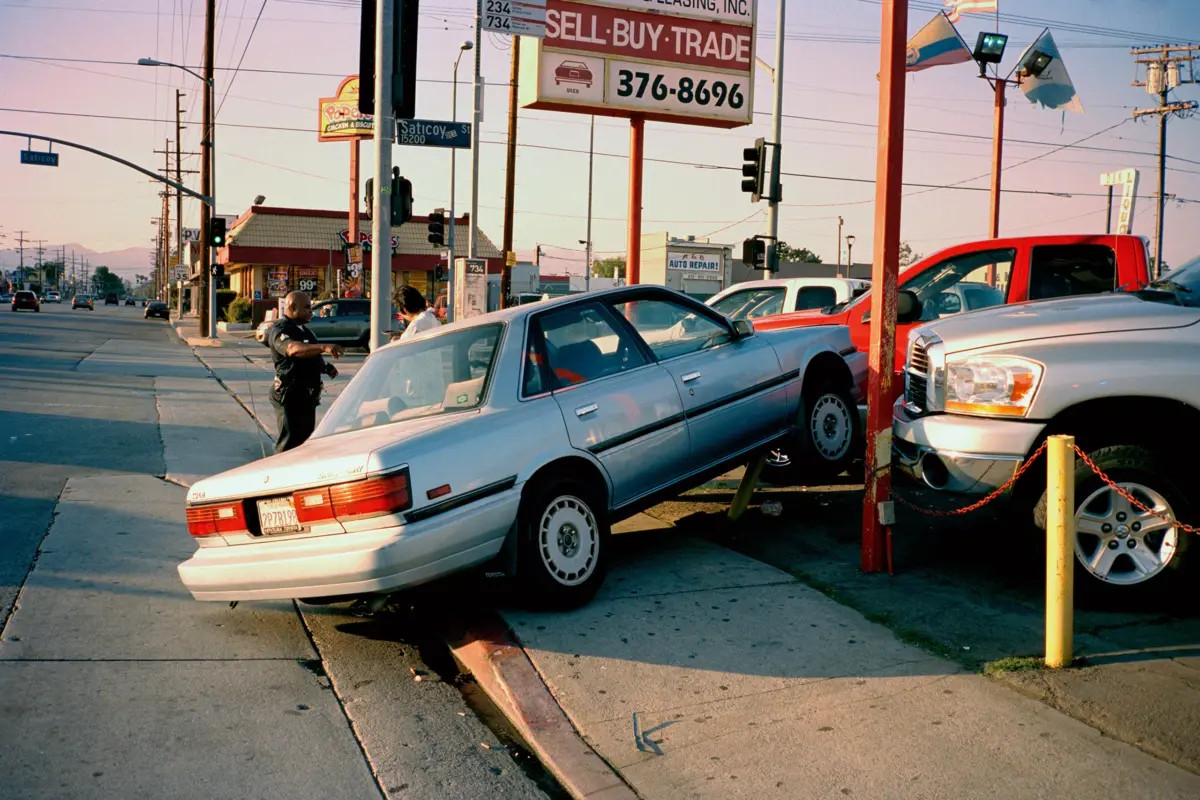
His latest photographic monograph, How About Never (published by MACK), represents the culmination of a decade and a half of relentless visual archiving across Los Angeles. Grounded in an aesthetic sensibility forged through years of converting public infrastructure into sites of artistic expression, Hsu’s work captures a metropolis characterized by extreme contrasts—ranging from violent vehicle collisions and ablaze architecture to delicate, absurd encounters within the urban sprawl.
Now 44, Hsu balances his artistic practice with the management of his apparel and skate brand, Sci-Fi Fantasy. How About Never serves as both an unsparing portrait of contemporary Los Angeles and a deeply personal subtextual record of personal transition, marital dissolution, and artistic maturation.
Read Also
Detailed Chronology
+-----------------------------------------------------------------------------------+
| CHRONOLOGY OF JERRY HSU'S DUAL CAREER                                             |
+-----------------------------------------------------------------------------------+
| 1980s–1990s  | Raised in San Jose; begins skateboarding; mother supports practice |
| Mid-1990s    | Turns professional in mid-teens; features in seminal skate videos  |
| 2000s        | Converts San Jose into a skate capital; develops photography habit |
| 2000s–2010   | Travels globally; publishes photos on Tumblr and Vice Magazine     |
| 2011         | Relocates to Los Angeles; deepens street photography focus         |
| 2010s–2020s  | Launches Sci-Fi Fantasy; begins 10-year curation of photo archives |
| Present      | Releases monograph *How About Never* with MACK Books               |
+-----------------------------------------------------------------------------------+
The San Jose Epoch and Early Prodigy (1980s–2000s)
Jerry Hsu was raised in San Jose, California, the son of Taiwanese immigrants. During the late 1990s and early 2000s, Silicon Valley was undergoing a rapid technological boom, yet its physical landscape offered a sprawling, quiet canvas for youth subcultures. Hsu demonstrated an early, precocious talent on a skateboard, turning professional in his mid-teens.
Along with a tight-knit cohort of peers, Hsu began documenting his maneuvers on video. These self-produced street videos catalyzed an unexpected cultural shift: young skateboarders from across the United States began migrating to San Jose. Through media distribution networks of the era—primarily VHS tapes and specialized print magazines—Hsu and his group effectively elevated a sleepy Northern California suburb into a globally recognized hub of street skateboarding.
Crucial to this early development was domestic support. Recognizing her son’s dedication, Hsu’s mother famously procured a heavy concrete parking block for their driveway, allowing him to endlessly practice technical tricks at home. She also regularly drove him to the local Barnes & Noble, where Hsu immersed himself in photo books. There, he encountered the work of artists who chronicled subcultural margins, notably Nan Goldin and Larry Clark.
International Touring and Digital Archiving (2000s–2010)
As major skateboard manufacturers dispatched Hsu across the globe for competitions, video projects, and promotional tours, his exposure to commercial media crews catalyzed a profound technical curiosity. Spending extended hours in front of photojournalists’ lenses, Hsu began questioning the mechanics of photography—studying focal lengths, film stocks, exposure values, and camera bodies.
Equipped with his own cameras, Hsu initiated an obsessive daily practice of photographing the absurd, gruesome, and uncanny artifacts encountered during international travel. Rather than pursuing traditional fine-art gallery avenues initially, Hsu utilized emerging digital channels, distributing his work through platforms like Tumblr and editorial features in Vice magazine. This era established his visual signature: an unblinking eye for dark humor, urban incongruity, and raw human vulnerability.
Los Angeles Relocation and Curation (2011–Present)
In 2011, Hsu made a strategic and personal decision to move south to Los Angeles. While driven by a romantic relationship and the operational demands of the skateboarding industry, the city’s vast, chaotic landscape presented an expanded field for his photographic ambitions.
Over the subsequent decade and a half, facing the physical toll of a twenty-year professional skateboarding career, Hsu transitioned his primary professional focus toward directing his brand, Sci-Fi Fantasy, and navigating Los Angeles on foot and by vehicle to capture its unpredictable daily scenes.
Between 2014 and 2024, Hsu systematically edited an ocean of archival negatives, contact sheets, and digital files. This painstaking ten-year editorial process ultimately crystallized into his landmark 2024 monograph, How About Never.
Supporting Context & Cultural Metrics
To fully understand Hsu’s artistic methodology, one must evaluate the intersection of spatial subversion inherent in skateboarding, the physical volume of his personal archive, and the unique mechanics of Los Angeles urbanism.
+------------------------------------------------------------------------------------+
| METHODOLOGICAL TRIAD OF HSU'S PHOTOGRAPHIC PRACTICE                                |
+------------------------------------------------------------------------------------+
| 1. Spatial Recontextualization | Translating skateboard line-seeking into visual    |
|                                | framing of architectural neglect and irony.       |
+------------------------------------------------------------------------------------+
| 2. Comprehensive Archiving     | Retaining failures, outtakes, and raw digital     |
|                                | stream (25 years of complete physical/digital logs)|
+------------------------------------------------------------------------------------+
| 3. Real-Time Emergency Tracking| Utilizing localized blotter apps (e.g., Citizen)  |
|                                | to locate active urban friction points.           |
+------------------------------------------------------------------------------------+
Spatial Subversion as Visual Training
Skateboarding requires an acute, non-traditional reading of the built environment. What city planners design as structural barriers, handrails, retaining walls, or drainage ditches, a skateboarder views as terrain for kinetic performance.
This spatial recontextualization directly informs Hsu’s photographic gaze. In How About Never, public and private infrastructure is frequently depicted as failing, misused, or surreal:
- Discarded Sanitation Infrastructure: Two broken toilets positioned on a sidewalk in a manner resembling the yin-and-yang symbol (or a crude sexual posture).
- Structural Fatigue: A heavy triangular slab that has dropped out of a concrete wall, leaving an empty void.
- Incongruous Florals: A secluded flower bush trapped behind industrial security fencing, or a rot-hollowed tree trunk carefully packed with fresh roses by an anonymous resident.
Archival Scale and Methodology
Unlike traditional street photographers who strictly edit on the fly, Hsu maintains an exhaustive archival strategy derived from his youth. During his early training, Hsu spent hundreds of hours in his parents’ garage filming himself practicing tricks—painstakingly cataloging every missed attempt alongside successful execution to study fluid movement and form.
This philosophy governs his photographic work today:
- Twenty-Five Years of Continuity: Hsu maintains a consolidated physical and digital archive containing virtually every frame captured over a quarter-century.
- Zero-Deletion Policy: Digital images taken on mobile devices or pocket cameras are rarely purged; raw outtakes and discarded frames are preserved for future thematic reappraisal.
- Decade-Long Curation: How About Never required nearly ten years of sequencing, distilling tens of thousands of exposures into a tightly paced, narrative-driven volume.
Urban Friction and Digital Dispatch
Hsu’s practice in Los Angeles actively leverages modern localized monitoring platforms. Rather than relying solely on passive, casual observation, Hsu frequently monitors incident-reporting applications such as Citizen. By tracking real-time emergency dispatches—structural fires, traffic collisions, and civic disturbances—he navigates directly toward points of urban tension, capturing moments immediately following chaotic events.
Official Statements & Analytical Commentary
Hsu’s reflections on his transition from subcultural icon to fine-art documentarian provide critical insight into the psychological underpinnings of How About Never.
On the Cultural Emergence of San Jose
Reflecting on the early era when San Jose became an epicenter for global street skating, Hsu emphasized the serendipitous nature of subcultural movements:
"It’s like when a random city becomes very important for some random reason. Young skateboarders were moving to San Jose, and it had to do with my group of friends and these videos we were making. We were able to have our slice of heaven."
On Physical Risk and Visual Calm
Addressing his persistent drawnness toward volatile situations—car crashes, active structural fires, overturned vehicles—Hsu frames this appetite not as morbid voyeurism, but as a search for an eerie internal equilibrium:
"My attraction to risk is ever present. There’s a sense of stillness in these images, akin to that flash of calm after you’ve done something ruinous to your body but before your brain registers pain or begins cycling through consequences."
+------------------------------------------------------------------------------------+
| KEY VISUAL MOTIFS IN *HOW ABOUT NEVER*                                            |
+------------------------------------------------------------------------------------+
| - Overturned suburban vehicles (e.g., Subaru on its side with "4A POEM" license)  |
| - Shattered windshields featuring reptilian glass fractures                        |
| - Intimate domestic details (hospital rooms, bruises, sink basins)                |
| - High-contrast fire light against Los Angeles suburban hills                      |
+------------------------------------------------------------------------------------+
On the Subtext of Marital Breakdown and Domestic Isolation
While How About Never functions externally as a portrait of Los Angeles, Hsu revealed that the internal editing process laid bare a painful, deeply personal arc—specifically, the gradual dissolution of his marriage over the decade the photos were taken:
"There is a private story of hope, despair, all the feelings that are associated with trying to make a loving relationship happen… All this chaos and these little beautiful secrets I found here reminded me of myself. It was a mirror and threshold."
On the Compulsion to Record Every Attempt
Comparing his photographic archive to his teenage practice tapes, Hsu noted the trade-offs of possessing a hyper-observant visual mind:
"Maybe because I have this type of vision, it really takes away from another type that’s more practical."
Future Outlook
The publication of How About Never marks a critical milestone in Jerry Hsu’s artistic career, cementing his shift from action-sports icon to a serious contributor to contemporary visual arts.
Key Trajectories for Hsu’s Work:
- Expanding the Archives: With twenty-five years of unreleased negatives, contact sheets, and digital drives stored in his Los Angeles studio, Hsu possesses raw material for multiple targeted monographs and retrospective exhibitions.
- Evolution of Sci-Fi Fantasy: Hsu’s creative direction of his brand, Sci-Fi Fantasy, continues to merge subcultural skate apparel with modern graphic design, providing financial independence outside the conventional gallery system.
- Documenting the Evolving Landscape: As Los Angeles undergoes rapid architectural, social, and technological shifts, Hsu’s real-time, emergency-app-assisted documentation ensures a rare, unglamorized record of the city’s underbelly.
Hsu’s relentless compulsion to observe remains entirely uninterrupted. Moments after concluding his interview discussing the new book, a alert flashed across his mobile device: a vehicle had just flipped over in Koreatown. Camera in hand, Hsu moved toward the line of fire once again.




Comments
Facebook App ID not configured. Please add it in the Customizer.