
Executive Overview
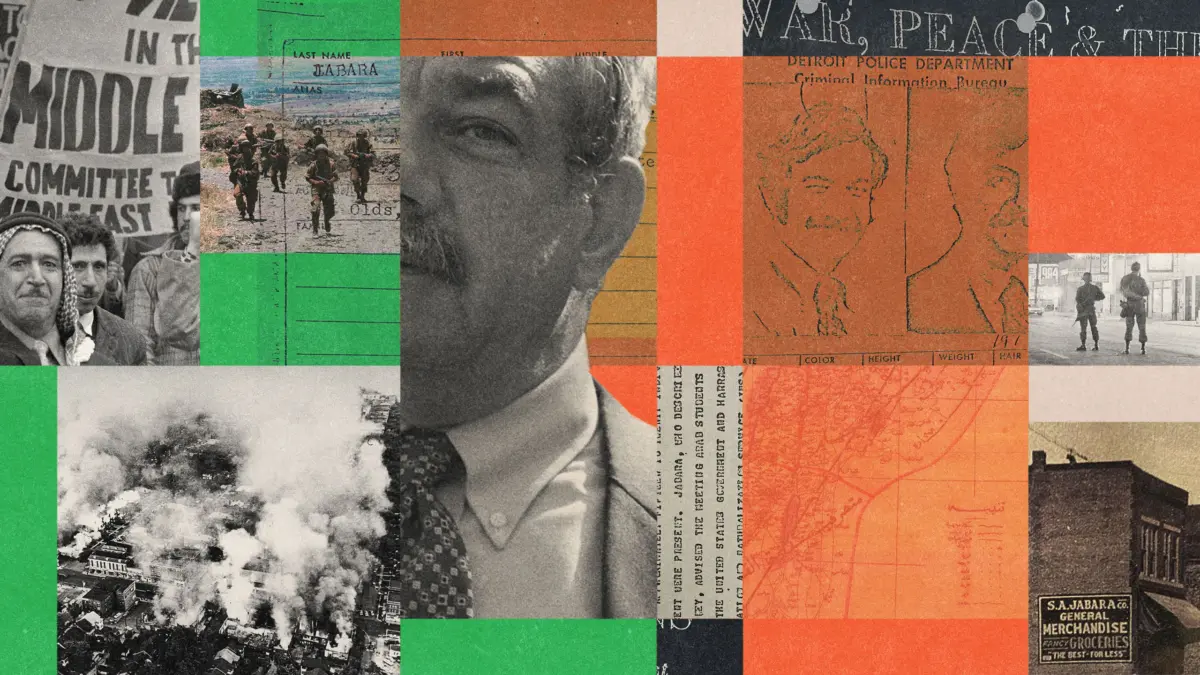
Long before the post-9/11 era solidified the architecture of mass electronic surveillance, American intelligence agencies constructed a expansive, clandestine apparatus targeting Arab Americans. At the center of this historical collision was Abdeen Jabara, a civil rights attorney whose journey from a small Michigan grocery store to the federal courts exposed the inner workings of state surveillance.
Jabara’s early life reflected the mid-20th-century Arab-American experience—rooted in Northern Michigan’s small towns, enriched by Levantine customs, and shaped by the geopolitical fractures of the Middle East. However, his work as an attorney during the late 1960s and 1970s placed him in direct conflict with federal intelligence agencies.
When the Nixon administration initiated Operation Boulder in 1972—a federal surveillance and profiling initiative targeting individuals of Arab descent—Jabara became a primary target. His subsequent federal lawsuit, Jabara v. Webster, yielded a historic revelation: for the first time in U.S. history, the National Security Agency (NSA) was forced to admit that it had intercepted the private communications of an American citizen without a warrant.
Read Also
This comprehensive report examines Jabara’s life, the geopolitical events that galvanized his political consciousness, the mechanics of early federal surveillance programs, and the legal precedents that continue to shape civil liberties and intelligence gathering in the United States today.
Detailed Chronology
1924 ── Sam & Mymonie Jabara marry; settle in Mancelona, MI
1940 ── Abdeen Jabara born in Mancelona
1948 ── Nakba displacement; father listens to Arabic radio broadcasts
1951 ── Father killed in fatal truck collision near Traverse City
1962 ── Abdeen travels to ancestral villages in Lebanon and Egypt
1965 ── Graduates Wayne State Law; begins civil rights work
1967 ── Detroit Uprising & Six-Day War; co-founds AAUG
1971 ── Discovers FBI financial surveillance via bank leak
1972 ── Munich Olympics; Nixon administration launches Operation Boulder
1973 ── Files constitutional lawsuit against FBI and federal agencies
1975 ── Operation Boulder officially ended by State Department
1980s─ Court orders FBI to destroy Jabara's surveillance files
Immigrant Roots in the Michigan Northwoods (1920s–1951)
The story of the Jabara family reflects early 20th-century Arab immigration to the American Midwest. In 1924, Mohammed Ali Jabara—a World War I veteran from a village on the slopes of Mt. Hermon in Greater Syria who adopted the name Sam Jabara—married Mymonie Mellem, a daughter of Syrian immigrants who had settled in Ross, North Dakota. The couple made their home in Mancelona, Michigan, a small town shaped by timber, iron smelting, and unpaved boardwalks.
Operating the S.A. Jabara Grocery store on the corner of State and Maple Streets, the family bridged two worlds. Inside their home, Mymonie baked flatbread in a wood-burning oven, prepared fatayer and kibbe, and gathered wild-grape leaves and mulberries. Outside, Sam delivered produce by horse and buggy, participated in community life through the local Masonic temple, and marched in Memorial Day parades in his U.S. Army uniform.
Abdeen Jabara, the youngest of seven children, was born in 1940. His early childhood was steeped in the rhythms of rural Michigan, but global events soon filtered into the family’s living room.
In May 1948, eight-year-old Abdeen observed his father hunched over a Stromberg-Carlson radio listening to crackling Arabic broadcasts reporting the Nakba—the displacement of hundreds of thousands of Palestinians during the establishment of the State of Israel. It was the first time Abdeen had seen his father visibly shaken, signaling the enduring emotional bond connecting the diaspora to the Middle East.
Tragedy struck the family in June 1951. While driving to a wholesale market in Traverse City with eleven-year-old Abdeen in the passenger seat, Sam’s truck collided with an oil tanker. Sam was killed instantly, and Abdeen suffered a severely fractured leg.
Identity, Nasserism, and Legal Education (1950s–1965)
Following his father’s death, Abdeen sought to preserve a connection to Sam’s heritage by immersing himself in Middle Eastern history, politics, and the Arabic language. He discovered that the collapsing Ottoman borderlines had reclassified his ancestral home from Syria to Lebanon.
During the mid-1950s, the rise of Egyptian President Gamal Abdel Nasser captivated the Arab diaspora. Nasser’s message of pan-Arabism, anti-colonial independence, and social reform resonated deeply with Abdeen. While in high school, Jabara entered a regional public speaking competition in Traverse City, delivering a speech on Arab nationalism that earned him first place.
While studying at the University of Michigan in the early 1960s, Jabara traveled to the Middle East. Journeying by freighter from Alexandria to Beirut, he retraced his parents’ migration routes, visited relatives in Cairo, and met his namesake—his mother’s uncle—in her ancestral village in the Bekaa Valley. In his father’s mountain home, he discovered that Sam had quietly sent funds from his Mancelona grocery store to build a village school.
Upon his return, Jabara enrolled at Wayne State University Law School in Detroit. Recognizing parallels between anti-colonial movements abroad and the domestic struggle for racial justice, he interned with Ernest Goodman, a prominent civil rights lawyer and leader in the National Lawyers Guild. Jabara passed the bar exam in 1965, intending to practice personal injury law while supporting civil rights litigation.
                  +-----------------------------------+
                  |  Post-1967 Mobilization Pathways  |
                  +-----------------------------------+
                                    |
          +-------------------------+-------------------------+
          |                                                   |
          v                                                   v
+-------------------------------+                   +-------------------------------+
|     Legal & Legal-Defense     |                   |    Academic & Public Policy   |
+-------------------------------+                   +-------------------------------+
| • Southend Dearborn Lawsuit   |                   | • Co-founding of AAUG (1967)  |
| • Defense of Student Visas    |                   | • Campus Symposia & Lectures  |
| • Opposition to Op. Boulder   |                   | • Middle East Delegations     |
+-------------------------------+                   +-------------------------------+
The Watershed of 1967: Uprising and War
The summer of 1967 served as a double catalyst for Jabara’s political and legal activism:
- The Detroit Rebellion (July 1967): A violent confrontation erupted after police raided an unlicensed club in a predominantly Black neighborhood, culminating in 43 deaths, thousands of injuries, and the deployment of the National Guard.
- The Six-Day War (June 1967): Israel defeated combined Arab armies, occupying the West Bank, Gaza Strip, East Jerusalem, the Golan Heights, and the Sinai Peninsula.
The military defeat fractured the secular Arab nationalist movement embodied by Nasser. In response to these shifts, Jabara co-founded the Association of Arab American University Graduates (AAUG) alongside other scholars in Ann Arbor. The organization aimed to inform the American public about Palestinian displacement and advocate for adjustments to U.S. foreign policy.
Simultaneously, Jabara applied his legal expertise locally in Dearborn, Michigan. The city’s Southend neighborhood—a working-class enclave populated by Arab, Southern European, and Appalachian immigrants—faced destruction under an urban renewal plan championed by Mayor Orville Hubbard. Hubbard’s administration sought to demolish residential housing to construct an industrial park.
Jabara helped file a class-action civil rights lawsuit on behalf of Southend residents, arguing that the city was intentionally displacing immigrant and minority populations. The residents won the suit, preserving the neighborhood and solidifying Dearborn as a focal point for Arab-American community organizing.
State Surveillance and Operation Boulder (1968–1975)
Jabara’s growing prominence drew the attention of federal intelligence agencies. Under Director J. Edgar Hoover, the Federal Bureau of Investigation (FBI) expanded its internal security programs to monitor anti-war, civil rights, and ethnic political organizations.
In 1971, Jabara’s law partner, Dennis James, received a tip from a bank clerk revealing that federal agents were monitoring the firm’s bank accounts. A hand-written list of targeted individuals included Jabara’s name.
                   +----------------------------------+
                   |  Operation Boulder Infrastructure |
                   |             (1972–1975)          |
                   +----------------------------------+
                                    |
         +--------------------------+--------------------------+
         |                                                     |
         v                                                     v
+---------------------------------+           +---------------------------------+
|      Immigration / Screening    |           |   Domestic Intelligence / FBI   |
+---------------------------------+           +---------------------------------+
| • Mandatory visa background     |           | • Warrantless wiretapping       |
|   checks for Arab nationals     |           | • Bank record collection        |
| • Mandatory student visa audits |           | • Informant network expansion   |
| • Targeted deportation sweeps   |           | • Physical surveillance & raids |
+---------------------------------+           +---------------------------------+
State surveillance escalated sharply in September 1972 following the Munich Olympics tragedy, in which the Palestinian militant group Black September taken hostage and killed eleven Israeli athletes. In response, President Richard Nixon created the Cabinet Committee to Combat Terrorism, led by Secretary of State William Rogers.
This committee authorized Operation Boulder, an interagency program overseen by the FBI, the State Department, and the Immigration and Naturalization Service (INS). Operation Boulder targeted individuals of Arab origin living in or entering the United States:
- Visa Screenings: Arab visitors and students faced heightened visa scrutiny and mandatory background investigations.
- Targeted Interrogations: FBI and INS agents questioned foreign students and Arab-American citizens regarding their political beliefs, affiliations with groups like Fatah, and views on the Israeli-Palestinian conflict.
- Warrantless Surveillance: Intelligence agencies expanded phone taps, physical surveillance, and financial audits against political organizers.
Federal agents conducted warrantless break-ins, including a raid on the Dallas office of the Arab Information Center, and conducted interrogations of Arab League diplomats and community leaders nationwide.
Jabara v. Webster: Unmasking NSA Wiretaps
Recognizing that his constitutional rights were being infringed upon, Jabara filed a federal lawsuit against the FBI and the federal government, alleging unlawful surveillance, harassment, and violations of the First, Fourth, and Fifth Amendments.
The Department of Justice initially refused to confirm or deny the existence of wiretaps, citing national security and state secrets. However, as litigation progressed, court orders forced the government to disclose its records:
+-----------------------------------------------------------------+
|                 COMPOSITION OF JABARA'S FBI FILE                |
+-----------------------------------------------------------------+
|  [X] Physical surveillance logs (1967–1975)                     |
|  [X] Transcripts of domestic and international telephone calls  |
|  [X] Summaries of public speeches and academic presentations    |
|  [X] Intercepts sourced from domestic private advocacy groups   |
|  [X] Financial transaction audits across multiple banks         |
|  [X] Intelligence shared across 17 federal agencies & 3 foreign |
|      governments                                                |
+-----------------------------------------------------------------+
The most significant disclosure emerged when the government admitted that the National Security Agency (NSA) had intercepted Jabara’s international communications without a warrant and passed those transcripts to the FBI. This marked the first official admission in U.S. history that the NSA had intercepted the private communications of an American citizen.
Supporting Context & Metrics
Operation Boulder and its associated surveillance operations represented a coordinated federal effort targeting a specific ethnic minority. The scale of these programs, along with the subsequent litigation outcome, is summarized below:
Operation Boulder Operational Metrics (1972–1975)
| Metric | Official Reported Value |
|---|---|
| Total Names Checked Against Intelligence Databases | ~150,000 |
| Federal Agencies Participating in Data-Sharing | 17 (including FBI, CIA, NSA, State Dept, INS) |
| Foreign Governments Receiving Shared Data | 3 |
| Total Deportations Executed Under Operation Boulder | 78 |
| Criminal Charges Filed Related to Terrorism | 0 |
| Duration of Operation Boulder | Sept 1972 – April 1975 |
Intelligence File Disclosures in Jabara v. Webster
- Surveillance Duration: The FBI maintained active surveillance on Jabara from 1967 to 1975 (8 years prior to public disclosure).
- Interviews Conducted: Federal agents interviewed over 100 acquaintances, colleagues, and associates regarding Jabara’s activities.
- Primary Source Materials: The dossier contained transcripts of radio interviews, speech notes, organizational meeting minutes, travel itineraries, and financial audit logs.
OPERATION BOULDER PROCESSING FLOW
=================================

[Arab Visa Applicants / U.S. Residents]
               │
               ▼
   [State Dept / INS Screening]
               │
               ▼
    [FBI Radical Division Audit] ◄─── [NSA Intercepts]
               │
               ▼
   ┌───────────────────────┐
   │ 150,000 Names Checked │
   └───────────────────────┘
               │
       ┌───────┴───────┐
       ▼               ▼
[78 Deportations]  [0 Criminal Charges]
Official Statements & Documented Record
The historical record contains admissions regarding the purpose, scope, and ultimate failure of Operation Boulder and associated surveillance practices.
On the Purpose and Conduct of Surveillance
In an internal 1970 memorandum detailing the agency’s domestic intelligence priorities, the Federal Bureau of Investigation framed its profiling strategy as follows:
"Any potential terrorist will almost invariably be an Arab national, having been born and raised in Palestine or one of the Arab countries most involved with Israel… If an attack occurs on American soil, it will likely be facilitated by sympathetic Arab students residing here."
Conversely, spokesperson representatives for Arab-American organizations pushed back publicly. Following an unannounced FBI raid in Dallas, an official for the Arab Information Center told The New York Times:
"Wherever we drive, they shadow us. We are extremely resentful of this. We regard it as obnoxious in a country under the rule of law."
On the Termination of Operation Boulder
In April 1975, amid Congressional investigations into intelligence agency abuses (the Church Committee hearings), the U.S. Department of State formally announced the termination of Operation Boulder, with an official stating:
"It was not worth the manpower that went into it."
Judicial Rulings in Jabara v. Webster
The litigation surrounding Jabara yielded mixed legal outcomes over a decade of proceedings:
- District Court Finding on the Fourth Amendment:
The federal district court ruled that the FBI’s targeted surveillance and collection of Jabara’s records violated his Fourth Amendment rights, ordering the Bureau to destroy its entire intelligence file on him. - Appeals Court Decision on NSA Interception:
The U.S. Court of Appeals for the Sixth Circuit ruled that while the FBI’s targeted domestic collection was unlawful, the NSA’s interception of Jabara’s communications—obtained while monitoring foreign communications traffic—did not violate the Fourth Amendment because he was not directly targeted by the NSA’s foreign sweep. This established a legal precedent allowing "incidental collection" of citizens’ communications.
Future Outlook & Legacy
The legal battles waged by Abdeen Jabara in the 1970s foreshadowed the modern debates surrounding national security, bulk data collection, and constitutional rights.
        PRE-9/11 SURVEILLANCE                    POST-9/11 SURVEILLANCE
   ===============================          =================================
   • Operation Boulder (1972)               • USA PATRIOT Act (2001)
   • Manual wiretaps & bank audits          • Bulk metadata collection (PRISM)
   • Focused on Arab-American activist      • Mass electronic screening
     networks                               • FISA Section 702 warrantless sweeps
   • Judicial finding: FBI file destruction • Widespread surveillance of Muslim
   • Counter-precedent: NSA "incidental"      community leaders
     collection allowed
The Lineage of Mass Surveillance
The appellate court’s ruling in Jabara v. Webster created the legal framework for the concept of "incidental collection." Under this doctrine, intelligence agencies monitoring foreign targets can retain, search, and analyze communications belonging to American citizens without first obtaining a warrant, provided the citizen was not the explicit primary target of the initial intercept.
Decades later, this precedent served as a cornerstone for post-9/11 intelligence expansion:
- FISA Section 702: Authorized bulk collection of electronic communications, relying on rationale similar to the arguments used to justify the NSA’s collection of Jabara’s international calls.
- Post-9/11 Executive Programs: In the years following September 11, 2001, the FBI and NSA initiated monitoring programs targeting Muslim-American leaders, lawyers, civil rights activists, and academics—mirroring the tactics tested during Operation Boulder.
Historic Significance
Abdeen Jabara’s trajectory—from a small-town grocery store in Mancelona to the forefront of constitutional law—highlights the intersection of foreign policy and domestic civil liberties. Operation Boulder demonstrated how foreign geopolitical crises can lead to state-sanctioned domestic profiling.
While Jabara succeeded in forcing the destruction of his FBI surveillance file, the legal loopholes exposed during his case laid the groundwork for modern intelligence operations. His legacy remains a foundational reference point for civil rights attorneys, privacy advocates, and communities navigating the boundaries between national security and constitutional protections.





Comments
Facebook App ID not configured. Please add it in the Customizer.