To speak with Ibrahim Mahama is to immediately understand that his towering international acclaim is not an isolated individual triumph. Rather, it is the collective manifestation of an expansive, highly collaborative ecosystem. Comprising market women, weavers, craftsmen, studio assistants, railway workers, curators, university professors, and fellow artists, Mahama’s community serves as the lifeblood of his monumental artistic practice.
Ranked at the apex of the influential ArtReview Power 100 list in 2025, Mahama also secured the prestigious Art Basel Gold Award that same year and was honored with the 2026 Arnold Bode Prize. Furthermore, the French government named him a chevalier of the Ordre des Arts et des Lettres, an honor formally bestowed upon him in Ghana by Diarra Dime Labille, France’s Ambassador to the West African nation. Despite this deluge of global accolades, Mahama remains steadfastly grounded in the social fabric that birthed his career.
As he prepares to unveil his most ambitious institutional takeover to date—"The Harvest Season," occupying the entirety of the Fondation Cartier pour l’art contemporain in Paris—Mahama is rewriting the paradigms of contemporary art. By channeling the financial gains of his global success directly back into grassroots Ghanaian infrastructure, such as the Red Clay Studio, the Savannah Centre for Contemporary Art, and Nkrumah Voli-ni in Tamale, Mahama has forged a sustainable model of institutional autonomy. This report examines his meteoric rise, his profound reliance on community, his challenging critique of colonial patrimony, and his unwavering resilience in the wake of systemic adversity.
Detailed Chronology: From Accidental Beginnings to Paris’s Grandest Stage
The Early Days and the Jute Sacks of Accra
Mahama’s artistic journey began during his student years in Ghana, where he started collecting worn-out jute sacks from the bustling Mallam Atta market in Accra. Initially, these materials elicited scorn, confusion, and suspicion from the market women who traded there. However, through persistent engagement, patience, and shared labor, those same women came to understand his vision. They evolved from wary onlookers into essential collaborators, helping him source the textiles that would soon define his aesthetic vocabulary.
These humble sacks quickly propelled Mahama onto the international stage, most notably through their inclusion in Okwui Enwezor’s landmark 2015 Venice Biennale. Yet, despite exhibiting in biennials and museums across the globe, Mahama has consistently rejected the notion of the isolated genius.
“We live and work in a community and nobody is an island by themselves. I built my practice based on the idea of collectivity and working with different collaborators,” Mahama explained in an interview with ARTnews. “I think the artist is just a vessel, and I see myself as that vessel in order to put all these different things together to do the work that we do.”
The Evolution of Institutional Infrastructure
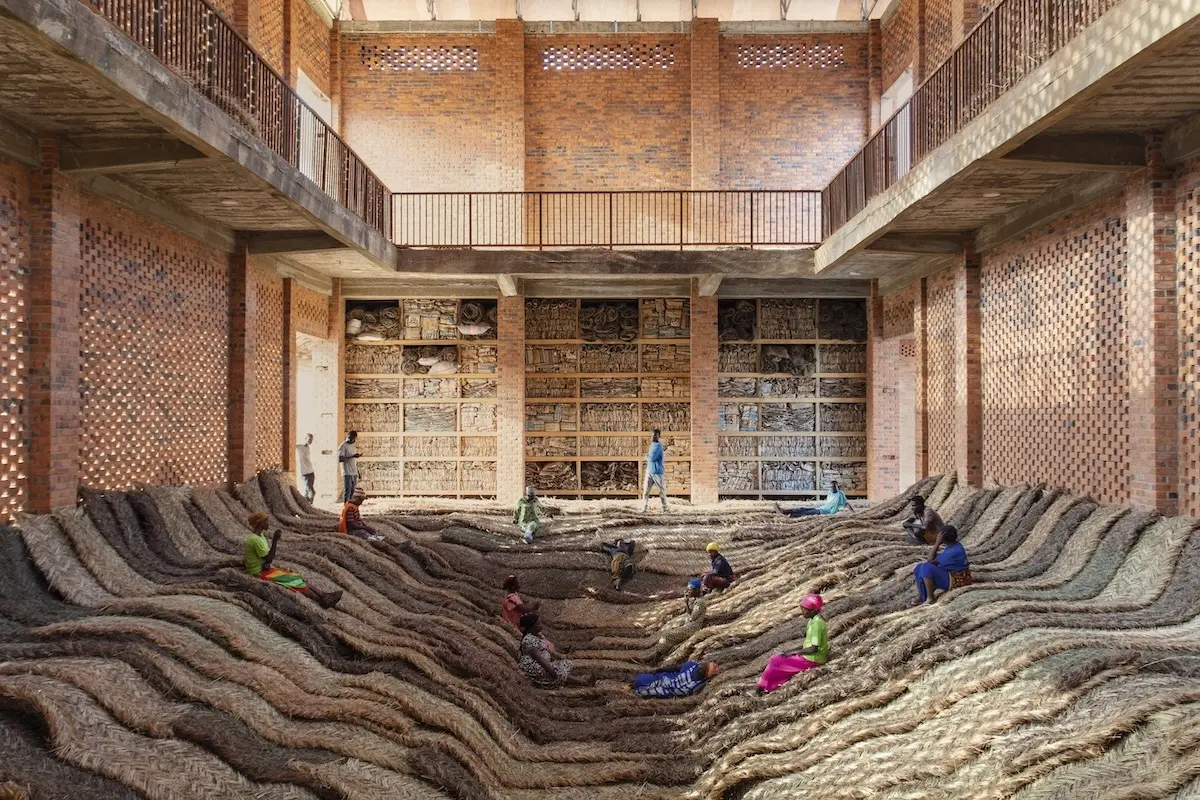
Rather than hoarding the capital generated by his surging market value, Mahama has systematically funneled proceeds into foundational infrastructure across Ghana. In Tamale, he established the Red Clay Studio and the Savannah Centre for Contemporary Art (SCCA). Moreover, he has routinely acquired dilapidated or abandoned industrial structures—transforming factories, commercial properties, and even grounded airplanes—into vibrant art, archival, and educational spaces. A prime example is Nkrumah Voli-ni, a former grain silo complex in Tamale converted into a thriving cultural hub in 2021.
This philosophy of reclamation extends beyond Ghana’s borders into international dialogues, such as his partnership with Kenyan-British artist Michael Armitage and the Nairobi Contemporary Art Institute. By participating in these cross-continental networks, Mahama continuously expands the structural and conceptual horizons of what African contemporary art can achieve.
"The Harvest Season" at Fondation Cartier
Opening on Thursday, "The Harvest Season" represents a watershed moment in Mahama’s career. According to the artist, it is the most expansive and ambitious exhibition he has ever produced, taking over the entirety of the Fondation Cartier building in Paris.
The exhibition weaves together several monumental bodies of work:
Parliament of Ghosts (2019/2026): Originally premiering in 2019, this immersive installation features discarded train seats, railway sleepers, school furniture, government archives, and worn-out jute sacks. For its Paris iteration, Mahama has incorporated approximately 200 collected and restored royal stools from the Asante Empire.
The Aboso Glass Factory Project (Things Fall Apart): Inspired by Chinua Achebe’s seminal 1958 novel, this installation reconstructs the abandoned glass bottle manufacturing plant established in 1966 by Ghana’s first president, Kwame Nkrumah, shortly before his overthrow.
Architectural & Railway Archives: A dedicated focus on the socio-political history of the Ghanaian railway system, paired with laterite wall reconstructions by architect Courage Dzidula Kpodo and tropical modernist postcards curated by Postbox Ghana.
Facade Textile Installation: A sprawling new textile installation—woven from northern Ghanaian fabrics, truck inner tubes, jute sacks, and found textiles—draped dramatically across the 1850s arcades of the Fondation Cartier exterior.
Supporting Context & Metrics: Cultural Economy and Decolonial Discourse
"The Harvest Season" is far more than a visual spectacle; it functions as a critical theoretical intervention regarding colonial looting, restitution, and structural memory.
Inverting the Museum Paradigm with Asante Stools
The inclusion of 200 restored Asante royal stools within Parliament of Ghosts directly challenges Western museological practices. Historically, such sacred objects have been violently looted, stripped of their living contexts, and entombed behind glass cases in European and American institutions for passive consumption.
At the Fondation Cartier, however, visitors are granted free, unmediated access to these objects. By placing these "living" artifacts in an environment where they can be utilized for their original communal purposes rather than static display, Mahama subverts standard restitution narratives. He forces viewers to confront a provocative question: What happens when historical African objects are brought to Europe not as dead relics trapped in glass, but as active catalysts for contemporary discourse, exposing the ghosts and erased histories tied to colonial exploitation?
Industrial Heritage and Things Fall Apart
The Aboso Glass Factory project encapsulates the fragile trajectory of post-independence African modernization. Founded during Kwame Nkrumah’s ambitious industrialization drive in 1966—only to be halted abruptly by a Western-backed military coup that same year—the factory represents a broken promise of national self-determination.
By purchasing the dilapidated industrial site two years ago with production funds secured from Fondation Cartier, Mahama initiated a transnational preservation effort. The installation in Paris is merely a preliminary waypoint. Once the Parisian exhibition concludes, the reconstructed factory components will return permanently to Ghana, destined for a new cultural institution in Kumasi. Concurrently, Mahama is collaborating with local cinema owners and craftsmen to rehabilitate abandoned movie houses across the country, injecting new life into fading cinematic and architectural archives.
Official Statements and Curatorial Perspectives
Curator Aby Gaye-Duparc emphasizes that understanding Mahama’s practice requires acknowledging its dual nature—the visible public spectacle and the invisible, grassroots labor executed in northern Ghana.
“There is a dialogue between this old building [constructed in the 1850s] and Ibrahim’s work, which addresses the history of the 19th century in Ghana, and the links between what was happening between Europe and West Africa at that time,” Gaye-Duparc remarked.
She further underscored the two-sided reality of his artistic methodology:
“What we really want to convey to the audience is that there are two sides of [Mahama]’s artistic practice. There’s work that we see: installations, videos, work on paper. Everything comes from this community in Tamale that he has built because a lot of the installations were made first in Tamale and then travel to Paris or other venues. The other part is the work behind it that is being built in Tamale—building artistic infrastructure and institutions that expand access to the arts for people who were left out for various reasons.”
True to this collaborative ethos, Mahama’s Paris exhibition extends its platform to numerous other artists and collectives, including James Barnor, Gideon Appah, CATPC (Cercle d’Art des Travailleurs de Plantation Congolaise), Tjaã Rener, Postbox Ghana, Courage Dzidula Kpodo, and Mahama’s own mentor, Dorothy Akpene Amenuke.
Architect Courage Dzidula Kpodo, who is presenting a critique of tropical modernism and colonial concrete architecture through laterite wall installations and Postbox Ghana postcards, noted:
“I would describe Ibrahim as someone who makes space within his own abilities and means for people that he thinks are doing interesting, important work.”
Future Outlook: Resilience, Community, and Looking Ahead
The opening of "The Harvest Season" in Paris arrives at a critical juncture in Mahama’s personal and professional life. Earlier this year, the artist was viciously attacked by a special operations unit of the Ghana Police Service in Tamale—an incident that sparked widespread national outrage and legal scrutiny.
Despite the violence of the encounter, the fallout revealed the profound depth of public affection for Mahama. Citizens, artists, and cultural workers traveled from Tamale, Accra, Kumasi, and beyond to express solidarity, condemn the police actions, and honor his immense contributions to the nation’s cultural landscape.
Regarding the status of the official investigation directed by Ghana’s Inspector General of Police and handled by the Criminal Investigation Department, Mahama notes that he has received no updates in months. Rather than allowing state negligence to derail his vision, however, he has chosen to channel his energy constructively.
“I want to channel my energy into this positive part of my practice of what I do and what it means to the community,” Mahama explained. “But certainly, I am also quite disappointed in the way that it was handled by the police. And I hope that at some point, we will be able to at least know more [about the investigations], so that we see what direction to take it in.”
As he prepares to return to Ghana by the end of the year after his international tour, Mahama’s focus remains squarely fixed on empowerment, institutional building, and narrative reclamation.
“I’m happy that the work I do has a very profound meaning and effect on people who live on our continent, in particular Ghana,” Mahama concluded. “I am also interested in how this work is traveling around the world, stretching the African sensibilities, and what we are bringing to art in the 21st century.” Through collective resilience, architectural reclamation, and unyielding community solidarity, Ibrahim Mahama is not merely participating in contemporary art history—he is actively rewriting its foundations.




Comments
Facebook App ID not configured. Please add it in the Customizer.