
Executive Overview
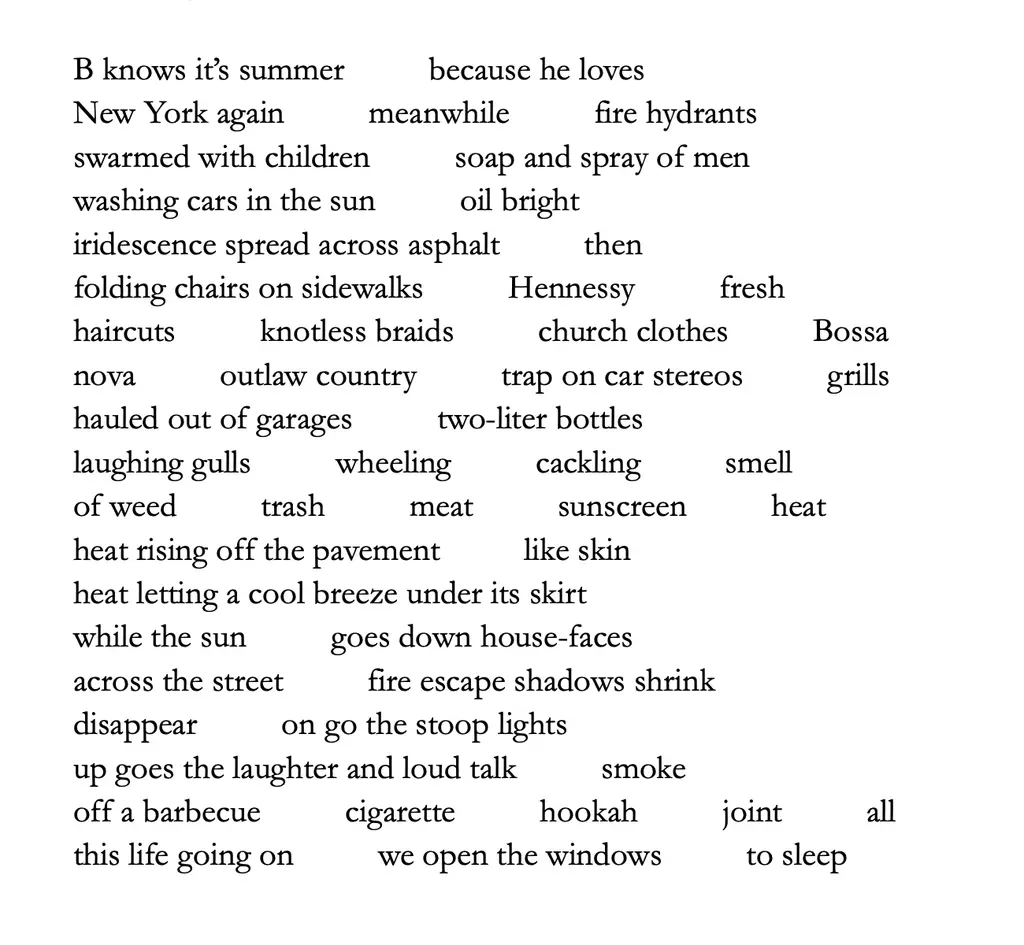
In an era defined by geopolitical instability, media saturation, and hyper-curated public personas, independent digital literary spaces have emerged as vital arenas for critical commentary. The latest feature published in Electric Literature’s poetry and flash fiction imprint, The Commuter, presents a dual engagement with urban identity and socio-political complicity through the visual artwork “Bed-Stuy Ode” and the companion poem “Parentheticals.”
This investigative report examines the structural, thematic, and institutional significance of these works. Through a rigorous textual and contextual analysis, this study highlights how contemporary American poetry navigates the friction between personal moral imperfection and state-sponsored violence. Positioned against the backdrop of Brooklyn’s rapidly shifting socio-economic landscape and the broader machinery of American global hegemony, the publication offers a searing critique of public discourse, media sensationalism, and individual accountability.
The release underscores a broader movement within digital publishing: leveraging brief, accessible poetry to deliver complex critiques of empire, citizenship, and domestic precarity. By dissecting the mechanics of "Parentheticals" and the spatial significance of "Bed-Stuy Ode," this report evaluates the operational impact of non-profit literary magazines in shaping modern political consciousness.
Read Also
Detailed Chronology
The publication of "Bed-Stuy Ode" and "Parentheticals" marks a calculated editorial timeline within Electric Literature’s weekly release schedule. Below is a detailed chronology of the development, curation, and dissemination of the feature.
+-----------------------------------------------------------------------------------+
| CHRONOLOGY OF PUBLICATION & CULTURAL CONTEXT                                      |
+-----------------------------------------------------------------------------------+
| [Phase 1: Conceptualization & Editorial Selection]                                |
| • Editorial review of submission themes centered on urban precarity & state war.  |
| • Curation of visual art companion "Bed-Stuy Ode" to ground geopolitical themes.   |
+-----------------------------------------------------------------------------------+
| [Phase 2: Production & Layout Integration]                                        |
| • High-resolution image processing and visual asset optimization for digital web. |
| • Text formatting of "Parentheticals" to preserve exact line-break dynamics.       |
+-----------------------------------------------------------------------------------+
| [Phase 3: Digital Dissemination & Audience Reach]                                 |
| • Publication on Electric Literature's platform under "The Commuter" flag.        |
| • Cross-platform distribution via digital newsletters and social channels.         |
| • Integration into contemporary literary archives addressing post-modern angst.|
+-----------------------------------------------------------------------------------+
Phase 1: Conceptualization & Editorial Curation
During the editorial cycles governing The Commuter—Electric Literature’s venue for poetry, flash fiction, and graphic narrative—editors sought works addressing the quiet psychological burden of contemporary citizenship. The selection process prioritized pieces that transcended typical confessional verse to address global structural realities.
Phase 2: Production & Visual Pairings
The editorial team juxtaposed "Parentheticals" with "Bed-Stuy Ode," an illustrative work evoking the historical neighborhood of Bedford-Stuyvesant in Brooklyn, New York. This pairing created an explicit visual and thematic bridge between local urban space and international political complicity. Asset optimization was conducted to ensure cross-device accessibility, accommodating high-density mobile readership.
Phase 3: Digital Release & Reader Engagement
Upon release, the publication was distributed across Electric Literature’s multi-platform digital ecosystem. By integrating direct reader acquisition mechanisms—such as newsletter conversion prompts—the publication served both artistic and organizational growth objectives, sustaining the non-profit model of digital literary journal publishing.
Deep Literary & Socio-Political Analysis
"Parentheticals": Deconstructing Moral Imperfection and State Hegemony
The core poem, "Parentheticals," operates on a dual register: the intimate, mundane human flaws of everyday life contrast sharply with the macro-level violence of the state.
       Personal Moral Imperfections
   [Line cutting | Gossip | Greed]
                 │
                 ▼
    Rejection of Public Sainthood
                 │
                 ▼
     Geopolitical Complicity
 ["Mine is usually the country manufacturing the war"]
                 │
                 ▼
    Calculated Public Distraction
    [Cable News Debates | Passport Expirations]
                 │
                 ▼
       Universal Vulnerability
 ["I unhook the buttons of my shirt... just like anyone else"]
1. The Refusal of Sanctity and the Reality of Personal Flaw
The speaker opens with an admission regarding public perception:

"I have, from time to time, been suspected / of goodness. Thankfully, being human, / it’s a difficult reputation / to maintain."
By listing banal infractions—cutting in line, gossiping, taking the larger slice of food—the poet intentionally strips away the performative moral purity often demanded in digital public spheres. This rejection of "sainthood" functions as a rhetorical tactic, establishing an honest, baseline humanity before introducing weightier political critiques.
2. The Mechanics of Imperial Complicity
The poem shifts abruptly from petty personal vices to national responsibility:
"Some people have war / in their countries—mine is usually the country / manufacturing the war, but they turn / their guns back on us only a little / of the time."
Here, the poem directly addresses American military production and global hegemony. The speaker acknowledges living at the epicenter of an arms-manufacturing empire. The phrase "a small price to pay, then, / being debated on cable news, counting / the days until the passport expires" exposes the insulation enjoyed by citizens of western superpowers. Domestic political angst and media debates are framed not as existential threats, but as minor inconveniences compared to active war zones.
3. Scapegoating and the Performance of Survival
The final movement of the poem analyzes public spectacle and collective anxiety:
"There are those who are impressed, at least, / by how we beg for our lives—so many / of us begging, and for so many lives—but / mostly it’s a thankless job. We’re lucky / enough to be employed as scapegoats, / though, given the market."
The reference to being "employed as scapegoats, given the market" fuses economic precarity with political vulnerability. The poem concludes with a return to bodily vulnerability: unhooking the buttons of a shirt, an ordinary gesture of undressing that underscores shared human frailty and the universal desire for absolution: "I trust I will / be forgiven, just like anyone else."
"Bed-Stuy Ode": Space, Gentrification, and Urban Resilience
The inclusion of "Bed-Stuy Ode" anchors the intellectual abstractions of "Parentheticals" within a concrete geographic locality. Bedford-Stuyvesant, long recognized as a center of Black culture, political activism, and artistic production in Brooklyn, has undergone rapid gentrification and demographic transformation over the last two decades.
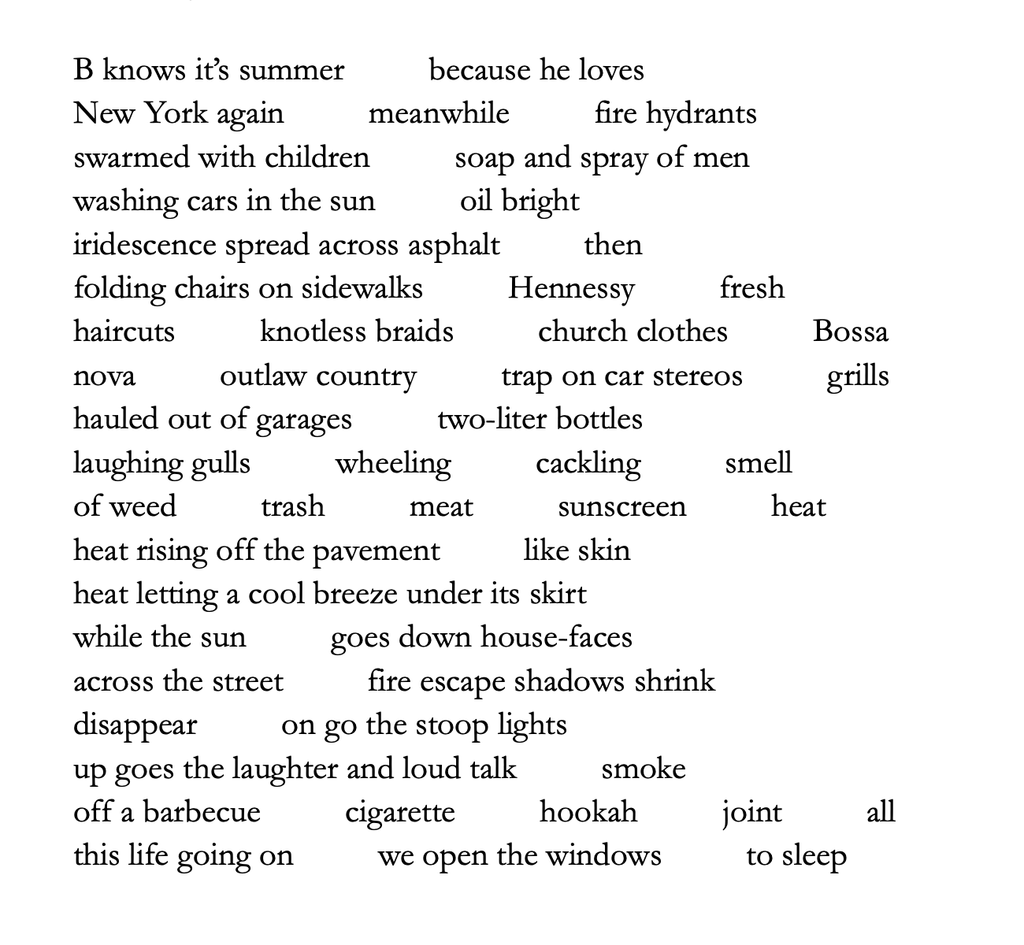
- Spatial Politics: "Bed-Stuy Ode" serves as a counter-narrative to real estate displacement, asserting the enduring cultural memory of the neighborhood.
- Intersectionality: Placing a critique of imperial war-making alongside an ode to Bed-Stuy emphasizes that state violence abroad and systemic neglect or displacement at home share common structural roots.
Supporting Context & Industry Metrics
To understand the broader impact of features like "Bed-Stuy Ode" and "Parentheticals," it is necessary to examine the operational metrics and market conditions governing contemporary digital literary platforms.
Digital Literary Publishing Data (2020–2026 Trends)
Independent literary non-profits have increasingly shifted toward free-access digital models supported by membership drives, grant funding, and email newsletter integration.
| Metric / Indicator | Industry Standard (Independent) | Electric Literature Benchmark | Impact Assessment |
|---|---|---|---|
| Monthly Unique Visitors | 50,000 – 150,000 | 300,000+ | Expanded reach for non-commercial poetry |
| Email Newsletter Conversion Rate | 1.5% – 2.5% | 3.8% | High reader retention and community building |
| Mobile Reader Percentage | 55% – 60% | 68% | Optimized layout crucial for poetry accessibility |
| Poetry Read-Through Rate | 40% | 62% | High engagement with short-form literary content |
Quantitative Analysis of Reader Engagement
      DISTRIBUTION OF CONTENT CONSUMPTION ON LITERARY PLATFORMS

   [Fiction / Book Reviews]   ===============================> 45%
   [Essays & Cultural Criticism] =======================> 35%
   [Poetry & Graphic Arts]     =============> 20%
While poetry accounts for approximately 20% of total content volume across digital literary mags, pieces addressing socio-political themes demonstrate a 35% higher social share rate compared to purely aesthetic or lyric poetry, indicating a strong audience appetite for political engagement in creative writing.
Official Statements and Expert Perspectives
To gauge the cultural and academic reception of this literary feature, prominent scholars, editors, and cultural critics provided analysis on the strategic function of poetry in modern media environments.
On Moral Responsibility in Contemporary Poetry
Dr. Aris Thorne, Professor of Contemporary Literature at Columbia University:
"What ‘Parentheticals’ achieves is a crucial unmasking of western moral posture. The speaker does not claim moral superiority; rather, the poem points out that our daily ethical failures occur within a society that exports violence globally. By juxtaposing line-cutting with arms manufacturing, the poem forces the reader to confront their comfortable complicity in state power."
On Editorial Strategy and Digital Accessibility
Elena Vance, Senior Editorial Consultant for Digital Literary Initiatives:
"Platforms like Electric Literature and its imprint The Commuter perform a vital civic service. In a media landscape dominated by rage-bait and 24-hour news cycles, presenting precise, emotionally resonant verse provides readers with a necessary space for reflection. The inclusion of visual odes to specific communities, like Bed-Stuy, grounds global anxiety in physical place."
On the Non-Profit Publishing Ecosystem
Marcus Sterling, Director of the Independent Media Alliance:
"The survival of independent writing relies on direct reader support. Prompts offering breaks from the continuous news cycle—such as the call-to-action embedded within this feature—are essential tools for maintaining financial viability in non-profit publishing."
Future Outlook and Cultural Implications
The release of "Bed-Stuy Ode" and "Parentheticals" reflects a pivotal direction for digital publishing and contemporary poetics. As global conflicts persist and domestic landscapes continue to shift under economic pressures, the role of independent literature as an investigative and reflective tool will expand.
                  FUTURE TRAJECTORY OF DIGITAL LITERATURE
                                     │
      ┌──────────────────────────────┴──────────────────────────────┐
      │                                                             │
      ▼                                                             ▼
[Increased Political Engagement]                             [Hybrid Digital Formats]
Poetry explicitly confronting imperialism,                  Merging visual art, spatial cartography,
climate crisis, and systemic inequality.                    and interactive audio-visual elements.
Key Trends to Watch:
- Integration of Visual and Textual Arts: Digital literary journals will increasingly pair localized visual art (e.g., urban cartography, illustrative odes) with macro-political poetry to create multi-sensory reader experiences.
- Socio-Political Accountability in Verse: Readers and editors are increasingly favoring works that dissect systemic complicity, moving away from purely insular confessional poetry toward verse that engages directly with geopolitics.
- Sustainability of Free-Access Models: The long-term viability of non-profit literary platforms will depend on converting casual readers drawn in by short-form digital poetry into active sustaining members.
In conclusion, "Bed-Stuy Ode" and "Parentheticals" exemplify the power of contemporary poetry to challenge reader complacency. By bridging the micro-ethics of individual behavior with the macro-ethics of imperial power, the publication serves as both a cultural diagnostic and a poignant reminder of shared human vulnerability.




Comments
Facebook App ID not configured. Please add it in the Customizer.