
Executive Overview
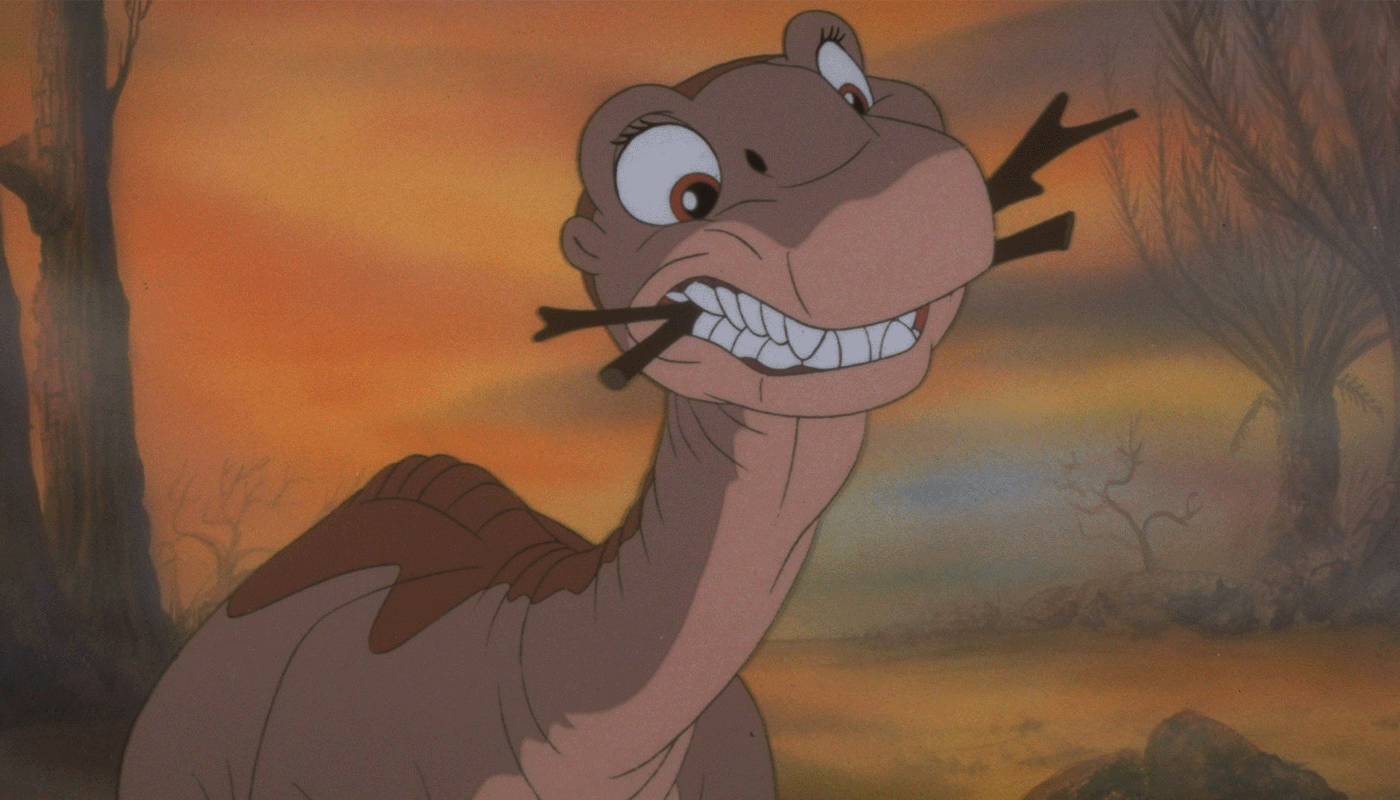
Released in November 1988, Don Bluth’s animated classic The Land Before Time occupies a unique space in cinematic history. Co-produced by George Lucas and Steven Spielberg, and written by Stu Krieger, the film follows a young Apatosaurus named Littlefoot and his companions—Cera, Duckie, Petrie, and Spike—as they navigate a volcanic, barren wasteland to reach the lush refuge of the Great Valley. On the surface, it is a quintessential coming-of-age children’s fable characterized by lush emotional beats, gorgeous hand-drawn animation, and sobering moments of genuine peril.
Yet, looking past its surface framing as a standard family feature reveals a profound cultural pivot. Prior to 1988, cinematic representations of dinosaurs fell largely into two camps: apocalyptic, destructive city-smashing monsters (typified by Godzilla and The Beast from 20,000 Fathoms) or cold, distant biological specimens roaming untamed, primeval wildernesses (The Lost World, Fantasia). Dinosaurs were viewed as "deliciously alien"—fearsome, wild, and fundamentally other.
The Land Before Time shattered that paradigm. By anthropomorphizing dinosaurs into children who mourn, migration-march, yearn for maternal comfort, and experience prejudice, the filmmakers established a new template for prehistoric media. This shift did not happen in a vacuum. It was the direct downstream effect of a quiet revolution within paleontology itself—the "Dinosaur Renaissance" of the 1960s and 70s—which transformed our perception of extinct reptiles from sluggish, swamp-bound cold-blooded brutes into agile, warm-blooded, bird-like creatures capable of complex social systems.
Read Also
This investigative piece explores the dual trajectories of paleontological science and cinematic history that enabled The Land Before Time to bridge the gap between science and popular imagination, permanently altering how humanity visualizes the ancient world.
Detailed Chronology: From Monsters to Migrants
To understand how dinosaurs became domestic, relatable protagonists, we must trace the historical timeline of how these creatures were portrayed in Western visual culture across the twentieth century.
[1914] Winsor McCay's "Gertie" (Playful Animation)
       │
[1925] "The Lost World" (Big Game / Untamed Wild)
       │
[1940] Disney's "Fantasia" - Rite of Spring (Natural/Dramatized)
       │
[1950s] "Godzilla" & "Beast from 20,000 Fathoms" (Atomic Monsters)
       │
[1964] Discovery of Deinonychus (The Paleontological Shift)
       │
[1985] "Baby: Secret of a Lost Legend" (Sympathy for Prehistory)
       │
[1988] "The Land Before Time" (Dinosaurs as Relatable Children)
The Early Cinematic Era (1914–1950s)
- 1914: Cartoonist Winsor McCay introduced the world to Gertie the Dinosaur, an animated short wherein a friendly, agile dinosaur performed tricks under the command of her live-action creator. Gertie proved that dinosaurs could charm audiences, but this portrayal remained an outlier for decades.
- 1925: The Lost World brought stop-motion animation master Ray Harryhausen’s spiritual predecessors to life, framing dinosaurs as exotic, terrifying big game to be hunted or marveled at in isolated ecosystems.
- 1940: Disney’s Fantasia attempted a scientifically ambitious, dialogue-free dramatization of the Mesozoic era set to Igor Stravinsky’s Rite of Spring. While grand, it maintained a detached, macro-level view of nature "red in tooth and claw."
- The Post-War Atomic Age (1953–1954): The atomic bomb ushered in an era of radioactive anxiety. Films like The Beast from 20,000 Fathoms (1953) and Godzilla (1954) weaponized dinosaurs, casting them as towering symbols of nature’s vengeance against human hubris.
The Paradigm Shift (1964–1980s)
- 1964: Paleontologist John Ostrom discovered the fossilized remains of Deinonychus in Montana. Its skeletal structure indicated a fast, bipedal predator with bird-like agility and pack-hunting capabilities.
- 1969: Ostrom’s student, Robert Bakker, published a groundbreaking anatomical illustration of Deinonychus sprinting lightly across the ground. This visual catalyzed the "Dinosaur Renaissance," shifting public perception toward warm-blooded, dynamic organisms.
- 1985: Baby: Secret of a Lost Legend signaled a tonal evolution in live-action cinema. Instead of hunting or escaping dinosaurs, human protagonists fought to protect a surviving family unit from poachers, shifting audience empathy directly onto the prehistoric animals.
- 1988: The Land Before Time arrived, completing the cultural transformation by rendering herbivorous dinosaurs as vulnerable children coping with loss, displacement, and environmental collapse.
Supporting Context & Metrics: Science Meets Animation
The creative marriage between Don Bluth and Steven Spielberg yielded a film that balanced visceral emotional storytelling with environmental dread. However, bringing this vision to the screen required navigating complex choices in animation technique, narrative editing, and musical scoring.
Scientific Accuracy vs. Artistic License
Purists often note the severe chronological inaccuracies inherent in The Land Before Time. The Apatosaurus (Littlefoot) lived during the Late Jurassic epoch, roughly 150 million years ago, whereas the Tyrannosaurus rex appeared in the Late Cretaceous, nearly 80 million years later. Furthermore, the apocalyptic volcanic upheaval depicted in the film mirrors mass extinction events that occurred at different points in geological history.
Yet, as paleontological literature (such as Steve Brusatte’s The Rise and Fall of the Dinosaurs) emphasizes, human understanding of dinosaurs has always been mediated through art, illustration, and museum mounting. Because non-avian dinosaurs are exclusively known through fossilized remains, paleoartists and animators must inject behavioral assumptions into their work. Bluth’s team chose to model their dinosaurs’ physical movements on mammalian behaviors—Spike, notably, was animated with mannerisms drawn directly from Bluth’s pet dog—which grounded the alien creatures in familiar emotional territory for human audiences.
Production Metrics and Creative Friction
The production of The Land Before Time was defined by an ongoing creative tension between director Don Bluth’s desire for a darker, high-stakes emotional journey and executive producer Steven Spielberg’s commercial anxiety regarding younger audiences.
- The Cuts: Following test screenings, Spielberg reportedly expressed concern that the primary antagonist—the adult Tyrannosaurus rex that kills Littlefoot’s mother—was "too scary," fearing that parents would be left with crying children in theater lobbies.
- Runtime Alterations: Approximately 10 minutes of finished animation, primarily drawn from the brutal T. rex attack sequences and prolonged scenes of existential dread, were excised from the final cut.
- Legacy: Though Bluth vocally lamented these edits—believing they weakened the narrative punch—the theatrical cut still delivered one of the most famously devastating emotional gut-punches in 1980s cinema.
Audio Landscape
The film’s sonic architecture was anchored by master composer James Horner. Before cementing his legendary status with blockbuster scores throughout the 1980s and 90s (Aliens, Willow, Apollo 13, Titanic), Horner crafted an orchestral tapestry for The Land Before Time that elevated the sweeping, desolate landscapes and emotional isolation of the young refugees. The musical score successfully bridges the gap between orchestral despair and uplifting familial triumph.
Official Statements and Industry Reception
When The Land Before Time hit theaters in November 1988, critical reception was mixed regarding its narrative risks, though universally complimentary of its technical artistry.
Renowned film critic Roger Ebert famously highlighted the narrative gamble of humanizing prehistoric reptiles:
"The filmmakers make a strategic error, I think, by making their dinosaurs into children. This destroys the distinction between the species… One of the reasons kids like dinosaurs is that they are not human. They are deliciously alien."
Despite early critical hesitation over whether audiences would accept cuddly dinosaurs, history proved Ebert and other skeptics decisively wrong. The film’s unprecedented commercial success triggered an explosion of dinosaur domesticity across pop culture. Within years, the market was flooded with derivative media:
- Direct-to-Video Sequels: The Land Before Time spawned an astonishing 13 direct-to-video sequels, cementing its characters in childhood media consumption for decades.
- Television and Literature: Shows like Dino-Riders (1988), Dinosaurs (1991–1994), and Barney & Friends (1992–2010), alongside James Gurney’s beautifully realized illustrated novel Dinotopia (1992), proved that the public appetite for civilized, relatable dinosaurs was insatiable.
Future Outlook: The Pendulum Swings Back
The cultural arc of dinosaurs in cinema demonstrates a pendulum swinging perpetually between empathy and terror. The Land Before Time proved that dinosaurs could be cute, vulnerable, and profoundly human surrogates.
However, this golden age of domesticity was short-lived. Just five years after Littlefoot reached the Green Valley, Michael Crichton and Steven Spielberg’s Jurassic Park (1993)—drawing heavily upon the very same Deinonychus-inspired scientific revolution spearheaded by John Ostrom and Robert Bakker—re-established dinosaurs as apex predators. The cultural zeitgeist pivoted overnight from nurturing baby sauropods to running for cover from genetically engineered Velociraptors.
As we look toward contemporary media and ongoing paleontological discoveries—such as the confirmation of feather-clad theropods and complex behavioral pattering—the legacy of The Land Before Time remains secure. It stands as a watershed moment where animation successfully leveraged cutting-edge science to teach generations of children that even the most ancient, unfamiliar creatures could share our deepest fears, our capacity for grief, and our enduring hope for a greener tomorrow.

Comments
Facebook App ID not configured. Please add it in the Customizer.