
By Mark Bauerlein
August 24, 2026
Executive Overview
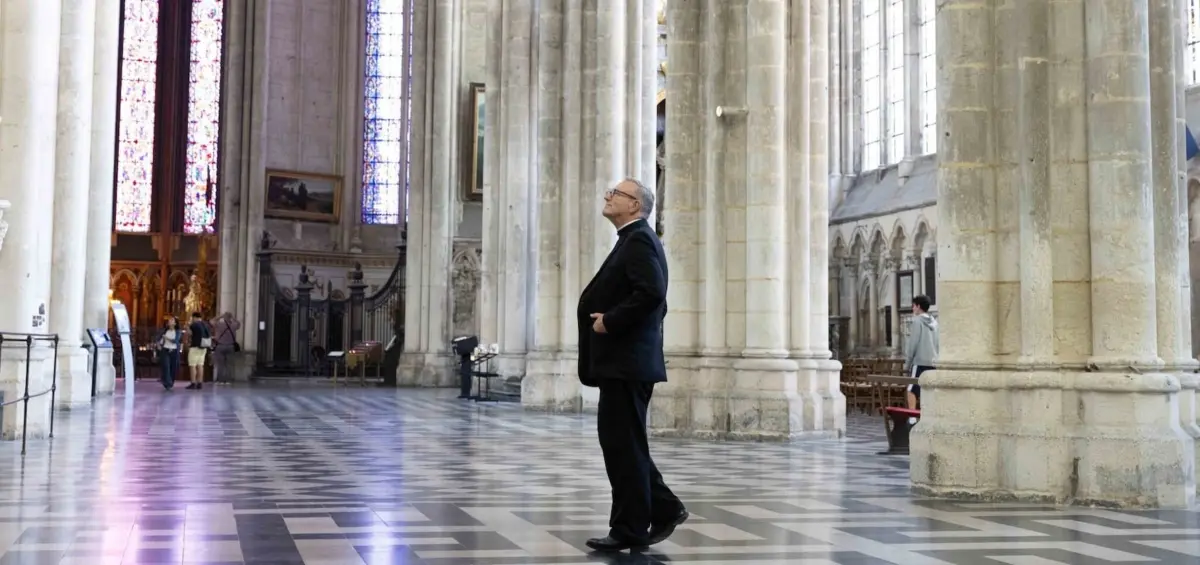
In the latest installment of our ongoing interview series, contributing editor Mark Bauerlein sits down with Bishop Robert Barron to explore his ambitious new cinematic and theological project, Heaven in Stone and Glass. This feature-length documentary dives deep into the intellectual, spiritual, and architectural history of the Gothic cathedral, framing these medieval marvels not merely as relics of a bygone era, but as enduring theological arguments rendered in limestone and stained glass.
Bishop Barron, founder of Word on Fire Catholic Ministries and Bishop of the Diocese of Winona-Rochester, has long championed the revitalization of Catholic culture through the classical transcendentals: the good, the beautiful, and the true. In Heaven in Stone and Glass, Barron turns his lens upward, examining how the master builders of the twelfth and thirteenth centuries sought to materialize the New Jerusalem on earth. Through towering vaults, flying buttresses, and walls of luminescent glass, these structures were engineered to pull the human gaze—and the human soul—out of the mundane and into the divine.
Read Also
This comprehensive report examines the genesis of Bishop Barron’s new film, placing it within the broader context of contemporary religious aesthetics and cultural commentary. Drawing from our extended interview, we unpack the structural philosophies of the Gothic era, the theological integration of light and space, and the urgent necessity of sacred architecture in an increasingly fragmented, secularized modern landscape.
Detailed Chronology: The Making of Heaven in Stone and Glass
From Concept to Screen: The Genesis of a Masterpiece
The intellectual groundwork for Heaven in Stone and Glass began years prior to production, stemming from Bishop Barron’s extensive travels across Europe and his lifelong engagement with Thomistic philosophy and sacramental theology. Recognizing that modern secularism often reduces religion to a set of ethical propositions or emotional coping mechanisms, Barron sought a medium that could capture the sheer, overwhelming objectivity of Catholic tradition. Architecture—specifically the Gothic cathedral—offered the ultimate canvas.
Principal photography for the documentary spanned over two years, capturing iconic sacred spaces across France and other parts of Europe, including the Basilique Saint-Denis, Chartres Cathedral, Notre-Dame de Paris, and Amiens. Utilizing cutting-edge cinematic techniques, including high-resolution drone cinematography and specialized interior lighting capture, the production crew sought to replicate the visceral experience of walking into a soaring medieval nave for the first time.
The Interview: Dialogue at the Intersection of Faith and Form
In our exclusive conversation, recorded in late August 2026, Bishop Barron elaborated on the intellectual framework guiding the documentary. Rather than treating cathedrals as static museum pieces, Barron and Bauerlein discussed how these spaces were designed as dynamic catechisms for a largely illiterate medieval populace. Every arch, column, and stained-glass window preached a sermon in stone.
[Production Timeline]
 ├── Phase I: Conceptualization & Thematic Structuring (2023–2024)
 ├── Phase II: On-Location Principal Photography in Europe (2024–2025)
 └── Phase III: Post-Production, Scoring, & Global Release (2026)
During the interview, Barron emphasized that the Gothic style was born out of a daring theological conviction: that God is light, and that matter is capable of being transfigured by grace. The transition from the heavy, fortress-like Romanesque architecture to the soaring, skeletal grace of the Gothic was not merely an engineering revolution; it was a spiritual awakening.
Supporting Context & Metrics: The Architecture of Transcendence
To truly appreciate the scope of Heaven in Stone and Glass, one must understand the monumental convergence of engineering, economics, and theology that birthed the Gothic cathedral.
The Metrics of Medieval Marvels
The construction of a Gothic cathedral was the ultimate communal endeavor, often spanning multiple generations and consuming a significant portion of a city’s economic output. Consider the following structural and historical benchmarks:
- Vertical Ambition: While Romanesque churches rarely exceeded 60 feet in interior height, Gothic masterpieces pushed the limits of physics. Chartres reaches an interior height of 120 feet, while the ill-fated nave of Beauvais Cathedral soared to an astonishing 157 feet before its partial collapse.
- The Engineering Breakthrough: The integration of the pointed arch, the ribbed vault, and the flying buttress allowed architects to redistribute heavy roof loads outward rather than downward. This liberated walls from their traditional load-bearing functions, paving the way for vast expanses of stained glass.
- The Theology of Stained Glass (Lux Nova): Abbot Suger of Saint-Denis, widely considered the father of Gothic architecture, championed the concept of lux nova (the new light). By filtering natural sunlight through deeply colored glass depicting biblical narratives and hagiographies, architects created an interior atmosphere that felt suspended between heaven and earth.
Cultural Reception and Digital Engagement
As part of Word on Fire’s broader multimedia evangelization strategy, the rollout of Heaven in Stone and Glass has leveraged digital platforms to reach global audiences. The trailer, released ahead of the full feature, has garnered significant traction across digital channels:
| Metric Category | Target / Platform | Estimated Reach / Impact |
|---|---|---|
| Trailer Views | YouTube & Social Channels | Rapidly scaling across Catholic and cultural networks |
| Podcast Distribution | Apple Podcasts & Spotify | Syndicated via the Conversations network with Mark Bauerlein |
| Global Audience | Academic, Clergy, and Laity | Bridging high-level theology with accessible cinematic art |
Official Statements and Excerpts from the Interview
The dialogue between Mark Bauerlein and Bishop Robert Barron traversed deep philosophical territory, touching upon the current state of modern architecture, the loss of the sacred in contemporary design, and the power of beauty to evangelize. Below are key thematic excerpts from their discussion.
On the Metaphysics of Beauty
Bishop Robert Barron: "We live in a utilitarian age. We build functional boxes—brutalist office buildings, sterile lecture halls, minimalist churches that look more like auditoriums than houses of God. But the human heart is wired for transcendence. When you walk into a Gothic cathedral, you are immediately confronted with something that cannot be reduced to utility. It points beyond itself. It says, ‘Behold, here is a dwelling place for the Infinite.’ That is what beauty does; it bypasses our ideological defenses and pierces the soul."
On the Cathedral as a Summa in Stone
Mark Bauerlein: "You often speak of these structures as theological texts. How does the physical layout of a cathedral mirror the intellectual achievements of high-medieval scholasticism, such as the Summa Theologiae of St. Thomas Aquinas?"
Bishop Robert Barron: "It’s no accident that the Gothic cathedral and the scholastic summa emerged in the exact same century and within a very narrow geographic radius around Paris. Both represent an insatiable desire to organize the totality of reality under the lordship of Christ. Just as Aquinas uses distinctions, objections, and harmonious resolutions to map out the architecture of doctrine, the master builder uses stone, glass, and geometry to map out the cosmos. Everything has its proper place, yet all lines converge on the altar—the sanctuary where heaven meets earth."
Future Outlook: The Legacy of Heaven in Stone and Glass
As Heaven in Stone and Glass enters public circulation, its implications extend far beyond the realm of cinematic documentary. The project arrives at a critical cultural juncture, prompting renewed conversations about sacred art, urban planning, and the architectural crisis plaguing contemporary religious construction.
Reclaiming the Sacred in Modern Design
For decades following the Second Vatican Council, much of Catholic church architecture swung toward a functionalist, auditorium-style minimalism, often driven by budgetary constraints and a misinterpretation of liturgical renewal. Critics have long argued that this architectural flattening contributed to a loss of the sense of the sacred among the faithful.
Bishop Barron’s documentary serves as a timely visual corrective. By showcasing the breathtaking heights of traditional sacred architecture, Heaven in Stone and Glass challenges contemporary architects, pastors, and diocesan leaders to re-engage with classical principles of beauty, proportion, and hierarchy in design. The film suggests that if the Church wishes to speak to a secularized culture, it must not mimic the utilitarian ugliness of the modern world, but rather present an alternative vision rooted in divine splendor.
How to Engage with the Series
For viewers wishing to dive deeper into the conversation, the full interview between Mark Bauerlein and Bishop Robert Barron is embedded across digital platforms.
- Watch the Trailer: View the official cinematic preview on YouTube.
- Subscribe to the Podcast: Listen to the complete, unabridged audio conversation by subscribing to the Conversations series via Apple Podcasts or Spotify.
- Explore Further: Visit archives and related essays by Mark Bauerlein at First Things.
In an era dominated by noise, digital distraction, and functional pragmatism, Heaven in Stone and Glass stands as a monumental reminder of what happens when human hands and hearts cooperate with divine grace to build something that outlasts the centuries.





Comments
Facebook App ID not configured. Please add it in the Customizer.