In an era of relentless media scrutiny, modern royal families spend an extraordinary amount of capital managing their public image. From high-profile family feuds to damaging tabloid headlines, the modern House of Windsor is constantly fighting to maintain relevance and public affection. However, the intersection of monarchy, public relations, and national myth-making is not a modern invention born of the digital age. Nearly three centuries ago, long before the advent of press secretaries, communication teams, and strategic crisis management, Queen Caroline of Brandenburg-Ansbach orchestrated a masterclass in 18th-century statecraft.
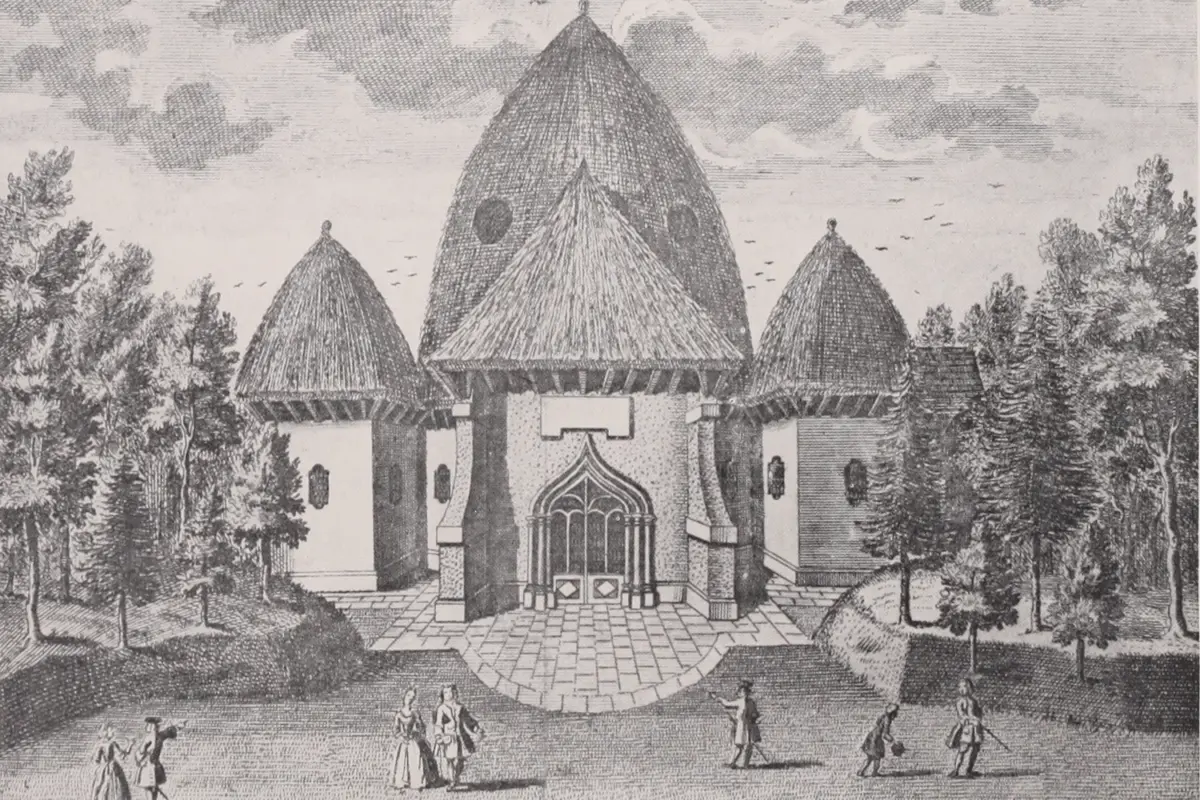
In 1735, facing a legitimacy crisis that threatened the survival of the recently established House of Hanover, Queen Caroline commissioned a peculiar, fairy-tale-esque garden folly in the grounds of Richmond Palace known as "Merlin’s Cave." Complete with thatched roofing, Gothic architecture, and a collection of wax figures depicting legendary prophets, queens, and the wizard Merlin himself, the attraction was dismissed by contemporary satirists as a collection of "strange puppets."
Yet, beneath its eccentric exterior, Merlin’s Cave was a sophisticated exercise in ideological engineering. By anchoring her German-born royal family to the deeply entrenched, romanticized mythology of King Arthur and Britain’s ancient past, Caroline sought to transcend foreign origins and construct a unified British identity. This long-form investigation explores the geopolitical landscape of 1730s Britain, the calculated deployment of Arthurian iconography as a tool of royal propaganda, the fierce partisan backlash it provoked, and the enduring lessons it offers regarding the performative nature of sovereign legitimacy.
Detailed Chronology: The Hanoverian Tightrope and the Birth of Merlin’s Cave
To fully appreciate the genius and desperation behind Merlin’s Cave, one must examine the precarious political tightrope the Hanoverian dynasty walked during the early decades of the 18th century.
The 1714 Succession and the Specter of Foreign Rule
When Queen Anne died in 1714 without a surviving Protestant heir, the British crown passed under the Act of Settlement 1701 to her distant cousin, Elector George Louis of Hanover. Ascending the throne as King George I, the new monarch arrived in Great Britain as a middle-aged German ruler who spoke little English and openly favored his Rhenish homeland. This transition left the Protestant dynasty deeply vulnerable to accusations of alien rule.
Opponents of the regime—most notably the Jacobites, who championed the restoration of the exiled Stuart dynasty—exploited these anti-German sentiments. The Jacobites framed the Hanoverians as illegitimate usurpers who lacked authentic ties to the British soil, sparking bloody and disruptive uprisings in 1715 and 1719. When George I died in 1727, his son, George II, inherited the throne alongside his brilliant, politically astute wife, Queen Caroline. While George II maintained the crown, the fundamental question remained: How does a foreign dynasty persuade a deeply skeptical populace that it genuinely belongs to the nation?
The Domestic Fracture of the 1730s
By the mid-1730s, the threats to Hanoverian stability were not merely external; they were rotting the royal household from within. A bitter, highly publicized feud had erupted between King George II and his eldest son, Frederick, Prince of Wales. This generational rift paralyzed court politics and threatened to shatter the veneer of national stability.
Britain had spent the previous century torn apart by civil war, the execution of Charles I, religious schisms, and the Glorious Revolution of 1688. The populace was exhausted by political volatility, yet deeply cynical about the new royal family. Into this breach stepped Queen Caroline.
1735: The Commission of Merlin’s Cave
Recognizing that her husband’s gruff demeanor and disinterest in the arts offered little cultural capital, Caroline took direct action. Drawing on her intellectually vibrant upbringing in the courts of Berlin and Hanover—where she had access to extensive libraries detailing medieval European and British chronicles—she devised a radical cultural initiative.
In 1735, Caroline commissioned architect and landscape designer William Kent to construct Merlin’s Cave within the royal gardens at Richmond. Unlike classical Palladian structures favored by the elite, the cave was designed as an archaic, rustic Gothic building featuring a thatched roof. Inside, visitors encountered an elaborate tableau of life-sized wax figures. Merlin, the legendary wizard and prophetic visionary of Arthurian romance, sat at the center, surrounded by historical queens, British prophets, and ancient sages.
By centering the exhibit on Merlin rather than King Arthur himself, Caroline engaged in a subtle theological and political maneuver. Merlin was not a contested medieval king tied to specific dynastic bloodlines; rather, he was an archetypal advisor, a prophet who bridged the ancient past with the prophetic destiny of the realm. The cave quickly became a premier destination for courtly visitors and the curious public alike, sparking intense literary and political commentary across the kingdom.
Supporting Context & Metrics: Cultural Weaponization and Public Reaction
The construction of Merlin’s Cave cannot be understood in isolation; it was part of a broader cultural campaign by the Whig administration under Sir Robert Walpole to solidify Hanoverian hegemony through art, architecture, and literature.
The Demographics of Dissent: Whigs vs. Tories and Jacobites
The political ecosystem of 1730s Britain was sharply polarized between the governing Whigs (who largely supported the Hanoverian settlement and parliamentary supremacy) and the Tories and covert Jacobites (who favored the hereditary divine right of the Stuarts).
Whig Objectives: To normalize the Hanoverian dynasty by linking Protestant succession with deep-rooted British historical continuity.
Tory/Jacobite Counter-Narratives: To mock the artificial nature of these historical linkages, framing the German royals as culturally bankrupt interlopers playing dress-up in Britain’s storied past.
Contemporary Literary Responses
The cultural friction generated by Merlin’s Cave manifested immediately in contemporary verse and satire.
In 1735, the Anglo-Welsh writer Jane Brereton published a widely read poem in which she imagined the figure of Merlin urging Prince Frederick to reconcile with his royal parents and fulfill his filial duty to "perpetuate Brunswick’s race." Brereton’s verse highlights how contemporary observers recognized the cave as an explicit plea for dynastic harmony and political healing.
Conversely, opposition writers weaponized the attraction. Nicholas Amhurst, writing under the pseudonym Caleb D’Anvers in the anti-government journal The Craftsman, launched scathing attacks against the folly. Amhurst and fellow satirists turned Merlin into an effigy of ministerial corruption, associating the wizard with Sir Robert Walpole—the cunning, untrustworthy "wizard" pulling the strings behind the throne.
As scholar Amanda S. Meixell noted in her 2005 analysis, the figure of Merlin became an object of fierce partisan contestation. Yet, the vehemence of the attacks proved that Caroline’s strategy was working: her political opponents understood her messaging all too well, choosing to parody it rather than ignore it.
Official Statements & Historical Analysis
While direct spoken quotes from Queen Caroline regarding the architectural blueprint of Merlin’s Cave are sparse in surviving royal archives, her intellectual motivations and political acumen are heavily documented through her correspondence and the observations of contemporary chroniclers.
Historians and cultural analysts specializing in 18th-century statecraft have long recognized the sophistication of Caroline’s initiative. Dr. Amy Louise Blaney, a leading researcher on the nationalism of British cultural mythologies, emphasizes that Caroline’s approach anticipated modern political communication by centuries:
"Long before communications teams and media advisers became fixtures of royal life, Queen Caroline attempted a remarkable piece of image management… In turning to Arthurian legend to promote the image of a stable, legitimate and distinctly British monarchy, Caroline understood a lesson that monarchies continue to grapple with today: Legitimacy depends not on inheritance but on the stories people tell about who belongs to the nation and who should shape its future."
Furthermore, contemporary court diarists noted Queen Caroline’s unique intellectual capacity compared to her royal spouse. While King George II famously declared that he "hated all boets [poets] and bainters," Caroline cultivated intellectual salons, corresponded with luminaries such as Gottfried Wilhelm Leibniz and Isaac Newton, and utilized her patronage of the arts to construct a protective cultural shield around the House of Hanover.
Future Outlook: The Enduring Legacy of Royal Myth-Making
The echoes of Queen Caroline’s 1735 experiment at Richmond resonate deeply within the modern study of political communication, institutional branding, and national identity.
As modern constitutional monarchies navigate shifting cultural values, republican movements, and generational transitions, the fundamental challenge identified by Queen Caroline remains unchanged: an institution cannot survive on legal mandates and hereditary right alone. It must continuously renew its social contract through compelling national narratives.
Merlin’s Cave eventually fell into disrepair and was dismantled, but the precedent it set transformed the British monarchy’s relationship with national myth. Caroline proved that myth is not merely a passive relic of the past, but an active, malleable instrument of statecraft.
Whether through royal weddings broadcast to millions, carefully curated documentary appearances, or the leveraging of historical milestones, today’s royal public relations strategies are the direct linear descendants of Queen Caroline’s thatched grotto. By marrying the foreign bloodline of Hanover to the timeless legend of Arthur and Merlin, Caroline ensured that the crown did not just rule Britain—it wove itself into the very fabric of the nation’s imaginary soul.

/https://tf-cmsv2-smithsonianmag-media.s3.amazonaws.com/filer_public/13/70/1370f852-7dce-4a95-839d-a51ca90c6d55/merlins-garden.png)
/https://tf-cmsv2-smithsonianmag-media.s3.amazonaws.com/filer_public/13/70/1370f852-7dce-4a95-839d-a51ca90c6d55/merlins-garden.png)
/https://tf-cmsv2-smithsonianmag-media.s3.amazonaws.com/filer_public/f8/0d/f80d2f09-9af7-4c9c-9361-314934fcdd31/caroline-and-george-ii.png)





Comments
Facebook App ID not configured. Please add it in the Customizer.