
Executive Overview
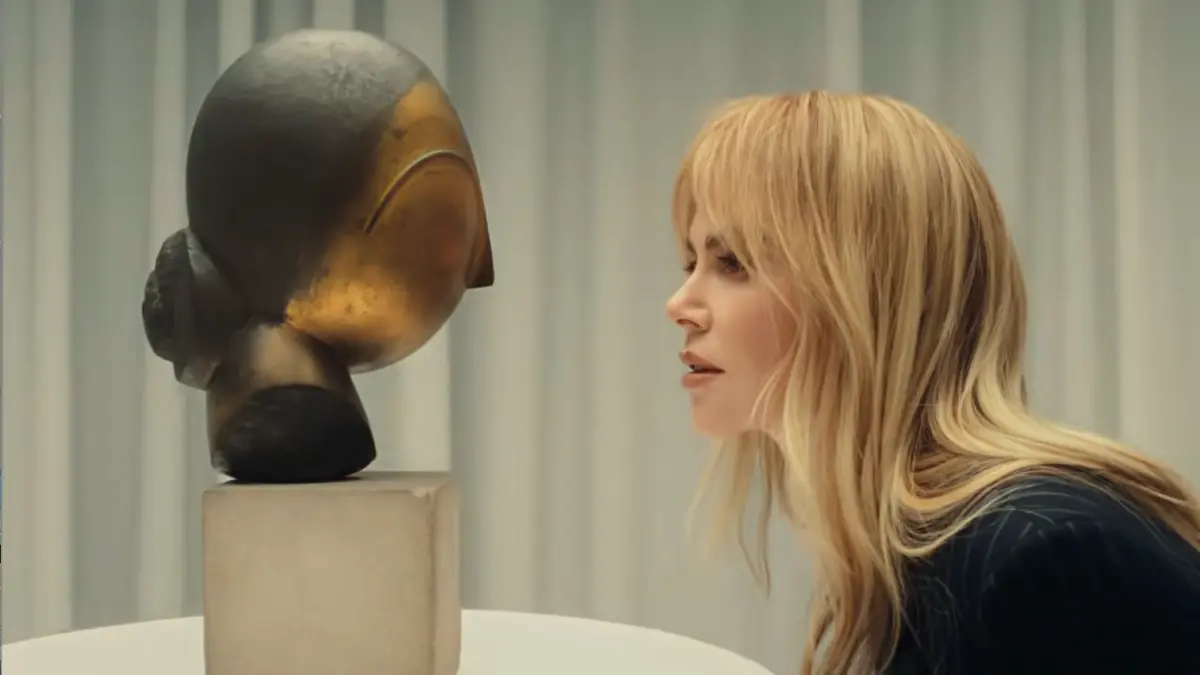
In the spring, Christie’s galleries at Rockefeller Center played host to a theatrical collision between Hollywood royalty and high-end sculpture. Dressed in stilettos and framed by a sweeping circular curtain, actress Nicole Kidman stalked Constantin Brancusi’s gilded masterpiece, Danaïde (1913). To the soundtrack of David Bowie’s "Golden Years," the cinematic short produced by the auction house captured Kidman gazing fixedly into the sculpture’s burnished, nearly vacant visage. The video cuts to speculative, fever-dream montages of her inner consciousness—a phantasmagoria blending ancient Greek statuary, Eastern Buddhas, John William Waterhouse’s pre-Raphaelite paintings, and, anachronistically, Alberto Giacometti’s 1951 bronze The Chariot.
When the spectacle concluded, Danaïde shattered auction records, selling for a staggering $107.6 million and claiming the all-time high watermark for a sculpture sold at auction. Whether Kidman’s performative rapture directly inflated the hammer price remains a matter of market conjecture; what is indisputable is that the stunt catalyzed a broader, zeitgeist-shifting reexamination of Brancusi’s enduring legacy.
This renewed cultural obsession extends far beyond the auction block. Across Europe and North America, museums are reevaluating the Romanian-born master’s contributions to modernism. With the Centre Pompidou undergoing extensive renovations, its celebrated Atelier Brancusi has been sent on an international tour. Following a major stop at Berlin’s Neue Nationalgalerie—the first major German survey of his work in half a century—the exhibition is slated to move to the Museum of Modern Art (MoMa) in New York this autumn. Bringing together more than 150 sculptures, alongside rare works on paper, historical photographs, and dense archival materials, these exhibitions offer a sweeping reassessment of an artist who fundamentally stripped sculpture down to its elemental, metaphysical truth.
Read Also

Detailed Chronology: From Parisian Studio to Global Tributes
To understand Constantin Brancusi’s monumental impact, one must trace the trajectory of his life and the institutional migrations of his studio. Born in Pestisani, Romania, in 1876, Brancusi relocated to Paris, where he established himself as a seismic force in avant-garde sculpture. Before his death in Paris in 1957 at the age of 81, Brancusi made a visionary bequest to the French government: he left his entire studio estate on the Rue Impasse Ronsin in the 15th arrondissement on the singular condition that it be reconstructed and preserved in perpetuity.
This studio became the heart of his artistic philosophy. Brancusi did not view his sculptures as isolated objects; rather, he understood them in dynamic relation to their carved bases—miniature architectural structures in their own right that often rivaled the primary works for visual dominance. When the Centre Pompidou was constructed, an exact reconstruction of the atelier was established in its adjacent plaza.
Now, with the Pompidou closed for long-term renovations, the contents of the studio have embarked on a global tour.

- Summer 2026: The historic exhibition opened at Berlin’s Neue Nationalgalerie, marking a momentous return to Germany after fifty years.
- October 2026: The exhibition transfers to New York’s Museum of Modern Art (MoMA), where curators will present a uniquely American lens on Brancusi’s century-long journey through the art market and institutional collections.
Supporting Context & Metrics: The Architecture of Minimalism
The recent exhibition at Berlin’s Neue Nationalgalerie provided an illuminating, if occasionally fraught, testing ground for Brancusi’s modernist axioms. Designed by legendary architect Mies van der Rohe, the gallery’s iconic open-plan space—interrupted by just four load-bearing columns—seemed conceptually tailor-made for Brancusi’s vertical distillations of form. As one of the 20th century artists most philosophically aligned with van der Rohe’s "Less is More" ethos, Brancusi’s work theoretically belonged within the glass-and-steel pavilion.
However, the reality of the installation exposed the limits of curatorial vision. Overseen by curators Klaus Biesenbach and Maike Steinkamp, the exhibition made several puzzling choices. While conservation mandates undoubtedly dictated the use of glass vitrines and elevated platforms, placing numerous sculptures directly against the gallery walls severely compromised the 360-degree viewing experience that Brancusi’s works inherently demand. Masterpieces like Bird in Space (1923) felt uncomfortably constrained—rendered, in the words of critics, nearly "agoraphobic." Similarly, the maquette Brancusi crafted for the lintel of the Kiss gate (1935–37)—part of his monumental war memorial complex in Târgu Jiu, Romania—was hung at such a height that visitors were forced into uncomfortable physical contortions merely to glimpse it.
Despite these spatial missteps, the exhibition successfully mapped the vast gamut of Brancusi’s media, materials, and conceptual formats. Photographic documentation of the Endless Column (1918) underscored his mastery of monumental public architecture, while an ovoid pavilion at the center of the exhibition space meticulously recreated his historic atelier. Chock-a-block with tools, letters, postcards exchanged with Fernand Léger and Blaise Cendrars, and foundational documents from his early days in Romania, the pavilion reintroduced the intellectual and personal flesh behind the austere, laconic beauty of his marble and bronze forms.

Official Statements & Critical Analysis: The Mythos of Materiality
Brancusi’s historical reception in the United States remains legendary, characterized by legal battles that permanently altered the definition of art. When Edward Steichen organized a landmark Brancusi retrospective in New York in 1926, Bird in Space was seized by United States customs officials. Tax authorities slapped the sleek, aerodynamic bronze with a hefty import tariff reserved for "manufactured metal objects" and kitchen utensils, refusing to recognize it as a work of art.
The ensuing court case—culminating in a historic deposition by the artist—vindicated Brancusi’s aesthetic pedigree, legally establishing that an object need not be figurative or utilitarian to qualify as sculpture. This landmark ruling paved the way for figures like Marcel Duchamp, Steichen, and collector John Quinn to champion his work stateside, embedding Brancusi into the DNA of American modernism.
Art historians and critics continue to grapple with the paradoxical complexity of Brancusi’s surfaces. Unlike contemporaries who relied on industrial casting or additive modeling, Brancusi championed taille directe—direct carving into marble, wood, and limestone. Even his cast bronze sculptures reflect an obsessive, alchemical obsession with manual labor:

- The Polish: Countless hours spent hand-polishing bronze until it dissolved into pure, liquid light.
- The Patina: The meticulous application of chemical patinas to modulate how light and shadow interacted with the volumes of works like Sleeping Muse (1910) or Danaïde (1913).
This dedication to material reduction has cast a long shadow over contemporary culture. In his 2020 book The Longing for Less, cultural critic Kyle Chayka diagnosed contemporary American culture’s obsession with a "minimalism glut"—a lifestyle trend characterized by decluttered spaces, streamlined consumer electronics, and ascetic interiors that traces its conceptual lineage directly back to Brancusi’s subtractive ethos.
Furthermore, the "Brancusi Effect" reverberates far beyond fine art. As curator Nicolaus Schafhausen demonstrated in his 2014 landmark exhibition, the sculptor’s influence spans international architecture and industrial design, touching everyone from German architect Jürgen Mayer H. and industrial designer Konstantin Grcic to conceptual artists like Sofia Hultén and André Cadere. In the fashion and luxury sectors, Brancusi’s organic, fluid forms continue to inspire campaigns by Balenciaga, Rick Owens, Tokyo jewelry label Ambush, and luxury houses where designers openly confess a desire to emulate the radical simplicity of his resting heads and ovoid forms.
Future Outlook: The Centennial Horizon and MoMA’s Turn
As the art world prepares for the landmark transfer of the Brancusi retrospective to New York’s Museum of Modern Up this autumn, critical questions loom regarding how a contemporary American audience will engage with his legacy a century after the historic 1926 Steichen exhibition.

The commercial frenzy surrounding the $107.6 million sale of Danaïde at Christie’s—amplified by high-profile marketing vignettes featuring Hollywood icons—signals a modern paradox. Brancusi’s art, born from an ascetic, monastic devotion to manual labor and material honesty, has become one of the ultimate status symbols of the ultra-wealthy global elite. Yet, beneath the veneer of luxury marketing and record-breaking auction blocks lies an uncompromising artistic vision that continues to challenge viewers.
When MoMA opens its doors to the exhibition this October, curators will have an unprecedented opportunity to strip away the pop-culture gloss and market hyperbole. By returning the focus to Brancusi’s revolutionary integration of base and sculpture, his tactile engagement with the body (exemplified by works like Sculpture for the Blind), and his seamless synthesis of archaic folk traditions and high modernism, the museum can reaffirm why Constantin Brancusi remains the ultimate sculptor of the modern soul.

Comments
Facebook App ID not configured. Please add it in the Customizer.