
Executive Overview
For centuries, the rugged sandstone escarpments of Arnhem Land in northern Australia have served as a sprawling, immutable archive of human history, spirituality, and artistic expression. Among these remote galleries lies Awunbarna, also known internationally as Mount Borradaile—a landmark held in deep custodial reverence by the Amurdak people. While the region is globally celebrated for rock art traditions stretching back some 18,000 years, a landmark new eight-year archaeological study reveals a powerful, defiant chapter of creativity born out of existential crisis.
Published in the journal Australian Archaeology and led by renowned Griffith University archaeologist Professor Paul Taçon, the study demonstrates that in the turbulent wake of European colonization during the 18th and 19th centuries, Aboriginal artists did not simply retreat or succumb to cultural erasure. Instead, they adapted their monumental visual culture. The research documents a dramatic surge in the creation of exceptionally large rock paintings and stone arrangements depicting powerful ancestral beings, local fauna, and European interlopers.
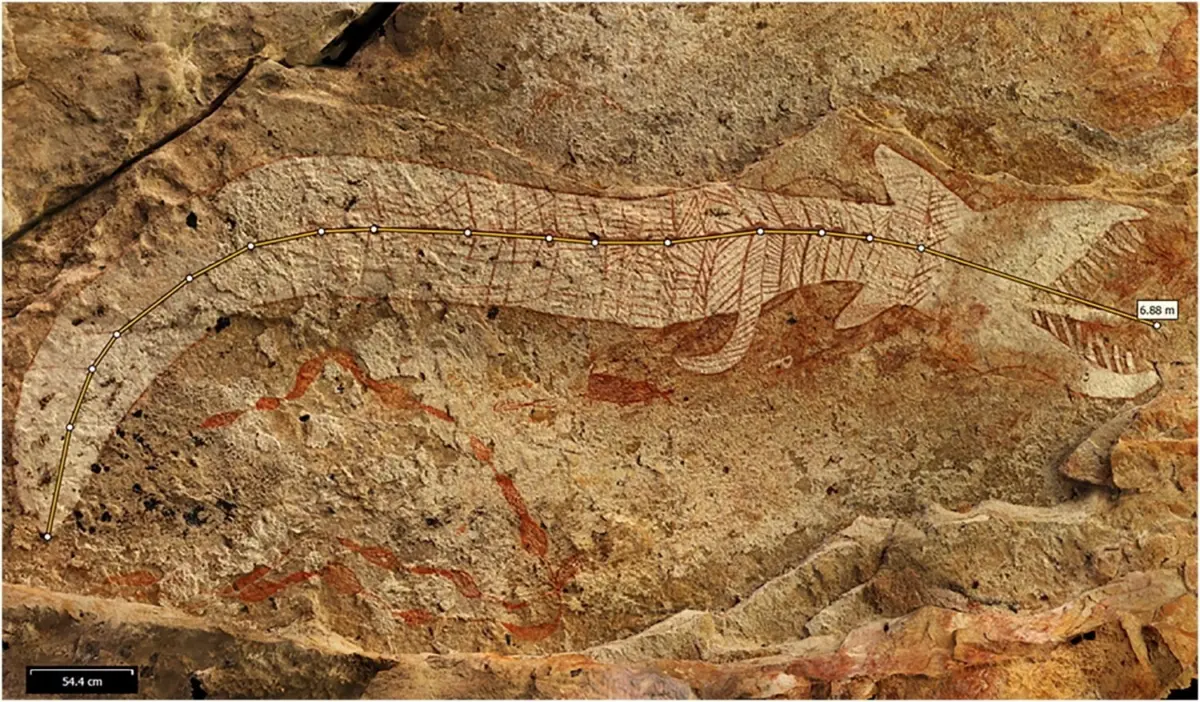
Working in close collaboration with senior Amurdak traditional owner Charlie Mungulda, the research team surveyed 165 sites across the Awunbarna region. Their findings offer an extraordinary window into indigenous resilience. By scaling up the dimensions of their sacred art—including ferocious, twenty-foot-long Rainbow Serpents and colossal anthropomorphic figures—Aboriginal artists made bold, authoritative declarations of sovereignty. These monumental creations served simultaneously as a spiritual invocation of ancient power, a psychological mechanism to master profound historical change, and a visible assertion of land ownership amid the violent encroachment of the British frontier.
Read Also
Detailed Chronology and Archaeological Investigation
To understand the profound weight of the findings at Awunbarna, one must trace both the historical timeline of the region and the meticulous methodology employed by Taçon and his multidisciplinary research team over nearly a decade of fieldwork.
The Contact Period and Shifting Horizons
The arrival of Europeans and Macassan traders on the northern coasts of Australia initiated a cascade of profound ecological, social, and political shocks for Indigenous populations. While Macassan trepangers had maintained peaceful, long-standing seasonal trade relationships with Arnhem Land traditional owners for centuries, the late 18th and 19th centuries brought the more disruptive, territorial, and violent pressures of British colonization.
As foreign settlers, livestock, European sailing ships, and firearms encroached upon the frontier, Aboriginal artists integrated these novel phenomena into their traditional visual vocabulary. Early-contact rock art across Arnhem Land famously includes depictions of sailing vessels, guns, and distinct handprints left by individuals staking their physical claim on the stone canvas.
However, alongside these documentary depictions of European arrival, a distinct stylistic shift occurred: an explosion in scale. While extra-large paintings of humans, animals, and mythological entities were occasionally produced in western Arnhem Land during earlier epochs, the post-contact period witnessed an unprecedented proliferation in the sheer volume and size of these monumental works.
Fieldwork and Methodology (2016–2024)
Recognizing that this post-contact scaling phenomenon warranted deep scientific and cultural inquiry, Professor Paul Taçon initiated an intensive eight-year archaeological project. The team partnered directly with senior Amurdak traditional owner Charlie Mungulda, whose intimate knowledge of country, kinship systems, and ancestral law guided the researchers through the labyrinthine rock shelters and hidden alcoves of the Awunbarna landscape.
Systematically recording rock art at 165 distinct sites across the region, the team cataloged a breathtaking array of imagery. Dating rock art, particularly paintings executed on open or semi-sheltered sandstone, remains one of archaeology’s most stubborn technical challenges because organic binders used in ancient paints often degrade. To circumvent this, the researchers utilized a combination of stratigraphic analysis—observing how newer layers of paint overlaid older ones—and material composition studies.
A crucial breakthrough in dating these monumental works came from analyzing the pigments used. Many of the post-contact oversized figures, particularly the Rainbow Serpents, were rendered in brilliant white pipe clay, or kaolin. Unlike iron-oxide-based red ochres that can bind deeply with sandstone matrices and endure for millennia, white pipe clay paintings are notoriously fugitive. They typically weather, erode, and wash away within a few hundred years—and in exposed microclimates, within mere decades. The presence of well-preserved white kaolin overlays on top of older, darker pigment layers provided undeniable physical evidence that these massive artworks were executed during or after the tumultuous contact period.
Supporting Context & Metrics: The Art of Scale and Ancestral Power
The empirical data gathered across the 165 surveyed sites at Awunbarna paints a vivid picture of a culture actively mobilizing its spiritual architecture to confront territorial displacement. The metrics and specifics of the cataloged art underscore an intentional, monumental aesthetic shift.
Monumental Scale and Masterworks
Among the cataloged works, several stand out for their sheer physical dimensions and intricate iconography:
- The Giant Rainbow Serpent: Measuring an imposing 20 feet in length, this masterpiece of post-contact rock art features a ferocious crocodile-like head, an elongated tongue, and a jaw lined with razor-sharp teeth. It dominates the rock shelter wall, commanding immediate visual and psychological attention.
- The Whale Depiction: The team recorded what remains the only known rock art image of a whale in the entire continent of Australia—a testament to the artists’ engagement with the vast, unfamiliar oceanic life introduced or more closely observed through interactions with foreign seafarers.
- Colossal Anthropomorphs: Alongside serpents and fauna, the researchers documented towering human figures, dwarfing the viewer and projecting an aura of ancestral authority and surveillance.
- The Serpent Stone Arrangement: Moving beyond two-dimensional wall paintings, the team recorded a massive, serpent-shaped stone arrangement stretching 125 feet across the landscape. This earthwork integrated the physical topography of Awunbarna into the sacred narrative, binding stone, earth, and myth into an unbreakable territorial marker.
The Theological Role of the Rainbow Serpent
To fully appreciate why these monumental works were created during a period of crisis, one must examine the role of the Rainbow Serpent (Ngalyod or equivalent ancestral entities in western Arnhem Land) in Aboriginal cosmology.
In Indigenous Australian belief systems, Rainbow Serpents are foundational ancestral beings associated with water, creation, wet seasons, and profound transformation. Crucially, they are believed to possess the supernatural ability to fold time—seamlessly bridging the past, present, and future. Traditional stories teach that humanity’s primary existential challenge is not to resist change, but to learn how to accept, cope with, and ultimately master it.
By rendering these transformative entities on an unprecedented, monumental scale during the disruptions of colonization, Aboriginal artists were engaging in a sophisticated form of cultural defense. The study’s authors note that these giant paintings served as a visually arresting, authoritative declaration: while the material world was being upended by foreign invaders, the foundational laws, spiritual structures, and ownership rights dictated by ancestral beings remained absolute and unyielding.
Official Statements and Academic Insights
The publication of the study in Australian Archaeology has sent ripples through the anthropological and archaeological communities, sparking vital conversations about Indigenous agency during colonial expansion.
Reflecting on the psychological and political motivations behind the art, lead author Professor Paul Taçon emphasized the proactive nature of the indigenous response:
"When faced with the existential threat of European colonization—the disruption of traditional movement, the introduction of foreign diseases, and the violent dispossession of land—Aboriginal artists did not curl up in defeat. They amplified their voice. By painting these monumental ancestral beings in hyper-visible locations using fresh, brilliant white clays, they were marking their territory in the most powerful way available to them. It was a clear message to any intruder, human or otherwise, that this country belonged to the ancestors and their living custodians."
Senior Amurdak traditional owner and co-researcher Charlie Mungulda provided the crucial cultural framework that anchored the scientific findings in living reality. Speaking on the enduring significance of the Awunbarna sites, Mungulda highlighted the continuity of custodial responsibility:
"Our old people walked these rocks, and they saw what was happening when the white men came on the country with their ships and guns. They didn’t just watch; they painted our law on the stone so everyone would know who is boss for this country. These paintings are not just pictures—they are power. They keep the country safe, and they remind us who we are and where we come from, no matter what changes come across the land."
Independent archaeologists and art historians have lauded the study for reframing the narrative around contact-era indigenous art. Rather than viewing the art of this period through a lens of decline or passive assimilation, the research establishes it as a dynamic, highly strategic aesthetic counter-offensive.
Future Outlook and Preservation Challenges
As this groundbreaking study opens new chapters in the understanding of Australian archaeology, it also sounds an urgent alarm regarding the preservation of these fragile cultural treasures for future generations.
Climate Change and Environmental Threats
The very material that made post-contact rock art so striking—white pipe clay (kaolin)—now renders it exceptionally vulnerable to environmental degradation. Unlike mineral-bound red ochres, kaolin is highly susceptible to moisture, shifting humidity, and microbial activity. In recent years, northern Australia has experienced increasingly erratic weather patterns, intensified monsoonal flooding, and prolonged dry seasons driven by global climate change.
These climatic shifts accelerate the erosion of sandstone shelters and wash away fragile pigment layers at an alarming rate. Archaeologists warn that without proactive, targeted conservation strategies, some of these monumental post-contact masterpieces could be lost within decades.
Cultural Tourism and Land Management
Awunbarna (Mount Borradaile) remains under the vigilant stewardship of traditional owners like Charlie Mungulda and their families. Balancing the preservation of these sacred sites with educational tourism is a delicate, ongoing challenge. Traditional owners, working in partnership with academic institutions and land councils, are advocating for increased funding for Indigenous-led ranger programs. These programs are vital for monitoring remote sites, managing feral animal populations that damage rock shelters, and preventing unauthorized access.
The Path Forward for Indigenous Archaeology
The Griffith University study serves as a powerful model for modern archaeological research—one rooted in deep collaboration, shared authority, and profound respect for living Indigenous knowledge systems. By treating Aboriginal traditional owners as equal scientific partners rather than mere informants, projects like the Awunbarna survey are rewriting the historiography of the Australian frontier.
Ultimately, the monumental serpent paintings and colossal figures of Awunbarna stand as eternal sentinels. They testify to a people who, facing the darkest storms of colonization, reached for their most ancient and potent spiritual symbols, magnified them on the stone walls of their country, and thereby inscribed their sovereign survival indelibly into the geological record.

Comments
Facebook App ID not configured. Please add it in the Customizer.