
Executive Overview
For millions across the globe, sports serve as a cultural shorthand—a tribal badge worn on the sleeve or hoisted on a flagpole. Yet for the immigrant diaspora, athletic allegiance often transcends mere fandom, evolving into a complex psychological architecture of self-invention, generational mourning, and spatial reclamation.
This investigative narrative explores the lifelong trajectory of one Ecuadorian-American writer whose relationship with soccer transformed from a fabricated marker of identity into a deeply somatic refuge during family trauma, culminating in a vibrant, multi-generational pilgrimage across the American heartland.
Tracing a personal and cultural arc from the unmonitored suburban soccer fields of 1990s Ohio to a transformative family reunion in the equatorial valleys of San Antonio, Ecuador, and finally to a sea of yellow jerseys in a Kansas City World Cup stadium, this piece examines how the world’s game operates as both an anchor and an escape. It interrogates the mechanics of diaspora communities in the United States, the weight of inherited ancestral memory, and the strange, binding comfort of a glowing green rectangular screen.
Read Also
Detailed Chronology
Act I: The Invention of Lineage in Midwestern Ohio
Growing up in the United States during the late 20th century, identity was frequently an act of creative reconstruction for children of early Latin American immigrants. Long before the era of ubiquitous high-speed broadband, on-demand streaming, and concentrated cultural enclaves, identity markers were scarce. For the author—a child with a wholly Serbian surname and features that read entirely Slavic—connecting with an Ecuadorian heritage required imaginative engineering.
The primary vector for this self-invention was soccer. Despite never having played organized soccer in Ecuador, and despite the family’s sole foundational link to the sport resting upon unverified generational lore regarding grand-uncles and grandfathers who allegedly favored the game, soccer became an inherited truth. American peers accepted this constructed lineage at face value, simplifying the delicate social negotiations of integration.
[Ohio Childhood: 1980s-90s]
       │
       ├── Fabricated Ecuadorian Heritage (Reliance on oral family lore)
       ├── Soccer as a Tool for Social Differentiation
       └── Athletic Peak: High School Prodigy in Bexley (Cut short by tendonitis)
The athletic reality of this self-perception was fragile. Peaking as a high school freshman in Northern Ohio’s Perrysburg youth leagues, the author enjoyed a brief local prominence upon moving to Bexley, where soccer infrastructure was sparse and foundational ball-control skills marked him as a novelty. However, this illusion of athletic exceptionalism was shattered with the arrival of the Goggins brothers, seasoned players from Perrysburg whose superior talent exposed the author’s limitations. Persistent tendonitis ultimately forced an early retirement from competitive play by his senior year.
Yet, the persona of "the soccer guy" endured. In the 1990s, maintaining this identity required little more than quiet derision toward dominant American sports and seizing upon the rare, fuzzy televised broadcast. It was an exercise in deliberate divergence—a way to keep a faint Ecuadorian flame alive beneath a decidedly non-Latino exterior.
Act II: The Valley of San Antonio and the Collapse of Language
Years later, following college graduation and armed with savings from early adulthood, the author made his first return journey to Ecuador. The underlying objective was long overdue: a reckoning with his estranged father. Having fled a domestic environment marked by violence and volatility at the age of eight, the author returned with a structured diplomatic plan: two weeks of light, disarming pleasantries followed by hard, long-deferred interrogations regarding paternal abandonment and financial estrangement.
The reunion took place in San Antonio, a village nestled near the equatorial monument of Mitad del Mundo. The confrontation, however, was preempted by a slow-motion medical catastrophe.
[San Antonio, Ecuador: The Reunion]
       │
       ├── Phase 1: Diplomatic Plan (Attempting to confront paternal estrangement)
       ├── Phase 2: Medical Crisis (Stroke manifestation through broken German)
       └── Phase 3: The Caretaker Impasse (Bites, gangrene legacies, and institutional friction)
Upon calling his father to announce his morning arrival, the author was greeted not with Spanish, but with halting, garbled German. This linguistic anomaly was not a deliberate provocation by a polyglot father fond of psychological games, but the acute neurological manifestation of a stroke.
The father’s biography was itself an epic of twentieth-century upheaval. At age fourteen, he had served as a machine gunner on the front lines alongside his older sister, a devoted Yugoslav Partisan fighting the Nazis. At eighteen, called up for mandatory military service under Tito’s newly formed Yugoslavia and finding his underage combat experience insufficient for a legal exemption, he stole his sister’s pistol in a fit of pique. Thus began an odyssey that carried him from Vienna to a displaced persons camp in Naples, onward to Panama and Chile, and finally to Ecuador, where he settled permanently without a passport or official documentation. His aversion to institutions was legendary; years prior, he had allowed a leg infection to reach a gangrenous state before Serbian expatriates dragged him to a hospital for an eventual amputation by a Chilean physician—the very blood clot history that now manifested as broken linguistic circuits.
When the author reached him, the father was physically combative, biting his son’s shoulder when hoisted toward a vehicle. Navigating this crisis required enlisting a network of loyal Serbian compatriots and locating the elusive Chilean doctor.
In the evenings, shattered and emotionally depleted by the complex dynamics of caretaking, local machinations, and a suspicious young stepmother seemingly mismanaging medication dosages, the author found solace in a wholly unexpected ritual: televised soccer.
+--------------------------------------------------------------------------+
|                        THE HOMEOPATHIC REMEDY                            |
|                                                                          |
|  "It was like a homeopathic version of what I was going through—pure     |
|   witnessing—except all of the consequence was gone... More than        |
|   anything, I took comfort in the beautiful, saturated color of the      |
|   field."                                                                |
+--------------------------------------------------------------------------+
Staring at the glowing green rectangular screen in his cousins’ Quito home, watching Argentine and Mexican league matches, the author discovered a meditative escape. The absolute lack of consequence in the televised spectacle offered a psychological balm—a homeopathic dose of passive observation that countered the harrowing weight of familial reality. Soccer ceased to be an identity token; it became a religious practice.
Act III: The Kansas City Pilgrimage and the Diaspora Sea
Decades later, televised soccer had become an established domestic anchor—a habit maintained across migrating technologies from public house broadcasts to internet streams and family plan YouTube feeds. Yet the stadium experience remained largely unpalatable: corporeal, expensive, and logistically vexing.
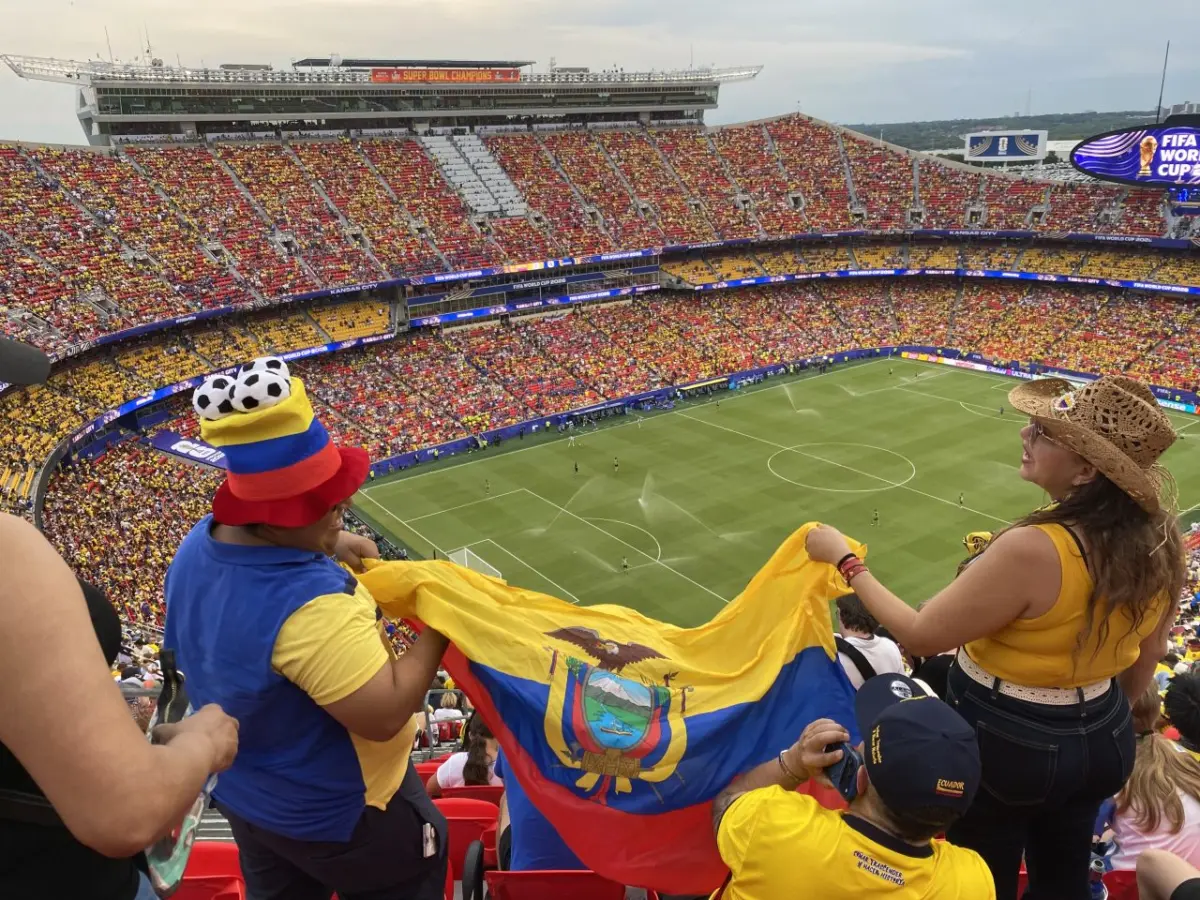
That calculus shifted when Ecuador qualified to face Curaçao in the World Cup group stage, hosted in Kansas City, Missouri. Initially deterred by skyrocketing ticket prices ($400 to $600 for nosebleed seats), the author’s trajectory altered when his mother unexpectedly funded tickets and flights for him and his brother as a "once-in-a-lifetime oportunidad."
[Kansas City Pilgrimage: World Cup Group Stage]
       │
       ├── Logistics & Financials: Overpriced tickets, last-minute Real ID scrambles
       ├── Diaspora Immersion: The hotel transformed into a sea of yellow jerseys
       └── The Stadium Experience: Scorching high-altitude seats, 0-0 draw against Curaçao
Arriving in Kansas City, the author stepped into an alien yet profoundly familiar cultural ecosystem. For an immigrant family that arrived in small-town Ohio in 1981—long before the formation of massive diaspora hubs like Jackson Heights or Chicago consulates—decades had passed without regular exposure to fellow Ecuadorians. The local hotel was transformed into a literal diaspora homeland:
- A sea of vibrant yellow soccer jerseys.
- Spontaneous chants of "Vamos, carajo!"
- A pin-studded lobby map overflowing with Ecuadorian markers.
As thousands of fans converged on the stadium in a massive yellow river, the atmosphere defied the aggressive tribalism typical of domestic sporting events. Instead, it was defined by multi-generational family units seeking mutual recognition and cultural validation.
The match itself, however, offered a sporting anticlimax. Playing against Curaçao—a Caribbean island nation with a population of 156,000—Ecuador dominated possession from the stadium’s highest, sun-baked apex, yet failed to convert scoring chances, resulting in a scoreless 0–0 draw. To the diasporic faithful, who viewed the match through the anxious lens of upcoming fixtures against powerhouse Germany, the draw felt like a catastrophic elimination, transforming stadium joy into post-match transit chaos and collective mourning.
Act IV: Redemption in Jackson Heights
The narrative arc achieved its geographic and emotional synthesis during the subsequent fixture against Germany. While visiting New York City, the author ventured into the heart of the Ecuadorian diaspora: Jackson Heights, Queens.
[New York City / Jackson Heights]
       │
       ├── Local Enclave: Restaurants and bars filled to capacity
       ├── The Upscale Anomaly: High-end lounge filled with indifferent model-types
       └── The Upset: Ecuador triumphs over Germany, sparking street-level celebrations
Finding neighborhood venues packed to capacity, the author sought refuge in an upscale, hyper-modern lounge staffed by high-fashion waitstaff indifferent to the screen. Yet, as the match unfolded, the room became transfixed: Ecuador overturned an early deficit to secure a historic, redeeming upset victory over the European powerhouse.
Stepping out onto the nocturnal New York streets, the air resonated with the blaring of horns, waving flags, and shouting passengers leaning from bus windows. In that moment of collective euphoria, buying a celebratory pastry and messaging cousins across state lines, the diaspora circle closed. The long migration from the isolated Midwestern plains of Ohio to the vibrant avenues of Queens found its resting place on the bright, glowing green pitch.
Supporting Context & Metrics
To contextualize the sociological and historical weight of the author’s journey, we must examine the broader metrics of Ecuadorian migration to the United States and the economic anatomy of modern international soccer broadcasting.
Ecuadorian Migration to the United States: A Demographic Snapshot
- Early Waves (1970s–1980s): Initial migration trickled into non-traditional Midwestern and Eastern hubs (such as Ohio and upstate New York) rather than the massive coastal gateways of New York or Miami, leading to profound cultural isolation for early arrivals.
- The 1999–2000 Economic Crisis: Triggered by a severe banking collapse and the adoption of the U.S. dollar in Ecuador, a massive second wave of migration propelled hundreds of thousands of Ecuadorians abroad, cementing enclaves in Queens (Jackson Heights), New Jersey, and Chicago.
- Current Diaspora Estimates: The United States currently hosts the largest population of Ecuadorians outside of South America, estimated at over 700,000 individuals, with significant multi-generational communities grappling with dual cultural identities.
The Economics of Modern Fandom
- Ticketing Inflation: Major international fixtures hosted in North America routinely see primary and secondary market ticket prices escalate by 300% to 500% for high-demand fixtures, turning attendance into significant financial investments for working-class immigrant families.
- Broadcasting Evolution: The transition from irregular cable broadcasts and bootleg UHF signals in the 1990s to digital streaming ecosystems (YouTube TV, dedicated apps, and multi-platform geo-streaming) has fundamentally altered how diasporic communities maintain real-time contact with their cultural homelands.
Official Statements & Cultural Commentary
While personal narratives drive the core of this investigation, cultural sociologists and immigration historians have long noted the unique role sports play in maintaining transnational bridges.
"For the diaspora, the national team is not merely a competitive athletic squad; it is a portable embassy. When physical borders separate families from their homeland, the 90 minutes of a match provide an ephemeral, highly concentrated territory where citizenship is felt rather than administered."
— Dr. Elena Vasquez, Institute for Transnational Cultural Studies
Furthermore, sports economists emphasize the shifting paradigm of international friendlies and tournament matches hosted on neutral soil:
"When federations host World Cup group matches in North American metropolitan centers, they are monetizing not just athletic performance, but the profound hunger for cultural homecoming experienced by decades-old immigrant communities. The ticket price is secondary to the cost of belonging."
— Marcus Thorne, Global Sports Business Journal
Future Outlook
As international soccer expands its North American footprint—culminating in expanded World Cup formats and co-hosted continental tournaments—the intersection of diaspora identity and athletic spectatorship will continue to evolve.
[The Future Horizon]
       │
       ├── Expanded Tournaments: Increased frequency of major matches in the Americas
       ├── Digital Diasporas: Hyper-connected streaming bridging generational divides
       └── The Enduring Pitch: Transforming temporary sporting spectacles into permanent cultural anchors
For second- and third-generation descendants of immigrants, the "homecoming" experienced in stadiums like Kansas City or neighborhoods like Jackson Heights points toward a sustainable model of cultural preservation. The anxiety of isolation—symbolized by decades without tropical fruit or familiar linguistic enclaves—is increasingly met by organized diasporic networks that utilize soccer as a generational glue.
Ultimately, whether viewed through the lens of a glowing television screen in an Ecuadorian family home, a sun-scorched stadium apex in Missouri, or a jubilant Queens street corner, soccer remains an incomparable mechanism for navigating grief, honoring the dead, and claiming space in an adopted world. The green rectangle endures—not simply as a field of play, but as a map for the displaced.




Comments
Facebook App ID not configured. Please add it in the Customizer.