
Executive Overview
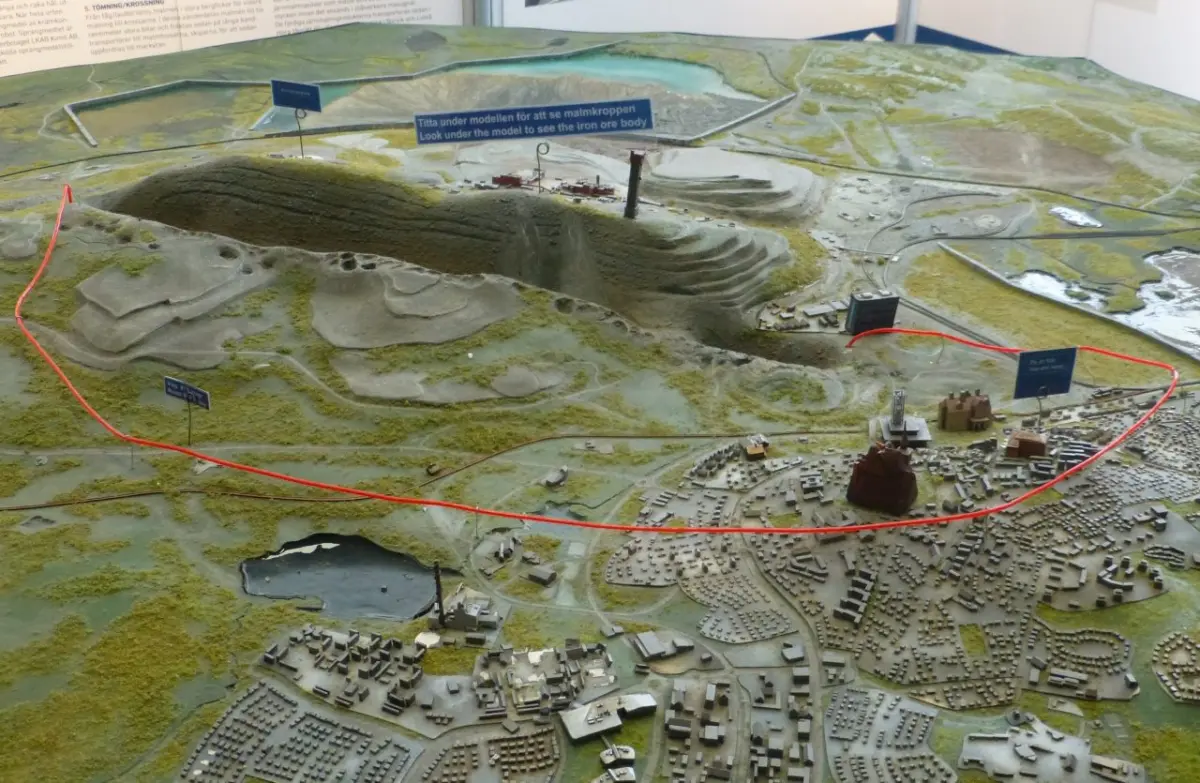
Every morning between 1:15 and 1:45, a seismic shockwave reverberates through Kiruna, Sweden’s northernmost city. Situated 90 miles north of the Arctic Circle, Kiruna sits directly above the world’s largest underground iron ore mine, operated by the state-owned enterprise Luossavaara-Kiirunavaara Aktiebolag (LKAB). For nearly seventy-five years, relentless sub-level caving extraction has hollowed out the earth, causing the surface to buckle, fracture, and steadily collapse eastward.
To prevent a catastrophic structural failure, the city is undergoing one of the most radical municipal relocations in modern history: a two-mile eastward migration designed to save its residents, its economy, and its defining industry. This ongoing twenty-year urban and social transformation requires the phased demolition of central Kiruna—including its schools, hospitals, commercial districts, and homes—while historic landmarks, such as the city’s iconic wooden church, are physically hauled to new foundations.
Yet, this massive engineering marvel represents a paradox of survival. The very corporation bankrolling the construction of "New Kiruna" is the architect of the old city’s destruction. As LKAB expands its operations to tap into newly discovered deposits of critical rare-earth minerals, the residents of Kiruna navigate a complex psychological landscape defined by corporate dependency, forced nostalgia, and the erasure of local history.
Read Also
Detailed Chronology: A Century of Extraction and Displacement
The history of Kiruna is inextricably bound to the industrial ambitions of the Swedish state and the geological wealth of the Kiirunavaara and Luossavaara mountains.
1900–1957: The Birth of a Model Industrial Town
- Early 1900s: Following the expansion of railways connecting the region to the southern ports of Luleå, large-scale iron ore mining begins under the stewardship of LKAB. Workers migrate north for high wages, establishing a company town on indigenous Sámi reindeer-herding lands.
- 1910: LKAB formally constructs a model industrial settlement, funding foundational infrastructure—including a fire station, hospital, and church—in exchange for local tax exemptions.
- 1957: The Swedish government completes its acquisition of LKAB, fully nationalizing the enterprise and solidifying the state’s direct role in the region’s socio-economic fabric.
2004–2014: The Crisis Unfolds and the Migration Begins
- 2004: LKAB issues a brief, five-sentence letter to the Kiruna Municipal Council warning of accelerated surface deformations. The mining company announces that the city center must be evacuated and relocated two miles east, affecting roughly 6,000 residents—one-third of the municipal population.
- 2008: LKAB’s board approves a deeper mining level, extending the mine’s lifespan by thirty years while dramatically widening the zone of ground deformation. The timeline for displacement accelerates.
- 2014: Kiruna officially initiates its physical migration eastward. White Arkitekter is tapped to design the new municipal center, framing the project not as a utopian urban experiment, but as an urgent exercise in crisis management.
2023–2025: Heavy Demolition and the Relocation of Landmarks
- August 2023: Kiruna enters a phase of heavy demolition in the "Old City." Cracks tear through municipal buildings, schools, and homes. The psychological toll prompts residents to collect mementos from abandoned public spaces before heavy machinery moves in.
- Late 2023: LKAB announces the discovery of Europe’s largest known deposit of rare-earth minerals in the region, signaling further industrial expansion that threatens surrounding reindeer migration routes.
- August 2025: Contractors execute the complex relocation of Kiruna’s 670-ton red wooden church. Transported across two days on a specialized 224-wheel hydraulic trailer, the landmark is successfully established between the old graveyard and the boundary of New Kiruna.
Supporting Context & Metrics: The Scale of the Transformation
To comprehend the sheer magnitude of the Kiruna relocation, one must examine the operational scale of LKAB and the systemic vulnerabilities of the municipality.
Industrial Footprint and Production Metrics
- Volume: LKAB extracts enough iron ore daily to construct six and a half Eiffel Towers. Four heavily loaded trains depart the mine daily, carrying concentrated iron ore pellets along the Ore Railway to the Gulf of Bothnia port of Luleå.
- Employment: LKAB directly employs approximately one-third of Kiruna Municipality’s 22,000 residents. According to anthropologists studying the region, the relationship between the citizenry and the corporate entity transcends economic dependence, amounting to what scholars term an "impossibility of refusal." Because LKAB finances the overwhelming majority of New Kiruna’s real estate development, any systemic rejection of the corporate-municipal pact effectively equates to leaving the city entirely.
Geotechnical Realities
- Seismic Activity: Blasting occurs daily between 1:15 AM and 1:45 AM. Near the deformation zone—colloquially known as "Old Kiruna" or the "Wrong Side"—tremors register as micro-earthquakes, visible in domestic settings as rippling water in glasses left on nightstands.
- Infrastructure Deficit: The division of the city has strained municipal services. Essential upgrades, such as restoring a fully functional maternity ward at the regional hospital, have lagged behind schedule as municipal leaders grapple with a fast-moving crack line that outpaces bureaucratic planning.
Official Statements and Institutional Perspectives
The relocation of Kiruna has generated a dichotomy between corporate optimism and individual mourning. Public officials emphasize economic modernization, while citizens confront the loss of personal and cultural heritage.
Municipal Leadership: The Drive for Expansion
Mats Taaveniku, chairman of the municipal council, has aggressively marketed the relocation as an overdue cultural and economic upgrade. Operating out of his office in New Kiruna, Taaveniku has set an ambitious target of growing the city’s population to 25,000 by 2030.
"We can’t wait anymore," Taaveniku stated regarding the rapid progression of the ground deformations. "If you ever thought about moving to Kiruna, now is the right time."
However, infrastructural shortcomings remain stark. When questioned about the absence of a fully operational maternity ward in the new city’s healthcare facilities, Taaveniku acknowledged the lag, noting simply, "We have to build it right now."
Corporate Narrative: Rebirth vs. Displacement
LKAB frames the urban transformation as a stewardship of the region’s future, projecting messages of corporate benevolence through branded banners, public relations campaigns, and guided underground tours. The corporate narrative champions the technological sophistication of sub-level caving—where remote-controlled rigs drill and blast ore bodies before processing them into high-purity pellets.
Yet, this corporate optimism jars against the physical reality on the ground. As the crack line advances eastward, dividing neighborhoods, closing community spaces like the Royal nightclub, and forcing schools to shutter, the corporate narrative of "rebirth" often conflicts with the lived experience of displacement.
Citizen Resistance and Nostalgia
Local educators, historians, and long-term residents have attempted to carve out emotional spaces within a municipal process dominated by corporate logistics. Timo Vilgats, a local high school history teacher, has frequently highlighted the emotional disenfranchisement experienced by elderly residents. While financial compensation is often provided for surrendered properties, many long-term inhabitants reject the primacy of monetary reimbursement over generational ties to the land.
Reflecting on the psychological weight of the move as the historic church was hauled past his porch in August 2025, Vilgats remarked on the revisionist historical tendencies surrounding the town’s industrial narrative:
"Before the church came here, this used to be a resting place for reindeer. Sometimes we misrepresent history and say the story begins when the railway and LKAB popped up here. That’s just nonsense. And a glaringly obvious revisionist history."
Future Outlook: The Sustainability Paradox
As Kiruna enters the latter half of the 2020s, the city faces a profound existential paradox. The global green energy transition—reliant on electric vehicles, wind turbines, and advanced electronics—has dramatically accelerated the demand for the very iron ore and rare-earth minerals locked beneath Arctic soil.
Yet, the extraction of these green technologies incurs severe localized environmental and social costs. The expansion of LKAB’s mining operations directly encroaches upon indigenous Sámi reindeer herding routes, fragmenting traditional lands and threatening cultural survival. Furthermore, the relentless eastward march of ground deformations ensures that New Kiruna may not represent a permanent sanctuary, but merely a temporary resting place in an ongoing cycle of resource extraction.
Ultimately, Kiruna serves as an extreme global case study for the anthropogenic era. It exposes the acute tension between planetary resource demands and local human habitation. As New Kiruna slowly populates with gray-painted apartment blocks, cubicle-based classrooms, and relocated historic monuments, its citizens remain tethered to an underground titan—one that feeds the modern world while continuously pulling the ground out from beneath their feet.



Comments
Facebook App ID not configured. Please add it in the Customizer.