
Executive Overview
In recent years, the graphic novel has firmly established itself as a deeply versatile medium for biographical nonfiction. Works such as Mimi Pond’s Do Admit: The Mitford Sisters and Me (Drawn & Quarterly, 2025) and Ken Krimstein’s Einstein in Kafkaland: How Albert Fell Down the Rabbit Hole and Came Up with the Universe (Bloomsbury, 2024) have brilliantly demonstrated how stylized sequential art can evoke the complex inner lives, intellectual struggles, and emotional landscapes of historical figures.
Yet, for contemporary graphic novelists, a unique and daunting artistic challenge arises when attempting to chronicle the lives of fellow comic creators. Choosing a particular narrative and visual style for a standard biography is one thing; finding a complementary, respectful, yet independently authentic art style for a book about an artistic titan—such as Will Eisner, Jack Kirby, Stan Lee, or Ernie Bushmiller—whose own legendary works possess distinct, instantly recognizable aesthetic footprints, requires an entirely different level of mastery.
This profound challenge sits at the heart of a burgeoning subgenre: the comics-about-comics biography. Rather than falling into the trap of cheap pastiche or slavish mimicry, today’s premier graphic biographers are deploying their own distinct artistic identities to interrogate, humanize, and reframe the architects of the sequential art industry. Through deep archival research, personal testimonies, and formal visual innovations, creators like Stephen Weiner, Dan Mazur, Tom Scioli, and Bill Griffith are expanding the boundaries of biographical storytelling. In doing so, they are not only preserving the legacy of the medium’s pioneers but also re-evaluating their flaws, historical oversights, and triumphs with unprecedented nuance.
Read Also
Detailed Chronology: Pioneers, Architects, and the Evolution of the Strip
To understand the weight of chronicling comics history, one must look closely at the timelines of the trailblazers who built the industry from the ground up, and the modern artists who have taken on the responsibility of mapping their trajectories.
Will Eisner and the Birth of an Industry (1936–2005)
Will Eisner entered the fledgling comic book scene in 1936, at a time when a true commercial industry barely existed. Best known for his masked crimefighter The Spirit (which ran from 1940 to 1952) and his seminal 1978 graphic novel A Contract with God, Eisner fundamentally reshaped the cultural perception of sequential art.
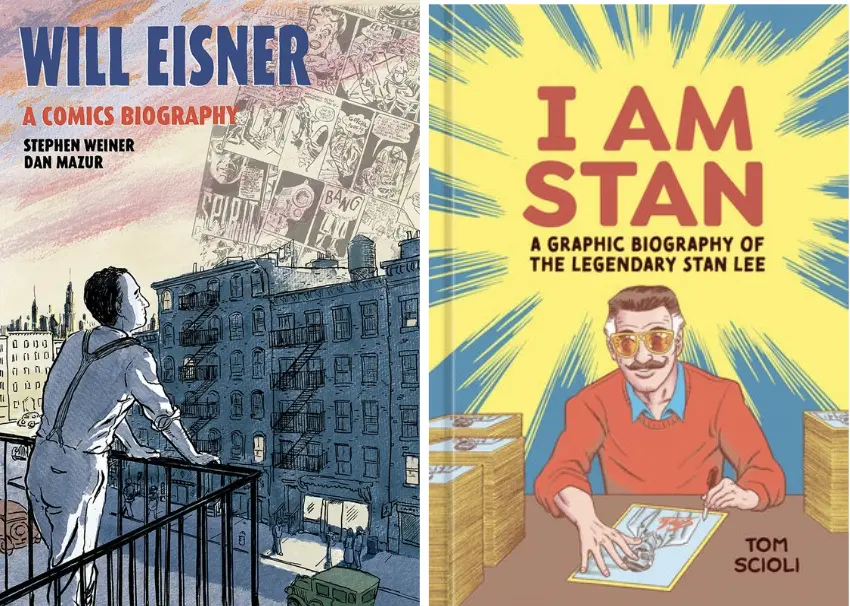
In Will Eisner: A Comics Biography (NBM), writer Stephen Weiner and artist-cowriter Dan Mazur set out to capture this turbulent foundational era. Recognizing that Eisner had already chronicled aspects of his early career in his 1985 autobiographical graphic novel The Dreamer, Mazur chose not to emulate Eisner’s signature style. Instead, Mazur relied on his own contemporary, independent aesthetic to appeal to modern readers who might not be deeply familiar with Eisner’s oeuvre.
Furthermore, Weiner and Mazur did not shy away from the controversial aspects of Eisner’s legacy. Most notably, they tackled the inclusion of Ebony White, the problematic racial caricature who served as The Spirit‘s sidekick. Rather than simply reproducing the offensive caricature on the page, Weiner and Mazur chose to address the historical criticisms head-on, incorporating insights from a 2003 interview in which Eisner reflected—often with lingering resistance—on his responsibility for the character’s depiction.
The Marvel Age and the Dynamic Duo: Stan Lee and Jack Kirby
While Eisner laid structural foundations, the 1960s ushered in the "Marvel Age" of comics, driven by the explosive partnership of artist Jack Kirby and writer-editor Stan Lee. Together, they co-created cultural cornerstones such as the Fantastic Four, the X-Men, the Avengers, and the Incredible Hulk.
Cartoonist Tom Scioli, celebrated for his maximalist science fiction and fantasy work, turned his formal innovations toward this legendary era in two definitive biographical volumes published by Ten Speed Press: Jack Kirby: The Epic Life of the King of Comics (2020) and I Am Stan: A Graphic Biography of the Legendary Stan Lee (2023).
Scioli’s trajectory from decade-long sci-fi creator to comics biographer allowed him to apply radical formal experiments to real-world histories. In I Am Stan, Scioli deliberately mirrored Lee’s chronological evolution through his artistic choices: Lee is initially drawn as a classic, mid-century comic strip character reminiscent of Hank Ketcham’s Dennis the Menace, before transitioning into a more realistic depiction as he ages. Influenced heavily by Andy Warhol—a nod to Marvel’s mid-1960s branding as "A Marvel Pop Art Production"—Scioli utilized recurring page grids filled with serial portraits of Lee’s head across different decades to visually encapsulate a lifetime in the public eye.
Ernie Bushmiller and the Surreal Structure of Nancy
Stepping outside the superhero and adventure genres, veteran underground cartoonist Bill Griffith tackled the architecture of the daily newspaper strip in Three Rocks (Abrams ComicArts), his acclaimed biography of Nancy creator Ernie Bushmiller.
For decades, Bushmiller’s gag-a-day strip was dismissed by highbrow critics as simple, formulaic ephemera. However, recent generations of cartoonists—most notably Olivia Jaimes (who wrote and drew the strip from 2018 to 2025) and Caroline Cash (who took over the strip in 2026)—have highlighted the brilliant, deadpan, and almost avant-garde structural minimalism underlying Bushmiller’s work. Griffith’s Three Rocks bridges historical biography and theoretical art criticism, framing Nancy not merely as a nostalgic artifact, but as a masterclass in the fundamental mechanics of reading and processing comics.
Supporting Context & Metrics: The Mechanics of Graphic Biographies
The creation of a graphic biography requires a distinct methodological framework that separates it from prose-only historical writing. The following table breaks down the primary stylistic approaches, primary sources, and historical hurdles faced by the creators discussed:
| Biography Title | Subject(s) | Primary Creator(s) | Artistic Approach / Visual Strategy | Key Historical / Ethical Challenge Addressed |
|---|---|---|---|---|
| Will Eisner: A Comics Biography | Will Eisner | Stephen Weiner & Dan Mazur | Contemporary independent comics style; avoids direct pastiche of Eisner’s work. | Confronting the legacy of Ebony White, Eisner’s racially insensitive sidekick character. |
| Jack Kirby: The Epic Life of the King of Comics | Jack Kirby | Tom Scioli | Maximalist, energetic, dynamic action-adventure framing reflecting Kirby’s artistic ethos. | Capturing the immense, under-compensated industrial output and dynamic life of "The King." |
| I Am Stan: A Graphic Biography of the Legendary Stan Lee | Stan Lee | Tom Scioli | Warholian pop-art pop-culture integration; character ages from cartoon strip to realism. | Navigating the complex mythos of Lee’s editorial persona versus his actual creative contributions. |
| Three Rocks | Ernie Bushmiller | Bill Griffith | Underground comix meets classic newspaper gag styling; deep reliance on oral history. | Elevating the perceived "low art" of daily gag strips into a respected avant-garde art form. |
The Value of Primary Archives and Oral History
A recurring metric of success across all these projects is the depth of primary source acquisition. Unlike traditional literary figures whose paper trails are preserved in university libraries through voluminous personal letters and diaries, early comic book creators often lived transient, blue-collar lives. Their original art was frequently lost, discarded by publishers, or sold off for pittance.
For Bill Griffith, the viability of Three Rocks hinged entirely on unearthing living memory. Griffith spent extensive hours interviewing Jim Carlsson, Bushmiller’s longtime assistant, right-hand man, and closest confidant. Without Carlsson’s intimate access, Griffith noted that the book would have simply recycled previously established, superficial narratives.
Similarly, Stephen Weiner’s personal relationship with Will Eisner—spanning the final 15 years of Eisner’s life—granted him a front-row seat to the creator’s philosophy on expanding the cultural footprint of the medium. Weiner, working as a librarian in the 1990s, collaborated with Eisner on grassroots initiatives to stock public libraries with graphic novels at a time when institutional gatekeepers routinely rejected them. This lived collaboration gave Weiner’s biographical framing an authenticity that archival research alone could never replicate.
Official Statements and Creator Insights
The challenges of translating real-life triumphs, corporate betrayals, and artistic philosophies into panels and speech bubbles have been openly discussed by the artists themselves.
Reflecting on why he chose to bypass emulating Eisner’s signature drafting style, cowriter Dan Mazur explained to Publishers Weekly:
"Because Eisner had already created an autobiographical graphic novel, 1985’s The Dreamer, in his own style, and is otherwise considered a master of the form, there was less need to emulate his style, which I would have had a hard time doing anyway. We wanted instead to reach an audience that doesn’t already know Will Eisner’s work that well. It’s my visual style, but it’s really got more to do with independent comics today."
Stephen Weiner expanded on how his perspective on The Dreamer differed from public consensus, aiming to strip away romanticized notions of the golden age of comic book production:
"I felt like that book was really very insincere, and I felt like he had not done himself justice, he hadn’t really portrayed how hard it was. I really wanted to focus on how difficult the challenges that he faced were in trying to jumpstart this industry—because there really wasn’t an industry before he joined it in 1936."
On the sensitive subject of racial representation in Eisner’s work, Weiner noted that the controversy surrounding Ebony White was not a retrospective modern grievance, but an active dialogue throughout Eisner’s life:
"The controversy was alive and active while Ebony was a character. It didn’t just come up in the 1960s. There were letters, there were debates, and Eisner was aware of it—and kind of in denial and resistant to it until the very, very end of his life."
Tom Scioli, reflecting on his progression from chronicling Jack Kirby to tackling Stan Lee, pointed to the natural evolution of his own career as a prerequisite for handling such towering legacies:
"After I had a decade-plus of experience making comic books, it just made a lot of sense to me to tell these guys’ stories. Jack Kirby was the person I’d studied the closest. So it made sense to do that and then once I’d done a Jack Kirby book, a Stan Lee book was almost expected as a next step."
Detailing his structural choices for I Am Stan, Scioli elaborated on his visual metamorphosis of Lee:
"With Stan, I had him start out as a comic strip character, like Hank Ketcham doing Dennis the Menace—which again feels like the right era for a young Stan. And then as he ages, he’s drawn more realistically."
Finally, Bill Griffith emphasized the foundational genius of Ernie Bushmiller, framing Nancy not as simplistic fluff, but as structural perfection:
"To me, Nancy defines what comics are in the most basic sense. Bushmiller added such an incredible degree of unaware surrealism to that structure, to the way that comics work when you read them, that it was just the best of both worlds."
Future Outlook: Uncharted Territories in Graphic Biography
As the market for graphic non-fiction matures, readers and publishers alike are left wondering where the genre of comics-about-comics will turn next. Naturally, enthusiasts and critics frequently query creators about potential future subjects.
Tom Scioli, despite the critical acclaim lavished upon his Kirby and Lee biographies, remains hesitant to tackle every monumental figure from the golden and silver ages. Most notably, readers have long clamored for a Scioli-penned biography of Steve Ditko—the enigmatic co-creator of Spider-Man and Doctor Strange, whose fierce independence, eventual embrace of Objectivism, and legendary reclusiveness made him the J.D. Salinger of the comic book world.
While Scioli acknowledges the allure of the project, the distinct lack of primary sources presents a massive hurdle. Unlike Stan Lee and Jack Kirby, who left behind decades of video interviews, panel appearances, and recorded oral histories, Ditko famously refused to grant interviews in his later years. As documented in a famous 2016 New York Magazine profile by Josephine Riesman—wherein the journalist staked out Ditko’s Manhattan office only to be rebuffed—Ditko chose to communicate with the world exclusively on his own terms and through the ink on his pages. For now, a comprehensive biographical treatment of Ditko remains an intimidating frontier.
Nevertheless, the overall trajectory of the graphic biography remains exceptionally bright. Whether exploring the gritty, pavement-pounding origins of Will Eisner’s early sweatshops, the cosmic myth-making of Jack Kirby, or the structural punchlines of Ernie Bushmiller, contemporary cartoonists have proven that comics are uniquely equipped to hold a mirror up to their own ancestry. By combining critical rigor, formal experimentation, and deep empathy, these creators ensure that the history of sequential art is preserved not as dry academic text, but as a living, breathing, and ever-evolving masterwork.


Comments
Facebook App ID not configured. Please add it in the Customizer.