
Executive Overview
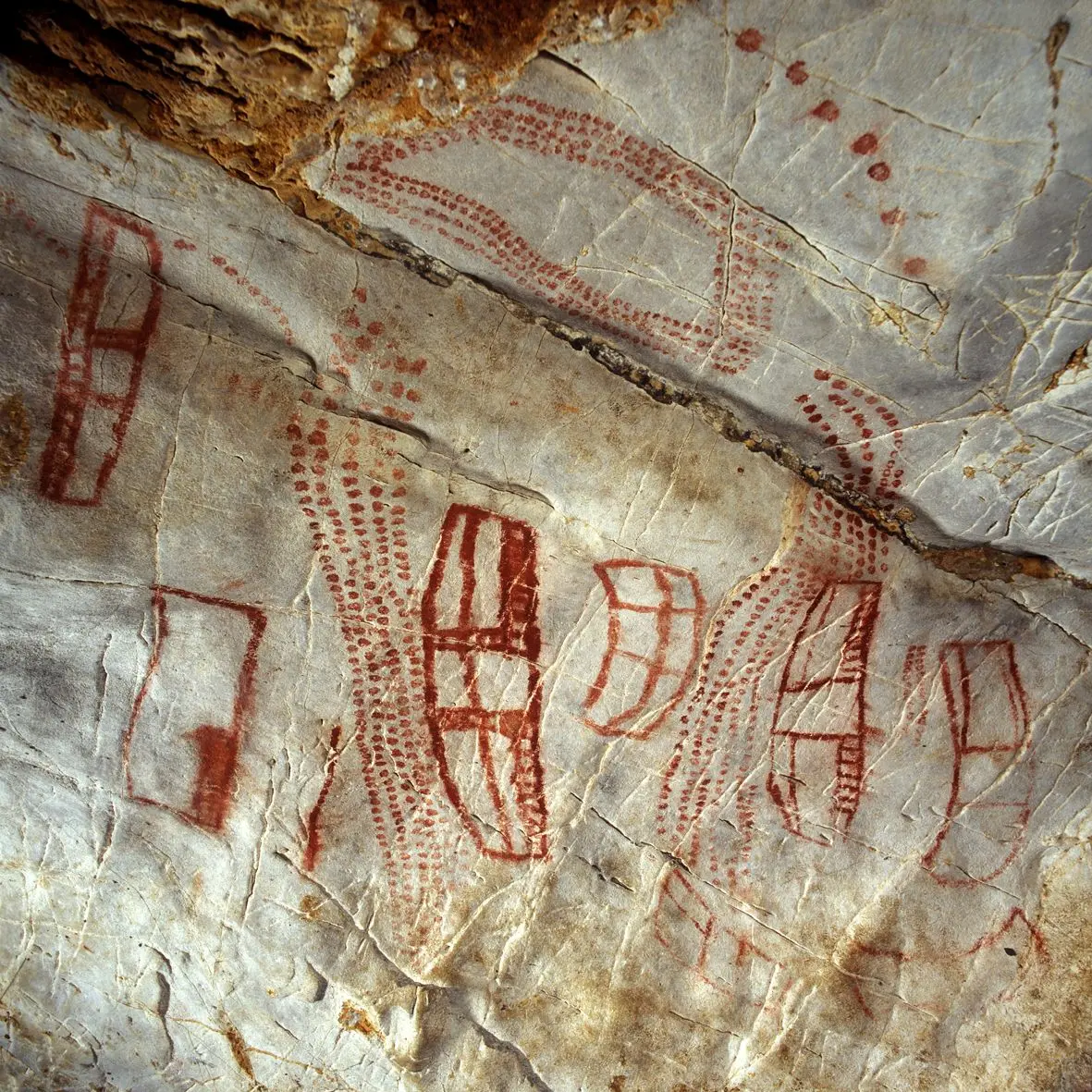
Deep within the subterranean labyrinth of northern Spain’s Cave of El Castillo, a persistent and profound shift is underway in how modern archaeologists understand Upper Paleolithic rock art. For generations, popular imagination and academic consensus alike framed prehistoric cave paintings as static, gallery-like compositions frozen in time—isolated portraits of ancient fauna, hand stencils, and geometric symbols illuminated by flat, white flashlight beams.
However, recent fieldwork, spatial analyses, and digital reconstructions are dismantling this sterile perspective. Archaeologists are discovering that Paleolithic artists did not merely draw on stone; they engaged in an intimate, multi-sensory dialogue with the geological contours of the earth. By painting within natural fissures, aligning handprints with stabilizing hand-holds, and exploiting the chaotic, dancing flicker of prehistoric torchlight, ancient creators transformed subterranean caverns into dynamic, immersive environments.
This burgeoning field of research suggests that the dark zones of Ice Age caves functioned as sophisticated cognitive testing grounds. Far from being passive canvases, these sacred rock faces acted as active participants in rituals, bridging the gap between human visual evolution, the dawn of abstract thought, and the birth of symbolic culture.
Read Also
Detailed Chronology: Unearthing the Secrets of El Castillo
1879–Late 20th Century: The Enigma of Altamira and Early Theories
The modern scientific engagement with Upper Paleolithic rock art effectively began with the 1879 discovery of the exquisite red-and-black bison adorning the ceiling of the Altamira cave, also in northern Spain. For decades following this revelation, researchers struggled to decode the motivations of prehistoric artists who ventured into pitch-black environments between 13,000 and 41,000 years ago, armed only with primitive torches and stone lamps.
/https://tf-cmsv2-smithsonianmag-media.s3.amazonaws.com/filer_public/8e/83/8e837bc6-e2b3-4bb6-bb1c-4f1287b45a6f/castillo-39-rincon_de_los_signos.jpg)
As different academic theories drifted into and out of fashion, cave art was successively explained as:
- Totemic clan markers representing tribal lineages or affiliations.
- Fertility symbols designed to ensure the propagation of game and human populations.
- Shamanistic records born from altered states of consciousness induced by sensory deprivation and darkness.
During the late 20th century, mainstream archaeology largely solidified around a single overarching consensus: the emergence of cave art marked the precise moment when Homo sapiens became "behaviorally modern"—a direct product of newly evolved neurological capacities for abstract and symbolic thought.
The 2010s: Shifting from Intentions to Experiences
As field researchers like Eduardo Palacio Pérez and Diego Garate—a professor at the University of Cantabria—began discovering and cataloging dozens of decorated caverns across Spain and France, the fundamental questions began to change. Rather than fixating exclusively on why ancient artists painted, researchers started investigating how they experienced these subterranean spaces.
A pivotal methodological breakthrough occurred when Garate explored a non-decorated Basque cave lit exclusively by a smoky, handheld torch rather than a modern flashlight. The empirical reality of the flame transformed the experience:
/https://tf-cmsv2-smithsonianmag-media.s3.amazonaws.com/filer_public/8e/83/8e837bc6-e2b3-4bb6-bb1c-4f1287b45a6f/castillo-39-rincon_de_los_signos.jpg)
- The red light flickered constantly, casting dancing shadows across the uneven stone.
- The illumination was severely limited, revealing only a narrow radius of roughly 10 to 12 feet at a time.
- The shifting perspective meant that static images appeared to move, emerge from, and recede into rock fissures.
This realization catalyzed a paradigm shift. Scholars began evaluating cave art not as isolated pictures, but as holistic installations encompassing lighting, spatial placement, acoustics, and tactile interaction.
Recent Discoveries: Spatial Analysis and Virtual Reality
In the past decade, international research teams have brought advanced technology to bear on these ancient sites. British archaeologist Paul Pettitt, alongside colleagues such as Derek Hodgson and Izzy Wisher of Aarhus University, conducted meticulous spatial analyses of hand stencils in El Castillo. They discovered that handprints were not randomly applied; over 35,000 years ago, artists meticulously studied cave surfaces, placing hand stencils near natural fissures and concave curves where explorers naturally sought physical stability.
Concurrently, modern researchers have turned to digital tools to settle long-standing debates regarding cave topography and shadow projection. By utilizing virtual reality (VR) to simulate ancient torchlight within caves like Las Monedas, researchers are testing whether 3D carvings—such as El Castillo’s famous bipedal "bison man" atop a central stalagmite—were intentionally designed to cast moving, animated silhouettes onto rear chamber walls.
Supporting Context & Metrics: The Cognitive Architecture of Ice Age Humanity
To fully grasp the magnitude of Paleolithic cave art, one must examine the intersection of archaeology, cognitive science, and human evolution. According to Steven Mithen, an archaeologist at the University of Reading and author of The Prehistory of the Mind, the creation of figurative art represents an evolutionary milestone comparable in impact to the later invention of writing.
/https://tf-cmsv2-smithsonianmag-media.s3.amazonaws.com/filer_public/fd/cb/fdcb1447-fea6-4499-80eb-baa875f8216f/castillo-27-techo_de_las_manos.jpg)
Cognitive Anchors and the Birth of Abstraction
When Ice Age hunter-gatherers crawled deep into subterranean chambers to paint a rudimentary bison or horse, they were externalizing internal concepts. Mithen notes that these painted animals and carved figurines functioned as ancient "cognitive anchors"—material objects that allowed early humans to process, store, and transmit complex symbolic information across generations.
| Evolutionary Stage | Primary Cognitive Strategy | Material Culture & Artifacts |
|---|---|---|
| Pre-Behaviorally Modern Humans (e.g., Neanderthals) | Intuitive, domain-specific processing; reliance on immediate physical environment. | Flint tools, hearths; absence of sustained symbolic external storage. |
| Early Homo sapiens (Upper Paleolithic) | Emergence of fluid intelligence; integration of cognitive domains; symbolic thought. | Hand stencils, geometric signs, figurative cave paintings, carved bone. |
| Modern Era | Offloaded memory into external technologies (digital devices, written text). | Smartphones, global information networks, mass media. |
As Mithen observes: "Earlier humans, whether of Homo sapiens or other species, such as the Neanderthals, never mastered this trick of extending their powers of thought by using material objects, constraining them to live in a world without abstract ideas."
The Visuo-Spatial System of Paleolithic Hunters
Pettitt and Hodgson have advanced the hypothesis that the visual systems of Upper Paleolithic hunters were evolutionarily primed to detect the outlines of large, partially obscured animals in complex natural environments. When these hunters entered the pitch-black, disorienting "dark zones" of deep caves, their brains naturally projected familiar forms onto ambiguous rock textures, cracks, and bulges.
In 2023, Izzy Wisher and her colleagues published research confirming that visual familiarity with specific stimuli trains the human visual system to perceive fragmented natural shapes as evocative forms. Consequently, the dark zone was not a lonely, lifeless void; it was a simulated hunting environment that dialogued directly with the human mind, generating the very visions that artists subsequently recorded on the stone.
/https://tf-cmsv2-smithsonianmag-media.s3.amazonaws.com/filer_public/c5/3d/c53d1353-a5e3-49c7-be3e-f883092fa7fe/castillo-69.jpg)
Official Statements and Expert Perspectives
The evolving consensus among leading archaeologists highlights a profound re-evaluation of the artist-environment relationship:
-
Diego Garate (University of Cantabria): Emphasizing the intimacy between artists and their canvas, Garate notes, "For scholars, the wall is sacred. You can’t touch anything, but obviously, for Paleolithic people, it was the contrary. They were in a close relationship with the walls." Regarding the animated shadow projections created by torchlight, Garate remains scientifically rigorous, maintaining that while the effect is striking, digital testing is required to verify intentionality: "The cave suggests a lot of things… We could light a torch in the computer and solve this problem with virtual reality."
-
Eduardo Palacio Pérez (Archaeologist): Reflecting on the comprehensive nature of the El Castillo site, Palacio Pérez remarks, "If the Paleolithic record were a book, then in El Castillo we have every chapter, more or less. We have practically all the themes in Paleolithic rock art in Europe." Describing minimalist works like ‘The Mask of El Castillo,’ he adds, "It’s like the head of a bison coming out of the wall."
-
Steven Mithen (University of Reading): Drawing parallels between ancient and modern human behavior, Mithen explains, "Today, much of my mind is contained within my mobile phone, the modern equivalent to a painted animal or carved figurine for an Ice Age hunter-gatherer." He further emphasizes the communicative power of the medium: "The figurative art of cave painting took the externalization of ideas and information to an unprecedented level, one not exceeded until the invention of writing many thousands of years later."

Future Outlook: The Digital Frontier of Subterranean Archaeology
As academic inquiry into Paleolithic rock art moves into the latter half of the 2020s, the discipline stands at an innovative crossroads between hard fieldwork and advanced digital technology.
Key Research Directions for the Coming Decade:
- Virtual Reality Torch Simulations: Expanding upon the work initiated by Izzy Wisher and Diego Garate, researchers are deploying VR models to map luminous decay, shadow dynamics, and flickering frequency across exact 3D laser scans of painted chambers in Spain and France. This will definitively test whether specific compositions were engineered to "move" under torchlight.
- Non-Invasive Biomolecular Analysis: Following recent breakthroughs by Max Planck Institute researchers in successfully recovering ancient human DNA directly from decorated cave walls, future protocols will likely uncover more biological signatures without damaging fragile pigment layers.
- Multi-Sensory Archaeological Integration: Future field studies will increasingly incorporate acoustic mapping—testing whether chambers with high concentrations of animal art also possess unique acoustic resonance, shedding light on whether Paleolithic rituals involved chanting, music, or vocalizations.
Ultimately, the peeling back of decades of academic assumptions reveals that Paleolithic cave art was never a static exhibition. It was an active, breathing theater of stone, shadow, and psyche—a testament to the moment humanity first learned to externalize its inner world and converse directly with the cosmos.





Comments
Facebook App ID not configured. Please add it in the Customizer.