
Executive Overview
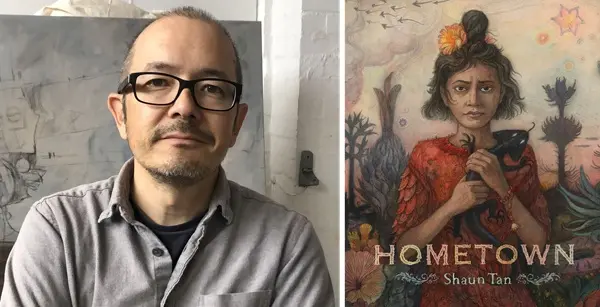
Four years after his last major publication, acclaimed author, illustrator, and Astrid Lindgren Memorial Award laureate Shaun Tan is returning to the literary landscape with a deeply anticipated new graphic novel. Titled Hometown and slated for publication by Levine Querido, the book represents a profound conceptual and stylistic shift for the master storyteller. Set in a universe that effortlessly blends the uncanny with the deeply comforting, Hometown follows a singular, sharp-witted young narrator whose life is disrupted by the crash-landing of an unexpected visitor—a human from another world who insists she belongs in his reality.
Tan’s intricate, immersive visual spreads invite readers to ponder complex questions regarding dogma, belonging, and the lengths to which individuals go to preserve their communities. In a wide-ranging interview from his studio in Melbourne, Tan discussed the chaotic genesis of the project, which evolved from an anxious, month-long sprint in 2017 into a seven-year labor of love. Furthermore, the artist detailed his surprising return to watercolor—a medium he had abandoned for four decades—and how deep-seated curiosities about missionary zeal, historical syncretism, and fundamentalist worldviews shaped the narrative core of Hometown.
As Hometown prepares to hit shelves, it arrives not merely as a new entry in Tan’s celebrated bibliography, but as a timely meditation on the friction between absolute truth and emotional truth. By examining how diverse audiences—from small children to teenagers—react to the protagonist’s profound moral dilemma, Tan has crafted a work that challenges readers to reevaluate their own definitions of home, loyalty, and identity.
Read Also
Detailed Chronology: From a 20-Minute Deadline to a Seven-Year Masterpiece
The trajectory of Hometown is a testament to the unpredictable nature of creative inspiration. The project’s origins date back to 2017, when a colleague of Tan’s was assembling an anthology centered around the thematic intersection of machines and emotions. At the time, Tan possessed no concrete proposals for the collection. However, he had been quietly ruminating on a compelling, albeit nascent, narrative concept: a young girl living in a surreal environment who encounters another human being for the very first time.
Presented with this loose concept, Tan’s colleague issued a formidable challenge: commit the idea to a 20-page story within a span of roughly one month. Faced with a schedule that defied his standard, meticulous pace—Tan typically requires approximately two weeks to complete a single illustrated page—the artist experienced a severe creative panic. Yet, rather than paralyzing him, this acute pressure acted as a psychological catalyst. Operating in an instinctual "panic mode," Tan bypassed the trap of overthinking, silencing the inner critic that frequently stalls narrative progression. He drove forward panel by panel, bypassing minor inconsistencies to capture the raw architecture of the story.
This high-stress sprint yielded an unexpected emotional attachment. Upon sketching out the foundational narrative, Tan realized he had stumbled into a universe he was reluctant to abandon. He found himself deeply enamored with the bizarre yet tender domesticity of the protagonist’s family—a household featuring a father with retracting tentacles, a mother with a multitude of arms, and siblings bearing fangs—anchored by a narrator who combined youthful innocence with a sharp, uncompromising bluntness.
Recognizing the rich thematic potential buried within these rapid sketches, Tan embarked on a rigorous seven-year developmental process. Over the course of the following eighty-four months, he plotted, revised, and refined the narrative architecture. What began as a hurried response to an anthology deadline matured into a sweeping graphic novel, proving that artistic breakthroughs are frequently born from the friction of tight constraints followed by patient, deliberate refinement.
Supporting Context & Metrics: The Philosophy of Dogma and the Mechanics of Watercolor
To fully appreciate the narrative weight of Hometown, one must examine the intellectual and artistic currents that informed its creation. Central to Tan’s exploration is the psychological mechanism of belief, an inquiry sparked by an unexpected theatrical experience. While living in Melbourne, Tan and his wife attended a performance of The Book of Mormon after spotting a promotional poster on the side of a tram. Though struck by the production’s irreverent humor, Tan found himself grappling with a more profound, haunting question: What drives human beings to embrace dogmas that appear fundamentally unbelievable to outsiders?
Tan’s conclusion points away from intellectual persuasion and toward the emotional architecture of community. Belief systems persist, he observed, because they offer individuals a sense of sanctuary, exclusivity, and profound personal significance. This dynamic manifests directly in Hometown through the introduction of the stranded boy, whose approach is relentlessly dogmatic and fundamentalist. Whether his absolute truths stem from a rigid rationalist-scientific worldview or religious fundamentalism remains ambiguous; what matters is that he possesses a book, and within his universe, that book constitutes immutable fact.
This ideological collision is further enriched by historical subtext. Tan cites a striking account from Mexico, where colonial conquerors constructed Catholic churches using the desecrated stones of ancient Aztec temples. In acts of subtle subversion, enslaved local builders concealed images of their ancestral gods within the mortar of the sanctuary walls, allowing them to maintain their indigenous spiritual practices while participating in enforced worship. This historical precedent of subterfuge finds a parallel in Hometown, where the young protagonist navigates her encounter with the invader through an act of delicate deception—a narrative maneuver designed to secure a peaceful resolution without sacrificing her autonomy.
Artistically, Hometown marks a dramatic departure from Tan’s established methodology. For decades, the illustrator relied primarily on acrylics and oils—opaque media that require working from dark to light, building highlights over a pre-established ground. Seeking a fresh visual language for Hometown, Tan took a bold risk: he picked up watercolor for the first time in nearly 40 years.
Initially dismissing watercolor as an unforgiving, fussy medium ill-suited for revision, Tan discovered through experimentation that it possessed a remarkable, organic flexibility. Mistakes could not only be corrected, but frequently yielded happy accidents that elevated the art. This fluid, bleeding quality proved ideal for rendering the twisting, surreal forms of the narrator’s world, creating an ethereal aesthetic that stands in stark contrast to the heavier textures of his earlier bibliography. To ground this ethereal style, Tan drew inspiration from 19th- and early 20th-century masters—most notably British romanticist Samuel Palmer. By studying Palmer’s textural, monochromatic landscapes, such as the evocative sketch Early Morning, Tan infused Hometown with a visual richness where familiar terrestrial lines evoke the haunting atmosphere of an undiscovered planet.
Official Statements & Creative Insights
The evolution of Hometown offers a fascinating window into Tan’s collaborative creative ecosystem and his willingness to allow external interpretations to shape his work. Long before the graphic novel reached its final publication stage, Tan shared his early sketches with the director of a local theater company. Impressed by the visual concepts, the director proposed adapting the narrative into a live puppet production—a proposition Tan enthusiastically endorsed, noting with characteristic humility that it would take him years to complete the book.
This theatrical adaptation served as an accidental psychological testing ground for the story’s core conflict. Observing how live audiences responded to the narrator’s ultimate dilemma provided Tan with invaluable feedback. He noted a striking generational divide in the reactions: younger children and parents watching the play invariably shouted pleas for the protagonist to stay, crying out, "Don’t go, don’t go!" Conversely, teenage girls in the audience leaned forward with an entirely different imperative, whispering fiercely, "Go!"
This dichotomy deeply influenced Tan’s final drafting process. Recognizing the profound weight of the protagonist’s choice, he deliberately heightened the emotional complexity of the narrative. Even as the sole creator of the universe, Tan admits that the final resolution carries a lingering shock value. "Even after all that revision," he reflects, "I’m still getting a little bit of a jolt."
Beyond Hometown, Tan’s creative output remains unabated. In November, Melbourne will play host to a major exhibition showcasing the original illustrations from the graphic novel, a project that currently occupies much of the artist’s administrative and curatorial focus. Simultaneously, Tan continues to maintain his sketchbooks, comparing the creative process to baking a cake that currently lacks a critical ingredient. For Tan, artistic progress is not a matter of forced inspiration, but of finding the disciplined quietude required to push disparate ideas together until they cohere.
Future Outlook: A New Benchmark in Graphic Literature
As Hometown prepares for its official release via Levine Querido, its arrival signals a major milestone in contemporary graphic literature. By intertwining the cozy surrealism of a tentacled, multi-armed household with the razor-sharp psychological friction of an ideological invader, Shaun Tan has once again proven his capacity to reinvent his aesthetic vocabulary while maintaining his signature thematic depth.
The book’s exploration of dogmatic certainty versus emotional truth resonates powerfully in an era marked by cultural polarization and competing absolute narratives. Furthermore, Tan’s triumphant return to watercolor opens exciting new avenues for his future artistic endeavors, proving that even after decades at the pinnacle of his craft, an artist can still find profound liberation in unchartered techniques.
Ultimately, Hometown transcends the boundaries of traditional children’s or young adult literature. It stands as an intricate, beautifully rendered philosophical inquiry into the nature of belonging. Whether readers find themselves identifying with the steadfast love of the narrator’s terrestrial home or the disruptive pull of the outsider’s absolute truth, Tan’s latest masterwork guarantees that they will view their own definitions of "home" through a transformed lens.





Comments
Facebook App ID not configured. Please add it in the Customizer.