
Executive Overview
In January 2025, the catastrophic Eaton Fire swept through the foothills of the San Gabriel Mountains, tearing through Altadena, California. The inferno reduced more than 6,000 homes to ash and laid waste to half of the unincorporated community’s structural footprint. In the immediate aftermath, civic leaders—including Los Angeles Mayor Karen Bass—pledged to "build back better." However, survivors quickly slammed into a punishing economic reality: soaring construction costs, widespread home underinsurance, labor shortages, and material inflation made traditional ground-up reconstruction nearly impossible for average families.
With contractor quotes skyrocketing to $700 per square foot—far outstripping typical insurance payouts calculated at $400 per square foot—displaced residents faced a bitter choice between accepting drastically downsized, generic replacements or leaving their community altogether.
Out of this devastation emerged an unexpected, radical alternative: The Historic House Relocation Project.
Read Also
Spearheaded by Los Angeles-based adaptive reuse architecture firm Omgivning, alongside preservationists and veteran structural movers, the initiative resurrects a forgotten Southern California practice from the early 20th century. By rescuing historic, structurally sound homes slated for demolition across the Los Angeles basin—often purchasing them for just one dollar—and physically transporting them across freeways onto wildfire-cleared lots, the project offers a faster, cheaper, and ecologically sustainable path toward community recovery.
       [ Urban Demolition Sites across L.A. ]
                         │
        (Bought for $1 / Rescued from Raze)
                         │
                         ▼
        [ Sliced & Transported via Flatbed ]
                         │
     (Avoids $700/sq.ft Rebuild Costs & Supply Bottlenecks)
                         │
                         ▼
       [ Placed on Burn Lots in Altadena ]
   (Restores neighborhood character; speeds rehousing)
Detailed Chronology
  Jan 7-8, 2025       May 2025            July-Aug 2025         Oct '25 - Jan '26         Present (2026)
───────┬──────────────────┬────────────────────┬──────────────────────┬───────────────────────┬──────►
       │                  │                    │                      │                       │
   Eaton Fire        Displaced victims    Historic House         "Pinky" (Tudor          Multiple homes
   destroys          meet at county       Relocation Project     Cottage) undergoes      placed; 200+
   6,000+ homes      listening session;   launches; Chambers     perilous 26-mile        families on
   in Altadena.      "$1 house" idea      family moves test      midnight move to        project waiting
                     sparks movement.     Craftsman home.        Altadena lot.           list.
January 7–8, 2025: The Eaton Fire and Night of Loss
On the evening of January 7, 2025, Lauren Martinez—eight months pregnant with her third child—was attending a work dinner in Hollywood when news broke of wildfires spreading across the region. Unbeknownst to her, a secondary blaze, the Eaton Fire, had ignited in the San Gabriel Mountains and descended upon Altadena. Her husband, David Martinez, was forced to evacuate their 1940s white stucco ranch bungalow with their twin nine-year-old daughters, leaving virtually all personal belongings behind.
The following morning, David returned to find their street leveled. As he arrived at their property, their home of eight years was caught in flames. Lauren was left with only the clothes she had worn to dinner and her pajama bottoms. Across Altadena, thousands of families suffered identical fates overnight.
Spring 2025: The Financial Wall of Rebuilding
The Martinez family initially hired an architect to design a replacement home. However, like the vast majority of fire victims, they soon discovered they were severely underinsured. Insurance providers had structured policies based on estimated construction costs of roughly $400 per square foot. Post-disaster market dynamics in Los Angeles quickly drove actual contractor quotes near $700 per square foot.
With insurance payouts averaging roughly 70 cents on the dollar relative to replacement costs, families were forced to consider smaller, lower-quality modern designs—or face long-term displacement once temporary mortgage relief benefits expired after 12 months.
May–July 2025: Genesis of the Relocation Movement
In May 2025, during a Los Angeles County listening session at the Pasadena Convention Center, Lauren Martinez met Evan Chambers, a fourth-generation Altadenan who had lost his family’s 1921 bungalow in the fire. Chambers shared a unconventional strategy: instead of rebuilding from scratch, he had purchased a historic home scheduled for demolition in Los Angeles for $1 and was arranging to move it to his empty lot.

Simultaneously, Morgan Sykes Jaybush, creative director at the architecture firm Omgivning and board member of the Santa Monica Conservancy, noted a surge in demolition permits across the city while thousands of fire victims remained homeless. Recognizing that house relocation functioned as "recycled prefabricated housing," Jaybush partnered with local movers, preservationists, and former banker Brad Chambers to formalize the Historic House Relocation Project in July 2025.
       DEMOLITION PERMITS                 EATON FIRE DESTRUCTION
   (Historic structures slated              (6,000+ homes destroyed;
    for destruction in L.A.)                 vacant lots in Altadena)
               │                                        │
               └───────────────┬────────────────────────┘
                               │
                               ▼
              HISTORIC HOUSE RELOCATION PROJECT
             • Acquire structures for ~$1.00
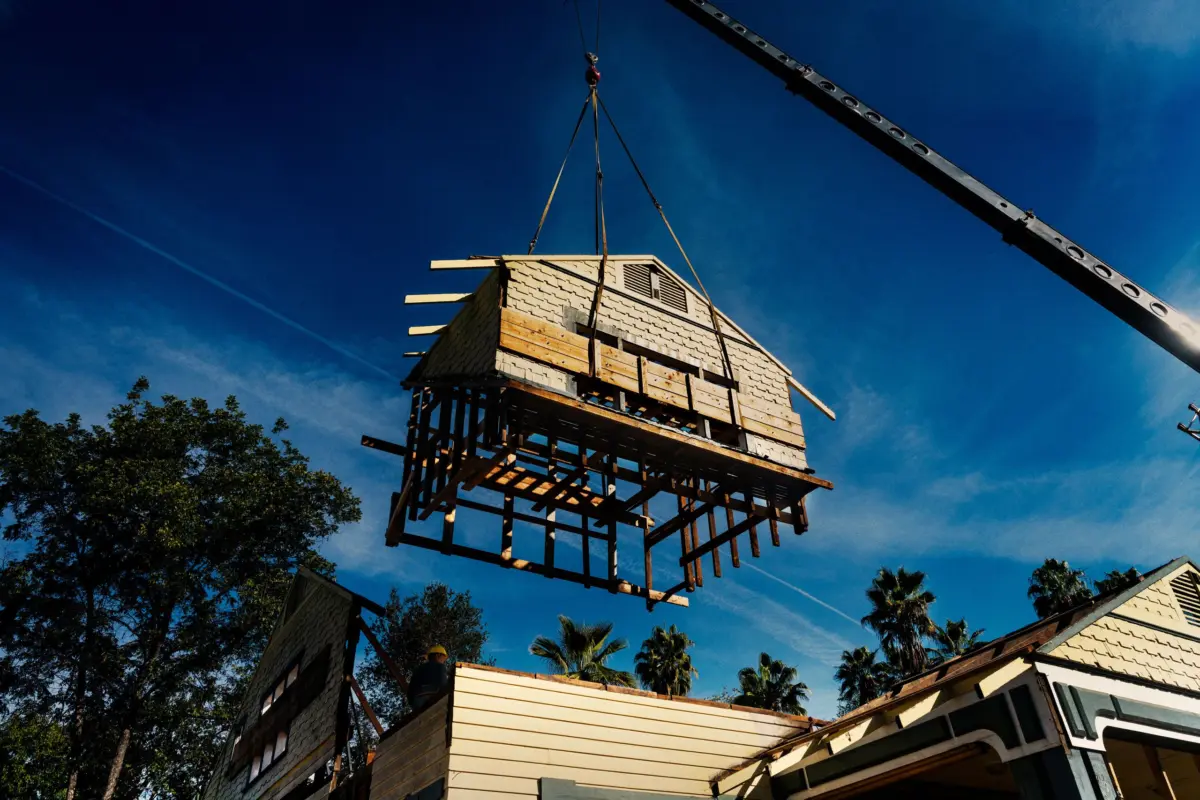
             • Slice into transportable modules
             • Relocate via heavy haulers overnight
             • Anchor onto new foundations
August 2025: The Proof-of-Concept Move
Evan and Caitlin Chambers served as the pilot case for the project. Working with Jaybush and American Heavy Moving, they acquired a doomed Craftsman home on Taft Avenue from a residential developer for $1. Over several nights in August 2025, the team sliced the structure into three road-ready sections, navigated a pre-mapped route across Los Angeles freeways, and set the building onto a new foundation on their Altadena lot, proving the model’s viability.
October 2025 – January 2026: The Odyssey of "Pinky"
Following the success of the Chambers move, Lauren and David Martinez identified a 100-year-old pastel-pink Tudor-style cottage in West Hollywood slated for demolition. The owner surrendered the home for $1, saving tens of thousands of dollars in wrecking fees.
The project encountered severe complications:
- Contractor Delays & Asbestos: Inexperienced deconstruction crews uncovered asbestos, requiring specialized containment and pushing the schedule back by weeks.
- Storm Damage: Unseasonal early winter storms compromised protective tarps after the roof was removed, causing water damage and ceiling collapses inside the historic structure.
- Logistical Deadlocks: Heavy-moving specialists were temporarily unavailable during November due to holiday schedules and regional commitments.
Despite these setbacks, inspectable load-bearing framing remained structural intact. On a Sunday night in January 2026, crew members illuminated the 25-foot-wide, shiny-tarped structure with holiday lights and towed it along a 26-mile route through downtown Los Angeles under California Highway Patrol escort. By dawn, the home was parked over timber cribbing on the Martinez family’s Altadena lot.
Supporting Context & Metrics
The Economics of Post-Disaster Reconstruction
Post-disaster rebuilds face compounding economic headwinds. Beyond immediate fire damage, broader macroeconomic variables—including federal trade tariffs on raw materials and regional labor constraints—severely inflated the cost of traditional construction in Southern California throughout 2025.
| Metric | Traditional New Rebuild | Historic Relocation Project | Difference / Benefit |
|---|---|---|---|
| Estimated Cost / Sq. Ft. | ~$700 | ~$250–$350 (Includes prep, transit & repairs) | 50%–60% Cost Reduction |
| Average Timeline to Occupancy | 3 to 4 Years | 12 to 14 Months | Up to 3 Years Faster |
| Typical Insurance Coverage Gap | ~30% Shortfall ($400 cap vs $700 actual) | Covered within standard policy limits | Mitigates Underinsurance |
| Structural Lumber Quality | Modern fast-growth softwoods | First-growth Redwood & Douglas Fir | Superior termite/fire resistance |
| Carbon Footprint | High (New manufacturing & transport) | Low (Reuse of existing framing/materials) | Significant Embodied Carbon Offset |
Historical Precedent: Los Angeles as a House-Moving Hub
While moving an entire house appears novel to modern observers, the practice was ubiquitous in American urban development during the 19th and early 20th centuries. In his 1838 volume Sketch of the Civil Engineering of North America, Scottish engineer David Stevenson noted with fascination that American engineering frequently resorted to moving whole structures—even multi-story brick buildings—to expand roads and urban spaces economically.
Los Angeles, in particular, became the global epicenter of house moving between 1870 and 1930.
   1870–1930: Golden Era
   • Light, wood-framed homes easy to unbolt.
   • Rapid L.A. population growth (doubling every decade).
   • High land values + cheap labor = constant relocation.
   • Movers like George Kress relocate ~250 homes/year.
                         │
                         ▼
   1940s–2020s: Decades of Decline
   • Expansion of overhead power lines, traffic density.
   • Complex municipal bureaucracy & zoning codes.
   • Surplus cheap post-war building materials.
   • Severe shortage of vacant urban lots.
                         │
                         ▼
   2025–Present: The Post-Wildfire Renaissance
   • Wildfires create sudden surplus of vacant lots.
   • High material tariffs & acute labor shortages.
   • Underinsurance crisis demands cost-effective alternatives.
Prominent movers like George Kress shifted hundreds of residential and commercial structures annually. In 1924, Kress famously relocated the six-story, 11,000-ton steel-and-concrete Alhambra Hotel up Broadway, and moved a nine-bedroom Queen Anne home two miles down Wilshire Boulevard while guests attended a mayoral party inside.

The industry collapsed mid-century due to grid density, overhead utility infrastructure, complex city permitting, and cheap post-war lumber. The 2025 wildfires inadvertently inverted those conditions by creating a sudden surplus of cleared land alongside sky-high costs for new raw materials.
Logistical Mechanics of Structural Transit
Transporting a century-old house through one of the nation’s most densely populated metropolitan corridors requires precision structural engineering and route planning.
                  [ STEP 1: PREPARATION ]
   • Slice structure into road-ready sections (max ~25 ft wide).
   • Dismantle chimneys/fireplaces; number bricks for reassembly.
   • Remove original roof shingles to clear overhead clearances.
                             │
                             ▼
                  [ STEP 2: ELEVATION ]
   • Cut around foundation or dig trenches beneath structure.
   • Insert heavy steel I-beam lattice beneath main joists.
   • Position hydraulic jacks beneath I-beams; lift evenly.
   • Stack timber cribbing ("Lincoln log" pillars) to support height.
                             │
                             ▼
                  [ STEP 3: TRANSPORTATION ]
   • Position multi-wheeled hydraulic dollies under steel lattice.
   • Secure route permits (avoiding low bridges, fragile sewers, trees).
   • Tow via heavy tractor trailer under police escort during off-peak hours (11 PM - 3 AM).
                             │
                             ▼
                  [ STEP 4: REPLACEMENT ]
   • Lower module over newly poured concrete foundation on site.
   • Precision-mate sections, weld I-beams, re-anchor framing.
   • Reinstall utilities, insulation, roof, and interior surfaces.
Official Statements and Key Voices
Architectural and Preservation Leaders
Morgan Sykes Jaybush, Creative Director at Omgivning:
"I left that meeting thinking, ‘What the heck are we doing?’ All these houses just burned, and now we’re tearing down perfectly cute, structurally sound homes elsewhere in the city. It doesn’t make sense. It hit me like a lightning bolt: house moving is recycled prefab. Older homes built with first-growth timber are vastly superior in material quality to modern builds, and moving them preserves regional architectural history while solving an acute humanitarian disaster."
Impacted Residents
Lauren Martinez, Altadena Resident and Relocation Participant:
"When we saw our home burn, we lost everything down to our daughters’ childhood memories. Rebuilding from scratch was going to leave us with a generic, soulless box that was smaller than what we had before because of the massive insurance shortfall. When we chose ‘Pinky,’ we realized this project is bigger than us. We are proving a sustainable, scalable model so Altadena can come back faster, affordably, and with real character."Caitlin Chambers, Altadena Resident and Early Pioneer:
"Evan’s dad helped move a house back in the eighties, so the concept was in our blood. Seeing our relocated home peeking over the park wall for the first time was deeply emotional—for a split second, I felt as though our lost home had come back to life. It gives us a path forward that building anew simply couldn’t offer."
Structural Transport Specialists
Ricky Craig, Third-Generation Mover at American Heavy Moving:
"House moving is a craft passed down through generations—most of our guys traces their roots back to movers coming out of Missouri or Oklahoma looking for work back in the day. The machinery has changed, but the physics haven’t. You get under the house, balance it on steel and hydraulics, and float it down the street. What’s crazy is that once we set it down on the new foundation and the finish work is done, it looks like it was always there."
Future Outlook and Scalability Challenges
As the Historic House Relocation Project enters its second year, it faces structural bottlenecks that limit its ability to fully address Southern California’s displacement crisis.
                            [ CAPACITY BOTTLENECKS ]
                                       │
         ┌─────────────────────────────┼─────────────────────────────┐
         ▼                             ▼                             ▼
 [ Contractor Shortage ]    [ Labor & Craft Limits ]     [ Permitting Bureaucracy ]
 Scarce general contractors  Only two licensed heavy     Complex inter-agency route
 trained in reassembling     house-moving companies      permits across multiple
 modular historic frames.     actively operating in L.A.   municipal jurisdictions.
Key Expansion Challenges
- Specialized Contractor Deficit: Very few modern general contractors possess the training required to prepare historic structures for sectioning or to seamlessly reassemble framing, plumbing, and electrical systems post-transit.
- Movers Shortage: Only two specialized heavy house-moving outfits—American Heavy Moving and Dinuba House Movers—currently operate within California with the capacity to navigate complex urban corridors.
- Bureaucratic Coordination: Moving a house across municipal boundaries requires synchronized permits from transit authorities, public works departments, utility companies (to clear power lines), and law enforcement escorts.
Scalability and Policy Impact
Despite these operational constraints, the project’s waitlist has ballooned to over 200 fire-displaced families. Omgivning has successfully completed four structural relocations to date, with nine additional historic acquisitions queued for transit.
Municipal planners and urban policy experts across California are now monitoring the Altadena initiative as a potential blueprint for post-disaster urban resilience. By bridging the gap between urban demolition management, historic preservation, and disaster relief, the project demonstrates that climate adaptation strategies can leverage historic solutions to rebuild communities efficiently and sustainably.





Comments
Facebook App ID not configured. Please add it in the Customizer.