
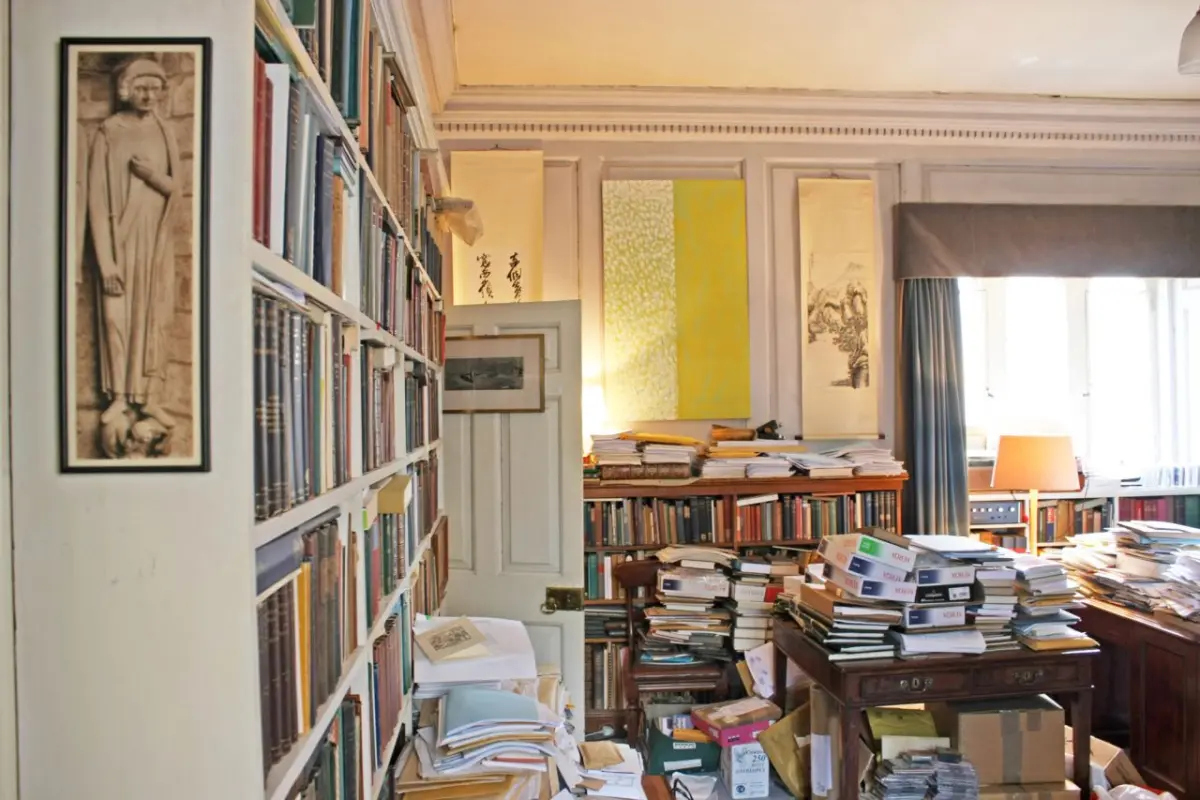
The passing of Jeremy Halvard (J.H.) Prynne in April at the age of 89 marks the definitive closure of one of the most singular, formidable, and uncompromising chapters in modern English letters. For decades, Prynne operated as a looming, if often elusive, presence—a towering figure of British poetry whose work became a touchstone for generations of Cambridge undergraduates, an object of fascination for an international cult following, and a source of profound bewilderment for mainstream critics.
Prynne’s immense literary footprint is now visible in its entirety with the publication of his comprehensive, two-volume Poems. This massive collection spans a career that challenged the very boundaries of linguistic intelligibility. Across a trajectory stretching from his 1960s breakthroughs to a torrential final decade of hyper-productivity, Prynne systematically dismantled the traditional expectations of lyrical poetry. He replaced them with an opaque, hyper-erudite architecture built from obscure vocabulary, fractured syntax, and sudden shifts in register.
While his obituaries in major British newspapers frequently grappled with his reputation as a "difficult" poet, they often underestimated the radical generosity underpinning his impenetrability. Prynne did not write to alienate; rather, he forced his readers to reckon with the raw, untethered nature of language itself. As the literary world confronts the landscape of post-Prynne poetry, his legacy stands as an imposing monument—not merely to a vanished academic lifestyle at Cambridge, but to an unyielding commitment to the infinite, dizzying expansiveness of human speech.
Read Also
Detailed Chronology: The Evolution of a Master’s Voice
Early Life and Academic Foundations (1936–1961)
Born in Kent in 1936, Jeremy Halvard Prynne followed a conventional yet distinguished path through the British educational establishment. After schooling in London and fulfilling his National Service, he matriculated at Jesus College, Cambridge, where he studied under the critic Donald Davie. Following a transformative year-long fellowship at Harvard University—where he immersed himself in the culture of Cambridge, Massachusetts’s Grolier Poetry Book Shop—Prynne returned to the UK. In 1962, he secured a fellowship at Gonville and Caius College, Cambridge, initiating a four-decade tenure as a revered, albeit idiosyncratic, educator before his formal retirement in 2005.
The American Pivot and The White Stones (1962–1971)
Prynne’s literary debut, Force of Circumstance and Other Poems (1962), was a work he quickly renounced, famously distancing himself from its conventional lyricism. The true catalyst for his poetic evolution was his discovery of American modernist and Black Mountain innovations, particularly through Donald Allen’s legendary anthology The New American Poetry. His correspondence with Charles Olson in 1961 signaled a vital breakthrough toward a more expansive, open-field poetics.
This newfound freedom informed Kitchen Poems (1968) and culminated in The White Stones (1969), widely regarded as one of the most important poetry collections of the 20th century. In works like "Bronze : Fish" and "The Holy City," Prynne balanced philosophical inquiry with archaeological and mercantile depth, establishing a unique register that felt simultaneously ancient and acutely contemporary.
The Hardening of the Medium (1971–2005)
Following The White Stones, Prynne’s relationship with the Black Mountain school cooled due to its increasingly dogmatic tendencies. With the publication of Brass in 1971, his style underwent a severe transformation. The first-person "I" receded, the language grew steelier and more densely layered, and traditional lyrical cadences were steadily abandoned.
Throughout the late 20th century, Prynne’s collections—such as Vernal Aspects (1975) and Bands Around the Throat (1987)—responded obliquely to geopolitical and technological shifts, from the hubris of the Apollo space program to the invisible linguistic fallout of the Chernobyl disaster. His 2006 collection To Pollen, written during the opening years of the Iraq War, temporarily shattered this obliquity with bursts of explicit political fury against "acts of stupendous cocky turpitude."
The Late Style and Lexical Trawl (2005–2024)
In his final decades, Prynne’s literary output reached an astonishing, almost unprecedented velocity. Between 2017 and 2024 alone, he published thirty-six new collections, captured within the second, monumental volume of his collected Poems. This late style abandoned conventional compositional frameworks in favor of what can best be described as direct excavations of the Oxford English Dictionary. Operating like a philological wizard, Prynne appeared driven by a Borgesian imperative to exhaust the English lexicon, using every obscure term, technical jargon, and archaic remnant one last time before his passing.
Supporting Context & Metrics: Decoding the Prynne Phenomenon
To understand the scale of Prynne’s contribution, one must examine the metrics of his career alongside the unique socio-literary ecosystem that grew up around him:
- The Late-Career Output: Between 2017 and 2024, Prynne produced 36 distinct poetry collections, a period of hyper-prolific output that mirrors the late-career trajectories of peers like John Ashbery.
- The Cambridge Axis: Prynne’s primary institutional and geographic base was Gonville and Caius College, where he taught for over forty years. His archive serves as the gravitational center for the loosely defined "Cambridge School" of innovative British poetry.
- Lexical Range: Prynne’s later poetry incorporates specialized vocabularies spanning nuclear physics, organic chemistry, archaic agriculture, theology, and international finance, demanding an interdisciplinary approach to close reading.
- Small Press Distribution: Eschewing major commercial houses for the majority of his career, Prynne’s works were predominantly issued in limited runs by small, independent presses, fostering a culture of rigorous connoisseurship.
The Mechanics of "Difficulty"
Prynne’s poetry is notoriously resistant to paraphrase. A characteristic passage from his late work—such as the opening of "Guardian Fitting" from Passing Grass Parnassus (2020)—juxtaposes terms like "fissile mockery," "octane contact," "unction rissole," and "boiling socket power pockets."
Approaching such texts is rarely an exercise in linear decoding. Instead, readers engage in what resembles lexicographical detective work, tracing obsolete usages in the OED, cross-referencing etymologies, and listening intently to the percussive, auditory friction of plosive consonants and liquid vowels. Unlike standard modernist puzzles, Prynne’s work rarely yields a totalizing master-key. The reader is left with an "indigestible remainder"—an intentional reminder that language resists total containment.
Official Statements and Critical Reception
The literary establishment’s response to Prynne’s work has long been characterized by a tension between institutional hesitation and cultic devotion.
Obituaries across major British publications acknowledged his formidable intellect while struggling to categorize his cultural impact. The Telegraph noted him as an "erudite and ‘difficult’ poet who became a cult figure to some readers and many Cambridge undergraduates, but made others flinch."
Prynne himself maintained a famously ambivalent stance toward his own influence and the critical industry surrounding his work. In an interview with the Paris Review, he addressed the discomfort of being positioned as a stylistic arbiter:
"I find the idea that I have offered any kind of arbitrations of experiments in style, or whatever, personally in my own behalf, exceptionally awkward, and unnecessary, and anxiety provoking."
Yet, he conceded the reality of his footprint:
"…there does seem to be a group of poets whose work exhibits a certain kind of stylistic commonality, and, ugh, some of that has to be due, obliquely, to me."
Academic assessments have increasingly moved past the initial barriers of his obscurity to evaluate his lectures and critical prose—such as Mental Ears and Poetic Work (2010)—which are celebrated for their rigorous, self-deprecating pedagogical brilliance. Scholars like Edward Allen, Jeremy Noel-Tod, and Ian Patterson have helped institutionalize his methods, framing his poetry not as an exercise in academic exclusion, but as an unmatched testament to the elasticity of English verse.
Future Outlook: Reading Prynne After Prynne
With the publication of his complete works, the critical conversation surrounding J.H. Prynne enters a new phase. No longer viewed simply as an underground cipher or an academic eccentric, Prynne must now be integrated into the broader canon of 20th- and 21st-century literature.
The future of Prynne studies—and the trajectory of poets working in his wake—will likely depend on how readers choose to navigate his monumental output. As contemporary writers such as Denise Riley, Andrea Brady, and Imogen Cassels have demonstrated, the most productive inheritance of Prynne’s art is not a rigid theoretical framework, but an active, hyper-attuned listening practice.
Prynne proved that a poem could function simultaneously as a rigorous intellectual treatise, an archaeological dig, and a repository of outrageous verbal music. As the poetic community adjusts to the silence left by his passing, his work remains an enduring challenge: a reminder that language is far larger, stranger, and more capacious than conventional discourse allows. To read Prynne now is to step onto the edge of the known linguistic world, recognizing, with both terror and exhilaration, that there is always further to go.




Comments
Facebook App ID not configured. Please add it in the Customizer.