
Executive Overview
Beneath the azure, deceptively calm waters of Menorca’s western coastline lies an extraordinary underwater archaeological treasure trove. Known locally as the "Cove of Mysteries," the ancient harbor of Cala en Busquets off the historic town of Ciutadella has yielded a breathtaking discovery: three exceptionally well-preserved 13th-century trading vessels resting in a tangled, overlapping grave.
Long before modern excavations began, this marine bottleneck served as a watery graveyard, accumulating hulls, anchors, and cargo spanning more than two millennia. However, the identification of three synchronized medieval wrecks—dubbed Busquets I, II, and III—represents a watershed moment for Mediterranean marine archaeology.
Dated to the late 1240s, the vessels likely fell victim to a catastrophic meteorological tsunami, locally known as a rissaga. These sudden, violent sea-level surges can materialize within minutes, capable of overwhelming entire fleets in a matter of hours. More than just a testament to ancient maritime peril, the cargo recovered from these ships offers an invaluable window into a turbulent geopolitical era. Preserved beneath layers of silt and largely protected from historical looting, the artifacts bridge two worlds on the brink of total war: the Christian kingdoms of the northern Iberian Peninsula and the Moorish communities governing the Balearic Islands under Islamic rule.
Read Also
As an international collective of marine researchers, local historians, and explorers from the Menorca Shipwreck Project and the Explorers Club continue their meticulous excavations, these submerged time capsules are rewriting our understanding of medieval commerce, cross-cultural diplomacy, and maritime tragedy in the western Mediterranean.
/https://tf-cmsv2-smithsonianmag-media.s3.amazonaws.com/filer_public/96/18/96189b3d-e04b-4d00-8996-245f89801b5f/dsc04914.jpg)
Detailed Chronology: From Submerged Mystery to Historical Breakthrough
The Initial Discovery (2009)
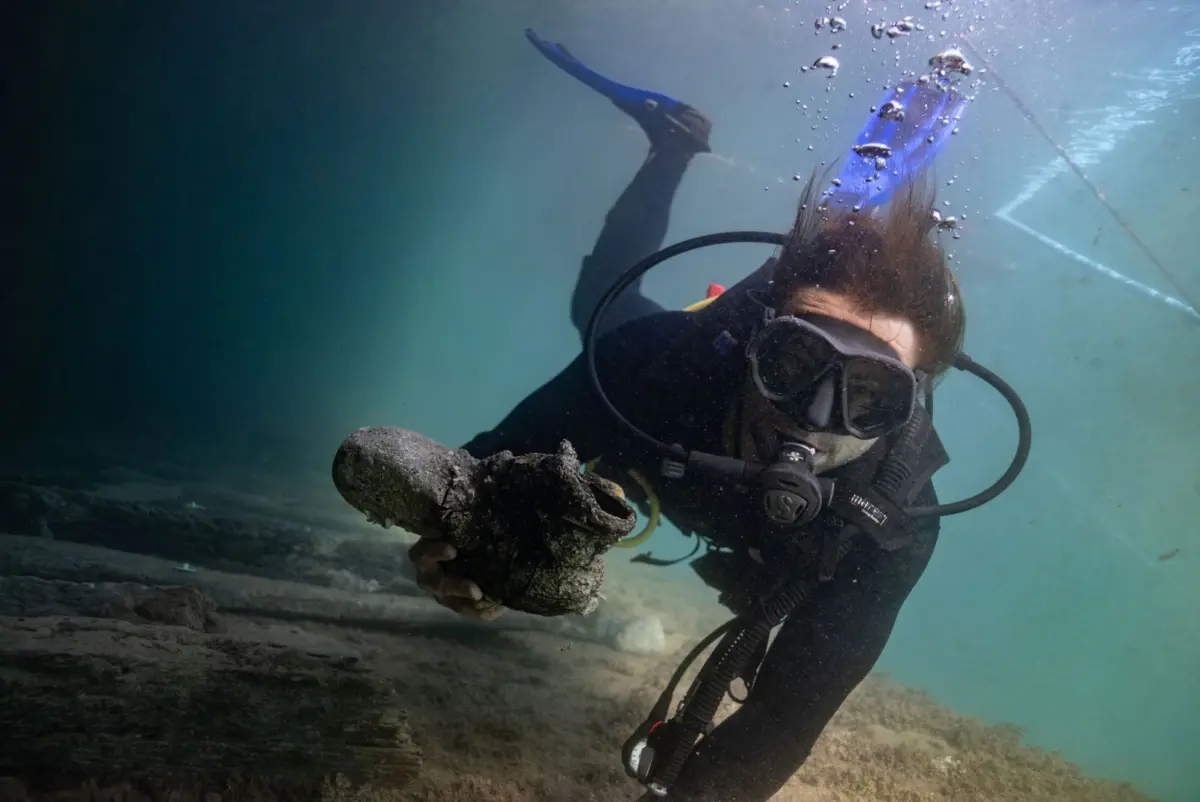
The story of the Busquets wreck site began more than a decade and a half ago. In 2009, Catalan archaeologist Xavier Aguelo Mas was surveying the murky depths of Cala en Busquets when he stumbled upon structural anomalies on the seafloor. Operating with limited institutional backing and under notoriously challenging diving conditions—where visibility can drop to zero, reducing the water to the consistency of melted chocolate—Aguelo Mas immediately recognized that the site held immense historical potential.
Yet, the archaeological community was slow to validate his intuition. Reflecting on the skepticism he initially faced, Aguelo Mas invokes a rough Spanish proverb: “After the bulls pass, everybody knows.” Once undeniable physical evidence emerged years later, his peers quickly aligned with the assessment he had maintained since his initial surveys.
The Launch of the Menorca Shipwreck Project (2023)
For years, the wreckage rested quietly, blanketed by sediment and largely overlooked by commercial salvage operations. This changed dramatically in 2023 when formal excavations commenced under the banner of the Menorca Shipwreck Project. This collaborative venture unites local cultural heritage experts with the New York City-based Explorers Club, spearheaded by expedition leader and founder Trevor J. Wallace.
Initial assumptions by early observers suggested the hulls might date back to the 18th century. However, as divers began meticulously clearing debris and charting hull timbers, it became clear that the ships belonged to a much older, more elusive era.
/https://tf-cmsv2-smithsonianmag-media.s3.amazonaws.com/accounts/headshot/katie-hitchcock-smith.png)
Wood-Dating Breakthrough and the 2025 Dive Season
A definitive turning point arrived during the wood-dating analyses conducted in 2025. Dendrochronological and radiocarbon assessments of the ship’s timbers revealed that the vessels actually sank during the late 1240s—more than 750 years ago.
By October 2025, when researchers descended into the chocolate-hued waters for another grueling dive session, the scope of the site was becoming sharply defined. Divers successfully mapped and excavated Busquets I and Busquets II, while deep-dive assessments on Busquets III laid the groundwork for ongoing recovery efforts. This phase also marked the unearthing of the expedition’s crown jewel: a rare 13th-century Christian encolpium (religious reliquary) discovered right alongside pristine, unbroken Islamic ceramics.
Supporting Context & Metrics: Navigating the Mediterranean’s Underwater Heritage
The Menace of the Rissaga
To understand how three distinct trading vessels came to rest in the exact same footprint, researchers must look to the unique meteorology of the Balearic Islands. Menorca is globally renowned for experiencing severe meteorological tsunamis, locally referred to as rissagas.
Unlike seismic tsunamis triggered by tectonic plate shifts, meteotsunamis are atmospheric phenomena. Rapid fluctuations in barometric pressure, combined with specific coastal topography—such as the narrow, resonant funnel of Ciutadella’s harbor—can generate massive, sudden oscillations in sea level. Within minutes, water is violently pulled out of the harbor and slammed back inland, creating chaotic currents capable of snapping mooring lines, dragging ships violently against the seafloor, and smashing vessels into one another before dragging them down into the dark.
:focal(2120x1413:2121x1414)/https://tf-cmsv2-smithsonianmag-media.s3.amazonaws.com/filer_public/96/18/96189b3d-e04b-4d00-8996-245f89801b5f/dsc04914.jpg)
The "Barrel Kills the Amphora" Phenomenon
The archaeological significance of the Busquets site is heavily amplified by its preservation state. In the wider Mediterranean, ancient Roman shipwrecks are far more common than medieval ones. Roman trading vessels typically transported goods in ceramic amphorae—large, durable storage jars filled with wine, olive oil, and fish sauce. Because these pottery shards survive indefinitely on the seabed, they have historically served as a magnet for treasure hunters, looters, and amateur divers, leaving many Roman sites heavily pillaged.
By the second century C.E., however, Mediterranean merchants largely transitioned from heavy ceramic amphorae to degradable wooden barrels, which were far more efficient to stack and transport. As Xavier Aguelo Mas succinctly notes in underwater archaeology circles: "The barrel killed the amphora."
Because the Busquets vessels utilized these wooden staves and planks rather than massive ceramic mounds, their cargo and structural layouts remained visually undetectable to centuries of looters. Furthermore, while 19th-century maritime engineers heavily dredged and excavated the eastern Mediterranean to clear paths for modern harbors—destroying countless medieval layers in the process—Menorca’s modern commercial harbor was constructed on the opposite side of the island. This fortuitous urban planning decision left the Cove of Mysteries entirely undisturbed for over seven and a half centuries.
A Microcosm of Medieval Geopolitics
During the 1240s, the Balearic archipelago—comprising Ibiza, Formentera, Majorca, and Menorca—was a crucial geopolitical flashpoint. The islands were under Moorish rule, functioning as a thriving nexus of Islamic culture and commerce in the western Mediterranean. At the same time, Christian kingdoms on the Iberian Peninsula were aggressively expanding southward in a movement known as the Reconquista.
/https://tf-cmsv2-smithsonianmag-media.s3.amazonaws.com/filer_public/51/0b/510bde82-912f-49ee-baf3-b38070d885f7/dsc02626.jpg)
King James I of Aragon successfully conquered Majorca in 1229 and Ibiza in 1235, placing Menorca in an increasingly isolated and precarious position. (Menorca would eventually fall to James’s grandson, Alfonso III of Aragon, in 1287, an event that wiped out many of the island’s prior medieval administrative records).
The eclectic cargo recovered from the Busquets fleet underscores this tense historical inflection point. Containing manufactured goods, pottery, and personal items originating from both Christian realms and Moorish communities, the shipwrecks provide undeniable material proof that Iberian merchants of differing faiths interacted, traded, and coexisted closely right up until the borders hardened into war.
Official Statements and Expert Perspectives
The uniqueness of the Busquets discovery has drawn praise and commentary from top-tier academic and archaeological institutions worldwide.
-
Dr. Beverly Goodman-Tchernov, a marine geoarchaeologist at the University of Haifa who was not directly involved in the excavation, emphasizes the sheer rarity of the find:

"Shipwrecks from this period are relatively rare in the Mediterranean archaeological record, particularly outside the eastern part of the region, because of widespread excavations conducted in the 19th century to clear the way for larger harbors. While nearly all discovered shipwrecks warrant some research and capture our attention, not all are equally important. The Busquets wreck site offers an irreplaceable baseline for medieval maritime history."
-
Trevor J. Wallace, expedition leader, founder of the Menorca Shipwreck Project, and member of the Explorers Club, reflects on the visceral, unpredictable nature of discovery during active dives:
"I was working next to a millstone, and I saw a black corner of something that I thought was contemporary trash. As I uncovered it, I saw a king with a scepter. It’s an unraveling story still. This tiny little cove, this underwater museum… still has a lot to tell."
-
Marcel Pujol Hamelink, an expert in medieval shipbuilding methods who collaborated on the project, notes how the physical artifacts challenge historical binaries:
/https://tf-cmsv2-smithsonianmag-media.s3.amazonaws.com/filer_public/72/19/7219c825-464f-4663-8bc6-e3e138249f0c/three_shipwrecks_bruno_2.jpg)
"The finds offer undeniable proof that Christian traders and Muslim Moors were not two worlds apart at this contentious inflection point in Balearic history. The material culture speaks to a deeply interconnected maritime network."
-
Xavier Aguelo Mas, lead Catalan archaeologist with the Menorca Shipwreck Project, summarizes the team’s resilient ethos regarding the brutal diving conditions and the validation of their long-term pursuit:
"We dive anyway! After the bulls pass, everybody knows. The Busquets were the bulls, and our early persistence has finally paid off in ways that will shape Mediterranean history for decades."
Future Outlook: Unlocking the Reliquary and Beyond
As the Menorca Shipwreck Project looks toward the immediate horizon, the momentum of the excavation is accelerating.
/https://tf-cmsv2-smithsonianmag-media.s3.amazonaws.com/filer_public/ab/e0/abe0f3e5-84d6-4e1d-8f6a-7f5c154eb5df/shipwreck-12-dh.jpg)
Having successfully mapped, recorded, and recovered structural elements from Busquets I and Busquets II, the multi-disciplinary team is currently intensifying its underwater efforts on Busquets III. Concurrently, the operational focus has expanded from the seabed to the conservation laboratories of the Museum of Menorca, where delicate artifacts are undergoing rigorous stabilization.
At the center of this conservation effort is the 13th-century encolpium. Having been retrieved from the sediment near a medieval millstone, the Christian reliquary—crafted for high-ranking clergy—is currently undergoing professional desalination. Once this multi-stage chemical stabilization process is complete, conservators and historians will carefully open the sacred vessel to inspect its contents. Whether it houses an ancient parchment, a fragment of bone, or other holy relics remains one of archaeology’s most anticipated pending reveals.
Looking forward, the Menorca Shipwreck Project plans to formally publish a comprehensive peer-reviewed research paper detailing the structural architecture of the 13th-century hulls, the meteorological mechanics of the rissagas that sank them, and the exhaustive catalog of cross-cultural trade goods in spring 2027.
Beyond the immediate conclusion of the Busquets excavation, senior team members remain optimistic that the Cove of Mysteries has not yet surrendered all its secrets. With advanced side-scan sonar, photogrammetry scanning managed by specialists like Bruno Parés Sansano, and persistent underwater reconnaissance, researchers believe additional hulls—potentially designated Busquets IV and V—may yet be mapped in the murky waters off Ciutadella.
/https://tf-cmsv2-smithsonianmag-media.s3.amazonaws.com/filer_public/6e/21/6e21315d-1412-4a29-960b-cb991acb4f27/encolpium.jpg)
For the historians, divers, and scientists diving into the dark, chocolate-like currents of Menorca, the Cove of Mysteries remains a vibrant, pulsing underwater classroom—proving that even after 750 years beneath the waves, history is still waiting to be written.


Comments
Facebook App ID not configured. Please add it in the Customizer.