
Executive Overview
The smartphone industry has long been defined by a homogenized pursuit of incremental upgrades: slightly thinner bezels, marginally brighter AMOLED panels, and imperceptible camera improvements. Yet, a persistent user base has continued to demand devices that break free from the attention economy—smartphones that prioritize eye health, minimal distractions, and exceptional battery endurance without sacrificing the raw performance expected of a modern daily driver. Enter Bigme, a manufacturer renowned for pushing the boundaries of E Ink technology.
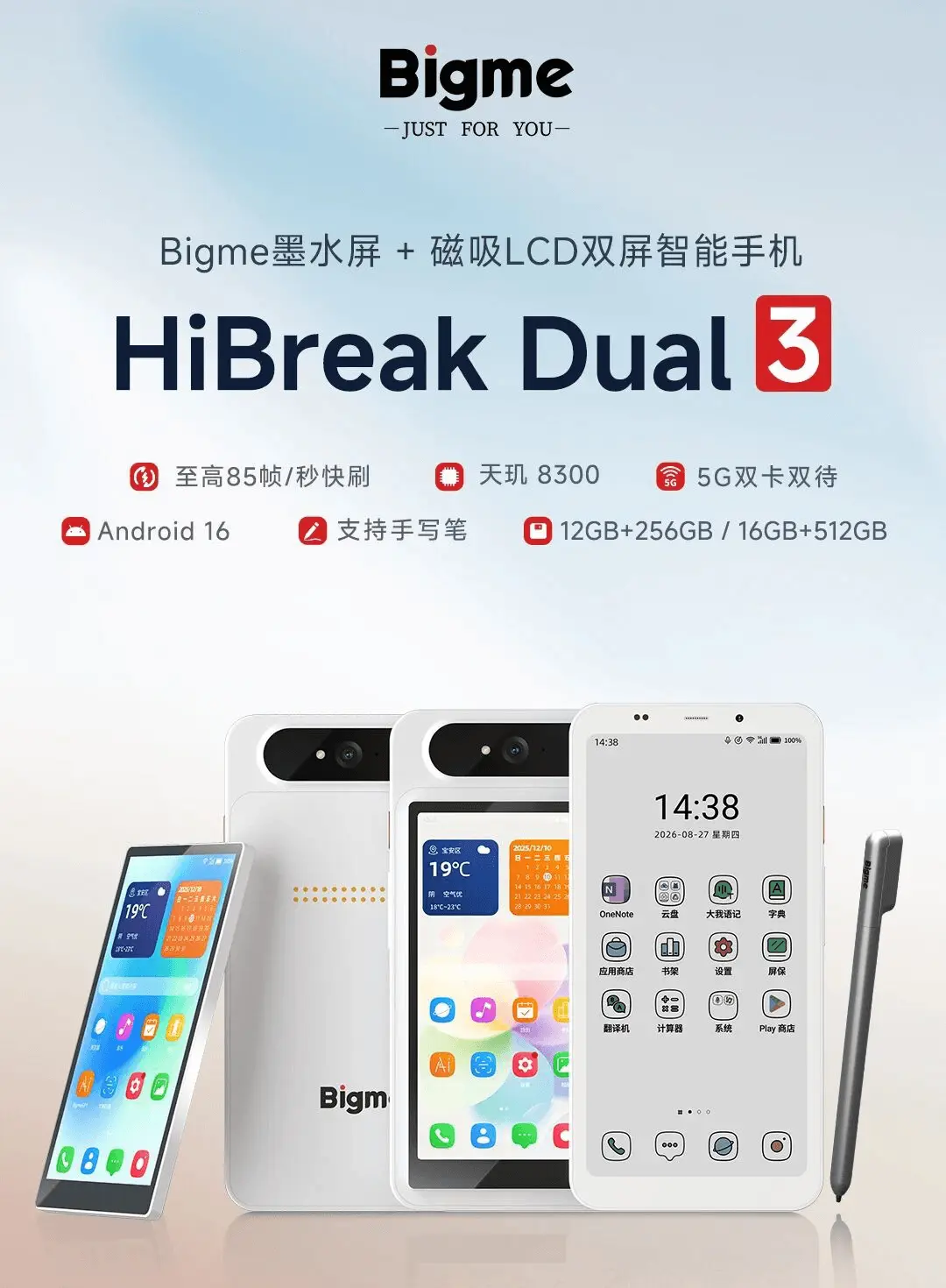
Officially unveiled in late August 2026, the Bigme HiBreak Dual 3 represents a radical departure from traditional mobile design philosophy. Rather than forcing consumers to choose between the eye-fatiguing glare of standard glass displays and the sluggish, monochromatic limitations of early e-readers, the HiBreak Dual 3 introduces a groundbreaking hybrid ecosystem. At its core is a vibrant, high-refresh-rate color E Ink primary display engineered for reading, productivity, and reduced eye strain. However, its masterstroke is an innovative, detachable magnetic LCD module on the rear. This modular approach allows users to seamlessly snap on a traditional screen when dynamic media consumption—such as video streaming or high-speed gaming—is required, and pop it off to return to a distraction-free, paper-like digital environment.
Powered by a flagship-class MediaTek Dimensity 8300 processor, up to 16GB of RAM, and running the latest Android 16 operating system with full Google Play Store access, the HiBreak Dual 3 is not merely a novelty proof-of-concept. It is a fully realized, high-performance mobile computing device designed to bridge the chasm between the e-reader and smartphone markets. As remote work, digital fatigue, and calls for technological minimalism reach an all-time high, the Bigme HiBreak Dual 3 arrives as a timely contender poised to redefine how we interact with mobile technology.
Read Also
Detailed Chronology: The Evolution of the HiBreak Lineage
To fully understand the engineering leap represented by the HiBreak Dual 3, one must examine the evolutionary trajectory of Bigme’s mobile hardware strategy. The journey from fixed dual-screen prototypes to a modular powerhouse spans several critical developmental milestones.
[Early Prototypes: Fixed Dual Screens]
       │
       ▼  (User feedback: Bulk, weight, and redundancy issues)
[HiBreak Generations 1 & 2]
       │
       ▼  (The engineering breakthrough: Magnetic data/power transfer)
[Late August 2026: Bigme HiBreak Dual 3 Unveiled]
The Genesis of E-Paper Telephony
In the early days of E Ink mobile experimentation, manufacturers treated electronic paper as an auxiliary feature—often relegated to a tiny secondary panel on the rear of a conventional smartphone, strictly meant for viewing notifications or the time. Bigme disrupted this narrow paradigm by inverting the concept: making the E Ink panel the primary front-facing display. Earlier iterations of the HiBreak series established that consumers were willing to embrace an E-paper primary screen for reading emails, e-books, and handling text-heavy applications.
However, these early models were constrained by a fundamental hardware contradiction. Fixed dual-screen phones—devices featuring permanent screens on both the front and back—suffered from excessive weight, added thickness, thermal management issues, and structural vulnerability. Users who loved the E Ink front panel found themselves carrying the dead weight of a secondary screen when they didn’t need it, and vice versa.
The Modular Breakthrough
Recognizing the ergonomic limitations of fixed dual screens, Bigme’s engineering teams spent the better part of a product cycle conceptualizing a dynamic hardware architecture. The breakthrough came with the design of a proprietary, low-profile magnetic mounting system capable of handling high-speed data transmission and stable power delivery via physical metal contact pins.
By shifting the secondary LCD screen from a permanent chassis fixture to a removable, snap-on magnetic module, Bigme solved the weight and thickness paradox. The HiBreak Dual 3 represents the culmination of this vision. Officially announced in late August 2026, the device marks a watershed moment: the world’s first mainstream-targeted modular E Ink smartphone that adapts its physical form factor to the immediate needs of the user.
Supporting Context & Metrics: Under the Hood of the HiBreak Dual 3
While its modular concept captures headlines, the technical specifications of the Bigme HiBreak Dual 3 cement its status as a serious contender in the mid-to-high-end smartphone arena. E Ink devices have historically been plagued by underpowered processors, sluggish memory configurations, and frustratingly low refresh rates. Bigme has systematically dismantled these performance bottlenecks.
Display Architecture and Visual Performance
- Primary Front Display: Color E Ink panel featuring an advanced 85 Hz refresh rate. This high refresh rate is a monumental achievement for electronic paper technology, virtually eliminating the notorious ghosting and sluggish cursor lag that rendered older e-readers useless for rapid scrolling.
- Stylus Integration: The front E Ink display fully supports a 4096-level pressure-sensitive stylus, transforming the device into a pocket-sized digital notepad, sketchpad, and enterprise-grade document annotator.
- Secondary Rear Display: A detachable, high-definition color LCD module that attaches via high-strength magnets and gold-plated contact pins. When mounted, it delivers standard smartphone visual fidelity for multimedia; when detached, it exposes a streamlined, minimalist chassis.
Processing Power and Memory Configurations
Breaking away from the tradition of outfitting e-readers with entry-level chipsets, Bigme has integrated the MediaTek Dimensity 8300 processor into the HiBreak Dual 3. Built on an advanced manufacturing node, the Dimensity 8300 provides exceptional computational throughput, energy efficiency, and robust graphical capabilities—performance levels previously unheard of in the E Ink mobile sector.

To complement this silicon foundation, Bigme offers two enterprise-tier memory and storage configurations:
- Standard Tier: 12GB of RAM paired with 256GB of internal storage.
- Maximum Tier: 16GB of RAM paired with 512GB of internal storage.
This hardware payload ensures that multitasking, background synchronization, and heavy application processing occur without stutter or latency.
Connectivity, Software, and Physical Form Factor
- Global Connectivity: Full 5G Dual-SIM capabilities, ensuring seamless high-speed network access across international bands.
- Operating System: Powered by Google Android 16, complete with native, uncompromised access to the Google Play Store. Users are not locked into a proprietary, restricted ecosystem; they can install standard productivity suites, communication apps, and tools without sideloading workarounds.
- Chassis and Camera: Despite its complex internal architecture, the physical footprint remains remarkably compact. The rear chassis features a revamped, minimalist layout housing a streamlined, pill-shaped camera module with a single high-resolution lens and an LED flash, engineered to look sleek and balanced even when the secondary LCD module is completely detached.
Official Statements and Industry Reception
The announcement of the Bigme HiBreak Dual 3 has generated considerable discourse across mobile technology circles, ergonomic advocacy groups, and consumer electronics forums.
Industry analysts note that Bigme’s modular approach directly addresses the psychological friction associated with digital addiction. In official communications accompanying the late August 2026 launch, Bigme representatives emphasized that the device was designed with cognitive wellness as a core architectural tenet.
"We live in an era of hyper-stimulation where consumers are constantly battling screen fatigue, sleep disruption, and fractured attention spans," noted a lead product strategist during the company’s hardware briefing. "The HiBreak Dual 3 is not just about combining two screens; it is about giving users back control over their digital environment. You can work and read in a calm, eye-friendly state on the E Ink panel, and intentionally choose when to bring vibrant multimedia back into your field of view via the magnetic LCD module."
Early industry reception from tech reviewers and accessibility advocates has been largely optimistic, particularly regarding the inclusion of the 85 Hz refresh rate on the E Ink panel. For years, the sluggish update speeds of electronic paper have been the primary barrier to mainstream adoption. By mitigating ghosting and bringing refresh rates closer to conventional display standards, Bigme has opened the door for E Ink technology to transition from a niche reading tool into a viable daily communications platform.
Future Outlook: The Road Ahead for Hybrid Mobile Devices
As the mobile tech landscape looks past the release of the Bigme HiBreak Dual 3, several crucial questions remain regarding its market trajectory, commercial availability, and long-term ecosystem viability.
Pricing, Availability, and Market Positioning
As of publication, Bigme has not yet disclosed official pricing figures or a definitive release date for the HiBreak Dual 3. Industry insiders speculate that given its premium specifications—featuring the MediaTek Dimensity 8300, up to 16GB of RAM, and sophisticated modular hardware—the device will command a mid-to-high-tier price point, positioning it alongside conventional flagship alternatives. Prospective buyers and tech enthusiasts are advised to monitor official channels and trusted industry outlets, such as Good e-Reader, for impending launch announcements and hands-on evaluations.
Implications for the Broader Smartphone Industry
The success or failure of the HiBreak Dual 3’s modular design could serve as a bellwether for the entire mobile industry. If consumers embrace the ability to physically swap display modules based on context, major manufacturers may be forced to rethink their rigid, monolithic form factors.
Furthermore, as regulatory bodies worldwide scrutinize the impact of screen time and blue light exposure on public health—particularly among younger demographics—devices that champion eye-safety and digital minimalism are well-positioned to capture a dedicated, growing market share. Bigme has taken a bold gamble with the HiBreak Dual 3; whether it sparks a broader modular E-paper revolution will depend entirely on its real-world execution, durability, and pricing strategy in the months to come.



Comments
Facebook App ID not configured. Please add it in the Customizer.