
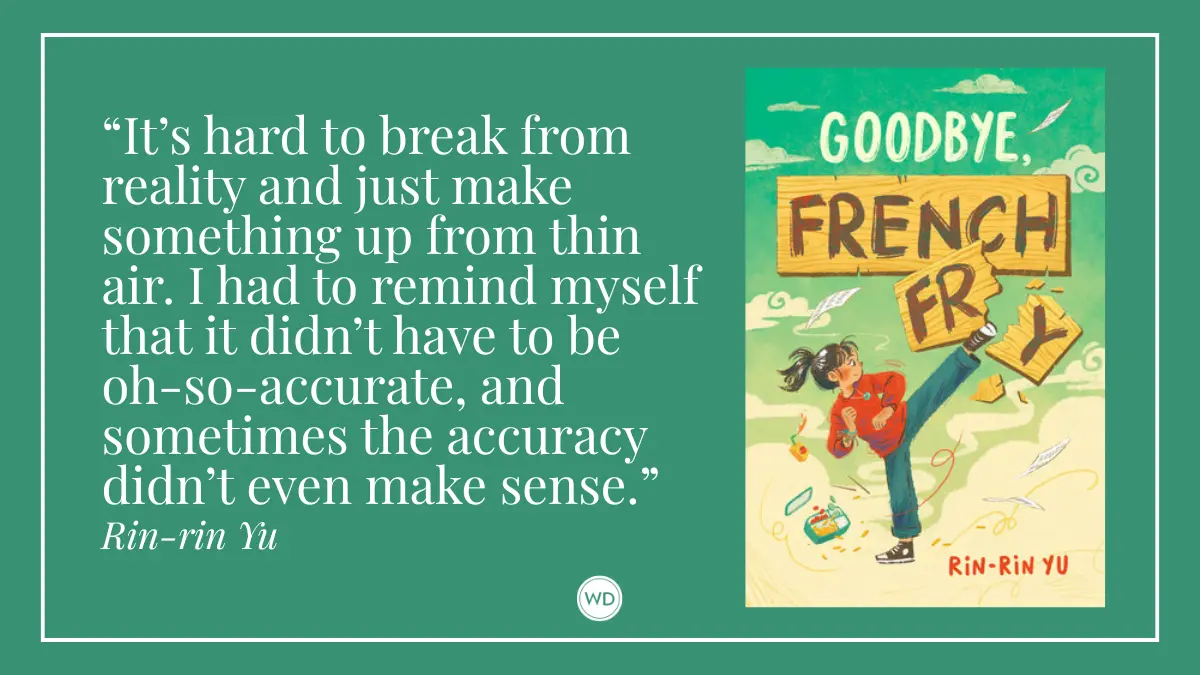
Originally featured in the March/April 2026 issue of Writer’s Digest magazine, this extended review and author profile investigates the delicate alchemy of autofiction, the challenges of normalizing the quiet nuances of the American-born Asian experience, and the craft of turning real-world memories into resonant middle-grade literature.
Executive Overview
For authors navigating the deeply personal terrain of autofiction, the creative process can often feel as though it has been decades in the making. Drawing inspiration directly from one’s own lived experiences provides an immediate wellspring of emotional truth, yet it introduces a formidable literary paradox: knowing precisely which realities to abandon in order to let fictional characters breathe on their own terms. This tension sits at the heart of Goodbye, French Fry, the debut middle-grade novel by author Rin-rin Yu.
Set against the suburban backdrop of New York, Yu’s novel follows Ping-Ping, a Chinese American girl grappling with the complexities of identity, cross-cultural heritage, and an impending, life-altering relocation to Kenya prompted by her father’s potential promotion at the United Nations. Straddling two distinct cultural worlds—frequently feeling "not Chinese enough" to certain peers and "not American enough" to others—Ping-Ping navigates the universally awkward, bittersweet topography of childhood. From nerve-racking piano recitals and backyard taekwondo lessons to celebrating the Lunar New Year and confronting schoolyard bullies, the narrative captures the quiet, everyday moments that shape a young person’s emerging sense of self.
Read Also
In a wide-ranging interview with Writer’s Digest, Yu discussed the arduous multi-year journey of bringing her debut novel to life, the mechanics of repurposing childhood journal entries into fiction, and the broader cultural imperative to normalize the unglamorous, relatable suburban lives of American-born Asian youth. This feature examines the genesis of Goodbye, French Fry, the blurred boundaries between authorial memory and imaginative invention, and the vital lessons Yu offers to writers attempting to fictionalize their own autobiographical pasts.
Detailed Chronology: From Abandoned Historical Epics to Suburban Truths
The path to Goodbye, French Fry was neither linear nor immediate. For years, Yu expended considerable creative energy attempting to write a sweeping historical novel inspired by the childhoods of her parents. However, she quickly encountered a practical roadblock familiar to many historical fiction writers: the immense weight of required research.
"I spent years trying to write a book based on my parents’ childhoods, but then I realized it would involve a lot of historical research that I did not have time or patience to conduct," Yu explained to Writer’s Digest.
Faced with this creative bottleneck, Yu pivoted toward a domain she understood implicitly: the world she had inhabited firsthand from her own childhood onward. This pivot coincided with a profound cultural realization. Looking across the contemporary literary landscape, Yu became acutely conscious of a striking demographic and narrative gap. There were vanishingly few middle-grade books featuring American-born Asian characters who simply occupied suburban spaces, going about their daily lives without the burden of hyper-dramatized trauma or sensationalized fanfare.
Yet, Yu’s personal and social reality told a completely different story. "I know so many American-born Asians who grew up exactly that way, and we all have great stories about our childhoods—some funny, some sad, some bittersweet," she noted. "But these stories, despite being so common, are not normalized… yet. So, I’m contributing at least one book toward this mission."
By choosing to ground her narrative in the familiar, unglamorous cadence of suburban existence, Yu set out to chart a new path for representation—one rooted in quiet authenticity rather than grand theatricality.
Supporting Context & Metrics: The Anatomy of a Composite Memoir
While Goodbye, French Fry is unmistakably a work of fiction, its structural bones are intensely autobiographical. The narrative operates as a complex mirror reflecting both the precise texture of Yu’s 20th-century upbringing and the contemporary dynamics of her own children’s lives.
The Intersection of Life and Art
The parallels between the author’s youth and Ping-Ping’s fictional world are striking. Like her protagonist, Yu grew up in suburban New York. Her father worked for the United Nations, focusing on population and demographics, and toyed with the enticing prospect of relocating his family to various international UN offices—a major plot catalyst in the novel, though one that ultimately mirrored her own family’s real-life stay-put reality.
Other elements are pulled straight from Yu’s personal archives:
- The Bullying Incident: The peculiar moniker that gives the book its title stems from a genuine childhood wound. "There was a kid who called me French Fry and harassed me for a solid four weeks at summer camp after fifth grade," Yu recalled.
- Domestic Details: Routine excursions like shopping trips in Chinatown, nerve-wracking piano lessons, and backyard gymnastics routines are lifted directly from Yu’s memories.
- Divergent Realities: Other components were updated to reflect contemporary dynamics. Ping-Ping’s taekwondo training, for example, is drawn directly from Yu’s observations of her own children’s experiences. Furthermore, while Yu grew up with an older sister, Ping-Ping’s familial unit is a hybrid creation. "Ping-Ping is a composite of my sister, me, and my daughter," Yu explained, "and Ping-Ping’s brother, Xy, is a composite of me and my son."
Archival Preservation: The Power of Childhood Journals
Reconstructing the emotional resonance and internal monologue of a pre-teen required more than just hazy nostalgia; it demanded documentary evidence. Yu credits her childhood habit of keeping a meticulous diary as the secret weapon behind her ability to channel an authentic youth perspective.
"I have a really, really good memory of my childhood," Yu shared. "I kept a journal at that age, and I wrote a ton of details in it, and that helped me remember a lot of things and from that perspective."
This archival impulse manifested in unexpected ways within the text. For instance, while Yu never sold friendship bracelets as a child, she did attempt to launch a neighborhood origami business. When prospective buyers balked at paying cash, barter systems naturally emerged. The eclectic inventory of items Ping-Ping receives as payment in the novel consists entirely of genuine objects logged in Yu’s decades-old journals.
Official Statements & Author Insights
Fictionalizing the Irrationality of Reality
One of the most persistent hurdles writers face when adapting their own lives into narrative fiction is the illogical nature of actual events. Real life rarely adheres to the neat, cause-and-effect structures demanded by a well-plotted novel.
Yu encountered this dilemma head-on when translating her childhood tormentor onto the page. "It’s hard to break from reality and just make something up from thin air," she admitted. "I had to remind myself that it didn’t have to be oh-so-accurate, and sometimes the accuracy didn’t even make sense."
As a prime example, Yu pointed to the enigmatic cruelty of her summer camp bully. "Why did the real-life bully call me French Fry? To this day that befuddles me," she noted. In an autobiography, an unexplained insult can simply exist as an absurd historical footnote. In fiction, however, narrative economy dictates that readers will demand motivation and internal logic. The author must invent a reason behind the action, forcing a departure from strict factual reportage in service of deeper emotional truth.
Navigating Microaggressions and Cultural Dissonance
Throughout Goodbye, French Fry, Ping-Ping encounters a spectrum of microaggressions and cultural friction. For Yu, writing these moments required drawing a distinct line between malicious intent and systemic ignorance—a discernment she believes children develop out of sheer psychological necessity.
"When you experience microaggressions regularly, you learn to pick your battles and shrug off the ones that come from ignorance rather than intentional spite," Yu observed. For Ping-Ping, reaching an age where she can distinguish between the two prevents the crushing exhaustion of reacting to every minor slight. Instead, the protagonist learns the art of intentional community curation—leaning toward peers who offer mutual respect and steadily distancing herself from those who do not.
This cultural balancing act extends directly into the domestic sphere, where Ping-Ping’s immigrant parents fiercely guard their heritage. From insisting on traditional Chinese names to mandating language lessons, these efforts sparked generational friction in Yu’s own youth—friction that she now views with fond, comedic appreciation. "In my own childhood, that was a constant battle with my dad that, in retrospect, is almost comedic and made a great story for the book."
Future Outlook: The Legacy of Small Victories in Children’s Literature
As Goodbye, French Fry finds its audience among both young readers and adults, its broader cultural footprint lies in its quiet subversion of traditional narrative stakes. In a literary market perpetually saturated with high-concept drama, epic quests, and catastrophic stakes, Yu’s novel champions the profound importance of minor triumphs.
Ping-Ping’s narrative arc is defined not by grand medals, championship trophies, or cinematic showdowns, but by the subtle, formative milestones of growing up: recognizing the unspoken love of immigrant parents, standing up to a class bully named Lee Beaumont and realizing his paper-thin authority, and navigating the terrifying prospect of geographical dislocation.
For aspiring authors hoping to mine their own lives for fiction, Yu offers a liberating piece of advice: do not let the tyranny of historical accuracy paralyze the creative impulse.
"Even though I kept journals growing up, there were still gaps I couldn’t remember, and trying to piece them together was sometimes challenging," Yu advised. "Writers should take advantage of those gaps being fun opportunities to fictionalize some details. For me, the overall feeling of the memory mattered more than getting every detail perfect—and once I focused on that, the rest kind of filled itself in."
Ultimately, Goodbye, French Fry stands as a testament to the power of autofiction to expand our cultural imagination. By documenting the specific yet universal texture of a Chinese American household in suburban New York—complete with jade pagodas nestled in fish tanks and finicky bagel-eating habits—Rin-rin Yu has not only validated the lived experiences of a generation of readers, but has also established a vital, enduring space for ordinary stories told with extraordinary heart.



Comments
Facebook App ID not configured. Please add it in the Customizer.