For decades, popular cultural history has cast Pop art as an unmistakably American phenomenon—a glittering, ironic mirror held up to the postwar United States. In the collective imagination, the genre is inextricably bound to the neon glow of Times Square, the celluloid glamour of Hollywood, the slick advertising copy of Madison Avenue, and the material abundance of suburban household appliances. The marquee names that dominate art history textbooks—Andy Warhol, Roy Lichtenstein, James Rosenquist, and Claes Oldenburg—cemented New York City as the undisputed epicenter of this vibrant movement. Alongside groundbreaking female contemporaries such as Rosalyn Drexler, Marisol Escobar, and Marjorie Strider, these artists defined an era through Campbell’s soup cans, Ben-Day dot comic panels, and colossal hamburgers.
Yet, this familiar narrative tells only half the story. While the United States transformed Pop art into a global commercial and cultural juggernaut, the movement’s true genesis occurred across the Atlantic Ocean, quietly taking shape in the austerity of postwar Britain.
Long before Warhol silkscreened Marilyn Monroe or Lichtenstein appropriated war comics, a radical collective of artists, architects, and critics in London began probing the psychological and visual landscape of mass consumerism. This deep dive examines the historical roots of British Pop art, tracing its conceptual framework back to a pivotal meeting in April 1952 at the Institute of Contemporary Arts (ICA). By exploring the contributions of key figures such as Eduardo Paolozzi, Richard Hamilton, and Lawrence Alloway, this report reclaims the transatlantic origins of a movement that forever altered the global visual lexicon.
Detailed Chronology: From London’s Ruins to the Birth of a Movement
To understand how Pop art crossed the Atlantic, one must first examine the stark socioeconomic realities of Great Britain in the late 1940s and early 1950s. While the United States experienced an unprecedented economic boom following the Second World War, Britain was mired in stringent rationing, bomb-damaged urban centers, and a palpable sense of imperial decline. Paradoxically, this acute material scarcity fueled an intense, almost obsessive fascination with American popular culture among British intellectuals. To young artists trapped in a gray, recovering nation, American magazines, advertisements, science fiction pulps, and Hollywood films represented a dazzling, technicolor utopia.
The Catalyst: April 1952 and the Independent Group
The official origin story of Pop art traces back to a damp evening in London in April 1952. Gathered within the modest confines of the Institute of Contemporary Arts (ICA) was a loose affiliation of forward-thinking creators who would collectively become known as the Independent Group (IG). This collective was not an official art movement with a manifesto; rather, it functioned as an intellectual incubator—a multidisciplinary salon where painters, sculptors, architects, and theorists could dissect the rapidly changing modern world.
The roster of attendees at these early foundational meetings reads like a who’s who of British artistic avant-garde: painters Richard Hamilton and William Turnbull, photographer Nigel Henderson, artist and theorist John McHale, and writer Toni del Renzio, alongside the influential art critic Lawrence Alloway. However, the undisputed prime mover of this foundational session was Scottish-Italian sculptor and collagist Eduardo Paolozzi.
Eduardo Paolozzi’s Epiphany: BUNK!
During that historic April 1952 gathering, Paolozzi delivered a lecture that fundamentally altered the trajectory of modern art. Utilizing an episcope—an early optical projector—he flashed a rapid-fire sequence of opaque projections onto a screen. The source material for these images was entirely unprecedented in a fine art context: American pulp magazine covers, advertisements for domestic appliances, military tech manuals, comic strips, and fast-food packaging.
Titled BUNK!—a nod to Henry Ford’s famous declaration that "history is more or less bunk"—the presentation was a dizzying assault on high-art hierarchies. Paolozzi had assembled these images during his time in Paris between 1947 and 1949, where he meticulously gathered discarded American magazines gifted to him by soldiers stationed overseas. By treating mass-produced ephemera with the analytical seriousness usually reserved for classical painting or high sculpture, Paolozzi inadvertently drafted the foundational blueprint for Pop art.
Among the slides shown that evening was Paolozzi’s seminal 1947 collage I was a Rich Man’s Plaything, which prominently features the word "POP" exploding in red block letters from a pistol barrel—marking the very first time the term appeared within a recognized work of visual art.
Richard Hamilton and the Definition of Pop
If Paolozzi provided the initial spark, artist and theorist Richard Hamilton supplied the intellectual rigor that elevated these early experiments into a coherent movement. Following the initial momentum generated by the Independent Group, Hamilton spearheaded the landmark 1956 exhibition This Is Tomorrow at the Whitechapel Art Gallery in London.
For the exhibition, Hamilton produced a small, unassuming collage that would become the quintessential icon of early British Pop art: Just what is it that makes today’s homes so different, so appealing? (1956). Measuring a mere 10¼ by 9¾ inches, the piece was densely packed with cut-outs from American magazines. It featured a muscular, shirtless bodybuilder holding a giant Tootsie Pop, a sensuous pin-up girl lounging on a sofa, a reel-to-reel tape recorder, a vacuum cleaner with an impossibly long hose snaking across the floor, and a tinned ham on a coffee table. Outside the window, a glowing marquee advertised The Jazz Singer.
Shortly after the exhibition, Hamilton penned a famous letter to his friends and fellow IG members, Peter and Alison Smithson, outlining the definitive characteristics of the burgeoning genre. Pop art, according to Hamilton, must be:
Popular (designed for a mass audience)
Transient (short-term solutions)
Expendable (easily forgotten)
Low cost
Mass produced
Young (aimed at youth)
Witty
Sexy
Gimmicky
Glamorous
Big business
This manifesto-like definition brilliantly encapsulated the frantic, consumer-driven heartbeat of the mid-20th century, laying the theoretical groundwork for what Warhol and Lichtenstein would later execute on a monumental scale across the Atlantic.
Supporting Context & Metrics: The Transatlantic Cultural Shift
To fully grasp the historical weight of the Independent Group’s contributions, one must analyze the cultural, economic, and institutional metrics that defined the art world during the transition from the 1950s to the 1960s.
The Economic Discrepancy: Scarcity vs. Abundance
Post-War Britain (1945–1954): Food rationing in the United Kingdom did not officially end until July 1954, nearly a decade after the cessation of hostilities. Consumer goods were heavily taxed or exported to pay down wartime national debt. Consequently, American mass media functioned as an exotic fantasy world.
The American Boom (1950s): Conversely, the United States Gross Domestic Product (GDP) skyrocketed by over 37% during the 1950s. Suburban expansion, automobile ownership, and television penetration rates created an unprecedented domestic consumer market, providing American artists with a literal and figurative playground of commercial excess.
Institutional Adoption and Terminology
Coining the Term: While Paolozzi introduced the visual iconography, and Hamilton defined its parameters, British art critic Lawrence Alloway is widely credited with officially codifying the term "Pop Art" in print during the mid-1950s to describe the cultural artifacts generated by mass media.
The Shift to New York: By the early 1960s, the economic gravity of the art market shifted decisively toward New York City. Leo Castelli, Sidney Janis, and other prominent Manhattan gallerists recognized the commercial viability of Pop imagery. American artists adapted the critical irony pioneered by the Independent Group and supercharged it with the scale, financial backing, and media savvy unique to the American capitalist landscape.
Official Perspectives and Critical Reappraisal
For decades, international art history relegated British Pop art to the status of a preliminary sketch—a quaint, academic precursor to the "real" Pop art executed in New York. However, contemporary curatorial scholarship has initiated a sweeping global reappraisal, recognizing that British artists approached consumerism from a position of detached, anthropological irony rather than uncritical immersion.
Art historians and museum directors have increasingly emphasized the unique socio-political lens through which British creators viewed American culture. In recent statements from major institutions housing these foundational works—such as the Tate in London and the Museum of Modern Art in New York—curators note that while American Pop art often celebrated or directly mirrored the dazzling consumer surface of its environment, British Pop art was inherently analytical, operating as an outsider’s critique of an imported dream.
Renowned art historian and curator Marco Livingstone once noted regarding the movement’s duality:
"The British artists were viewing American mass culture through the equivalent of a telescope from across an ocean. Their work possessed a cool, observational distance. They were investigating a culture they desired but could not fully inhabit, which gave their appropriations of mass media a sharp, conceptual edge that differed fundamentally from the visceral, immersive bravado of their later American counterparts."
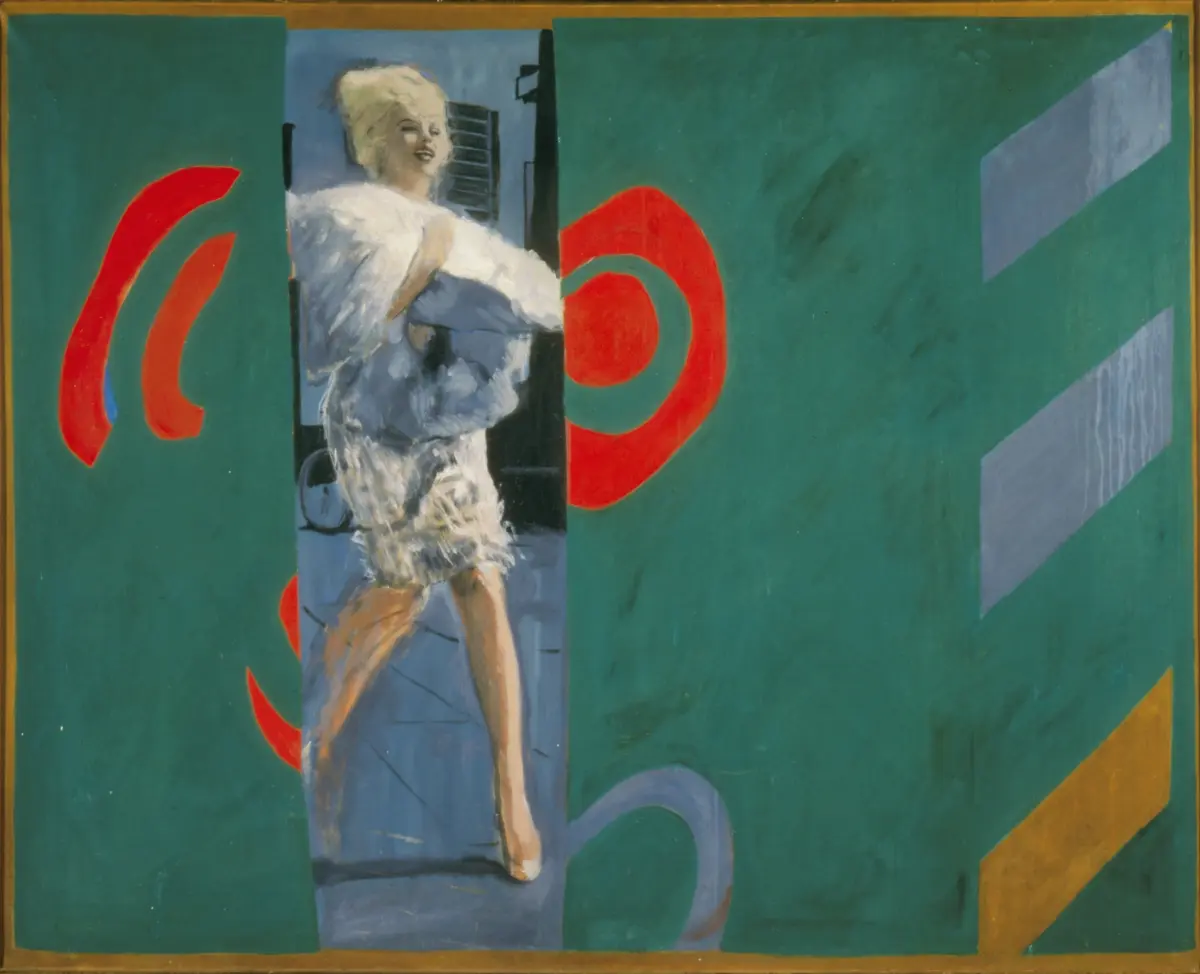
Furthermore, the inclusion of trailblazing female artists like Pauline Boty—whose vibrant, politically charged, and unabashedly feminist Pop paintings such as The Only Blonde in the World (1963) challenged the male-dominated gaze of both society and the art world—has enriched our understanding of British Pop as a diverse, multifaceted dialogue rather than a monolithic school.
Future Outlook: Preserving and Re-evaluating the Roots of Modernity
As we move deeper into the 21st century, the legacy of the Independent Group and the British roots of Pop art continue to undergo a profound renaissance. In an era saturated by digital media, algorithmic advertising, and hyper-consumerism, contemporary digital natives find a striking prescience in the collages of Paolozzi and Hamilton. Long before the advent of the internet, Photoshop, or social media feeds, these artists were already diagnosing the human condition in an age of infinite mechanical reproduction and visual overload.
Major international retrospectives are increasingly dismantling the outdated geographic hierarchy that placed New York at the absolute center of Pop’s inception. Institutions worldwide are investing heavily in the conservation, exhibition, and scholarly research of early British Pop archives.
Ultimately, acknowledging that Pop art was conceived in the gray, austere drawing rooms of postwar London—rather than the sun-drenched advertising agencies of Madison Avenue—does not diminish the explosive impact of American masters like Warhol and Lichtenstein. Instead, it completes the narrative. It reveals a rich, transatlantic dialogue about the alluring, terrifying, and ultimately enduring power of mass culture—a dialogue that began not with a splash of soup, but with the flicker of an episcope in a London basement.





Comments
Facebook App ID not configured. Please add it in the Customizer.