Janine Antoni has spent over three decades challenging the boundaries of contemporary sculpture, performance, and feminist art. By deploying her own body as both a primary tool and a central medium, Antoni systematically dismantles the detached formalism of the traditional art-historical canon. Rather than relying on industrial-scale fabrication or relying on standard artistic implements, she transforms hair into a paintbrush, teeth into a chisel, and bone molds into gilded frames.
Her works—often bearing dynamic verb titles like Gnaw, Lick and Lather, and Loving Care—explore the fragile intersection of production, destruction, gender conditioning, and material estrangement. As she prepares for her first major museum retrospective at the Museum of Contemporary Art Chicago (MCA) in December 2026, Antoni’s practice continues to resonate profoundly. This upcoming exhibition will cement her status as a foundational figure in contemporary art, tracing an uncompromising, deeply physical career that collapses the distance between the artist, the object, and the audience.
Detailed Chronology: From the Caribbean to the Avant-Garde
Formative Years and Early Influences (1964–1987)
Born in Freeport, Bahamas, in 1964 to Trinidadian parents, Antoni’s early life was intimately tied to the medical and domestic worlds. Her father practiced as a physician alongside his brothers, frequently treating neighbors in emergency home visits where a young Antoni would assist by handing him his instruments. This domestic proximity to clinical care instilled in her an early, profound wonder at the miraculous mechanics of the human body.
However, this untethered island worldview shifted dramatically in 1977 at age 13, when she relocated to attend a Catholic girls’ high school in West Palm Beach, Florida. Thrust into a new cultural landscape, Antoni became acutely aware of how human gestures are read differently across cultural divides. She began to view the body not merely as a biological entity, but as something socially conditioned by race, class, and gender.
The 1990s: Explosive Debuts and Institutional Interrogations
Entering the New York art scene in the early 1990s after earning her MFA from the Rhode Island School of Design (RISD) in 1989, Antoni immediately confronted the patriarchal legacies of Minimalism.
1992 (Gnaw): In her breakthrough solo exhibition at Sandra Gering’s Broome Street gallery, Antoni presented two massive, 600-pound cubic blocks—one made of lard, the other of chocolate. Mimicking the geometric rigor of Minimalist icons like Sol LeWitt and Tony Smith, Antoni subverted their sterile industrialism by using her own teeth to bite away at the blocks. The expelled material was subsequently repurposed into lipsticks and heart-shaped chocolate boxes, forging a direct link between the monumental scale of sculpture and the intimate, oral drives of the body.
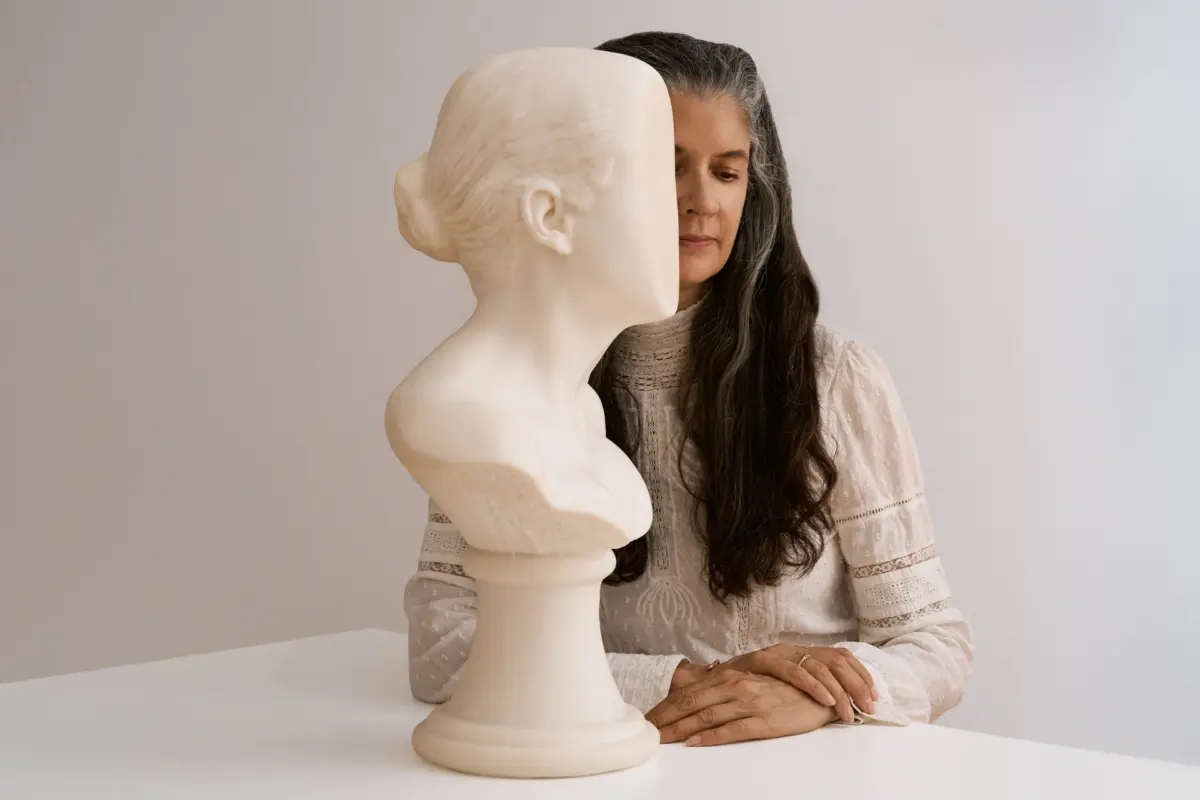
1993 (Lick and Lather): Commissioned for the Venice Biennale, this installation comprised 14 neoclassical portrait busts cast from a mold of the artist’s head and chest—seven made of chocolate and seven of soap. Antoni slowly degraded her own effigy by washing the soap busts and licking the chocolate ones, visualizing a complex love-hate relationship with physical appearance and self-image.
1993 (Loving Care): Staged live at the Anthony d’Offay Gallery in London, Antoni soaked her hair in Clairol’s "natural black" hair dye (the brand used by her mother) and, on hands and knees, "washed" the gallery floor. The performance served as a feminist critique of Abstract Expressionist action painting and Yves Klein’s gendered "human paintbrushes," deliberately expelling onlookers as the space filled with the dark marks of domestic labor.
The Turn of the Millennium: Illness, Dance, and Corporeal Evolution (1998–2015)
At the age of 33, Antoni was diagnosed with breast cancer, undergoing surgery, chemotherapy, and radiation through the late 1990s. This confrontation with mortality deepened her engagement with ritual, somatic movement, and the body’s resilience. She integrated daily movement practices like 5Rhythms and Emilie Conrad’s Continuum Movement into her life, viewing somatic dance as a natural extension of her sculptural investigations.
This corporeal pivot led to landmark collaborations, most notably with pioneering postmodern choreographer Anna Halprin. After attending Halprin’s workshop in Big Sur in 2011, Antoni began developing her own sculptural interpretation of Halprin’s 1965 improvisational score, Paper Dance. Premiering publicly in 2016 at the Fabric Workshop in Philadelphia, the performance featured Antoni drawing with shadow and motion on a rolling sheet of brown paper, seamlessly blending the ephemeral gestures of dance with the enduring material traces of sculpture.
Supporting Context & Metrics
Key Artistic Milestones & Exhibitions
1993 Whitney Biennial: Featured Gnaw, cementing Antoni’s place at the forefront of identity politics and material-based feminist art.
1999–2012 Columbia University Mentorship: Served as a vital mentor in Columbia’s MFA program, shaping the trajectory of notable contemporary artists including Chitra Ganesh, Aki Sasamoto, and Liz Magic Laser.
2019 "I am fertile ground": Staged in the Catacombs at Brooklyn’s Green-Wood Cemetery, this exhibition featured forensic photo-portraits encased in gilded frames molded from plastic anatomy-classroom bone casts.
December 2026 Museum of Contemporary Art Chicago (MCA) Retrospective: Set to be her first comprehensive museum survey, co-organized by Joey Orr and Adrian Heathfield.
Materiality and Process Metrics
Antoni’s work relies heavily on durational processes rather than rapid fabrication. The metrics of her practice are often biological and physical:
600 Pounds: The weight of each individual block of lard and chocolate consumed via biting in Gnaw.
14 Busts: The total number of self-portrait sculptures comprising Lick and Lather (Venice Biennale, 1993), evenly split between soap and chocolate.
13 Years: The duration of Antoni’s direct teaching tenure at Columbia University, where her classroom expanded to encompass the entirety of New York City.
Official Statements and Curatorial Perspectives
Janine Antoni’s philosophy centers on bridging the perceptual gap between audiences and the objects they interact with daily. Reflecting on her studio practice during a recent interview in her Brooklyn, Park Slope home, she remarked:
"For me, [this work is] about that conflict, that kind of love/hate relationship we have with our physical appearance. And, really, the problem I have of looking in the mirror and thinking, ‘Is that who I am?’"
Discussing the frequent absence of procedural transparency in institutional art spaces, Antoni noted the cultural alienation born from modern manufacturing separation:
"We have lost our connection to the way the objects we are in contact with every day are made. This alienates us from our world."
Curatorial leadership preparing for her upcoming retrospective emphasizes the inescapable bodily impact of her oeuvre. Joey Orr, Deputy Director and Chief of Curatorial Affairs at the MCA Chicago, shared insights regarding the upcoming 2026 exhibition:
"While the show will primarily feature sculptures, drawings, photographs, and video, there’s no way to walk out of the exhibition without having had an experience with the body."
Future Outlook
As Janine Antoni looks toward her upcoming museum retrospective at the Museum of Contemporary Art Chicago, her retrospective evaluation of her own work reflects an evolving philosophy regarding authorship and physical endurance.
While her early career centered strictly on her unique relationship to her own body—leading her to reject the idea of other performers enacting pieces like Loving Care—time has softened her stance on singular ownership. Today, Antoni is actively exploring how her past works can be reinterpreted to honor their historical roots while engaging contemporary cultural dialogues.
By continuing to investigate the erotics of physical presence, the enduring traces of human labor, and the transmission of feminist art histories across generations, Antoni ensures that her body of work remains as vital, challenging, and fertile as ever.






Comments
Facebook App ID not configured. Please add it in the Customizer.