
Executive Overview
In a bitterly divided and politically seismic 5–4 decision, the United States Supreme Court has cleared the path for President Donald Trump to construct a massive, highly controversial presidential ballroom on the historic grounds of the White House. The ruling in National Park Service v. National Trust for Historic Preservation effectively immunizes the executive branch from judicial oversight in this case, neutralizing federal statutory protections and leaving historic preservationists scrambling to understand the broader legal fallout.
Strikingly, no member of the conservative majority attempted to defend the legality of the construction project itself. Instead, the Court’s five-judge Republican majority deployed a convoluted, narrowly tailored standing doctrine to shield the project from legal challenges. In doing so, they sidestepped clear federal statutes that explicitly forbid the erection of unauthorized structures on public lands within the nation’s capital.
Chief Justice John Roberts issued a scathing dissent, joined by the Court’s three liberal justices, accusing his conservative colleagues of judicial gymnastics. Roberts pointed out the glaring absurdity of the majority’s logic, noting that under the new ruling, wishing to observe a crocodile in the wild satisfies the legal threshold for "standing," while wanting to gaze at the unobstructed neoclassical facade of the White House does not.
Read Also
The ruling raises profound questions about the expansion of executive power, the erosion of administrative guardrails, and the stability of decades-old environmental and historical preservation jurisprudence. As legal scholars and litigators attempt to parse the ambiguous opinion, the shadow of an "imperial presidency" looms larger than ever over Washington, D.C.
Detailed Chronology: From Concept to Courtroom
The Genesis of the East Wing Overhaul
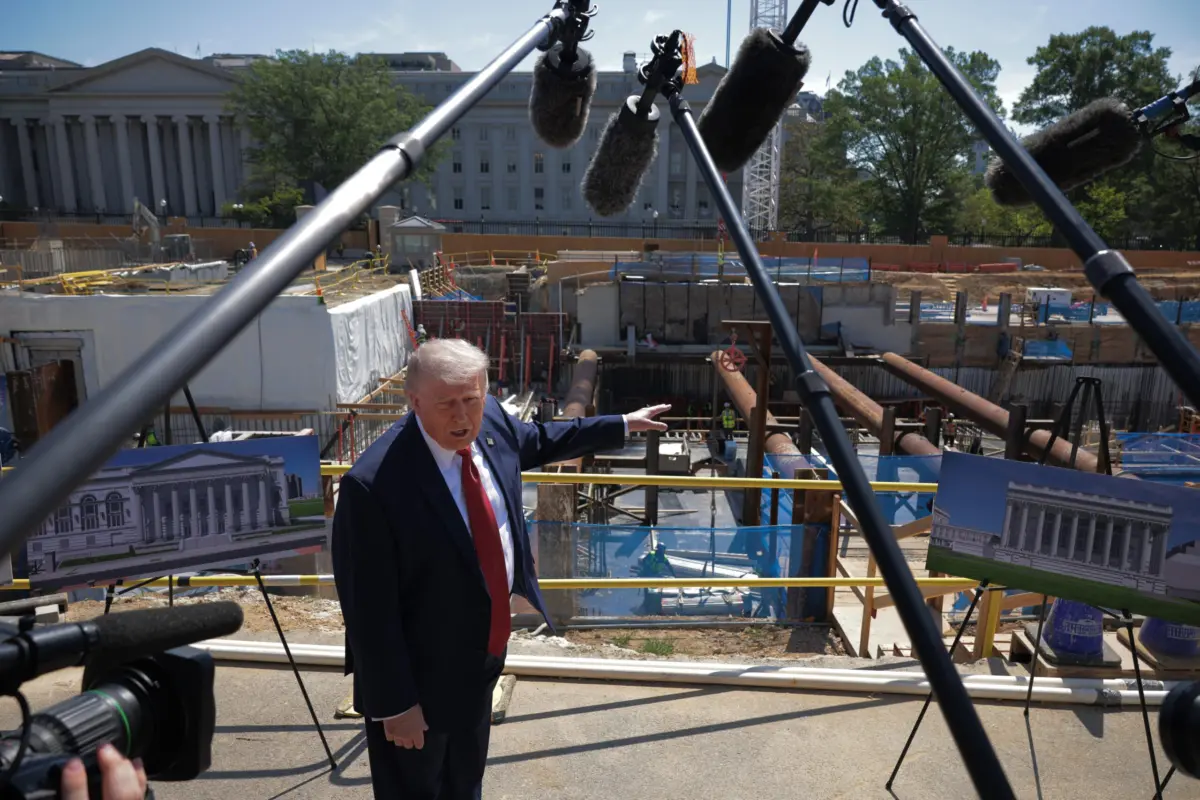
The controversy began when the Trump administration quietly unveiled ambitious blueprints to fundamentally alter the historic layout of the White House complex. The centerpiece of the proposal: an enormous, modern ballroom slated to occupy the footprint of the former East Wing—a historic section of the executive mansion long associated with the offices of the First Lady and visitor operations.
While modern presidents have frequently remodeled interior residential and office spaces, the scale of the proposed ballroom went far beyond interior decorating. It envisioned a massive external structure altering one of the most recognized and culturally protected architectural landmarks in the Western Hemisphere.
Legislative Hurdles and Public Backlash
Almost immediately, the project drew fierce opposition from historical preservation societies, urban planners, and environmental advocates. Opponents pointed to long-standing federal statutes designed to protect the National Mall and surrounding federal reservations in the District of Columbia.
Chief among these is a federal law explicitly prohibiting the construction of any "building or structure […] on any reservation, park, or public grounds of the Federal Government in the District of Columbia without express authority of Congress."
Legal analysts and congressional watchdogs noted that Congress had never debated, voted upon, or passed any legislation granting the executive branch authorization to construct a mega-ballroom on the White House grounds. Recognizing the legal vulnerability of the project, preservationist coalitions mobilized quickly, filing emergency federal lawsuits aimed at halting groundbreaking and securing injunctions against the National Park Service and the General Services Administration.
The Rush to the Supreme Court
The legal battle bypassed traditional multi-year appellate timelines, landing on the Supreme Court’s emergency docket as the administration sought to fast-track construction. The petitioner, the National Trust for Historic Preservation, argued that allowing the executive branch to bypass statutory restrictions set a dangerous precedent for all federal public lands.
In a move that surprised few Court watchers given the current conservative supermajority, the justices agreed to intervene. On Monday afternoon, the Court handed down its decision, delivering a decisive victory to the White House while leaving foundational legal doctrines battered and bruised.
Supporting Context & Metrics: Decoding "Standing" and the Rule of Law
To understand the magnitude of the Supreme Court’s ruling, one must examine the legal doctrine of "standing"—the requirement that a plaintiff must demonstrate a concrete, particularized injury caused by the defendant before a federal court will hear their case.
Historical Precedents in Environmental and Aesthetic Law
For decades, federal jurisprudence has recognized aesthetic, recreational, and conservationist injuries as legitimate grounds for standing.
- Lujan v. Defenders of Wildlife (1992): The Supreme Court affirmed that "the desire to use or observe an animal species, even for purely esthetic purposes, is undeniably a cognizable interest" capable of supporting federal litigation.
- Friends of the Earth v. Laidlaw Environmental Services (2000): The Court ruled that environmental plaintiffs "adequately allege injury in fact when they aver that they use the affected area and are persons ‘for whom the aesthetic and recreational values of the area will be lessened’ by the challenged activity."
In the National Park Service case, the plaintiffs included a retired university professor and long-time Washington resident who frequently strolled past the White House, deriving deep aesthetic and cultural appreciation from its historic, unobstructed architecture. Under Lujan and Laidlaw, this connection historically constituted a valid basis to challenge structural alterations to the public grounds.
The Majority’s Linguistic Gymnastics
The five-justice conservative majority dismissed the plaintiff’s claims by drawing an artificial and unpersuasive distinction. They asserted that the plaintiff merely claimed to be "offended" by the construction, arguing that past environmental cases required "more than mere offense."
The majority drew false equivalents, noting that plaintiffs in Laidlaw wanted to fish, swim, and camp near a river, whereas the plaintiff here merely wanted to look at a building. Yet, they failed to meaningfully distinguish Lujan, which explicitly protected the aesthetic pleasure of observing wildlife without requiring the observer to hunt, trap, or consume the animals in question.
| Legal Precedent | Year | Core Principle of Standing | Application in National Park Service v. NTHP |
|---|---|---|---|
| Lujan v. Defenders of Wildlife | 1992 | Aesthetic enjoyment of nature/animals is a cognizable injury. | Dismissed by majority without coherent legal distinction. |
| Friends of the Earth v. Laidlaw | 2000 | Loss of aesthetic/recreational value of an area constitutes injury. | Reinterpreted by majority to demand recreational utility (swimming/fishing) over pure observation. |
| National Park Service v. NTHP | Current | Aesthetic appreciation of historic architecture does not confer standing. | Established as a new, restrictive benchmark for public lands litigation. |
Official Statements and Judicial Rebuttals
The deep ideological and philosophical fractures within the judiciary were laid bare in the opinions accompanying the ruling.
The Conservative Majority’s Silence
True to a growing trend in emergency-docket jurisprudence, the majority opinion was remarkably brief and notably devoid of deep jurisprudential justification. By shielding the White House project behind an opaque wall of standing restrictions, the majority avoided addressing the elephant in the room: whether the executive branch possesses the inherent constitutional authority to override federal building prohibitions in the nation’s capital. Legal scholars have criticized this approach as "result-oriented jurisprudence"—crafting narrow, poorly reasoned exceptions to achieve a predetermined political outcome.
Chief Justice Roberts’s Scathing Dissent
Chief Justice John Roberts, joined by Justices Sonia Sotomayor, Elena Kagan, and Ketanji Brown Jackson, did not mince words in his dissenting opinion. Roberts underscored the blatant executive overreach enabled by his colleagues:
"Congress has not passed any law resembling ‘express authority’ for the Executive’s construction of Trump’s ballroom," Roberts wrote, highlighting that the project directly violates federal statutes governing public spaces in the District of Columbia.
Roberts targeted the majority’s incoherent application of standing law with dry judicial sarcasm:
"It now is the case that ‘I want to look at a crocodile’ can adequately answer the ever-critical ‘what’s it to you?’ question of Article III standing, while ‘I want to look at the White House’ cannot."
The dissent warned that by weaponizing standing doctrine to insulate executive branch projects from public accountability, the Court was abandoning its constitutional duty to act as an effective check on presidential power.
Future Outlook: Implications for the Environment, Preservation, and Executive Power
The long-term ramifications of National Park Service v. National Trust for Historic Preservation extend far beyond the blueprints of a presidential ballroom.
A Threat to Conservation and Environmental Regimes?
Legal experts are deeply divided over whether this ruling represents a "one-off" judicial favor tailored specifically to accommodate the Trump administration or if it signals an existential threat to America’s broader environmental and historic preservation laws.
If lower courts interpret the ruling as a signal to severely restrict aesthetic and observational standing, countless public interest lawsuits could be thrown out of court. Environmental groups seeking to halt logging in national forests, urban preservationists fighting the demolition of historic districts, and conservationists protecting scenic vistas could all find themselves locked out of the federal courthouse doors. Without plaintiffs who can clear this newly erected, ambiguous standing hurdle, federal agencies may find themselves entirely unaccountable when managing public lands.
The Normalization of the "Imperial Presidency"
Perhaps the most enduring legacy of the decision is its contribution to the normalisation of unbridled executive power. When the judiciary actively constructs procedural loopholes to shield high-profile executive projects from statutory review, the traditional system of checks and balances begins to fracture.
As heavy machinery prepares to break ground on the East Wing, the ruling serves as a stark reminder of the judiciary’s shifting priorities. Whether this decision remains an isolated anomaly or becomes the foundational stone of a radically altered legal landscape remains one of the most pressing questions facing American democracy today. For now, the ballroom is cleared for construction—and the guardrails of accountability have been pushed dangerously aside.





Comments
Facebook App ID not configured. Please add it in the Customizer.