
Executive Overview
Every June, the geography of professional basketball temporarily bifurcates along the fault lines of triumph and despair. In Manhattan, a celebratory parade honors the ultimate victors of the league’s grueling marathon. Yet, weeks later across the East River in Brooklyn, a vastly different gathering unfolds—an event fundamentally predicated on failure. The annual NBA Draft Lottery and its subsequent selection ceremonies represent a uniquely American ritual where futurity is directly subsidized by ineptitude.
For decades, the NBA’s inverse-order lottery system created a perverse economic incentive: the worse a franchise performed on the hardwood during the regular season, the higher its statistical probability of securing transformative, generational talent. Franchises like the Washington Wizards and the Utah Jazz mastered this art, converting their ’25–’26 campaign deficits into coveted top draft positions. Others, such as the Memphis Grizzlies and the Chicago Bulls, leaned into the capricious whims of statistical variance, riding sheer luck up the selection order.
Yet, this high-stakes ecosystem of engineered obsolescence is rapidly drawing to a close. With impending league reforms designed to systematically penalize and eliminate intentional losing, the 2026 draft class stands as a historical milestone: the final group of franchises that will straightforwardly profit from strategic, systemic regression.
Read Also
Beyond the front-office mathematics and lottery balls, the event at the Barclays Center functions as a microcosmic mirror of modern sports culture. It is an industry gathering disguised as public theater, where corporate sponsorships dwarf athletic purity, insider "scoop" journalists command more attention than the games themselves, and fans willingly participate in a digitized economy of speculation, algorithms, and content creation.
Detailed Chronology: Winners, Losers, and the Anatomy of the Draft
The Lottery Champions and the Final Era of Tanking
Not all losers are created equal in the eyes of the NBA lottery machine. Weighted odds, meticulously calculated from regular-season win-loss records, rewarded franchises that plumbed the depths of competitive play. The Washington Wizards and Utah Jazz emerged as the architects of this strategy, successfully translating months of dismal box scores into the architectural foundations of their rebuilding projects. Alongside them, the Memphis Grizzlies and Chicago Bulls utilized favorable lottery bounces to vault ahead in a draft class universally heralded by scouts as historically deep and talented.
However, the shadow of tomorrow looms heavy over these triumphs. The league’s impending structural overhaul means that future iterations of the lottery will flatten odds and decouple high picks from abysmal records, rendering these four organizations the last beneficiaries of the "tanking" era.
The Multi-Tiered Misery of the Brooklyn Nets
If the Wizards and Jazz engineered a masterclass in converting loss into gain, their geographic neighbors across the river provide a stark counter-narrative. The Brooklyn Nets suffered a compounding cascade of failures across every conceivable vector:
- The Record: A disastrous campaign resulted in the third-worst baseline record in the association.
- The Lottery: Possessing tied-best odds for the coveted first overall selection, the ping-pong balls fell unkindly, pushing Brooklyn back to the sixth pick.
- Draft Capital Exhaustion: Their historical accumulation of draft assets—most notably burning an unprecedented five first-round picks in the previous year’s draft—yielded a rookie cohort seemingly incapable of stemming the tide of institutional losing.
- The Historical Fall: The sharp, vertiginous drop from the gleaming, albeit brief, championship-contention window of the Kevin Durant, Kyrie Irving, and James Harden "super-team" era of 2021–2022.
- The Cultural Deficit: Operating in the monolithic shadow of their crosstown rivals, the newly resurgent New York Knicks.
The Indiana Pacers and Sacramento Kings: Variance and Regret
The Indiana Pacers’ trajectory reads like a Greek tragedy scripted by sports economists. Following a heroic 2025 postseason run that saw them dismantle the Knicks in the Eastern Conference Finals and push the powerhouse Oklahoma City Thunder to a grueling seven-game NBA Finals, disaster struck. Star guard Tyreese Haliburton suffered a catastrophic Achilles tendon tear. Deprived of their offensive engine, the Pacers plummeted down the standings, eventually landing in a lottery position tied with Brooklyn and Washington.
Compounding their misfortune, a mid-season trade forced Indiana to surrender its heavily protected top-four pick to the LA Clippers when the selection slipped to fifth, leaving the franchise entirely empty-handed in the first round. Despite this, structural optimism remains: a healthy Haliburton next season restores the core that nearly captured a title.
Conversely, the Sacramento Kings—historically branded as one of the league’s most volatile organizations—stumbled once again. Despite holding a robust 45.2 percent statistical probability of leaping into the top four, the Kings watched their fortunes evaporate, settling instead for the seventh selection. The infectious, ultraviolet euphoria of the 2022–23 "Beam Team" era has steadily dissipated, leaving fans to confront the institutional reality of returning to the league’s basement.
Supporting Context & Metrics: The Mechanics of Modern Spectacle
The Draft as an Industrial Apparatus
Stripped of its television gloss, the NBA Draft is a remarkably clinical business event. Young athletes, orbiting an ecosystem of agents, handlers, and media trainers, converge upon the Barclays Center floor. At the discretion of executives sequestered in remote "war rooms," these draftees ascend the stage to don a team cap, embrace the commissioner, and pose for flashbulbs.
The entire process functions as the terminal node of an opaque causal chain—an industry convention formatted for public consumption. In structural terms, it closely mirrors the Academy Awards, albeit lacking cinematic prestige. It is an industry gala where the underlying assets (rookie contracts governed by the complex Collective Bargaining Agreement negotiated between the league and the National Basketball Players Association) are traded, leveraged, and protected with actuarial precision.
[Front Office War Rooms]
         │
         ▼ (Secretive Calculations & Analytics)
[The Lottery & Draft Floor]
         │
         ▼ (Public Spectacle & Corporate Activation)
[The Fan Experience / Content Generation Economy]
Navigating the CBA Labyrinth
To understand the modern NBA fan is to understand the legalistic machinery of the Collective Bargaining Agreement (CBA). Modern fandom requires an ad-hoc fluency in contract law and financial accounting that rivals corporate jurisprudence. Supporters routinely debate:
- Salary caps and the punitive "tax aprons"
- Frozen draft assets and complicated protections
- Bird Rights and Disabled Player Exceptions
- Traded Player Exceptions (TPE) and Mid-Level Exceptions (MLE)
This administrative bloat has fostered a culture where the league’s administrative complexity is consumed with the same fervor as the games themselves.
The Gamification and Corporate Sponsorship of the Fan Experience
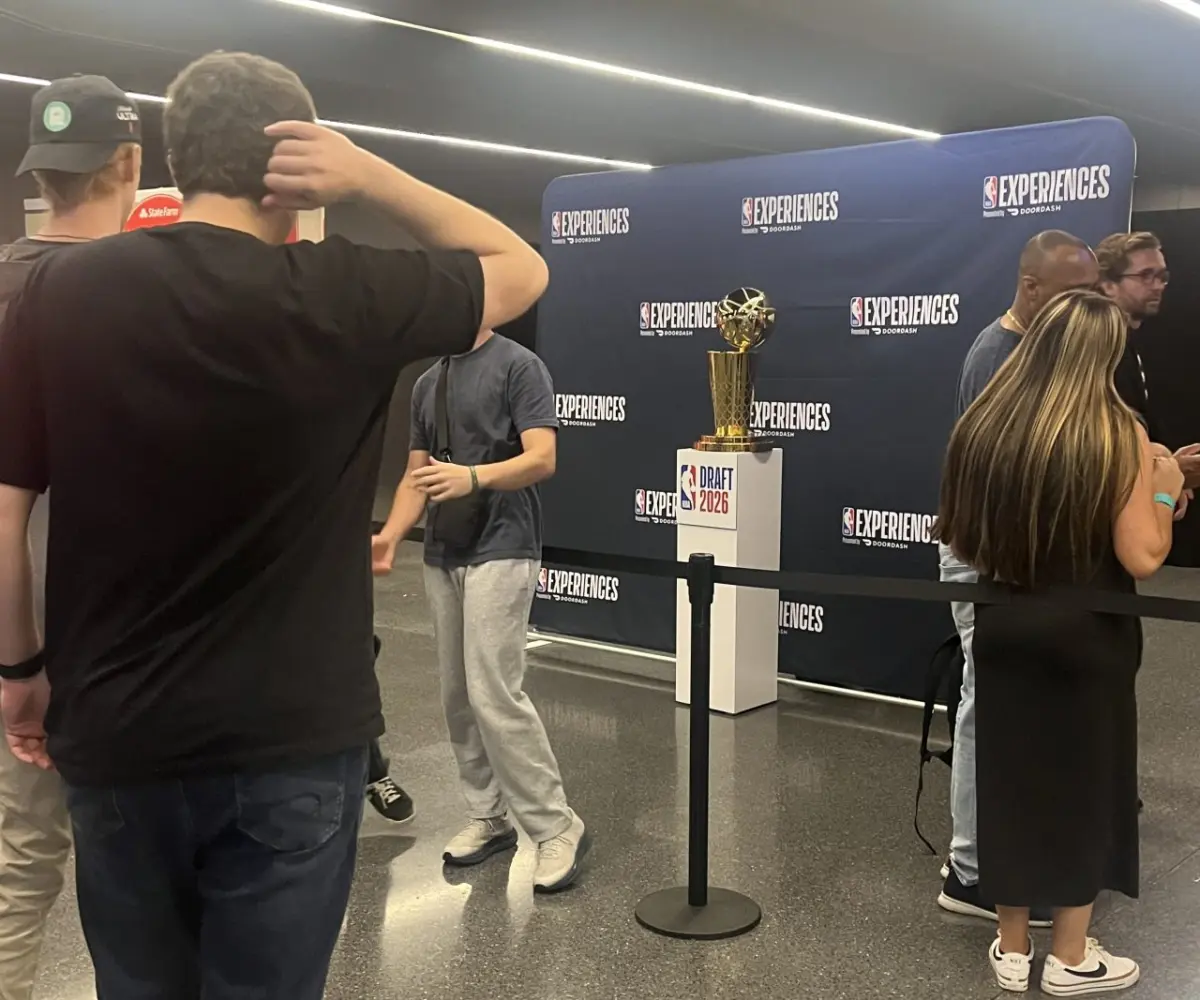
Walking through the security checkpoints of the Barclays Center on draft night reveals a profound ontological shift: the fan is no longer merely a spectator; the fan is the primary product. The concourses are transformed into immersive, corporate-sponsored activations designed to generate digital engagement.
- The Glass-Box Trophy: Fans wait in serpentine lines—curated by corporate partners like DoorDash—to pose with replica Larry O’Brien Championship Trophies or marvel at a display case purportedly housing the Rookie of the Year award.
- Funko Pop Economies: Attendees chase exclusive merchandise, such as branded "Jake From State Farm" vinyl collectibles, blending pop-culture ubiquity with insurance marketing.
- The Gemini Cam and AR Interactivity: Jumbotron activations digitally transmute audience members into animals or virtual athletes, prioritizing self-referential media generation over collective athletic appreciation.
Official Statements and Industry Perspectives
The structural transition of the league is underscored by shifting philosophies among executives, agents, and journalists. While front-office personnel maintain public optimism regarding lottery reforms, league insiders privately acknowledge the end of an era defined by calculated uncompetitiveness.
The cultural evaporation of traditional sports journalism was famously encapsulated by veteran news-breaker Adrian Wojnarowski prior to his retirement in 2024. Reflecting on the relentless, 24/7 news cycle and the transactional nature of modern access reporting, Wojnarowski remarked:
"Nobody gives a shit. Nobody remembers in the end. It’s just vapor."
His departure cleared the path for a new generation of digital-native reporters. Shams Charania, operating under the intense klieg lights of modern multi-platform sports broadcasting, represents the vanguard of this evolution. Stationed at a dedicated desk off the main analysis floor with a specialized camera trained exclusively on his screen, Charania’s role exemplifies the shift from game analysis to real-time information brokerage. However, this hyper-connected ecosystem—deeply intertwined with sports betting monoliths like FanDuel—has raised persistent concerns regarding market manipulation, the verification speed of breaking reports, and the erosion of traditional journalistic distance.
Future Outlook: The NBA as a Soap Opera
As the league prepares to implement its anti-tanking lottery reforms next season, the fundamental nature of NBA fandom continues to migrate away from the 82-game regular-season schedule. The sport has successfully positioned itself as a high-velocity, year-round soap opera, where player empowerment, trade rumors, social media psychodramas, and front-office intrigue frequently eclipse the games on the court.
When star players sit out regular-season contests due to soft-tissue management protocols, and opponents actively conspire to lose for lottery positioning, the audience’s attention naturally drifts toward the digital gossip economy. Trade demands by superstars like Giannis Antetokounmpo generate more cultural gravity than late-winter matchups between rebuilding squads.
Yet, amidst the corporate activations, the frantic texting of insider journalists, and the algorithmic noise of modern sports entertainment, moments of pure, unadulterated fandom persist. Whether it is young supporters meticulously tracking their personal "Big Boards" to celebrate a sleeper draft selection like Yaxel Lendeborg, or fans navigating the anarchic, unmarshalled energy of the stadium concourse, the underlying passion for the sport endures.
As the lights dim inside the Barclays Center and the final draftees exit into the New York night, the collective hope resets. For franchises like the Wizards, Jazz, Nets, and Bulls, the calculus of failure is about to change forever. The long, difficult road out of the basement toward competitive light remains arduous, but the promise of a blank slate—unencumbered by the explicit mandate to lose—offers a compelling horizon for the league’s next chapter.




Comments
Facebook App ID not configured. Please add it in the Customizer.