
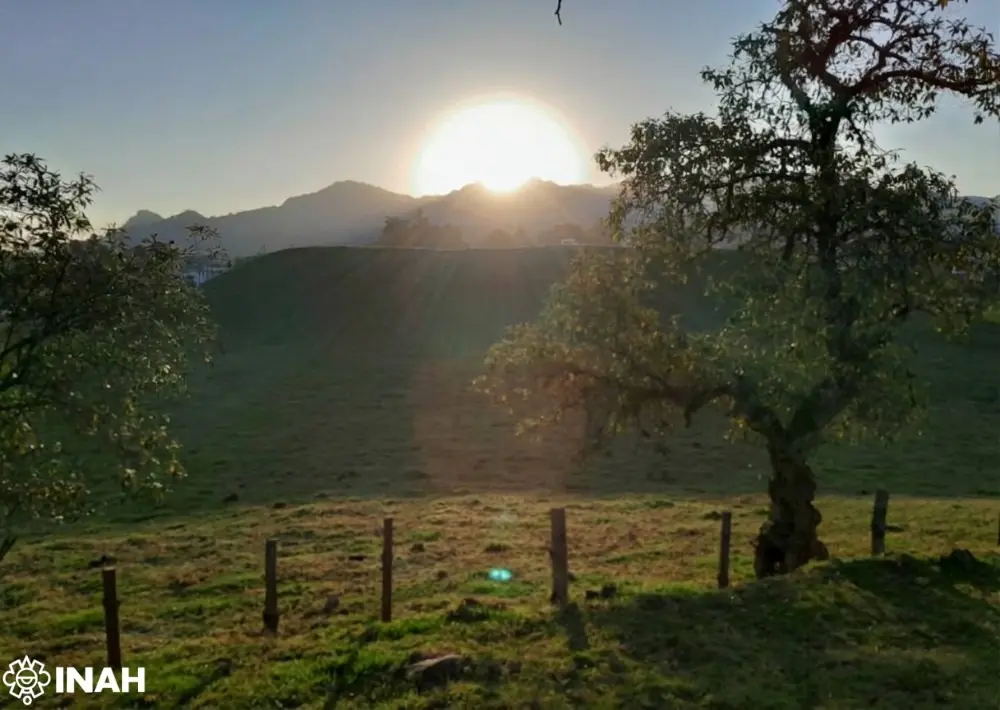
MEXICO CITY — In a monumental breakthrough that deepens our understanding of pre-Hispanic scientific prowess, researchers at Mexico’s National Institute of Anthropology and History (INAH) have officially announced the discovery of a sophisticated, 2,500-year-old solar observatory. Uncovered within the Teteles de Ávila Castillo archaeological zone in the rugged Sierra Norte de Puebla, this ancient architectural marvel reveals a society deeply attuned to the rhythms of the cosmos, employing advanced astronomical calculations to structure its religious, agricultural, and civic life.
The find not only illuminates the complex engineering capabilities of Mesoamerican architects during the Middle Preclassic period but also redefines the historical geography of ancient trade networks, regional power dynamics, and cultural exchanges that shaped the region millennia before the rise of the Aztec Empire.
Executive Overview
The newly identified solar observatory is situated within the expansive, multi-component archaeological site of Teteles de Ávila Castillo, nestled in the highlands of Puebla, Mexico. According to INAH researchers, the structure dates back approximately two and a half millennia, anchoring its origins deep within the Middle Preclassic period (spanning roughly 900 BCE to 600 BCE).
Read Also
The observatory’s architectural layout was meticulously engineered to track celestial events. By utilizing precise alignments with the rising sun, the ancient builders designed the eastern base of the complex to function as a monumental solar calendar. This enabled inhabitants to mark crucial agricultural and ritual transitions, such as the dawn of the Mesoamerican calendar year in February and the vital harvest season in October.
The excavation project, which has been methodically advanced by INAH teams since 2015, is led by archaeologist Alberto Diez Barroso Repizo. Alongside insights provided by Mexico’s Secretary of Culture, Claudia Curiel de Icaza, the discovery is being hailed as a transformative milestone in Mesoamerican archaeology—one that proves early highland societies possessed a profound, codified understanding of solar mechanics integrated directly into their ceremonial architecture. Plans are currently underway to preserve the site, conduct further excavations, and ultimately open both the ruins and a dedicated on-site museum to the global public.
Detailed Chronology and Excavation History
The Genesis of Teteles: The Middle Preclassic Period
To truly appreciate the significance of the solar observatory, historians must look back to the origins of the Teteles de Ávila Castillo settlement. Archaeological stratigraphy indicates that the site flourished primarily during the Middle Preclassic period, between 900 BCE and 600 BCE. During this foundational era of Mesoamerican civilization, small agrarian communities were rapidly evolving into complex, stratified societies characterized by monumental architecture, centralized religious authority, and emerging trade networks.
The builders of Teteles selected a strategic geographic vantage point in the Sierra Norte de Puebla, a mountainous terrain that offered natural defensive advantages and proximity to vital overland transportation corridors. For centuries, the site served as a vibrant regional hub where spiritual practices and scientific observations converged.
The Shifting Tides of Regional Power (circa 100 CE)
Despite its early prominence, Teteles de Ávila Castillo did not remain a dominant power indefinitely. Around 100 CE, the settlement experienced a significant decline. Archaeological indicators suggest that this waning influence was heavily tied to geopolitical shifts within the broader Mesoamerican landscape—specifically, the explosive expansion and hegemony of nearby Cantona, a massive, heavily fortified urban center that grew to dominate the region.
As Cantona’s sphere of influence widened, smaller surrounding polities like Teteles either adapted, were subjugated, or were gradually abandoned as populations migrated toward more powerful economic centers. Yet, the physical legacy of Teteles remained preserved beneath centuries of overgrowth, waiting for modern archaeological techniques to bring its hidden secrets back to light.
The Modern Era: Decades of Discovery (2015–Present)
The path to uncovering the solar observatory has been a labor of meticulous scientific dedication. INAH launched the official archaeological project at Teteles de Ávila Castillo in 2015, placing it under the direction of Alberto Diez Barroso Repizo. Over the past decade, Diez and his multidisciplinary team of archaeologists, epigraphers, and archaeoastronomers have worked painstakingly to clear vegetation, stabilize crumbling masonry, and map the complex spatial layout of the zone.
The breakthrough identification of the solar observatory did not happen overnight; it was the culmination of years of structural analysis, topographic mapping, and astronomical modeling. By tracking how sunlight interacts with the architecture during solstices and equinoxes, researchers were able to confirm the true purpose of the eastern structural base, transitioning the site from a standard civic-ceremonial zone into a recognized scientific landmark of the ancient world.
Supporting Context, Metrics, and Material Culture
Archaeoastronomical Sophistication
The discovery of the Teteles observatory underscores a fundamental truth about ancient Mesoamerican civilizations: science, religion, and agriculture were inextricably linked. The inhabitants did not view the cosmos as separate from their daily survival; rather, the movements of the sun dictated the survival of the community.
According to technical statements released by INAH, the structural alignment of the observatory is remarkably precise. The eastern base acts as a physical solar calendar. During the onset of the equinoxes and solstices, the front of the structure aligns flawlessly with the trajectory of the rising sun. This alignment allowed ancient priests and astronomers to announce critical temporal milestones to the populace:
- February: Signaling the dawn of the Mesoamerican ritual and agricultural calendar year, preparing communities for the clearing and planting of fields.
- October: Marking the culmination of the agricultural cycle and the beginning of the harvest season, inspiring communal feasts and thanksgiving rituals.
Trade Networks and Material Evidence: The Teotihuacan Connection
Beyond its astronomical functions, Teteles de Ávila Castillo served as a vital node in ancient Mesoamerican commerce. Because the archaeological site is situated along a historic trade route, its inhabitants engaged in extensive economic exchanges with larger, more powerful urban centers across the highlands.
A critical piece of physical evidence supporting this trade network is the discovery of green obsidian beads at the site. Green obsidian is a distinct, highly prized volcanic glass that holds immense archaeological significance in Mesoamerica. Geological sourcing confirms that this material originated from a specific quarry controlled exclusively by Teotihuacan—the massive, influential metropolis located in the Valley of Mexico.
The presence of green obsidian beads at Teteles de Ávila Castillo provides tangible proof that, despite its earlier decline around 100 CE and its geographic distance from the sprawling urban core, Teteles maintained long-distance economic and diplomatic ties with Teotihuacan during periods of its occupation, validating its status as an important regional trade station.
Official Statements and Academic Perspectives
The announcement of the 2,500-year-old solar observatory has generated widespread acclaim within the international archaeological community and high-ranking cultural ministries in Mexico.
Claudia Curiel de Icaza, Mexico’s Secretary of Culture, emphasized the profound cultural weight of the discovery during a national address. She noted that unearthing such sophisticated astronomical infrastructure fundamentally expands our collective understanding of pre-Hispanic history and intellectual achievement.
"The architecture of Teteles de Ávila Castillo tells us about societies that developed advanced astronomical knowledge and incorporated it directly into the organization of their ceremonial spaces," Curiel de Icaza stated. "This discovery reminds us of the intellectual depth and scientific rigor of our ancestors, whose legacy continues to shape our national identity."
Echoing these sentiments, Alberto Diez Barroso Repizo, the director of the Teteles archaeological project, provided detailed insights to academic outlets regarding the settlement’s historical arc. Diez highlighted how the convergence of trade routes, obsidian artifact analysis, and architectural orientation paints a vivid portrait of a dynamic, interconnected highland society that bridged the gap between the Middle Preclassic era and later classical Mesoamerican civilizations.
Future Outlook: Preservation, Research, and Public Access
As the initial excitement surrounding the INAH announcement settles into rigorous, ongoing fieldwork, the roadmap for the Teteles de Ávila Castillo archaeological site enters a transformative new phase. The primary objectives moving forward encompass three main pillars: preservation, academic expansion, and public integration.
Conservation and Continued Excavation
With portions of the solar observatory and surrounding residential and ceremonial compounds now exposed to the elements, immediate conservation efforts are paramount. INAH conservators are implementing cutting-edge preservation techniques to stabilize ancient stucco, stone masonry, and earthen platforms against weathering, erosion, and seismic activity typical of the Puebla region. Simultaneously, archaeologists plan to expand trenching operations around the periphery of the observatory to search for residential quarters, elite burials, and additional artifact caches that may yield further clues regarding the daily lives of Teteles’ ancient inhabitants.
Opening the Site and Museum to the Public
In alignment with INAH’s broader mandate to democratize cultural heritage and promote educational tourism, Director Alberto Diez Barroso Repizo confirmed that plans are actively underway to open the Teteles de Ávila Castillo site to the general public.
To facilitate this, regional authorities are coordinating the development of a dedicated on-site museum. This facility will house artifacts recovered during the decade-long excavation—most notably the prized green obsidian beads, ceramic fragments, and astronomical tools—allowing visitors to contextualize the ruins they explore. By integrating sustainable tourism infrastructure, the project aims to boost the local economy of the Sierra Norte de Puebla while offering travelers an immersive window into the scientific brilliance of pre-Hispanic Mexico.
As researchers continue to decode the alignments etched into the stone monuments of Teteles, the ancient skies above Puebla are once again revealing the profound wisdom of those who watched them two and a half millennia ago.




Comments
Facebook App ID not configured. Please add it in the Customizer.