
Executive Overview
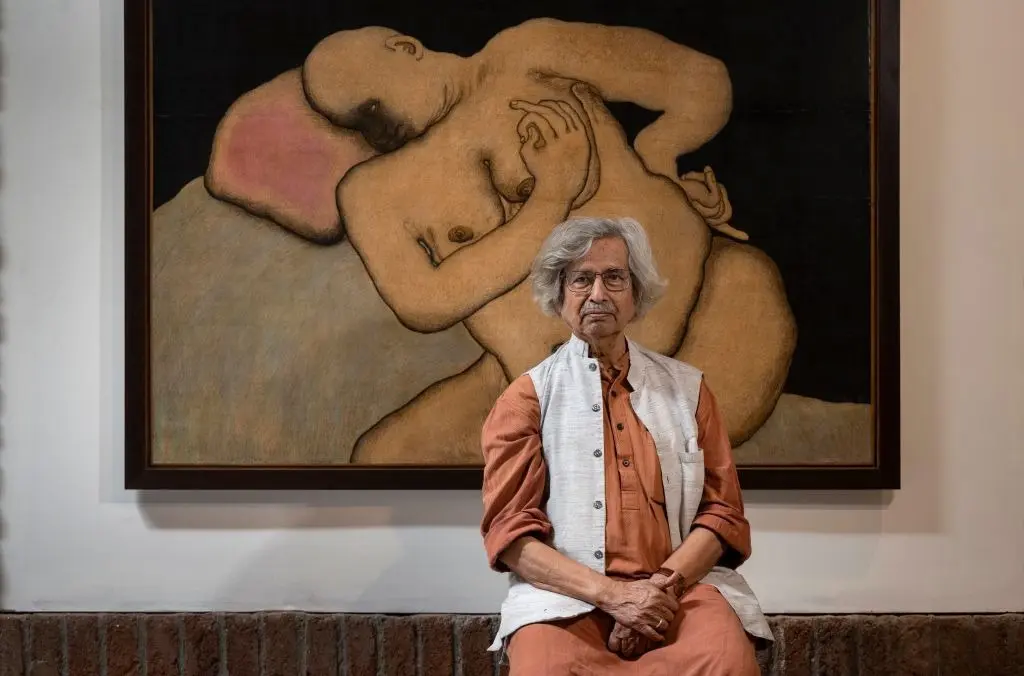
Jogen Chowdhury, one of India’s most visionary and enduring modern painters, whose figurative works offered a profound, visceral exploration of humanity, passed away on October 25 at a hospital in Kolkata. He was 87 years old. According to local media reports, Chowdhury had been battling a rare blood cancer for over a year, a private struggle he carried on with the same quiet resilience that characterized his artistic journey.
Chowdhury’s death marks the closing of a monumental chapter in the annals of South Asian art history. Straddling the worlds of traditional Indian aesthetics and European modernism, Chowdhury carved out a distinct visual vocabulary. He was internationally celebrated for his mastery of line work, his distinctive cross-hatching techniques, and his ability to translate the complex internal states—the anxieties, vulnerabilities, and quiet dignities—of ordinary people onto canvas and paper. His works were not merely representations of the human form; they were psychological landscapes that invited viewers to confront their own innermost truths.
Tributes from political leaders, cultural institutions, and fellow artists have flooded social media and news outlets. West Bengal Chief Minister Suvendu Adhikari took to social media to eulogize Chowdhury as "a towering pillar of our cultural world," asserting that his artistic legacy would remain "immortal through the ages." Fellow Kolkata-based painter Samir Aich mourned his passing not only as a personal bereavement but as the fading of a vital link to the historic Bengal School of Art—a movement that sought to reclaim Indian artistic identity during the twilight of the British Raj.
Read Also
Beyond his contributions to the canvas, Chowdhury’s life was deeply intertwined with the civic and political fabric of India. From curating the art collection at the Rashtrapati Bhavan to serving as a Member of Parliament in the Rajya Sabha, he was an intellectual force who believed that art and society were inextricably linked. This comprehensive retrospective explores his formative years, his stylistic evolution, his illustrious career, and the indelible imprint he leaves on the global art community.
Detailed Chronology: From the Rivers of Undivided Bengal to the Global Stage
Formative Years and the Partition
Jogen Chowdhury was born on February 16, 1939, in the village of Daharpara, located in the Faridpur district of what was then undivided Bengal. He entered the world during a period of immense political and social turbulence, on the precipice of seismic historical shifts that would permanently fracture the geography and psyche of the subcontinent.
Chowdhury’s early life, however, was anchored in a rich creative environment. He often described an artistic, cultured upbringing that nurtured his latent talents. His mother was locally renowned for her exceptional skill in Alpana—traditional floor art created with rice paste, characterized by intricate, rhythmic linear patterns that would subtly influence Chowdhury’s mature style. His father was an accomplished painter and sculptor who introduced young Jogen to the fundamentals of visual arts.
This idyllic immersion in the arts was disrupted by the geopolitics of the era. The British colonial administration partitioned Bengal along religious lines in 1947, an event that unleashed widespread communal violence and displaced millions. Like countless families, Chowdhury’s family experienced the trauma of displacement, migrating from East Bengal (now Bangladesh) to the bustling, culturally vibrant city of Kolkata. This early exposure to displacement, upheaval, and the resilience of ordinary people would quietly infuse his artistic worldview, imbuing his later portraits with an enduring sense of empathy for the marginalized and the introspective.
Academic Training: Kolkata and Paris
In 1955, Chowdhury formally committed to his vocation by enrolling in the prestigious Government College of Art & Craft in Kolkata. During his time there from 1955 to 1960, he immersed himself in rigorous classical training, studying the nuances of drawing, painting, and composition. Yet, like many artists of his generation, he found himself navigating a curriculum that was heavily tilted toward Western academic realism—a legacy of colonial art education that often subordinated indigenous expressions to European traditions.
Seeking to expand his horizons and engage directly with the epicenter of Western modernism, Chowdhury traveled to France in the 1960s. He undertook advanced studies at the École Nationale Supérieure des Beaux-Arts in Paris. Living and working in Europe during a time of intense artistic experimentation allowed him to encounter Cubism, Surrealism, and abstract expressionism firsthand.
Crucially, rather than abandoning his roots in favor of pure European modernism, Chowdhury used his time in Paris to synthesize diverse global traditions. He observed how Western masters abstracted the human form, yet recognized that his own cultural heritage offered a vastly different, more tactile relationship with line and space. He returned to India in 1968 equipped with a refined, cosmopolitan vision that honored both his Bengali origins and his engagement with international avant-garde movements.
Curatorial Leadership and Political Engagement
Chowdhury’s influence extended far beyond his private studio. In 1972, he assumed the role of curator at the Art Gallery of Rashtrapati Bhavan, the official residence of the President of India in New Delhi. In this prestigious position, he was instrumental in curating and preserving a significant collection of contemporary Indian art, helping to shape the national narrative around modern visual culture.
Demonstrating a lifelong commitment to public service and cultural advocacy, Chowdhury stepped into the political arena late in life. In April 2014, he was elected to the Rajya Sabha—the upper house of the Indian Parliament—as a representative of West Bengal’s Trinamool Congress party. Serving a full six-year term until April 2020, he brought an artist’s sensitivity and ethical rigor to legislative debates, frequently advocating for the preservation of heritage sites, increased support for cultural institutions, and the welfare of working artists across India.
Supporting Context & Metrics: The Aesthetic of the Psyche
The Bengal School and the Reaction Against Western Realism
To fully appreciate Chowdhury’s artistic breakthrough, one must examine the intellectual and artistic ecosystem from which he emerged. The Bengal School of Art, which originated in Kolkata (then Calcutta) and Santiniketan during the British Raj, was spearheaded by figures like Abanindranath Tagore. Buoyed by the rising tide of the Indian Independence Movement, these artists sought to forge a distinctly national art style that rejected the dry, formulaic academic realism imposed by British art schools.
Instead, the Bengal School drew deep inspiration from classical Indian art forms, including Mughal and Rajput miniatures, Ajanta frescoes, pastoral folk traditions, and the seamless intermingling of history and mythology. Furthermore, the movement benefited from a thriving, pan-Asian cultural exchange involving Japanese modern artists and European intellectuals who visited Santiniketan.
Chowdhury maintained a lifelong association with Santiniketan, where he established a home. The distinctive red earth landscape of the region, with its stark contrasts, organic textures, and rustic simplicity, became a recurring motif in his mental and physical workspace.
Mastery of Line and Cross-Hatching
Art critics and historians have long marveled at Chowdhury’s technical virtuosity, particularly his revolutionary approach to drawing. While many modernists gravitated toward abstraction or vibrant color fields, Chowdhury remained fundamentally devoted to the human figure, albeit rendered in a deeply psychological, expressionistic manner.
His signature technique relied heavily on delicate, rhythmic ink work and dense cross-hatching. By layering fine lines across the contours of the body, he achieved a tactile, almost sculptural quality. His figures are often distorted—stretched, compressed, or warped—not out of a desire for mockery or caricature, but as a deliberate strategy to visualize internal psychic states. A slumped shoulder, a protruding eye, or a twisted torso served as emotional barometers, registering anxiety, alienation, desire, or quiet exhaustion.
Noted Indian art critic R. Siva Kumar once astutely observed the paradoxical nature of Chowdhury’s figures:
"The figures are wrought by a combination of decorative wilfulness and expressive distortion and are imbued with an effusive sensuality. Chowdhury’s art is rich in suggestions; it is to be apprehended without bracketing our fund of knowledge, experience or memories, but also cannot be narrativised without trivialising it, without depleting its sensory particularities."
This refusal to reduce his art to a simple narrative is what makes Chowdhury’s oeuvre enduringly powerful. His portraits—often featuring anonymous middle-class men and women, politicians, couples, and solitary figures—speak to universal human vulnerabilities. They capture the quiet dramas played out behind closed doors, away from the public gaze.
Honors, Accolades, and International Recognition
Throughout a career spanning more than six decades, Chowdhury’s contributions to modern art earned him widespread critical acclaim and numerous prestigious awards, both in India and abroad.
- 1966: Awarded the Prix de la Jeune Peinture in Paris, signaling his early international promise.
- 1986: Received formal recognition at the Second Havana Biennial in Cuba, cementing his status on the global stage alongside peers from the Global South.
- 2001: Honored with the Kalidas Samman by the Government of Madhya Pradesh, one of India’s highest civilian awards for artistic excellence.
- 2012: Conferred the Banga Bibhushan by the Government of West Bengal, the state’s highest civilian tribute, in recognition of his lifetime dedication to the region’s cultural heritage.
Official Statements and Tributes
The passing of Jogen Chowdhury triggered an outpouring of grief and reverence from across the political and cultural spectrum, reflecting his status as a unifying figure in Indian public life.
West Bengal Chief Minister Suvendu Adhikari shared his condolences on X (formerly Twitter), writing that Chowdhury was "a towering pillar of our cultural world," whose profound artistic vision and deep humanity would ensure his legacy remains "immortal through the ages."
Prominent Kolkata-based painter Samir Aich articulated the collective grief of the artistic fraternity, describing Chowdhury’s death as a deeply "personal loss." Aich noted that Chowdhury’s passing symbolizes the closing of a chapter on the historic lineage of artists shaped by the ideals of the Bengal School and the humanist traditions of Santiniketan.
Cultural institutions across India have announced plans for retrospective exhibitions and memorial lectures to honor his memory, ensuring that future generations of artists continue to engage with his rigorous draftsmanship and empathetic worldview.
Future Outlook: Preserving a Humanist Legacy
As the art world mourns the loss of Jogen Chowdhury, curators, historians, and collectors are turning their attention to the long-term preservation and institutional study of his vast body of work. Chowdhury’s oeuvre—encompassing pen-and-ink drawings, pastel works, oil paintings, and mixed-media compositions—resides in major museums, public galleries, and private collections around the globe, including the National Gallery of Modern Art in New Delhi.
The challenge ahead lies in introducing younger generations of global audiences to the subtleties of his visual language. In an era dominated by digital media and hyper-fast visual consumption, Chowdhury’s deliberate, meditative cross-hatching and his insistence on confronting the quiet complexities of the human soul offer a vital counter-narrative. His works remind us that art’s highest calling is to bear witness to the interior lives of ordinary people.
Institutions in Kolkata and Santiniketan are reportedly exploring initiatives to catalog his unpublished sketches, correspondence, and studio notes, ensuring that scholars have access to the inner workings of his creative mind. Furthermore, educational programs inspired by his techniques are being planned to foster draftsmanship among emerging artists.
Jogen Chowdhury may have left the physical plane at the age of 87, but the world he conjured through his ink lines and textured canvases—a world of delicate vulnerability, fierce psychological honesty, and profound empathy—remains vibrantly alive. His brushstrokes continue to speak across generations, echoing the timeless truth that to be human is to be complex, flawed, and infinitely worthy of contemplation.


Comments
Facebook App ID not configured. Please add it in the Customizer.