
Executive Overview
In the literary landscape of the past two decades, a quiet revolution has been taking shape between the margins. A growing cadre of novelists, poets, and experimental prose stylists—pioneered by figures such as Claudia Rankine, Teju Cole, and Anne Carson—have increasingly rejected the traditional tyranny of pure text. By embedding photographs, anatomical drawings, scanned documents, and even sheet music directly into their narratives, these writers are forging a hybrid aesthetic. Far from acting as mere decorative ornaments or passive visual rest stops for the reader’s eye, these images function as active participants in a dynamic, cross-media dialogue.
This article explores the mechanics, history, and evolving strategies of writing with images. Drawing from critical literary models—ranging from the foundational melancholy of W.G. Sebald to the aggressive text-collages of Anne Carson and the structural experiments of contemporary novelists—we examine how visual elements can anchor a narrative, stand up to prose, complicate the act of reading, and ultimately unlock profound emotional resonance. For contemporary authors willing to look beyond the boundaries of convention, the integration of text and image represents a vast, largely uncharted frontier in storytelling.
Detailed Chronology: From Early Pioneers to Modern Hybrids
While the contemporary surge of illustrated fiction often feels like a radical break from tradition, its lineage is deeply rooted in literary history, evolving through distinct phases of experimentation and technical adaptation.
Read Also
The 19th Century and Surrealist Precedents
While modern literary criticism frequently points to the mid-20th century as the genesis of visual fiction, literary historians like Paul Edwards trace the practice much further back. Throughout the 19th century, serialized novels and gothic tales occasionally experimented with frontispieces and inserted plates. However, it was the Surrealist movement that first weaponized the juxtaposition of image and text to disrupt linear logic. André Breton’s pioneering works incorporated photographs and drawings not as illustrations of a stable reality, but as psychic disruptors designed to challenge the reader’s perception.
The Sebaldian Paradigm (Late 20th Century)
For most modern writers, the undisputed model for integrating images into serious fiction is the German author W.G. Sebald. A generation of academics and novelists has been deeply influenced by Sebald’s signature aesthetic: grainy black-and-white photographs, vintage postcards, and ephemera culled from newspapers and magazines, embedded within narratives of wandering, memory, and loss.
Sebald meticulously calibrated the placement of his images. Utilizing what can be termed "the anchor"—a deliberate spatial relationship where an image’s textual identification is set precisely two lines away—Sebald ensured a seamless reading experience. By avoiding traditional captions or titles, he created a rhythm where the reader moves smoothly from prose into the image and back out again, experiencing a continuous narrative flow briefly suspended by a visual echo. Writers such as Orhan Pamuk (Istanbul), George Sirtes (The Photographer at Sixteen), and Teju Cole (Blind Spot, utilizing high-resolution color photography) have all built upon this Sebaldian foundation.
The Contemporary Explosion (2000s–Present)
Over the last twenty years, the availability of desktop publishing, digital scanning, and high-resolution layout software has democratized the process of hybrid book design. Authors are no longer at the mercy of traditional publishing houses’ rigid typesetting limitations. Today’s practitioners—including Monica Ong, Alexander Kluge, Gerhard Richter, Jacques Roubaud, and James Elkins—are pushing past Sebald’s subtle, ghostly integration. They are deploying strong, aggressive images that talk back to the prose, transforming the page into a multimodal canvas where words and pictures engage in an ongoing, sometimes adversarial conversation.
Supporting Context & Metrics: Strategies of Visual-Textual Integration
Integrating images into a literary work is deceptively simple from a technical standpoint, but fraught with aesthetic peril. A poorly managed image can alienate a reader, undermine the authority of the prose, or be dismissed as an empty stylistic gimmick. Through an analysis of several contemporary masterworks, several distinct strategies emerge for successfully harmonizing text and image.
1. Strong Images That "Talk Back"
The risk of Sebald’s approach is that readers may breeze past the grainy photographs, treating them as atmospheric ornaments. To counteract this, some authors deploy images with overwhelming visual force.
In Monica Ong’s poetry collection Silent Anatomies, the physical book becomes a museum of diaspora, memory, and anatomical trauma. Opening with an anatomical drawing of a larynx whose parts are labeled with poetic fragments ("lips part," "disrupt," "the rapture of"), Ong pairs poems with X-rays, invented medical product labels, and botanical collages. A standout double-page spread pairs the poem "Etymology of an Untranslated Cervix" with a surreal photograph looking up a pelvis besieged by pine trees and a buzzing helicopter. The image does not merely illustrate the poem; it stands up to the prose, forcing the reader to halt, linger, and actively decode the tension between the clinical and the poetic.
2. The Danger of Literalism and the Henry James Solution
Authors working with photography immediately confront a fundamental challenge: photographs are inherently specific, concrete, and "vivid" instances of reality.
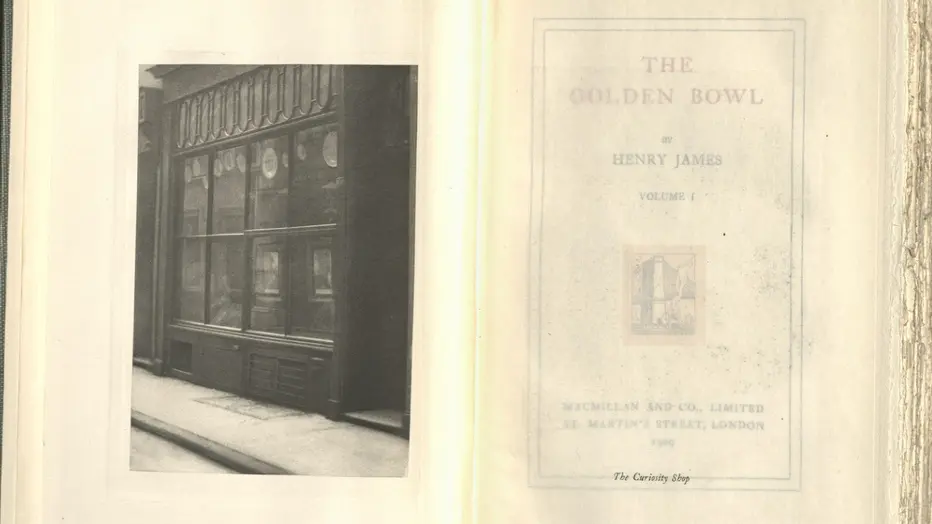
When Henry James collaborated with photographer Alvin Langdon Coburn for the frontispieces of the New York edition of his novels, they faced this exact dilemma. Walking the streets of London, James and Coburn sought locations that could evoke the atmosphere of novels like The Golden Bowl without being overly specific. James worried that a too-recognizable photograph would yank the reader out of the psychological interior of the fiction and cast them onto the literal sidewalks of London.
This tension explains why many fiction writers favor gray, out-of-focus, or generic images. Conversely, if an author uses drawings or artwork, readers immediately begin to question the artifact’s provenance: Did a character draw this? When did they have time? Is this supposed to be the author’s own amateur sketching? James resolved this by keeping his discussions of Coburn’s photography entirely separate from the novels themselves, preserving the sanctity of the narrative illusion.
3. Disconnected and Disjunctive Images
Another strategy is to deliberately sever the link between text and image, creating an atmosphere of estrangement. In December, a collaboration between writer-director Alexander Kluge and artist Gerhard Richter, Richter’s contributions consist entirely of photographs of snowy forests. While some of Kluge’s prose touches upon wintry themes, many entries have no direct connection to the imagery. The resulting book is stark and beautiful, producing a profound sense of loneliness—not only because of the subject matter, but because the two creators appear to have worked in absolute isolation from one another.
4. Directing the Reader Back and Forth
While Sebald preferred a linear reading experience where images are glimpsed and left behind, prose can also mimic the mechanics of poetry or museum-going, where the audience is repeatedly forced to shuttle between text and image.
In James Elkins’s Stories, Like Illnesses, a narrator describes the complex, sponge-like underside of boletus mushrooms, comparing their intricate, labyrinthine structures to a mother’s complex mind. Paired with a close-up photograph of the mushroom cap, the text triggers a mild sense of visual vertigo. The reader reads the description, looks down at the photograph, and then returns to the text with a newly informed perspective, establishing a rhythmic, iterative engagement.
5. Using Texts as Images
In Anne Carson’s monumental work Nox—an elegy for her estranged brother—text itself becomes an image. Constructed as an accordion book, Nox blends family memories with philological meditations on a single Latin poem by Catullus mourning his own brother. Carson presents dictionary-style analyses of individual Latin words as scanned, torn-out printouts glued directly onto the page alongside fragmented letters and photographs. The physical labor of cutting, taping, scanning, and tearing mirrors the agonizing, fractured work of mourning, transforming the book’s physical artifacts into visceral emotional expressions.
Official Perspectives & Industry Insights
As the field of multimodal literature expands, literary theorists, critics, and creator-practitioners are grappling with the implications of merging visual art with narrative prose.
According to literary historian Paul Edwards, the history of illustrated fiction is not a linear progression, but rather a series of recurring reinventions. Because fewer than a thousand works of fiction featuring photographs have been published over the last century—often written by authors unaware of previous precedents—writers frequently find themselves reinventing the wheel. Platforms such as writingwithimages.com and Terry Pitts’s Vertigo blog (sebald.wordpress.com) have emerged as critical archives, housing massive bibliographies and extended analyses for contemporary practitioners.
Critics and educators alike emphasize that the cardinal sin of illustrated fiction is the tentative image. Many contemporary novelists incorporate photographs half-heartedly—tucking them into a single chapter, isolating them like frontispieces, or scattering them so sparingly that readers feel entirely justified in ignoring them.
As seen in works like Ali Smith’s Artful or Jonathan Safran Foer’s Extremely Loud & Incredibly Close, marginal or timid image placement often signals a lack of commitment. In contrast, works that fully integrate visual material—treating the layout, typography, and image as foundational architecture rather than supplementary decoration—achieve a much higher level of artistic coherence. As scholar Marjorie Perloff notes in her analyses of difficult modernist and postmodern texts, the visual layout of a page (even when deliberately jarring or misaligned, as in Susan Howe’s The Midnight) communicates subtext, trauma, and editorial intent that raw text alone cannot convey.
Future Outlook: The Uncharted Territory of Visual Prose
The territory where literature and visual art intersect remains vast, wild, and largely unmapped. As digital publishing tools become more sophisticated and printing costs for mixed-media projects decline, the coming decade is poised to see an explosion of hybrid storytelling.
Future writers are no longer constrained by the traditional boundaries separating the novelist from the photographer, the typographer, or the conceptual artist. Whether through the inclusion of mathematical diagrams, architectural blueprints, silent sheet music, or live-feed webcam captures embedded directly into psychological thrillers, the potential for cross-modal storytelling is virtually limitless.
Ultimately, the advice for contemporary writers stepping into this space is clear: be bold. Avoid the trap of the decorative, easily ignorable image. Treat your visual elements not as passive windows into the text, but as active interlocutors. When an author successfully bridges the gap between language and image, the resulting conversation between page and picture can be deeply surprising, mesmerizing, and transformative—proving that sometimes, the most powerful way forward for fiction is to look closely at what is placed right beside the words.

Comments
Facebook App ID not configured. Please add it in the Customizer.