
Executive Overview
Few narrative devices evoke as much instant engagement—or run the risk of alienating an audience quite as quickly—as the traditional literary love triangle. When executed with precision, a divided heart transforms a standard romance or drama into a page-turning exploration of human desire, identity, and sacrifice. However, the construct collapses the precise moment readers recognize that one romantic lead is merely a narrative placeholder, standing idly in the way of an inevitable, pre-destined union.
To maintain tension, an author must do more than simply introduce a second suitor; they must construct two distinct, highly viable futures.
Drawing from insights surrounding the release of her novel The Love Operation, author Melissa R. Collings highlights the emotional sweet spot of crafting rival romances: the golden window where readers continually flip their allegiances, oscillating between candidates and feeling genuine psychological angst. This analytical report examines the underlying mechanics of writing successful love triangles, moving beyond cliché tropes and into the realm of relationship psychology, character chemistry, and narrative sacrifice. By establishing distinct chemistry, meaningful compatibility, mutual care, identity expansion, and heavy narrative costs, writers can transform a formulaic subplot into the emotional anchor of their entire manuscript.
Read Also
Detailed Chronology & Structural Evolution of the Love Triangle
Historically, the love triangle has evolved from a classical theatrical device—often utilized for comedic misunderstandings or tragic irony in Shakespearean drama—into a cornerstone of modern commercial fiction, spanning YA fantasy, contemporary romance, and literary suspense.
Phase 1: The Inciting Disruption
In the formative stages of a narrative, a love triangle typically begins with an established or emerging bond between a protagonist and a primary love interest (often labeled the "safe" choice or the initial catalyst). The disruption occurs with the introduction of the secondary suitor. Chronologically, this second figure must not arrive as a mere obstacle, but as a disruptive force that challenges the protagonist’s foundational assumptions about love and stability.
Phase 2: The Escalation of Ambiguity
As the narrative progresses through the middle acts, the author must carefully pace the interactions to prevent reader fatigue. If the protagonist bounces back and forth erratically without growth, the character appears flighty rather than conflicted. Successful pacing requires parallel development: as the connection with Suitor A deepens through shared adversity, the connection with Suitor B must similarly evolve through unexpected vulnerability or intellectual resonance.
Phase 3: The Point of No Return and Resolution
The climax of a well-constructed triangle is not merely the selection of one partner over another, but the realization that both paths are fully realized options. The chronology culminates in a moment of decisive action where the protagonist is forced to confront what they are willing to lose. The resolution validates one future while permanently closing the door on another, leaving the reader with a profound sense of emotional closure tempered by the bittersweet ache of the road not taken.
Supporting Context, Psychological Frameworks, and Core Strategies
To construct a love triangle that survives rigorous critical analysis, authors must lean heavily on psychological principles and structural discipline. The following five foundational pillars govern the execution of believable, high-stakes romantic rivalries.
+-------------------------------------------------------------------------+
|                  THE FIVE PILLARS OF THE LOVE TRIANGLE                  |
+--------------------------+----------------------------------------------+
| 1. Chemistry             | Distinct, non-interchangeable sparks         |
| 2. Compatibility         | Survivability on a "random Tuesday"          |
| 3. Actionable Care       | Mutual responsiveness and intimacy           |
| 4. Self-Expansion        | Different versions of the protagonist        |
| 5. Tangible Cost         | Genuine sacrifices attached to every choice  |
+--------------------------+----------------------------------------------+
1. Give Each Relationship Its Own Chemistry
Chemistry is frequently misinterpreted as a universal constant—a magnetic pull that a character inherently possesses. In effective storytelling, however, chemistry is emergent; it is a chemical reaction created uniquely between two specific entities.
- Sensory and Emotional Cues: On the page, readers experience chemistry through anticipation, nervous tension, micro-expressions, and the electric shift in atmosphere when a specific person enters a room.
- Differentiating the Sparks: The chemistry in each leg of a triangle must never be interchangeable. One dynamic might rely on effortless banter, shared humor, and playful teasing—a relationship built on comfort and ease. Conversely, the alternate dynamic might be electric, unpredictable, and marked by intense silences, lingering eye contact, and the heavy weight of unspoken words. If a reader can easily swap the dialogue tags between the two love interests without altering the scene’s dynamic, the chemistry has not been sufficiently individualized.
2. Establish Meaningful Compatibility
While chemistry explains why two characters want each other in the heat of the moment, compatibility explains why they could realistically exist together long after the initial rush of infatuation fades.
Shared hobbies or surface-level interests can spark an initial connection, but true literary compatibility dives deep into core values, ethical frameworks, and worldviews. Furthermore, an author must grant each potential couple an exclusive lens—something they recognize in one another that the rest of the world entirely misses.
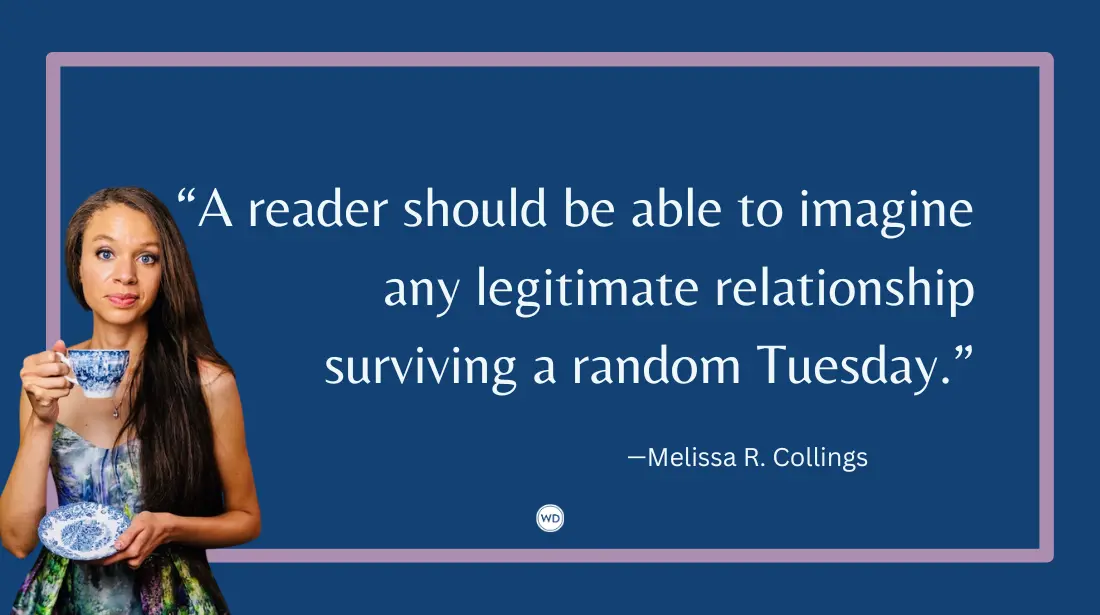
Crucially, the writer must provide glimpses of an ordinary life between the protagonist and each suitor. A reader should be able to visualize either legitimate relationship surviving a mundane, uneventful Tuesday afternoon. If a pairing relies entirely on high-stakes crisis mode to function, it lacks the structural integrity required for a long-term future.
3. Put Care Into Action
In contemporary relationship psychology, responsiveness—the profound feeling that another person actively understands, validates, and cares for us—is recognized as a primary driver of emotional intimacy. When a protagonist entrusts a suitor with a deeply guarded fear and receives genuine validation in return, the reader is provided concrete evidence of a maturing bond.
- Personalized Gestures: Each love interest must care for the protagonist in a way that feels uniquely tailored to their flaws and strengths. One suitor may instinctively recognize when the protagonist requires protection and shelter, whereas the other may recognize that protection is the ultimate insult, offering space and challenge instead.
- The Two-Way Street: Care must invariably travel in both directions. If the dynamic consists solely of two people performing grand, sweeping gestures to audition for the protagonist’s hand while the protagonist remains a passive prize, the narrative devolves into a hollow spectacle. True emotional reciprocity requires the protagonist to invest deeply in the well-being and emotional survival of both candidates.
4. Let Each Relationship Reveal a Different Self
This pillar draws directly from the psychological concept of self-expansion theory, which posits that humans possess a fundamental motivation to expand their potential, acquire resources, and broaden their identities through close relationships.
In compelling fiction, a romantic entanglement is magnetic not just because of the partner’s attributes, but because of what that partner unlocks within the protagonist.
- Divergent Identities: One romantic interest may tether the protagonist to history, familial comfort, emotional safety, or a discarded version of their youth that they once abandoned out of fear. The alternate interest may invite calculated risk, professional ambition, creative playfulness, or an expansive future the protagonist never previously dared to conceptualize.
- The Core Question: By anchoring the relationships to identity expansion, the central thematic question shifts entirely. It ceases to be a simplistic query of "Which person is right for me?" and evolves into a profound existential dilemma: "Which version of myself am I finally ready to become?"
5. Make Each Choice Cost Something
The ultimate structural failure of a weak love triangle is a zero-risk resolution. If one relationship clearly represents emotional health, stability, and future happiness, while the other represents toxicity, manipulation, or stagnation, there is no genuine triangle—only a delayed realization.
Choosing either path must demand a painful, meaningful sacrifice:
- The Cost of Belonging: Selecting one path might offer absolute security and community, but require the protagonist to permanently surrender a wild, long-held personal ambition.
- The Cost of Ambition: Selecting the alternative might offer radical growth and self-actualization, but demand that they leave behind the comforting roots and traditions of a life they once believed they wanted.
The losses do not need to be precisely balanced on a scale, but both must carry immense emotional weight. The final choice should not retroactively invalidate one relationship as a "mistake"; rather, it should clarify which specific truth, future, and sacrifice the protagonist has resolved to accept.
Official Statements and Authorial Insights
Reflecting on the psychological mechanics behind her novel The Love Operation, author Melissa R. Collings emphasizes that the truest metric of a successful love triangle is the psychological turbulence experienced by the audience.
"I knew I’d succeeded when readers began texting me that they were rooting for one man, then switching allegiance to the other," Collings notes, detailing the reader engagement process. "Their emotional angst was my reward. Even readers with a clear favorite understood the pull of both relationships."
Industry editors and literary critics frequently echo this sentiment, pointing out that modern audiences have grown weary of manipulative plotting where secondary characters are deliberately sabotaged by the author just to make the preferred choice look better. When an author treats all competing paths with intellectual and emotional respect, the resulting narrative achieves a level of resonance that lingers long after the final page is turned.
Future Outlook: The Evolution of Romance and Character Dynamics
As contemporary fiction continues to prioritize complex emotional internalities, psychological realism, and multifaceted character arcs, the tropes of genre fiction are undergoing a rigorous reinvention.
The days of the passive protagonist tossed helplessly between two interchangeable archetypes—such as the "safe best friend" versus the "dangerous bad boy"—are rapidly fading. Modern readers demand emotional autonomy, high-stakes communication, and genuine internal conflict. Future contributions to the romance, fantasy, and drama genres will likely lean even heavier into the psychological frameworks of self-expansion and relational responsiveness.
Ultimately, when a protagonist makes their definitive choice in a masterfully constructed love triangle, the reader should not feel a sense of smug vindication that the "obvious" winner finally crossed the finish line. Instead, they should feel the absolute rightness of the chosen future, balanced delicately against the poignant, lingering ache of the life that will never be lived. That precise ache is the ultimate proof that the triangle was real.




Comments
Facebook App ID not configured. Please add it in the Customizer.