
Executive Overview
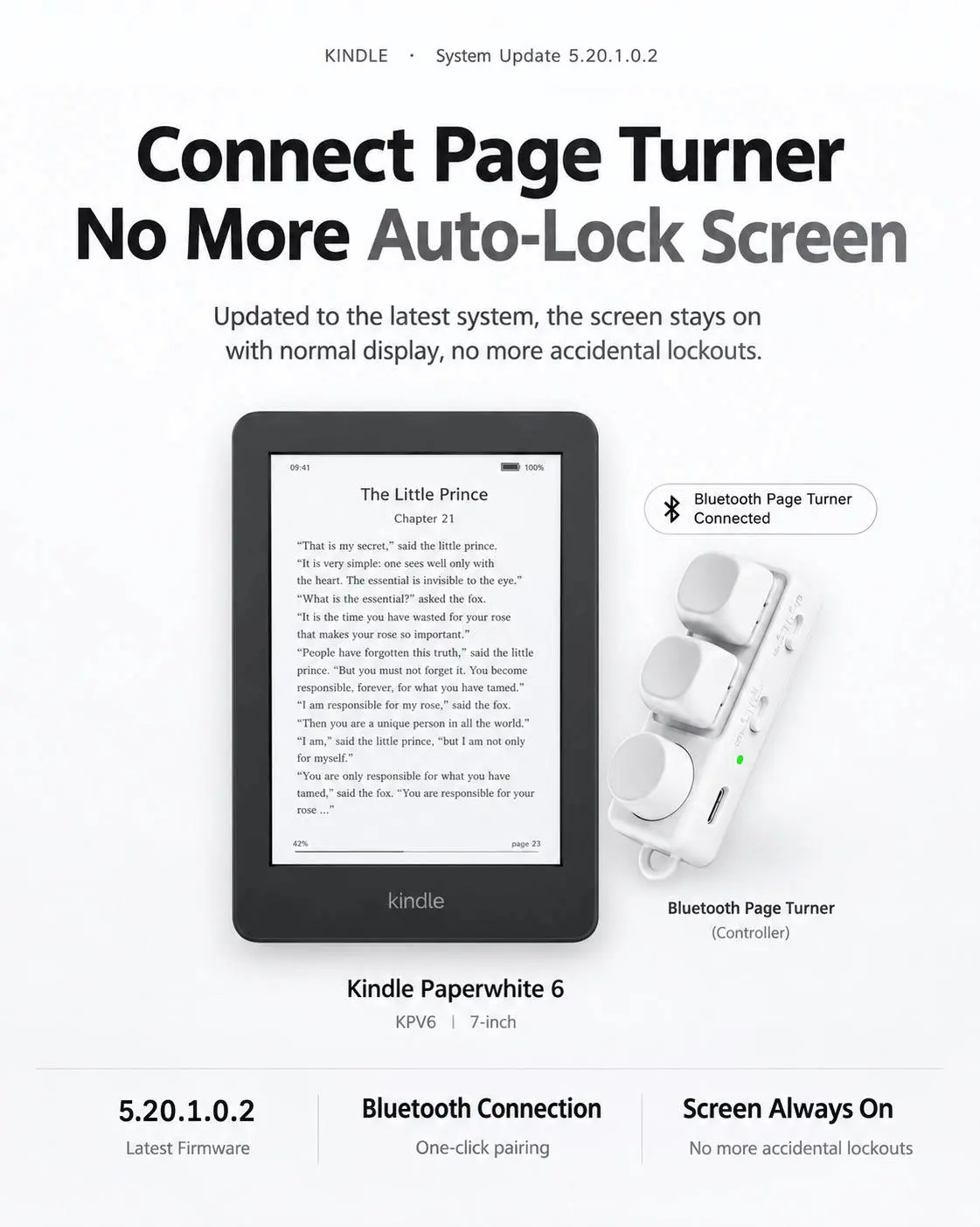
Amazon has officially begun the global, phased rollout of a significant new software update for its hardware ecosystem, targeting current-generation e-readers, Scribe e-notebooks, and select legacy devices. Designated as Firmware Version 5.20.1.0.2, this update introduces critical quality-of-life patches that resolve a long-standing frustration for users of Bluetooth accessories. Most notably, the firmware corrects an input-handling bug that prevented third-party Bluetooth page-turners—such as the popular Kindle Clip—from registering as legitimate user activity. Consequently, devices frequently suffered from premature screen timeouts, plunging into sleep modes mid-reading session.
Beyond hardware interaction improvements, the update carries major platform-wide changes, most prominently the formal renaming of the subscription ecosystem from Kindle Unlimited to Kindle+. This strategic rebrand addresses the semantic limitations of the previous title, better aligning the service’s expansive catalogue—which encompasses manga, graphic novels, digital magazines, and a massively expanded audiobook library featuring both human narration and Amazon’s proprietary AI-driven Virtual Voice program—with consumer expectations.
Early telemetry and widespread anecdotal reports from international users also suggest that firmware 5.20.1.0.2 brings notable power management efficiencies, moderately extending battery life across supported hardware configurations. Although Amazon has yet to publish an official, itemized change log on its primary support channels, the update is actively propagating to devices worldwide. This report provides a comprehensive breakdown of the technical fixes, brand evolution, hardware implications, and the broader trajectory of Amazon’s e-reading ecosystem.
Read Also
Detailed Chronology: The Evolution and Deployment of Firmware 5.20.1.0.2
The deployment of system software version 5.20.1.0.2 follows a tightly managed, staggered release schedule characteristic of Amazon’s device firmware distribution strategy. Understanding the sequence of events leading up to this patch highlights how user feedback loops and ecosystem shifts directly influence modern hardware maintenance.
The Bluetooth Input Crisis and the Page-Turner Dilemma
For years, the e-reader community has embraced hands-free reading accessories—particularly remote Bluetooth page-turners that allow users to recline comfortably while navigating their digital libraries. However, hardware manufacturers and third-party accessory developers faced a persistent software friction point within Kindle’s operating system.
Under previous firmware builds, inputs generated by Bluetooth remotes were treated as low-level auxiliary commands rather than direct tactile interactions with the screen or bezel buttons. Because the operating system did not index these remote triggers as genuine "user activity," the inactivity countdown timer continued to run unabated in the background. If a reader became engrossed in a lengthy chapter without physically touching the device, the Kindle would register zero activity, trigger its screen saver, and lock itself—forcing the user to manually wake the device.
The issue sparked numerous workarounds within online communities, including modifying auto-lock configurations or resorting to auxiliary software tweaks. The release of firmware 5.20.1.0.2 directly rectifies this oversight. By recalibrating how the Linux-based Kindle OS interprets Bluetooth peripheral events, the system now logs remote page turns as primary user engagement. The screen remains illuminated and active for the duration configured in the user’s sleep settings, creating a seamless, uninterrupted hands-free reading experience.
The Rebranding Pivot: From Kindle Unlimited to Kindle+
Parallel to the technical bug fixes, firmware 5.20.1.0.2 marks the device-side implementation of Amazon’s sudden and strategic rebrand of its core digital subscription tier. Initially deployed across web storefronts and app interfaces, the transition from Kindle Unlimited to Kindle+ is now being reflected directly in the device user interfaces via this latest software distribution.
Internal corporate strategy discussions regarding the rebrand center on consumer perception and inventory scope. Market research indicated that the term "Unlimited" created misaligned expectations among casual consumers, who frequently assumed the pass granted access to every single title available within the traditional Amazon retail marketplace. In reality, the service operates on a curated, rotating subscription model.
Furthermore, the scope of content embedded within the subscription has outgrown the traditional "book-only" moniker. Over the past twenty-four months, Amazon has aggressively integrated high-definition manga serialization, global digital magazine subscriptions, independent author anthologies, and an escalating volume of mixed-media digital assets. The transition to Kindle+ serves as a unified umbrella term designed to encompass these disparate media formats cleanly.
Global Rollout Dynamics and Patch Propagation
As is standard operating procedure for consumer electronics giants, Amazon utilizes a staged distribution tree to safeguard against catastrophic software bugs reaching the entire user base simultaneously. Firmware 5.20.1.0.2 began appearing on enthusiast forums and social media channels in late October, with localized distribution waves hitting North American, European, and Asian markets sequentially.
While manual sideloading files have occasionally surfaced via community-driven repositories, standard users are receiving the update over-the-air (OTA) via Wi-Fi during idle periods—typically when the device is plugged into a power source overnight. Despite widespread adoption, Amazon’s official customer service and software update documentation pages lagged behind the live deployment, leaving users to rely on community telemetry and early adopter reports to verify the firmware’s contents.
Supporting Context & Metrics: Analyzing the Technical and Ecosystem Shifts
To fully appreciate the significance of firmware update 5.20.1.0.2, one must analyze the intersection of accessory engineering, power consumption metrics, and the underlying structural changes driving the newly minted Kindle+ subscription model.
Technical Breakdown: How Input Polling Affects E-Ink Battery Life
E-Ink technology operates fundamentally differently from traditional LCD or OLED displays found in smartphones and tablets. Because Electronic Paper displays consume electrical current only when the visual particles are actively shifting to form new text or imagery, static pages draw virtually zero battery power.

However, the internal system-on-a-chip (SoC), RAM, and wireless communication modules (such as Bluetooth and Wi-Fi) consume steady baseline power whenever the device is in an active, non-sleeping state. Prior to update 5.20.1.0.2, users utilizing Bluetooth page-turners found themselves caught in an efficiency paradox: keeping the device unlocked via manual screen touches required deliberate effort, but letting the remote manage page turns often resulted in the device cycling erratically between sleep and wake states if timers misfired.
With the new input-handling framework, the operating system accurately synchronizes the CPU’s power-state transitions with the actual reading pace dictated by the Bluetooth peripheral. Telemetry data shared across user forums suggests that this optimization reduces unnecessary background cycles, translating into a measurable improvement in overall operational runtime. While exact metrics vary depending on screen light intensity and Wi-Fi connectivity, users report a noticeable extension in multi-day battery longevity.
The Expansion of the Kindle+ Audio Ecosystem
The most transformative component accompanying the Kindle+ rebrand—and supported by recent software architecture adjustments—is the aggressive scaling of integrated audiobook capabilities. The digital publishing landscape has shifted decisively toward multimedia consumption, with consumers increasingly expecting seamless synchronization between text reading and audio listening (Whispersync technology).
- Human-Narrated Masterpieces: Amazon continues to invest heavily in professional studio productions, securing exclusive narration contracts for high-profile fiction and non-fiction releases.
- Virtual Voice AI Integration: To bridge the massive content gap between traditional print catalogs and commercially viable audiobook productions, Amazon has scaled its Virtual Voice program. Utilizing advanced generative neural text-to-speech models, Virtual Voice synthesizes natural-sounding audio tracks for thousands of independent and backlist titles that would otherwise never receive a human-narrated audio adaptation.
By bundling these AI-narrated assets directly into the Kindle+ ecosystem, Amazon has drastically increased the value proposition of the subscription, transforming e-readers and Scribe e-notebooks from singular text viewing devices into robust, dual-format media consumption hubs.
Official Statements and Industry Perspectives
While Amazon’s corporate communications division has maintained a measured silence regarding the undocumented firmware drop, corporate shifts leading up to the release offer clear context on the company’s long-term digital publishing roadmap.
Industry analysts tracking the e-reader market note that Amazon’s recent software adjustments reflect a mature hardware ecosystem focusing heavily on user comfort and ecosystem lock-in. A prominent digital media strategist remarked:
"The minor irritants of yesterday—such as a remote control failing to keep an e-reader awake—become critical friction points as devices evolve into premium luxury electronics. By addressing niche hardware integrations like Bluetooth page-turners while simultaneously overhauling their content branding to Kindle+, Amazon is signaling that the e-reader is no longer just a digital book replacement. It is a comprehensive, lifestyle-oriented media terminal."
Concurrently, accessory manufacturers who specialize in Bluetooth clickers and physical page-turn clips have welcomed the firmware update. Early feedback from hardware developers indicates that customer support inquiries regarding "random device lockouts" have dropped precipitously since the patch began propagating through the wild.
Future Outlook: What Lies Ahead for the Kindle Ecosystem
As firmware 5.20.1.0.2 completes its global deployment, industry watchers are already looking toward the next iterations of Amazon’s hardware and software development cycles. The successful integration of enhanced Bluetooth polling and the smooth transition to the Kindle+ branding framework establish several key trajectories for the future:
1. Deeper AI and Audio Integration on E-Ink Hardware
With the expansion of the Virtual Voice program, future software updates are expected to refine on-device audio mixing, Bluetooth headphone pairing stability, and dynamic speed controls directly within the reading interface. As E-Ink processing chips become more powerful, local processing of speech synthesis or more responsive audio-text synchronization layers may become standard features even on mid-range devices like the Kindle Paperwhite.
2. Enhanced Ecosystem Synergy with Scribe E-Notebooks
The inclusion of Scribe devices in the current software rollout underscores Amazon’s commitment to unifying its product lines under a single software branch. Future updates are anticipated to further bridge the gap between active note-taking, document annotation, and cloud-synced audio companion features, making the Scribe an increasingly formidable tool for academic and professional workflows.
3. Refinement of Subscription Tiers
As the Kindle+ brand takes root across all user touchpoints, market analysts expect Amazon to introduce tiered subscription structures within the service. Potential future expansions could include dedicated audio-only passes, specialized academic bundles, or premium international manga libraries, leveraging the robust infrastructure laid down by current firmware optimizations.
Conclusion
Amazon’s firmware update 5.20.1.0.2 may have arrived quietly without an accompanying corporate press release, but its impact on the user experience is profound. By resolving the frustrating Bluetooth page-turner timeout bug, the update restores seamless, hands-free reading for thousands of enthusiasts worldwide. Simultaneously, the structural transition to Kindle+ and the expansion of AI-driven and human-narrated audiobooks reposition Amazon’s hardware and service ecosystem for the next generation of digital media consumption. As the rollout concludes globally, Kindle users can look forward to a more stable, responsive, and versatile reading experience.





Comments
Facebook App ID not configured. Please add it in the Customizer.