
Executive Overview
Amazon has officially initiated one of the most significant structural and branding overhauls in the history of its digital reading ecosystem by transitioning its flagship subscription service, Kindle Unlimited, into the newly minted Kindle+. This marks the first time the tech conglomerate has fundamentally altered the naming convention of its premier reading subscription since its inception.
The rebrand, however, has been far from seamless. As the update rolls out across global storefronts—affecting the United States, the United Kingdom, Canada, and various other international territories—Amazon’s digital infrastructure has experienced widespread bugs, cross-platform inconsistencies, and configuration errors.
Compounding these technical hiccups is a controversial strategic shift within the subscription’s catalog: the massive, automated integration of AI-generated audiobooks via Amazon’s proprietary "Virtual Voice" technology. By allowing independent authors utilizing Kindle Direct Publishing (KDP) to convert their text into synthesized audio at no upfront cost, Amazon is rapidly swelling the Kindle+ audiobook library.
Read Also
While this move democratizes audiobook production for indie creators, it has sparked a fierce debate among consumers and industry veterans alike. The influx of synthetic narration threatens to dilute the value proposition for listeners accustomed to professional human narration, raising critical questions about curation, consumer choice, and the future division of synthetic versus human-crafted media.
Detailed Chronology: The Launch and Immediate Fallout
The transition from Kindle Unlimited to Kindle+ began rolling out quietly across backend databases before appearing on consumer-facing product pages. However, the deployment timeline has been marred by systemic operational friction.
Phase 1: The Quiet Backend Shift
Weeks prior to the public-facing adjustments, developers and eagle-eyed users noticed subtle API shifts and asset changes on Amazon’s merchant platforms. References to the legacy "Kindle Unlimited" brand began to deprecate in favor of "Kindle+."
Phase 2: The Global Rollout and Systemic Bugs
When the update went live globally, it exposed a deeply fractured digital storefront. Because Amazon relies on an intricate web of localized sub-domains and hardware-bundling options, the rebranding triggered widespread display errors.
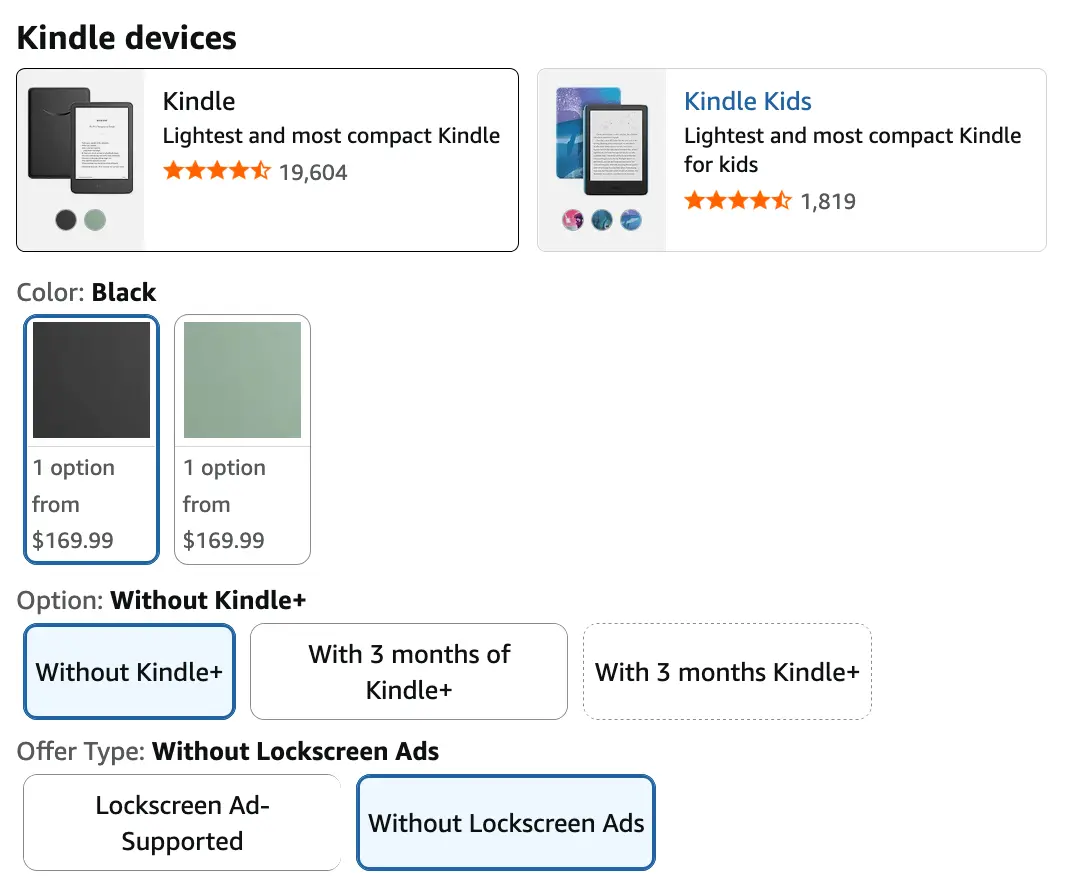
- Hardware Inconsistencies: The upcoming, highly anticipated Kindle Colorsoft Signature Edition still prominently features legacy references to Kindle Unlimited on various promotional layouts. Meanwhile, standard 11th-generation Kindle purchases in basic black or Matcha display erratic purchase options—oscillating between "without Kindle+" and overlapping, differently sized text boxes reading "With Kindle+."
- Omitted Options: Certain newly launched hardware iterations, such as the latest Kindle featuring an updated aluminum backplate, initially failed to offer the option to bundle or enroll in Kindle+ at checkout.
- International Spillover: These backend errors were not isolated to the U.S. marketplace. Consumers in Canada, the United Kingdom, and European storefronts reported identical pricing discrepancies, broken subscription checkboxes, and contradictory promotional copy.
Phase 3: The AI Audiobook Inundation
Simultaneously with the rebranding, the operational framework of the subscription model shifted. The newly rebranded Kindle+ quietly integrated a vast wave of audiobooks powered by Amazon’s Virtual Voice text-to-speech technology. Aimed initially at U.S. subscribers and KDP authors—with international expansions slated for the UK and Canada—this feature automatically indexes AI-narrated audiobooks into the subscription catalog if the source e-book is enrolled in KDP Select.
Supporting Context & Metrics: The Mechanics of Virtual Voice
To understand the gravity of the Kindle+ transition, one must examine the economic and technical mechanics driving Amazon’s push toward automated media generation.
The Economics of KDP Select and Virtual Voice
For over a decade, Kindle Direct Publishing (KDP) has served as the engine room for indie publishing. KDP Select grants authors higher royalty rates and promotional tools in exchange for digital exclusivity on Amazon.

By introducing Virtual Voice, Amazon has removed the most prohibitive barrier to entry for independent authors: the steep cost of professional audiobook production. Traditional studio recording, casting, hiring a professional narrator, and paying for post-production engineering can easily cost thousands of dollars per title—a risk many indie authors cannot absorb.
Through Virtual Voice, an author can generate an audiobook via automated text-to-speech algorithms with a single click. If that title is tied to KDP Select, it flows directly into the Kindle+ ecosystem.
Scaling Metrics and Catalog Bloat
- Exponential Growth: Within weeks of the Virtual Voice integration, the volume of available audio content within the subscription tier surged exponentially, dwarfing traditional acquisition rates.
- Cost Efficiency for Amazon: By populating its subscription catalog with zero-cost AI-generated assets, Amazon bypasses traditional licensing negotiations with major audiobook publishers, drastically lowering its internal content-acquisition overhead while maintaining a high subscription price point.
- The Discoverability Crisis: As thousands of synthetic titles flood the platform daily, readers searching for curated content face an unprecedented discoverability crisis, as algorithmically generated titles crowd out human-narrated works.
Official Perspectives and Industry Reactions
The reception to Kindle+ has exposed a widening chasm between platform efficiency metrics and consumer expectations.
The Industry Critique
Industry analysts and long-time digital publishing observers have voiced deep skepticism regarding the value proposition of Kindle+. Critics point out that subscribing to a reading service explicitly for audio content has historically relied on the premise of artistic performance—the nuance, emotional depth, and pacing delivered by trained voice actors working alongside professional sound engineers in dedicated studio environments.
Prominent publishing commentators have noted that conflating professionally produced audiobooks with automated text-to-speech files under a single, unsegmented subscription umbrella is a significant gamble.
"I only listen to Audible audiobooks with proven narrators; subscribing to Kindle+ just for audiobooks is a gamble right now. It will be hard to find audiobooks with legit narrators who are trained, sit in a studio with a sound engineer, and ones that click ‘turn my e-books into an audiobook with AI.’"
The Author’s Dilemma
From the perspective of independent creators, Virtual Voice represents a double-edged sword. On one hand, it provides a cost-free avenue to capture audio-first consumers who might otherwise bypass a purely text-based e-book. On the other hand, authors who invest heavily in professional voice talent worry that the proliferation of low-quality, robotic AI narration will devalue the perceived worth of audiobooks as an artistic medium as a whole.
Future Outlook: Where is Kindle+ Headed?
As Amazon works to patch the frontend software bugs plaguing its global storefronts and prepares to roll out the Kindle+ framework to international markets, the long-term viability of the service hinges on how the company manages consumer pushback.
Industry experts anticipate that Amazon will inevitably be forced to pivot or introduce structural changes to stave off subscriber dissatisfaction. Two distinct trajectories seem most probable:
- Massive Subscriber Attrition: If consumers feel deceived by paying a recurring fee for a catalog increasingly saturated with unpolished synthetic narration, Amazon could face a wave of subscription cancellations. Readers accustomed to the high curation standards of Audible may reject a blended model that fails to distinguish between human and machine performance.
- Catalog Segregation: To preserve the integrity of the subscription, Amazon will likely need to implement rigorous UI/UX filtering. This would involve segregating Virtual Voice titles into distinct, clearly labeled categories or search filters, allowing users to opt-in or opt-out of synthetic narration entirely.
The rebranding of Kindle Unlimited to Kindle+ is more than a cosmetic facelift; it is a stress test for the future of digital consumption in the age of generative AI. How Amazon navigates the friction between automated catalog scaling and consumer desire for authentic human art will define the next era of the digital reading landscape.





Comments
Facebook App ID not configured. Please add it in the Customizer.