
By Global Tech & Digital Publishing Desk
Published: October 22, 2026
Executive Overview
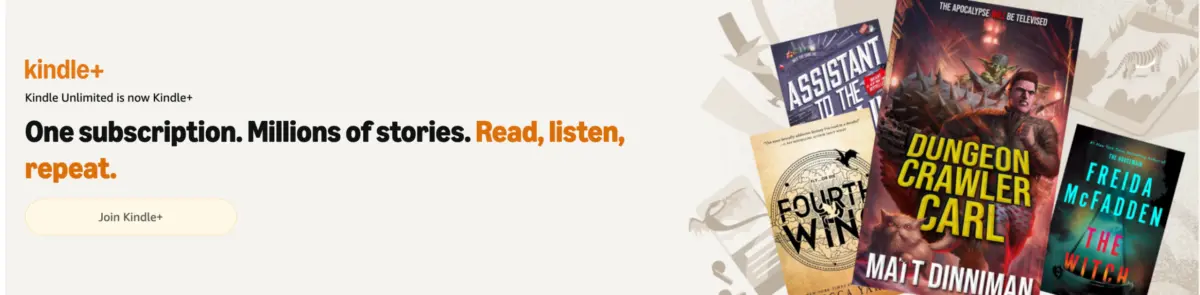
In what marks the most significant brand and strategic overhaul of its digital reading ecosystem in over a decade, retail and technology titan Amazon has officially retired the Kindle Unlimited moniker. Moving forward, the ubiquitous subscription service will be known globally as Kindle+.
The rebrand is far more than a superficial cosmetic change; it represents a fundamental shift in how Amazon packages, delivers, and scales its digital content library. While the foundational mechanics of the service—such as the ability to borrow up to 20 titles concurrently with no expiration dates—remain intact, the introduction of the "+" suffix signals a decisive pivot toward an all-inclusive, multi-format media ecosystem.
Read Also
Most notably, the transition introduces the deep, seamless integration of audiobooks at no extra cost for millions of subscribers, effectively bridging the traditional gap between reading and listening. By adopting the universally recognized "+" streaming nomenclature, Amazon has aligned Kindle+ with modern entertainment platforms, positioning the service to compete more aggressively in an increasingly converged audio-visual and literary marketplace. This comprehensive report breaks down the structural changes, global rollouts, pricing frameworks, and long-term implications of Amazon’s historic transition to Kindle+.
Detailed Chronology: The Evolution from Unlimited to Kindle+
The genesis of Kindle Unlimited dates back to its initial launch in July 2014, when Amazon sought to create a "Netflix for books" model. Over the ensuing twelve years, the service expanded incrementally, moving beyond traditional text-based e-books to incorporate select magazines, comic books, and localized indie titles. However, despite its massive library expansion, the brand identity remained static under the "Unlimited" banner.
Industry insiders note that the warning signs of an impending rebrand began appearing late last year, as Amazon quietly tested unified media bundles in select international test markets. The culmination of these trials arrived this week, marked by a coordinated digital sweep across all major Amazon properties:
- Interface and Asset Overhaul: Amazon has systematically updated its global web architecture. All primary Kindle Unlimited landing pages have been scrubbed of legacy branding, replaced instantly with fresh "Kindle+" graphical headers, updated promotional banners, and revised value-proposition copy.
- Promotional Messaging Shift: The service’s overarching marketing slogan has pivoted decisively to highlight dual-consumption habits. Promotional material now leads with the catchphrase: "One subscription. Millions of stories. Read, listen, repeat."
- App-Wide Deployment: System updates rolling out concurrently for the free Kindle App across iOS, Android, Fire OS, and desktop platforms reflect the nomenclature update, ensuring a unified user experience whether accessing titles via a dedicated Kindle e-reader, an Alexa-enabled tablet, or a smartphone.
Supporting Context & Metrics: The Mechanics of Kindle+
To truly understand the weight of the Kindle+ rebrand, one must examine the operational framework that underpins the service. While the name has changed, the core consumer value proposition has been supercharged to meet modern media consumption trends.
The Audiobook Integration Breakthrough
The crown jewel of the Kindle+ transition is the widespread integration of audiobooks. Historically, Amazon-owned Audible dominated the audiobook subscription space as a strictly separate, premium-priced entity, while Kindle Unlimited subscribers had to rely on periodic, limited-time Whispersync deals or separate audiobook purchases.
Under the new Kindle+ ecosystem, millions of subscribers in the United States and participating regions can now seamlessly toggle between reading an e-book and listening to its matching audiobook version without paying additional fees. This synergy addresses a major behavioral shift in digital consumption: modern readers increasingly expect multi-format access, often alternating between visual reading and audio consumption during commutes, workouts, or chores.

Core Service Parameters
Despite the expanded format options, Amazon has preserved the user-friendly borrowing rules that made Kindle Unlimited popular:
- Borrow Limit: Subscribers can retain up to 20 titles in their active digital library at any single moment.
- No Due Dates: Titles carry zero expiration dates, allowing readers to consume dense non-fiction or sprawling epic fantasy series at their own pace without fear of automatic returns.
- Device Agnosticism: The service continues to support cross-device syncing. A user can read a chapter on a Paperwhite e-reader during a morning flight, pick up the exact sentence on an iPhone app during lunch, and switch to the audiobook version while driving home in the evening.
Global Availability and Pricing Structure
Kindle+ is not merely a localized U.S. experiment; it has launched simultaneously across Amazon’s primary international markets. The service is now live—under either its translated or localized Kindle+ identity—in:
- North America: United States, Canada, Mexico
- Europe: United Kingdom, France, Germany, Italy, Spain
- Asia-Pacific & Latin America: Australia, Brazil, India, Japan
- And numerous other global territories (with a comprehensive, updating list maintained via Amazon’s official Customer Service portal).
In the United States, the pricing for Kindle+ remains anchored at $11.99 USD per month—remaining independent of the broader Amazon Prime membership tier. Regional pricing adjustments apply globally based on local currency valuations and localized publishing agreements.
Official Statements and Industry Reception
While Amazon’s corporate communications department has framed the rebrand as an evolutionary step designed to honor the expanding horizons of modern storytelling, independent publishing analysts have offered deeper interpretations.
"The addition of the ‘+’ sign is not accidental," notes a prominent digital media analyst based in Seattle. "It is a psychological and structural marker. For years, ‘Unlimited’ implied a quantity game—how many pages you could flip. ‘Kindle+’ implies a multi-dimensional media experience. It says: you aren’t just getting books anymore; you are getting the ecosystem. By rolling audiobooks directly into the baseline subscription, Amazon is attempting to build an impenetrable moat around digital readers."
Authors and independent publishers participating in the Kindle Direct Publishing (KDP) Select program have expressed cautiously optimistic views. While payout formulas—which calculate author royalties based on page-reads via the Kindle Edition Normalized Page Count (KENP)—remain structurally separate from audiobook royalty pools for now, publishers anticipate that increased user engagement driven by the audiobook inclusion will ultimately direct more traffic, visibility, and algorithmic momentum toward participating titles.
Future Outlook: What Kindle+ Means for the Future of Digital Reading
As the dust settles on the rollout of Kindle+, industry watchers are turning their attention to what lies ahead for Amazon’s digital reading division. Several key trajectories are expected to shape the platform’s evolution over the next 24 to 36 months:
- Intensified Streaming Wars: By framing Kindle+ alongside modern entertainment bundles (such as Disney+, Apple TV+, and Paramount+), Amazon is explicitly training consumers to view reading and listening as a unified subscription category rather than isolated, traditional book purchases. This could trigger defensive maneuvers from competing platforms like Scribd (Everand) and Storytel.
- Hardware Evolution: Expect future iterations of Kindle e-readers and Fire tablets to feature even tighter hardware optimizations for instant audio switching, potentially capitalizing on advanced Bluetooth integration and spatial audio technologies specifically tailored for Kindle+ subscribers.
- AI-Driven Narration and Localization: As synthetic voice technologies and AI narration mature, industry experts speculate that Amazon may leverage its vast cloud infrastructure to rapidly expand audiobook availability for millions of independent Kindle+ titles that previously lacked traditional human-narrated audio versions.
For now, the message to consumers is clear: the era of Kindle Unlimited has officially closed, and the era of Kindle+ has begun. Whether casual readers, voracious bookworms, or audio enthusiasts, subscribers are poised to experience a more versatile, interconnected digital library than ever before.





Comments
Facebook App ID not configured. Please add it in the Customizer.