
Executive Overview
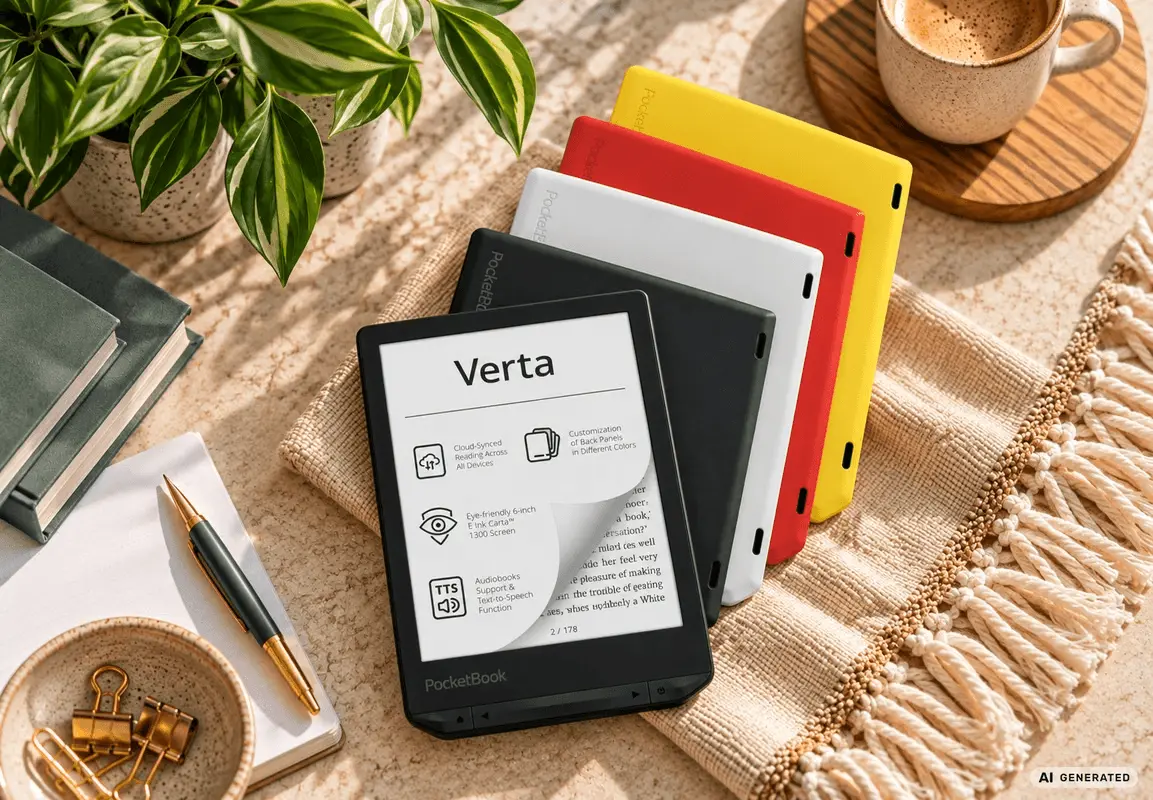
In the rapidly evolving landscape of digital reading technology, pocket-sized ergonomics, screen fidelity, and open-ecosystem flexibility have become the ultimate battlegrounds for hardware manufacturers. Amid fierce competition from dominant industry giants such as Amazon’s Kindle and Kobo, European e-reader pioneer PocketBook is once again preparing to shake up the market. Within the next couple of months, the company is slated to officially launch two brand-new, highly anticipated e-readers: the monochrome PocketBook Verta and its colorful counterpart, the PocketBook Verta Color.
Positioned as the direct successors to the popular Verse and Verse Color lines, these next-generation devices aim to bridge the gap between high-end performance and budget-conscious accessibility. The standard Verta introduces cutting-edge monochrome screen tech via the newly minted E Ink Carta 1300 panel, promising unprecedented contrast, lightning-fast page-turn speeds, and ultra-crisp text rendering at 300 PPI. Meanwhile, the Verta Color brings visual vibrancy to comics, graphic novels, and children’s books through E Ink Kaleido 3 color filter technology, making digital media pop while preserving eye-safe reading comfort.
Beneath their sleek, tactile exteriors, both models share a robust hardware foundation featuring a capable Rockchip quad-core processor, modern Bluetooth connectivity for immersive audiobook consumption, native integration with library apps like Libby, and extensive file format compatibility that shatters the walled gardens typical of competing hardware. Priced aggressively at $169 for the monochrome Verta and $179.99 for the Verta Color, PocketBook is making a bold play for consumers seeking high-value alternatives to current-generation Amazon Kindle devices. This extensive report delves into the hardware specifications, market positioning, underlying technologies, software ecosystems, and future implications of PocketBook’s latest hardware offensive.
Read Also
Detailed Chronology and Hardware Specifications
The announcement of the Verta and Verta Color marks the culmination of years of iterative engineering by PocketBook to refine its 6-inch form factor. For nearly a decade, the 6-inch e-reader category has served as the gold standard for portability—fitting comfortably into jacket pockets, small purses, and one-handed reading grips while offering a footprint close to a traditional paperback book. With the introduction of the Verta series, PocketBook is modernizing this classic size class with state-of-the-art display innovations and performance upgrades that address long-standing user complaints regarding sluggish interfaces and ghosting.
Display Technology: Carta 1300 Meets Kaleido 3
The crown jewel of the standard PocketBook Verta is its incorporation of the E Ink Carta 1300 e-paper display. As one of the very first devices on the market to adopt this advanced panel, the Verta represents a significant generational leap over the Carta 1200 and older Carta 1000 screens found in previous iterations. The Carta 1300 technology yields a notable improvement in response time—translating to roughly 20% faster page turns—alongside heightened contrast ratios that make black text appear deeper and background fields appear cleaner, mimicking the aesthetic of high-grade newsprint. Retaining a resolution of 1,448 x 1,072 pixels at a crisp 300 PPI (Pixels Per Inch) across its 6-inch diagonal, the monochrome Verta delivers exceptional typographic clarity for long-form literature.
Conversely, the PocketBook Verta Color targets readers who consume richly illustrated content. It utilizes an E Ink Kaleido 3 color filter array layered on top of a high-resolution monochrome e-paper backplane. When displaying black-and-white text, the panel maintains a sharp 300 PPI resolution, ensuring that traditional novels remain effortlessly readable. However, when rendering illustrations, magazines, or comics, the Kaleido 3 layer introduces a palette of 4,096 distinct colors at a resolution of 150 PPI. While color e-paper inherently sacrifices some brightness and resolution compared to its monochrome sibling due to the physical color filter array, Kaleido 3 represents a dramatic maturation over past color iterations, offering softer, more natural pastel tones that reduce eye strain during extended reading sessions.
Both the Verta and Verta Color are equipped with advanced front-lit displays featuring adjustable color temperatures. This dual-lighting system incorporates both bright white LEDs for daytime reading and warm amber LEDs for night-time sessions. By allowing users to dial down blue light exposure before bedtime, PocketBook ensures that circadian rhythms remain undisturbed, catering to the growing demographic of nightly e-book enthusiasts.
Internal Architecture and Processing Power
Underneath the exterior housing, PocketBook has equipped both Verta models with a modern, highly efficient processing stack designed to eradicate the interface lag that has historically plagued budget e-readers.
- CPU: Rockchip RK3566 Quad-core ARM Cortex-A55 processor, clocked at 1.8 GHz. This modern chip architecture provides ample computational headroom for rendering complex PDF layouts, decompressing large EPUB files, and driving smooth user interface animations.
- RAM: 1 GB of LPDDR memory, ensuring stable multitasking between open books, dictionaries, and background audio players.
- Internal Storage: 16 GB of onboard flash storage. Unlike brands that force users into cloud-only storage tiers, 16 GB provides more than enough physical space to house tens of thousands of EPUB novels, hundreds of illustrated PDF textbooks, or dozens of multi-gigabyte audiobook files locally on the device.
- Battery & Power Management: Powered by a robust 1,500 mAh internal lithium-ion battery. Thanks to the inherent energy efficiency of e-paper technology—which only draws power when the image on the screen is actively changing—the Verta series easily achieves multiple weeks of heavy, continuous use on a single charge, depending on Wi-Fi usage and front-light intensity.
- Connectivity: Equipped with a physical USB Type-C port utilized for high-speed data transfer and rapid battery recharging, alongside Bluetooth 5.0 wireless connectivity. The inclusion of Bluetooth 5.0 is critical, as it allows users to pair wireless headphones, earbuds, or external speakers directly to the e-reader for untethered audiobook and text-to-speech playback.
- Durability: Both devices feature an IPX4 water-resistance rating. While not entirely waterproofed for deep-water submersion (such as an IPX8 rating), an IPX4 rating ensures reliable protection against accidental splashes, rain showers, poolside mist, or reading in the bathtub.
Supporting Context and Metrics: Ecosystem, Formats, and Pricing
A piece of hardware is only as strong as the software ecosystem and file compatibility supporting it. While mega-corporations like Amazon rely on proprietary formatting (such as AZW and KFX) designed to lock consumers into a single store, PocketBook has historically championed an open ecosystem. The upcoming Verta series proudly continues this tradition, cementing PocketBook’s reputation as the ultimate device for digital media enthusiasts who value freedom and flexibility.
Unmatched File Format Support
One of the most profound advantages of the PocketBook Verta and Verta Color lies in their native support for an exhaustive array of file formats. Users are completely liberated from the cumbersome conversion processes required by closed ecosystems like Kindle. The Verta series natively opens and renders the following document, book, and comic formats without requiring third-party software conversions:
- Standard E-Books: EPUB, EPUB (DRM), MOBI, FB2, FB2.ZIP, TXT, RTF, HTM, HTML, AZW, AZW3
- Fixed-Layout & Documents: PDF, PDF (DRM), DJVU, DOC, DOCX, PRC, CHM, ACSM
- Comics & Graphic Novels: CBR, CBZ
This extensive format compatibility makes the Verta series particularly attractive to academic researchers, legal professionals, and students who frequently interact with complex PDF and DJVU documents, as well as comic book aficionados who rely on CBZ and CBR archives.

Software Integration: PocketBook Store, Libby, and Audiobooks
Out of the box, the Verta series runs a polished, responsive Linux-based operating system tailored specifically for e-paper displays.
- The PocketBook Store: Users can browse, purchase, and instantly download thousands of bestsellers and indie titles directly from the built-in bookstore over Wi-Fi without needing a companion smartphone app.
- Built-in Libby Integration: Recognizing the modern reader’s reliance on public libraries, PocketBook has preinstalled the Libby app directly onto the Verta operating system. Users can input their local public library card credentials to seamlessly browse library branches, borrow e-books and digital magazines, and stream audiobooks directly from the cloud.
- Audio Ecosystem: With the integrated audio player and Bluetooth 5.0 support, the Verta acts as a dual-purpose media consumption device. Users can effortlessly switch between reading an e-book visually and listening to its audiobook adaptation while commuting, exercising, or doing household chores.
Aggressive Pricing Strategy and Customization
In a market dominated by inflation and rising consumer tech prices, PocketBook has chosen an aggressive pricing model that undercuts major competitors.
- PocketBook Verta (Monochrome): Retailing at $169 USD.
- PocketBook Verta Color: Retailing at $179.99 USD.
At these price points, PocketBook is positioning the Verta series directly against Amazon’s mainstream Kindle Paperwhite lineup and Kobo’s Clara series. By offering cutting-edge display technology like Carta 1300 and Kaleido 3 color capabilities alongside Bluetooth audio, expansive format support, and library integration for under $180, PocketBook is delivering immense value.
Furthermore, PocketBook is leaning heavily into consumer personalization. The standard Verta will be made available with a wide assortment of interchangeable back-plate color shells—including classic black, pristine white, vibrant red, and sunny yellow—sold separately. This modular approach allows users to customize the physical appearance of their reading device to match their personal style, a rarity in the modern consumer electronics landscape.
Official Statements and Industry Insights
Speaking on the upcoming rollout of the Verta and Verta Color, industry analysts and company representatives emphasize a strategic shift toward open-source flexibility and hardware innovation.
Michael Kozlowski, Editor-in-Chief of Good e-Reader and a leading authority on digital reading hardware with over fifteen years of industry commentary, notes that the inclusion of the E Ink Carta 1300 display places PocketBook at the bleeding edge of monochrome screen fidelity. "For years, consumers have asked for faster page turns and deeper contrast without upgrading to oversized, expensive 8-inch or 10-inch tablets," Kozlowski explains. "By bringing Carta 1300 to a compact 6-inch form factor, PocketBook is catering directly to purists who demand the absolute highest quality black-and-white text rendering available on the market today."
Industry observers also point out that PocketBook’s commitment to native Libby integration and open-format support serves as a powerful antidote to digital monopolies. As regulatory scrutiny over walled gardens and digital content ownership intensifies globally, hardware manufacturers that champion user freedom—allowing individuals to read whatever files they want, source books from any library, and buy content outside of a single corporate ecosystem—are poised to capture discerning consumer segments who reject digital lock-in.
Future Outlook: The Competitive Landscape of E-Readers
The launch of the PocketBook Verta and Verta Color in the coming months arrives at a critical juncture for the e-reader industry. As color e-paper technology matures from a novelty into a viable mainstream medium, consumer expectations are shifting rapidly. No longer are readers satisfied with washed-out, dark color screens; the arrival of Kaleido 3 in affordable 6-inch devices proves that color reading can be both visually pleasing and financially accessible.
Looking ahead, the success of the Verta series will likely force competitors like Amazon and Kobo to reevaluate their entry-level and mid-tier product offerings. If PocketBook can successfully scale production, maintain quality control, and effectively market the Verta’s hardware superiority and open-ecosystem advantages to North American and European audiences, the company could capture significant market share from entrenched players.
Ultimately, the PocketBook Verta and Verta Color represent more than just incremental hardware updates—they are a testament to the enduring appeal of dedicated reading devices. By combining next-generation E Ink Carta 1300 and Kaleido 3 panels, robust quad-core processing, extensive file compatibility, and pocket-friendly pricing, PocketBook has engineered a compelling duo of devices designed to satisfy the needs of both traditional book purists and modern multimedia readers alike. As these devices hit store shelves in the next couple of months, they promise to set a new benchmark for what consumers should expect from a mid-range e-reader.



Comments
Facebook App ID not configured. Please add it in the Customizer.