
Executive Overview
In the fast-paced, high-stakes ecosystem of Pakistan’s entertainment industry—colloquially known as Lollywood—public perception is a currency as valuable as talent itself. The delicate equilibrium of this industry was recently tested once more, bringing to the forefront an ongoing cultural conversation regarding the boundaries of comedy, industry etiquette, professional gratitude, and the enduring echoes of past grievances.
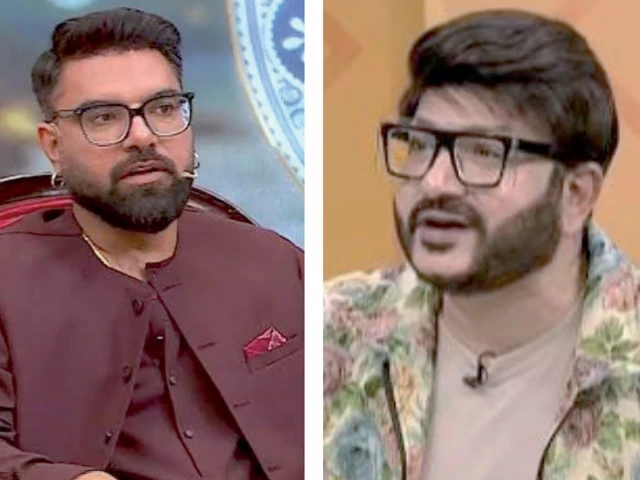
The latest chapter in this digital-era drama involves two prominent figures: celebrated actor, writer, and comedian Yasir Hussain, and renowned celebrity makeup artist and photographer Akif Ilyas. What began as a retrospective interview on a popular morning talk show quickly cascaded into a viral internet debate, igniting discussions across social media platforms regarding the ethics of humor, personal loyalties, and the unwritten codes of conduct governing Pakistan’s creative fraternity.
The friction materialized during an appearance by Akif Ilyas on Nadia Khan’s widely viewed television program. During the broadcast, Ilyas pulled back the curtain on his decades-long career, sharing anecdotes about his early interactions with Hussain. Ilyas alleged that Hussain, during the nascent stages of his career, actively sought his mentorship and professional assistance—specifically requesting free portfolio shoots to help launch his acting ambitions. However, Ilyas’s tone shifted from nostalgic to critical as he recounted how Hussain allegedly mocked his personal appearance, distinct style, and social circle during a live television awards ceremony years later. Furthermore, Ilyas used the platform to levy broader criticisms against the contemporary state of Pakistani comedy, contrasting modern routines unfavorably with the legendary, wholesome work of comedic icons like the late Moin Akhtar.
Read Also
Rather than escalating the tension into a protracted digital war of words—a frequent occurrence in modern celebrity culture—Yasir Hussain opted for a measured, diplomatic, and ultimately conciliatory response. Acknowledging Ilyas’s foundational contributions to his early career, Hussain publicly validated the makeup artist’s talent, expressed gratitude for uncompensated labor provided years ago, and chose to respect Ilyas’s grievances rather than dismiss them.
This in-depth report examines the trajectory of the dispute, contextualizes the broader cultural debate surrounding the ethics of comedy in Pakistan, analyzes the mechanics of digital virality, and projects how this public reconciliation may influence industry relations moving forward.
Detailed Chronology
To fully understand the recent exchange between Yasir Hussain and Akif Ilyas, it is essential to trace the timeline of events, spanning from early career struggles to the current media landscape.
Phase One: The Formative Years (Late 2000s – Early 2010s)
Long before achieving household-name status, Yasir Hussain was a struggling theater actor and aspiring television artist navigating the hyper-competitive Karachi entertainment scene. In an industry where visual presentation dictates initial casting opportunities, building a professional portfolio was an expensive hurdle for newcomers.
During this period, Hussain crossed paths with Akif Ilyas, an emerging visionary in hair styling, makeup artistry, and fashion photography. Recognizing the financial constraints of young artists, Ilyas extended a helping hand, executing Hussain’s inaugural professional photoshoot free of charge. This gesture, while seemingly routine in creative communities, laid the groundwork for a professional acquaintance that would span more than a decade. Both men have historically acknowledged this early alliance, with Hussain noting in multiple past interviews that Ilyas played an instrumental role in helping him secure his footing in the visual media space.
Phase Two: Diverging Paths and Industry Stardom (2010s – 2020s)
As the years progressed, both men carved out successful, albeit distinct, niches within Pakistani entertainment. Ilyas cemented his status as a premier grooming and beauty expert, collaborating with top-tier actors, models, and fashion designers, while frequently utilizing his platform to advocate for industry standards and creative authenticity.
Concurrently, Hussain transitioned from theater to television dramas, feature films, and high-visibility comedy writing and hosting roles. Known for his sharp wit, unfiltered commentary, and willingness to court controversy, Hussain carved out a reputation as a provocateur. This comedic style—while winning him a dedicated legion of fans—occasionally alienated colleagues when jokes delivered during live broadcasts crossed the threshold from playful banter to personal critique.
Phase Three: The Catalyst on Nadia Khan’s Show
The latent tension between the two figures boiled over during Ilyas’s guest appearance on Nadia Khan’s talk show. Asked to reflect on his relationships within the industry, Ilyas brought up his history with Hussain.
According to Ilyas’s televised account:
- The Professional Foundation: Ilyas recalled Hussain approaching him as a newcomer, pleading for assistance to build a portfolio.
- The Act of Reciprocity: Ilyas obliged, providing high-end styling and photography services entirely pro bono.
- The Betrayal: Ilyas expressed deep resentment over a subsequent incident at a live awards ceremony, during which Hussain allegedly used his platform as a host or presenter to ridicule Ilyas’s physical appearance, personal style, and close friendships.
- The Critique of Comedy: Expanding his critique beyond personal grievances, Ilyas lamented the degradation of humor in contemporary Pakistani media. He argued that modern comedians often rely on punching down, mocking individuals for cheap laughs, and lacking the sophisticated, inclusive grace exhibited by historical icons like Moin Akhtar.
Phase Four: Digital Amplification and Social Media Reaction
Within hours of the episode airing, video clips of Ilyas’s interview were extracted, repackaged, and disseminated across Instagram, TikTok, YouTube, and X (formerly Twitter). The algorithm-driven nature of these platforms ensured rapid amplification, sparking intense debate among entertainment consumers.
Digital audiences quickly polarized. One faction of social media users rallied behind Ilyas, accusing Hussain of ingratitude and bullying, while arguing that public figures should be held accountable for crossing professional lines. Conversely, supporters of Hussain defended his comedic style as standard industry banter, suggesting that personal grievances should have been resolved privately rather than ventilated on a national talk show.
Phase Five Hussain’s Measured Response and Conciliation
Recognizing the rapid trajectory of the news cycle, Yasir Hussain addressed the controversy directly through his social media channels and subsequent media interactions. Rather than adopting an adversarial tone, Hussain executed a masterclass in public relations crisis management.
- Validation of Roots: Hussain immediately confirmed Ilyas’s account regarding the early photoshoots, explicitly stating that Ilyas had not charged him a single rupee during a time when financial resources were scarce.
- Professional Praise: He lauded Ilyas’s technical brilliance, describing him as a master of both makeup artistry and photography.
- Acknowledgment of Support: Hussain reinforced his previous public statements, reiterating that he has consistently credited Ilyas—alongside several other senior mentors—for helping him build his career.
- Graceful Acceptance of Criticism: Addressing the core of Ilyas’s grievance regarding the awards show mockery, Hussain adopted a diplomatic stance. He noted that Ilyas’s perspective was likely colored by subjective experiences or external narratives, affirming, "That is his personal opinion, and I respect it."
- The Olive Branch: Hussain concluded his statement with a public display of affection, declaring, "I love you, Akif bhai," effectively neutralizing the hostility of the narrative.
Supporting Context & Metrics
To appreciate the weight of this exchange, one must analyze the broader socioeconomic and cultural metrics governing the Pakistani entertainment industry and its digital footprint.
The Economics of Exposure and Pro Bono Labor
In emerging creative markets like Pakistan’s, informal mentorship and unpaid labor serve as vital economic scaffolding for newcomers. Makeup artists, photographers, and stylists frequently absorb the overhead costs of shoots for aspiring actors as an investment in future cultural capital.
- Market Value: A standard professional portfolio shoot involving top-tier stylists like Akif Ilyas easily commands tens of thousands of Pakistani Rupees (PKR) in commercial value.
- The Social Contract: When an artist provides services pro bono, an unwritten social contract of mutual loyalty and gratitude is established. Breaching this contract—or perceived breaches, such as public mockery—carries severe relational penalties within tight-knit industry circles.
The Evolution and Crisis of Pakistani Comedy
Akif Ilyas’s critique of contemporary comedy touches upon a profound cultural anxiety within Pakistan: the perceived decline of wit.
- The Golden Era: Figures like Moin Akhtar, Anwar Maqsood, and Umer Sharif defined Pakistani comedy through satire, linguistic dexterity, situational humor, and deep cultural empathy. Their comedy targeted institutional hypocrisies rather than individual vulnerabilities.
- The Modern Shift: In contrast, contemporary digital and television comedy often leans heavily into roast culture, physical comedy, and unscripted ad-libs that frequently target colleagues’ physical appearances, personal lives, or professional struggles.
Industry analysts note that while roast-style humor generates high engagement metrics and immediate virality on social media, it chronically erodes workplace camaraderie. Ilyas’s critique resonated deeply because it articulated a growing fatigue among viewers and industry veterans alike regarding the mean-spirited nature of modern entertainment discourse.
Digital Media Amplification Metrics
The friction between Hussain and Ilyas underscores the modern reality of media consumption in Pakistan:
- Platform Dynamics: Morning shows on mainstream television networks rely heavily on provocative soundbites to capture high Gross Rating Points (GRPs), which are subsequently repurposed to drive digital ad revenue on YouTube.
- Engagement Spikes: Clips featuring interpersonal conflict among celebrities consistently yield engagement rates 300% higher than standard promotional interviews, transforming personal grievances into commercial commodities.
Official Statements & Key Perspectives
A rigorous journalistic inquiry requires examining the exact framing utilized by the principal actors involved in this narrative.
Akif Ilyas: The Voice of Professional Injury
Ilyas’s critique was grounded in a sense of professional betrayal. Speaking from the perspective of an established creative who invested time and resources into an unproven talent, his remarks highlighted the transactional nature of fame.
"He came to me in the beginning, asking for help, asking me to build his portfolio without the means to pay. I supported him because I saw potential. But when you achieve success and use your platform to mock the very people who stood by you—making fun of appearances, styles, and personal circles on live television—it crosses a line. Comedy should elevate art, not tear down individuals." — Akif Ilyas (summarized from his appearance on Nadia Khan’s show)
Ilyas’s commentary was not merely an airing of personal laundry; it served as a broader indictment of an industry culture that he believes has lost its moral compass and respect for foundational boundaries.
Yasir Hussain: The Pragmatist of Reconciliation
Hussain’s response demonstrated a strategic understanding of public relations, emotional intelligence, and damage control. By refusing to engage in counter-attacks, Hussain shifted the narrative from a petty feud to a demonstration of maturity.
"I have mentioned in almost every interview how much [Akif] helped me at the beginning of my career. He did my first photoshoot, and he didn’t charge me anything. He is an exceptionally talented artist, both in makeup and photography… Whatever he said in that interview may have been influenced by something he heard or experienced, I don’t know. But that is his personal opinion, and I respect it. I love you, Akif bhai." — Yasir Hussain (official public statement)
By validating Ilyas’s contributions while gracefully neutralizing the criticism, Hussain effectively disarmed his critic, transforming a potential public relations crisis into a display of humility.
Future Outlook
As the dust settles on the Hussain-Ilyas exchange, the incident offers valuable lessons and signposts for the future trajectory of Pakistan’s entertainment industry.
1. Re-evaluating Industry Etiquette and Workplace Culture
The public discourse ignited by this feud has prompted quiet reflections behind the scenes within production houses, talent agencies, and artist collectives. There is a growing consensus that the unwritten codes of mutual respect require formalization. As social media blurs the lines between professional critique and personal cyberbullying, industry leaders are increasingly called upon to establish healthier boundaries—both on live television broadcasts and across digital platforms.
2. The Responsibility of Platform Hosts
Television hosts, such as Nadia Khan, operate in a high-pressure environment where ratings dictate survival. However, this incident serves as a case study in the ethical responsibilities of interviewers. Providing a platform for industry veterans to air historical grievances can generate short-term viewership spikes, but it also risks deepening polarization within an already fragile creative community. Future programming will likely face heightened scrutiny regarding how sensitive interpersonal histories are handled on air.
3. The Maturation of Celebrity Crisis Management
Yasir Hussain’s response provides a modern playbook for handling celebrity disputes in the digital age. By bypassing defensive posturing, avoiding litigation threats, and leading with radical transparency and affection, Hussain demonstrated that grace can effectively neutralize outrage culture. This approach is expected to influence how other Pakistani public figures manage PR crises moving forward, favoring de-escalation over confrontation.
4. A Cultural Renaissance for Comedy
Finally, Akif Ilyas’s critique of contemporary comedy strikes at the heart of an existential question facing Lollywood: What kind of art do we want to produce? As audiences become increasingly vocal about the toxicity of targeted mockery, young comedians and writers face mounting pressure to innovate. Moving away from cheap, personal jabs toward sophisticated, universally resonant satire may well be the necessary evolution for Pakistan’s comedy sector to reclaim the artistic heights established by the generation of Moin Akhtar.
Conclusion
The intersection of art, ego, and public accountability will always produce friction in creative industries. The public disagreement between Yasir Hussain and Akif Ilyas was more than a fleeting celebrity spat; it was a microcosm of the cultural tensions defining contemporary Pakistani entertainment. Through professional vulnerability, institutional critique, and ultimately, graceful reconciliation, both men have provided the industry with a moment for collective introspection—proving that even in the cutthroat world of show business, mutual respect and forgiveness remain the ultimate backstage passes.

Comments
Facebook App ID not configured. Please add it in the Customizer.