
Executive Overview
In the contemporary literary landscape, the romantic comedy genre occupies a commanding and lucrative space, captivating millions of readers seeking an escape into witty banter, emotional vulnerability, and guaranteed happily-ever-afters. Yet, achieving the delicate equilibrium required to craft a genuinely funny, emotionally resonant romance novel is a rigorous literary enterprise. As the publishing industry prepares for the eagerly anticipated release of Dina Gets Lucky—the eighth novel by acclaimed author Uzma Jalaluddin—the mechanics of comedic writing within romance are once again thrust into the spotlight.
Jalaluddin, a veteran voice in contemporary intersectional romance, has spent years refining the complex architecture of romantic comedy. Drawing from a golden era of 1990s and 2000s "chick-lit," her journey reflects a broader literary evolution: moving away from homogenous, single-perspective narratives toward inclusive, culturally vibrant stories that subvert traditional tropes. In this comprehensive examination, Jalaluddin shares her hard-won insights on the subjective nature of humor, the distinct classifications of comedic writing, the perils of comedic over-indulgence, and the golden rules for successfully balancing the "romance" with the "comedy."
Read Also
Detailed Chronology: From Golden-Age Reader to Contemporary Lit-Star
To understand Jalaluddin’s approach to comedic structure, one must trace the historical lineage of the genre that shaped her formative years as a reader.
The 1990s–Early 2000s: Inhaling the Golden Age
Growing up during the peak of the late 20th-century "chick-lit" boom, Jalaluddin immersed herself in the works of literary pioneers such as Meg Cabot, Jennifer Weiner, the late Sophie Kinsella, Helen Fielding, and Candace Bushnell. For readers of that era, these novels offered an intoxicating blend of career angst, urban exploration, and sparkling romance.
However, looking back through a contemporary lens, Jalaluddin acknowledges the profound cultural limitations of that foundational era. The casts of characters were almost universally white, and the central conflicts were deeply rooted in second-wave feminist concerns—focusing heavily on shattering the glass ceiling, navigating restrictive gender roles, and managing "woman-on-top" office politics. Intersectionality, a framework that came to dominate literary discourse in later decades, was largely absent. Despite these dated socio-cultural paradigms, the defining characteristic of these books remained their undeniable, laugh-out-loud humor.
The Pivot to Authorial Craft
Years later, when Jalaluddin transitioned from consumer to creator, she consciously attempted to capture that same sense of droll comedy—aiming to write stories that were light, joke-filled, heartfelt, and swoony. The transition, however, proved formidable. Every writerly lesson was hard-won, and learning how to effectively execute the "com" in "rom-com" required a systematic deconstruction of what makes narrative humor function on the page.
The upcoming release of Dina Gets Lucky serves as a critical milestone in this literary evolution, providing an ideal vantage point to reflect on the mechanics of humor and how to seamlessly meld it with high-stakes romance.
Supporting Context & Metrics: The Mechanics of Narrative Humor
Writing a funny book over the course of a multi-year drafting marathon is vastly different from writing a tight, ten-minute stand-up comedy routine or a sitcom spec script. Jalaluddin’s methodology breaks down the fundamental pillars of literary comedy into actionable, strategic frameworks for contemporary novelists.
1. Humor is Subjective: Lean Into Your Own Tastes
One of the primary hazards for comedic writers is the trap of universal appeal. Humor is inherently subjective, a reality Jalaluddin learned through personal trial and error. Sharing one of her absolute favorite books, The Hitchhiker’s Guide to the Galaxy, with her older son resulted in profound disappointment when he failed to find the absurdist British science fiction funny, famously asking, "What’s a digital watch?" and "What’s funny about towels?"
This domestic critique underscores a foundational commandment of writing: Don’t yuck someone else’s yum. Writers must accept that their comedic idols—whether it is Douglas Adams or the dry, cringe-inducing mockumentary style of The Office—will not resonate with every reader.
The antidote to this subjectivity is simple yet demanding: Write what YOU think is funny. Because writing is a solitary endurance contest spanning months or years spent in the company of imaginary people, authors must stick to what genuinely tickles their own funny bones.
- Case Study: In Jalaluddin’s second novel, Hana Khan Carries On, she introduced a character named Rashid, a man who may or may not belong to an accountant-mafia family from New Delhi. While readers found him delightful, his deadpan delivery was written entirely for the author’s own amusement.
- The "Biryani Poutine" Phenomenon: The same novel features a long-running joke about "biryani poutine," a fictional culinary monstrosity invented solely because it made Jalaluddin laugh. Anyone familiar with authentic biryani (a savory South Asian rice and meat casserole) and poutine (Canadian fries smothered in gravy and cheese curds) understands these two beloved dishes should never be wed—making the absurdity of the joke land with maximum impact.
2. Taxonomy of Comedy: Knowing Your Comic Vehicles
Different stories require different comedic engines. Writers must deliberately select the comedic vehicle that matches their narrative’s tone:
- Slapstick and Situational Comedy: Difficult to execute on the printed page, physical comedy and elaborate set pieces thrive in the brilliant works of Meg Cabot and Sophie Kinsella, relying on cascading misunderstandings and chaotic environments.
- Absurdist and Satirical Comedy: Exemplified by Terry Pratchett’s fictional Discworld or Candace Bushnell’s dark, satirical takes on high society, these stories rely on wildly over-the-top, surreal situations.
- The Austen-esque Witty Tone: Employed masterfully by Jennifer Weiner and Curtis Sittenfeld, this style relies on arch asides, sharp-tongued first-person narrators, and sparkling banter between romantic leads.
- Irony (Verbal, Dramatic, and Situational): Jalaluddin heavily leans on verbal and situational irony, particularly through her Muslim and South Asian characters, who take pleasure in flipping the script on expected cultural stereotypes. In Dina Gets Lucky, the central conflict utilizes dramatic irony to simultaneously drive comedic relief and deep character development.
Official Insights: Balancing Comedy and Emotional Architecture
As a seasoned novelist navigating the complexities of genre fiction, Jalaluddin offers critical warnings regarding the execution of comedic elements within a long-form narrative structure.
The Danger of Secondary-Character Takeover
A common pitfall for developing authors is attempting to make every character a comedic genius, assigning the perfect one-liner to every individual on the page. Jalaluddin candidly admits to battling "secondary-character-takeover" syndrome—a phenomenon where minor characters routinely threaten to outshine, out-wit, and out-charm the protagonists.
"Resist the urge," Jalaluddin advises. "Remember that you’re writing a nuanced long-form story, not a tight-ten stand-up routine."
When writers allow characters to endlessly frolic in the sandbox of comedic banter rather than plumbing the unexplored psychological caves of genuine character development, the narrative suffers. Comedic distraction undermines emotional stakes. To build a resonant story, authors must periodically put down the joke book and pick up thematic analysis.
Flavor Enhancer, Not the Main Course
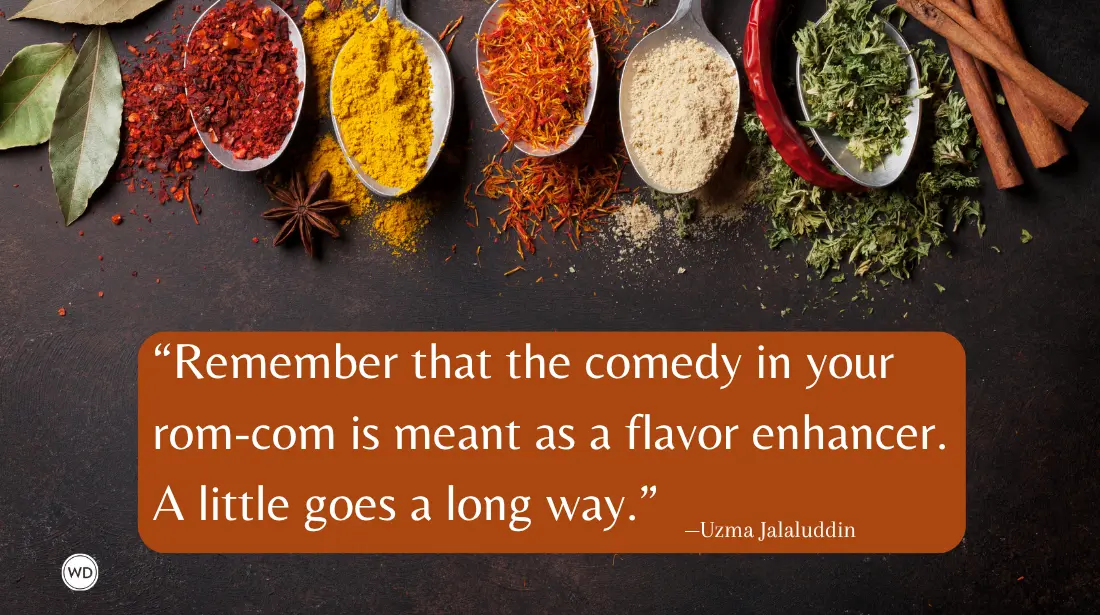
Furthermore, Jalaluddin stresses that a little funny goes a long way. Unless an author is drafting an absurdist, hyper-surreal spec script filled with continuous pratfalls, relentless snark, and irony-sandwiches, comedy in a romance novel functions primarily as a flavor enhancer.
Readers gravitate toward the rom-com genre because they desire an authentic emotional love story seasoned with wit and banter—not a chaotic circus where the romance is drowned out by relentless gags. By carefully calibrating comedic elements to support rather than overshadow the central relationship, authors ensure a deeply satisfying reader experience.
Future Outlook: The Evolution of the Rom-Com Genre
As the literary market absorbs the arrival of Dina Gets Lucky, the landscape of romantic comedy continues to broaden and mature. The rigid, monocultural boundaries of the 1990s "chick-lit" era have been permanently dismantled, replaced by a diverse, globally conscious literary ecosystem where authors from all backgrounds reclaim and reinvent the genre.
Yet, despite these seismic shifts in representation and narrative scope, the foundational laws of comedic writing articulated by Jalaluddin remain immutable. Whether writing about accountant-mafias, biryani-poutine hybrids, or navigating complex cultural dynamics through dramatic irony, the ultimate objective of the genre endures: every laugh must be authentically earned, and the human heart must remain at the very center of the narrative.
For aspiring rom-com authors, Jalaluddin’s journey offers both a roadmap and a reassurance. Put simply: keep yourself entertained through the long, lonely hours of drafting, bring the "com" back into rom-com with intention, and trust that if you write what makes you laugh, your readers will gladly follow.

Comments
Facebook App ID not configured. Please add it in the Customizer.